Paper II — Q4
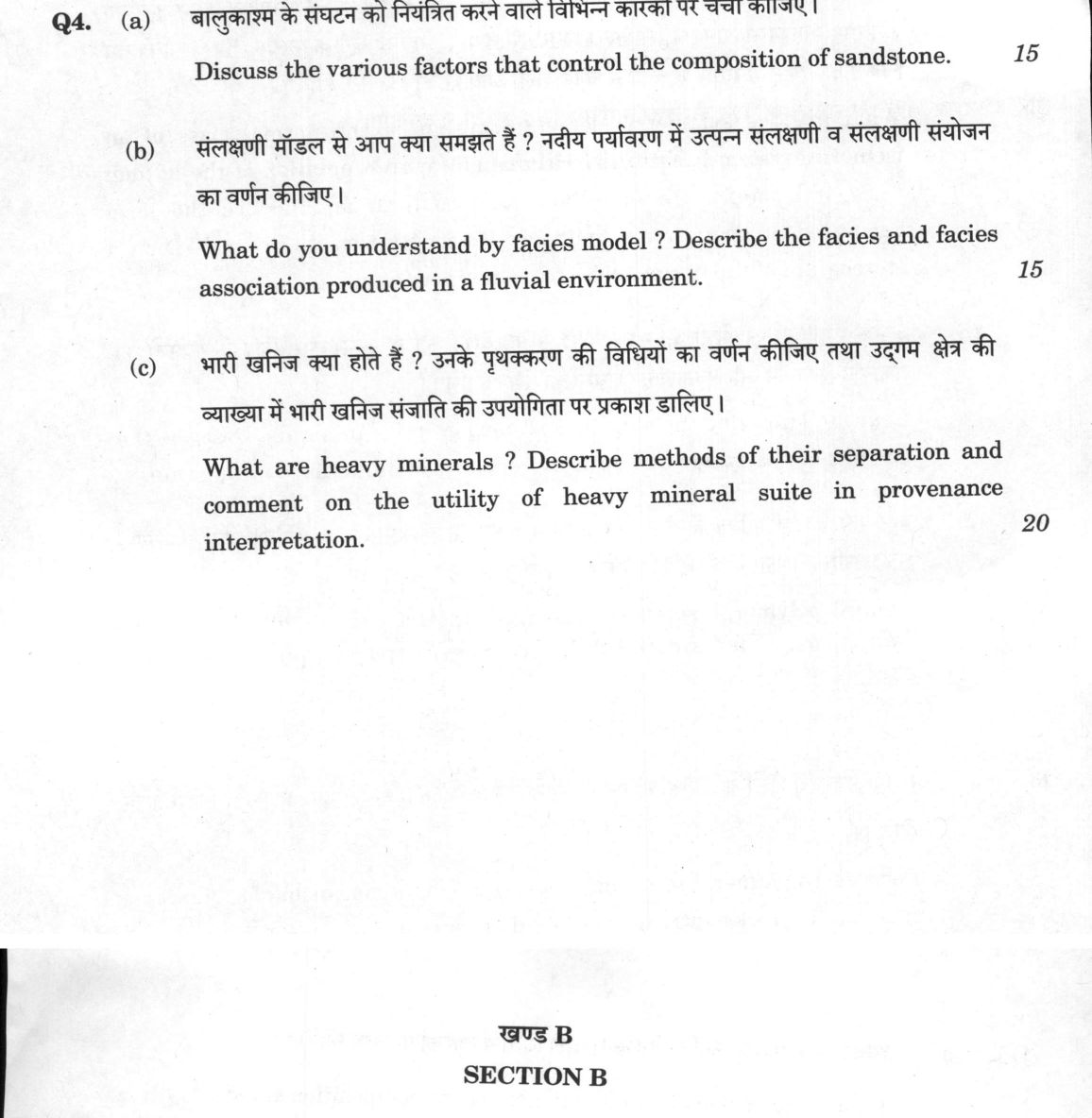
(a) Discuss the various factors that control the composition of sandstone. (15 marks) (b) What do you understand by facies model…
Discuss the various factors that control the composition of sandstone. 15 marks
What do you understand by facies model ? Describe the facies and facies association produced in a fluvial environment. 15 marks
What are heavy minerals ? Describe methods of their separation and comment on the utility of heavy mineral suite in provenance interpretation. 20 marks
हिंदी में प्रश्न पढ़ें
बालुकाश्म के संघटन को नियंत्रित करने वाले विभिन्न कारकों पर चर्चा कीजिए। (15 अंक)
संलक्षणी मॉडल से आप क्या समझते हैं ? नदीय पर्यावरण में उत्पन्न संलक्षणी व संलक्षणी संयोजन का वर्णन कीजिए। (15 अंक)
भारी खनिज क्या होते हैं ? उनके पृथक्करण की विधियों का वर्णन कीजिए तथा उद्गम क्षेत्र की व्याख्या में भारी खनिज संजाती की उपयोगिता पर प्रकाश डालिए। (20 अंक)
Model answer
Written by UPSC Answer Check against this question's marking rubric, to the expected length. UPSC does not publish answers for Mains — this is one way to score well, not an official key.
Factors Controlling Sandstone Composition
Sandstone composition is governed by the interplay of source rock lithology, tectonic setting, climate, relief, transport distance, depositional environment, and diagenesis. The primary mineralogy—represented on Pettijohn’s and Dott’s (1964) QFL ternary classification (quartz, feldspar, lithic fragments)—is initially determined by parent rock lithology.
Climate and relief directly control the rate of chemical versus mechanical weathering. In humid, tropical conditions with low relief, intense chemical breakdown destroys unstable feldspars and lithic fragments, producing compositionally mature quartz arenites, such as the Proterozoic Vindhyan Supergroup sandstones. Conversely, in arid or cold climates with high tectonic relief, rapid physical erosion and unroofing preserve labile feldspars and rock fragments, resulting in immature arkoses and lithic arenites, such as the Permian Barakar Formation of the Gondwana Supergroup.
Transport distance and hydrodynamic energy further alter composition; extended transport causes selective abrasion and elimination of softer minerals, progressively increasing Folk’s compositional maturity. Post-depositional diagenesis modifies composition through the dissolution of unstable grains, authigenic cementation, and the albitization of feldspars.
Facies Models and Fluvial Environments
A facies model is an idealized, generalized summary of a specific sedimentary depositional environment, synthesized from modern analogues and ancient rock records. It acts as a norm for comparison, a framework for observations, and a predictive tool for spatial and vertical distribution of strata. In contrast to a single facies—which represents a distinct rock unit with specific lithological, structural, and paleontological characteristics—a facies association is a group of genetically related facies reflecting a broader environmental setting.
In a meandering fluvial environment, the facies association characteristically displays a fining-upward cycle (Allen model), comprising three distinct facies:
Channel facies: Situated at the base above an erosional scour surface, consisting of basal intraformational conglomerate or lag gravels that grade upward into medium-to-coarse, trough and planar cross-bedded sandstones deposited by migrating dunes and point bars.
Levee and crevasse splay facies: Intermediate units composed of fine-grained sandstones and siltstones exhibiting ripple cross-laminations, climbing ripples, and small-scale scours formed during overbank flood stages.
Floodplain facies: Uppermost vertical accretion deposits consisting of thinly laminated mudstones, shales, and silts, often containing pedogenic features like paleosols, root traces, and calcrete nodules.
Heavy Minerals: Separation and Provenance Interpretation
Heavy minerals are accessory detrital mineral grains having a specific gravity greater than 2.85 to 2.89 g/cm³, noticeably higher than framework minerals like quartz and feldspar.
Separation is carried out systematically on disaggregated, sieved sand fractions (typically 63–250 µm). Preliminary concentration is achieved by panning. Dense liquid separation is subsequently conducted using bromoform (specific gravity 2.85) or tetrabromoethane (specific gravity 2.96) in a separating funnel or centrifuge tube, allowing the heavies to settle while quartz and feldspar float. The separated heavy fractions are further divided using a Frantz isodynamic magnetic separator based on differential magnetic susceptibility (e.g., separating magnetite, ilmenite, garnet, and tourmaline from non-magnetic zircon and rutile), followed by optical mounting for petrographic study.
In provenance interpretation, heavy mineral suites provide diagnostic fingerprints of the parent source terrane:
Source lithology: Acidic plutonic sources yield assemblages of zircon, tourmaline, monazite, and apatite; high-grade metamorphic sources contribute kyanite, sillimanite, garnet, and staurolite; and mafic to ultramafic rocks supply chromite, olivine, and pyroxenes.
Transport history and maturity: The ZTR index (percentage of ultra-stable zircon, tourmaline, and rutile) assesses the degree of chemical and mechanical weathering, sediment recycling, and transport distance.
Stratigraphic correlation: Characteristic heavy mineral suites allow basin-wide correlation of strata and delineate unroofing histories.
This utility is exemplified by the heavy mineral assemblages of the Siwalik foreland basin, which record the sequential tectonic uplift and erosion of the Himalayas, and the economically vital coastal beach placers of Chavara, Kerala, where ilmenite, monazite, and sillimanite suites trace sediment derivation from the high-grade metamorphic Southern Granulite Terrane.
What "Describe" is asking you to do
Give a full, ordered account of the thing named — its parts, stages or mechanism — in the sequence in which it actually exists or occurs. Most describe questions come from the science optionals, where the marks sit in correct technical detail and, where the stem says so, a labelled diagram.
Structure that answers it
One-line identification of the subject → the parts or stages in their real order, each with its defining detail → labelled diagram where the subject is structural → closing line on function or significance
Where marks are lost
Loose general prose where the examiner is ticking named parts, correct terminology and their sequence; and in the General Studies papers, turning to evaluation before the description is finished.
How this answer will be evaluated
Approach
Framework: Geology Paper 2: Define > Process > Field/Petrographic Evidence > Indian Example. (a) discuss: intro > 3-4 dimensions > example > balanced close | (b) describe: define > structure or process in order > labelled diagram > significance | (c) comment: context > arguments both sides > judgment > close Full marks: Precise petrographic terms, labelled diagrams, specific Indian examples, clear causal chains
Key points expected
- Source rock lithology and tectonic setting
- Climatic influence on chemical weathering
- Transport distance and energy regime
- Diagenetic processes (compaction, cementation)
- Definition of facies model
- Channel vs. overbank facies
- Facies association (e.g., meandering vs. braided)
- Labelled vertical or lateral diagram
Evaluation rubric
Each sub-part is marked on its own, against the marks and word limit printed on the paper.
- (a) Intro > 3-4 controlling factors > example > balanced close 15 marks
discuss— intro → 3-4 dimensions → example → balanced close
Must cover
- Source rock lithology and tectonic setting
- Climatic influence on chemical weathering
- Transport distance and energy regime
- Diagenetic processes (compaction, cementation)
Loses marks
- Generic description without causal links
- Ignoring diagenetic modification
Earns more
- Maturity indices (QFL, QRF)
- Grain size and sorting controls
- Specific Indian sandstone example (e.g., Vindhyan)
Extra mark
- Sketch of provenance vs. composition
- Reference to specific Indian basin
- (b) Define facies model > Fluvial facies in order > labelled diagram > significance 15 marks
describe— define → structure or process in order → labelled diagram → significance
Must cover
- Definition of facies model
- Channel vs. overbank facies
- Facies association (e.g., meandering vs. braided)
- Labelled vertical or lateral diagram
Loses marks
- Missing labelled diagram
- Confusing fluvial with deltaic facies
Earns more
- Specific sedimentary structures (cross-beds)
- Lithofacies vs. biofacies distinction
- Indian fluvial sequence example
Extra mark
- Sketch of a specific fluvial model
- Reference to specific Indian formation
- (c) Context > Separation methods > Provenance utility > Judgment 20 marks
comment— context → arguments both sides → judgment → close
Must cover
- Definition of heavy minerals (SG > 2.8)
- Separation methods (heavy liquid, magnetic)
- Utility in provenance interpretation
- Stability index (e.g., Goldschmidt)
Loses marks
- Vague description of separation
- Ignoring provenance utility
Earns more
- Specific mineral names (zircon, rutile)
- Link to specific Indian craton
- Discussion of mineral assemblages
Extra mark
- Sketch of heavy liquid separation
- Reference to specific Indian study
Practice this exact question
Write your answer and it is marked point by point against the model answer above — what you covered, what you missed, what you got wrong.
Evaluate my answer →More from Geology 2024 Paper II
- Q1 Answer the following questions in about 150 words each. (a) What are the different types…
- Q2 (a) What are the symmetry elements present in the normal class of an isometric system ? W…
- Q3 (a) Describe the mineral reactions in prograde metamorphism of argillaceous sedimentary r…
- Q4 (a) Discuss the various factors that control the composition of sandstone. (15 marks) (b)…
- Q5 Answer the following questions in about 150 words each. (a) Give an account of the geolog…
- Q6 (a) Explain the various peculiarities inherent in the mineral industry. (15 marks) (b) Wh…
- Q7 (a) (i) What is the difference between a sample and a specimen ? (5 marks) (ii) Describe…