Paper II — Q6
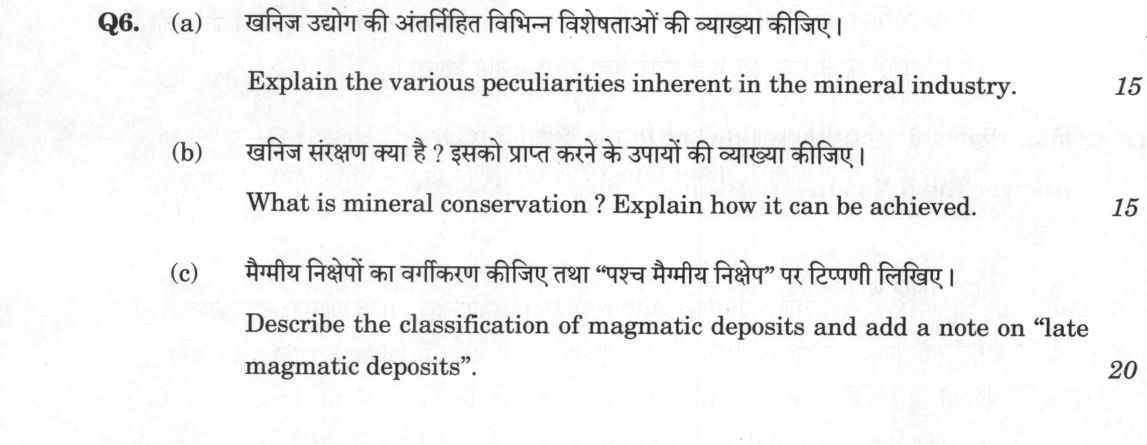
(a) Explain the various peculiarities inherent in the mineral industry. (15 marks) (b) What is mineral conservation ? Explain…
Explain the various peculiarities inherent in the mineral industry. 15 marks
What is mineral conservation ? Explain how it can be achieved. 15 marks
Describe the classification of magmatic deposits and add a note on "late magmatic deposits". 20 marks
हिंदी में प्रश्न पढ़ें
खनिज उद्योग की अन्तर्निहित विभिन्न विशेषताओं की व्याख्या कीजिए। (15 अंक)
खनिज संरक्षण क्या है ? इसको प्राप्त करने के उपायों की व्याख्या कीजिए। (15 अंक)
मैग्मीय निक्षेपों का वर्गीकरण कीजिए तथा "पश्च मैग्मीय निक्षेप" पर टिप्पणी लिखिए। (20 अंक)
Model answer
Written by UPSC Answer Check against this question's marking rubric, to the expected length. UPSC does not publish answers for Mains — this is one way to score well, not an official key.
Mineral economics and magmatic ore formation are linked: the industry’s constraints shape conservation policy, while the origin of deposits determines what can be recovered, how much waste is produced, and how exploration should be planned.
Part (a) The mineral industry is peculiar because its product is a finite, geologically formed stock. Non-renewability means extraction permanently reduces available reserves, so long-run supply depends on discovery, grade and mining rate. Capital intensity and long gestation periods follow because exploration, environmental clearance, mine development, rail/road and port infrastructure take years; this makes supply lumpy, raises entry barriers and creates regional fiscal dependence. Demand is often price inelastic in the short run because steel, power, cement and defence needs cannot be substituted quickly, while supply is also inelastic because new mines cannot be opened immediately; the result is price volatility. This is why mineral prices often move ahead of demand and why reserve replacement becomes a policy issue. Mining also creates externalities—land degradation, water pollution, air emissions and displacement—which, if not priced, encourage over-extraction. Deposits are geographically immobile, so production clusters where geology is favourable, raising transport costs and regional dependence. In India, coal is concentrated in Jharkhand, Chhattisgarh and Odisha, while iron ore is concentrated in Odisha, Jharkhand and Karnataka; large deposits and few major producers can give an oligopolistic market structure, especially in bulk minerals.
Part (b) Mineral conservation means using minerals sustainably in the present while preserving enough quality and quantity for future generations. It is achieved by reducing waste and increasing effective supply. Beneficiation concentrates ore, improves recovery and reduces tailings; where sub-grade material is blended, thresholds are prescribed under the Mineral Conservation and Development Rules by the Indian Bureau of Mines, not by the MMDR Act alone. Substitution lowers primary demand by using alternative materials or energy, while recycling and use of scrap—especially in steel and aluminium—reduce the need for fresh ore. Policy instruments such as the Mines and Minerals (Development and Regulation) Act, 1957, mining plans, environmental safeguards, pricing and taxation help internalize costs and prevent wasteful mining. Mine planning, waste-rock management and closure obligations further reduce loss and environmental damage. Together, these measures convert conservation from a slogan into measurable recovery, lower depletion and intergenerational equity.
Part (c) Magmatic deposits form directly from magma. A broad genetic scheme distinguishes early magmatic, late magmatic and magmatic-hydrothermal deposits, although many classifications keep magmatic-hydrothermal deposits separate because fluids, not direct crystallization, control ore formation. Early magmatic deposits form during the first stages of crystallization, when dense crystals settle and accumulate as cumulates; examples include chromite and magnetite in layered intrusions. Late magmatic deposits form from the residual silicate liquid left after early minerals such as olivine, pyroxene and plagioclase have crystallized. Fractional crystallization enriches this residual liquid in Fe, Ti, P and other incompatible elements. It may segregate by density, be injected into fractures, or be filter-pressed; in some Fe-Ti-P or sulfide systems, liquid immiscibility produces an oxide-rich liquid that separates from the silicate melt. The result is titaniferous magnetite, ilmenite and apatite-magnetite. Such deposits are economically important because fractional crystallization concentrates elements that were dispersed in the original magma. In India, the Ganjam apatite-magnetite deposits of Odisha are a standard late magmatic example. The Kolar gold field associations are sometimes invoked in Indian discussions, but the gold-quartz veins are not a late magmatic oxide deposit; they are better treated as hydrothermal/structural, which shows why magmatic and hydrothermal classes must not be conflated.
In synthesis, the mineral industry’s immobility, capital intensity and externalities make conservation essential, while correct genetic classification—especially distinguishing late magmatic residual-liquid deposits from hydrothermal systems—guides exploration, beneficiation and sustainable management.
What "Explain" is asking you to do
Make the working of something clear — what sets it off, what follows from what, and what it produces. Explain is the Commission's mechanism word: it dominates the technical papers and the “explain why” stems, where the marks sit in the causal chain and not in the label.
Structure that answers it
State what it is → the initiating condition → the chain of cause, step by step → an instance where it plays out → what the chain produces
Where marks are lost
Describing what something looks like instead of why it works that way. Naming the stages without linking them reads as description too.
How this answer will be evaluated
Approach
(a) explain: definition/context > points in order > small example > short close | (b) explain: definition/context > points in order > small example > short close | (c) describe: define > structure or process in order > labelled diagram > significance Full marks: Comprehensive coverage of all points with specific examples and clear diagrams.
Key points expected
- Non-renewable nature of mineral resources
- High capital intensity and long gestation period
- Geological uncertainty and exploration risk
- Environmental impact and land reclamation
- Definition: rational use to meet present/future needs
- Recycling and re-use of mineral products
- Substitution of scarce minerals with abundant ones
- Prevention of waste during mining and processing
Evaluation rubric
Each sub-part is marked on its own, against the marks and word limit printed on the paper.
- (a) Definition of mineral industry and its unique operational characteristics. 15 marks
explain— definition/context → points in order → small example → short close
Must cover
- Non-renewable nature of mineral resources
- High capital intensity and long gestation period
- Geological uncertainty and exploration risk
- Environmental impact and land reclamation
Loses marks
- Treating minerals as renewable resources
- Ignoring the high cost of exploration
- Generic business description without geological context
Earns more
- Price volatility and market dependence
- Location-specific nature of deposits
- Regulatory and policy framework (Mineral Act)
Extra mark
- Reference to specific Indian mining policy
- Comparison with renewable energy sectors
- (b) Definition of mineral conservation and specific measures for its achievement. 15 marks
explain— definition/context → points in order → small example → short close
Must cover
- Definition: rational use to meet present/future needs
- Recycling and re-use of mineral products
- Substitution of scarce minerals with abundant ones
- Prevention of waste during mining and processing
Loses marks
- Confusing conservation with mere preservation
- Vague suggestions without specific measures
- Ignoring the economic aspect of conservation
Earns more
- Improving mining techniques to reduce waste
- Legislative measures for conservation
- Public awareness and education
Extra mark
- Specific example of mineral substitution (e.g., plastics for wood)
- Reference to specific Indian conservation policy
- (c) Classification of magmatic deposits and a detailed note on late magmatic deposits. 20 marks
describe— define → structure or process in order → labelled diagram → significance
Must cover
- Classification: Primary (direct) and Secondary (indirect)
- Direct: Intrusive (plutonic) and Extrusive (volcanic)
- Indirect: Hydrothermal (high, medium, low temp)
- Late magmatic: pegmatites and aplites
Loses marks
- Missing the distinction between direct and indirect
- Confusing late magmatic with hydrothermal
- No specific examples of deposits
Earns more
- Mechanism of formation for each type
- Examples of minerals for each type
- Diagram of magmatic differentiation
Extra mark
- Specific Indian example of pegmatite (e.g., Khetri)
- Detailed description of pegmatite texture
Practice this exact question
Write your answer and it is marked point by point against the model answer above — what you covered, what you missed, what you got wrong.
Evaluate my answer →More from Geology 2024 Paper II
- Q3 (a) Describe the mineral reactions in prograde metamorphism of argillaceous sedimentary r…
- Q4 (a) Discuss the various factors that control the composition of sandstone. (15 marks) (b)…
- Q5 Answer the following questions in about 150 words each. (a) Give an account of the geolog…
- Q6 (a) Explain the various peculiarities inherent in the mineral industry. (15 marks) (b) Wh…
- Q7 (a) (i) What is the difference between a sample and a specimen ? (5 marks) (ii) Describe…
- Q8 (a) What are the different layers in the Earth's interior ? How is the layered structure…