Paper II — Q7
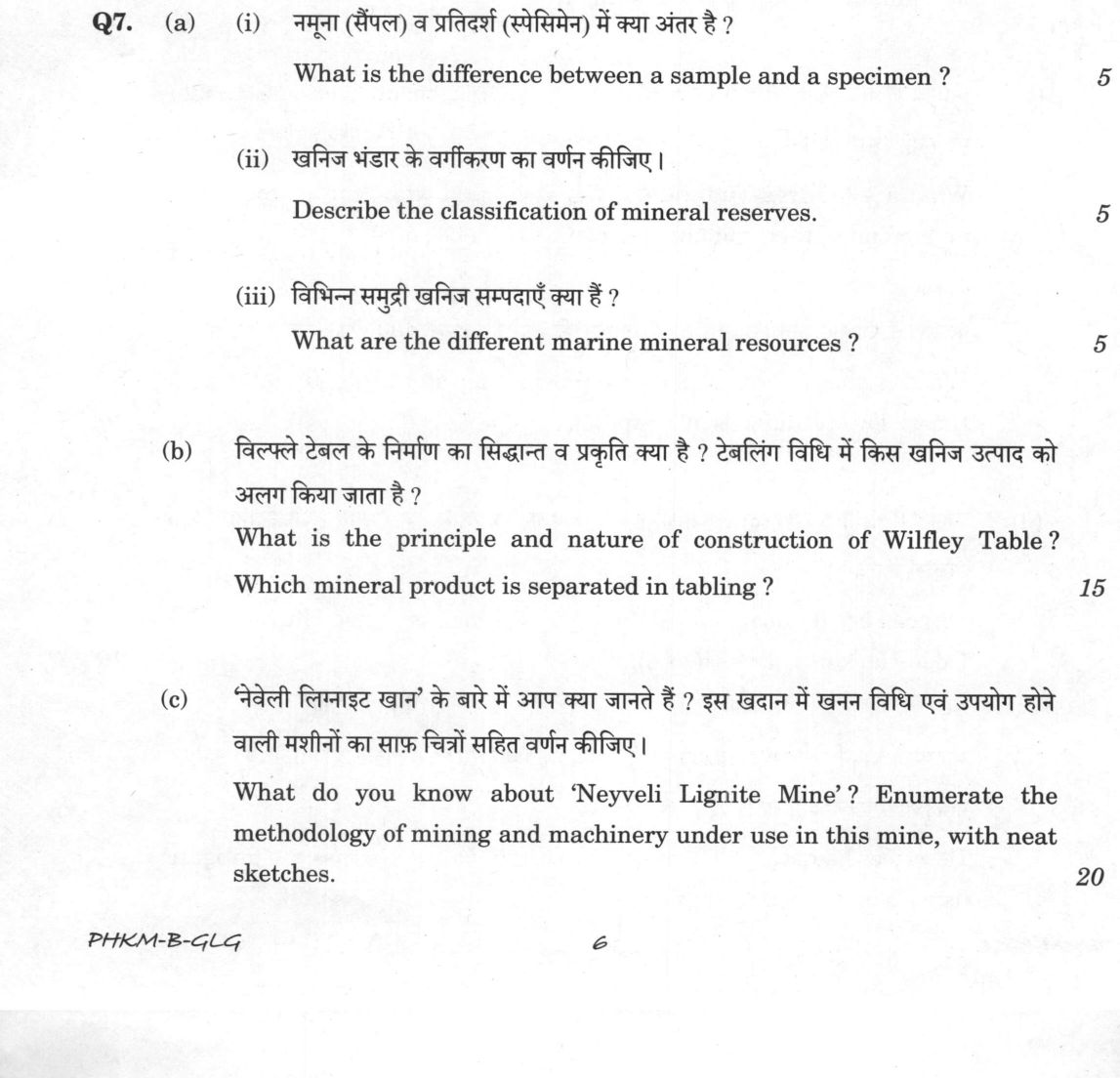
(a) (i) What is the difference between a sample and a specimen ? (5 marks) (ii) Describe the classification of mineral reserves…
What is the difference between a sample and a specimen ? 5 marks
Describe the classification of mineral reserves. 5 marks
What are the different marine mineral resources ? 5 marks
What is the principle and nature of construction of Wilfley Table ? Which mineral product is separated in tabling ? 15 marks
What do you know about 'Neyveli Lignite Mine' ? Enumerate the methodology of mining and machinery under use in this mine, with neat sketches. 20 marks
हिंदी में प्रश्न पढ़ें
नमूना (सैंपल) व प्रतिदर्श (स्पेसिमेन) में क्या अंतर है ? (5 अंक)
खनिज भंडार के वर्गीकरण का वर्णन कीजिए। (5 अंक)
विभिन्न समुद्री खनिज सम्पदाएँ क्या हैं ? (5 अंक)
विल्फले टेबल के निर्माण का सिद्धान्त व प्रकृति क्या है ? टेबलिंग विधि में किस खनिज उत्पाद को अलग किया जाता है ? (15 अंक)
'नेयवेली लिग्नाइट खान' के बारे में आप क्या जानते हैं ? इस खदान में खनन विधि एवं उपयोग होने वाली मशीनों का साफ चित्रों सहित वर्णन कीजिए। (20 अंक)
Model answer
Written by UPSC Answer Check against this question's marking rubric, to the expected length. UPSC does not publish answers for Mains — this is one way to score well, not an official key.
Sample and specimen. The distinction is operational. A sample is a representative portion of bulk ore, rock or coal taken for assay, grade control or bulk testing; its value lies in statistical representativeness. A specimen is a single, often visually or mineralogically significant piece kept for identification, display or detailed study; it need not represent the whole deposit.
Mineral reserves. In Indian mineral-reserve practice, reserves are classified as Proved, Probable and Possible on the basis of quantity, quality, location and economic viability. The classification guides mining lease, planning and economic evaluation. Proved reserves are the highest-confidence, economically mineable quantities based on detailed exploration and reliable grade and geometry. Probable reserves have lower confidence but are reasonably expected to be economic. Possible reserves are the least certain and require further exploration to confirm economics. International codes such as JORC and UNFC also separate resources from economically viable reserves, but the Indian reserve categories are Proved, Probable and Possible.
Marine mineral resources. Marine mineral resources include polymetallic nodules on abyssal plains, cobalt-rich ferromanganese crusts on seamounts, massive sulphides at hydrothermal vents, placer deposits of heavy minerals on continental shelves and beaches, and gas hydrates in cold, high-pressure sediments; offshore petroleum, gas and marine sands are also exploited. Marine placers may include ilmenite, monazite, rutile and zircon. They occur in abyssal, seamount, vent, shelf and sedimentary settings.
Wilfley table. The Wilfley table separates minerals by density through differential settling and streaming in a thin, streaming water film over a riffled deck. It is used for fine heavy mineral separation where gravity concentration is needed. The deck is slightly inclined longitudinally and shaken laterally; wash water flows across, controlling the streaming film and helping separate fines; riffles create pockets that retard coarse and heavy particles while fine light gangue reports to middlings or tailings. Its construction comprises a rectangular wooden or metal deck, transverse riffles, longitudinal tilt, lateral shake, and wash-water troughs. Tabling recovers heavy mineral products—cassiterite, wolframite, chromite, gold, ilmenite and zircon—by concentrating them in the headings.
Neyveli Lignite Mine. Neyveli Lignite Mine is in Cuddalore district, Tamil Nadu, operated by NLC. It is an opencast mine in the Cuddalore Formation of the Gondwana basin, with low-rank lignite seams beneath overburden. The mine is a major lignite source for NLC's power plants. The method is bench mining by a BWE-conveyor system. The sequence is: geological mapping and seam delineation; overburden stripping by BWE-conveyor-spreader (BWE-CS); lignite extraction by BWE-conveyor to stockyard; reclamation by bucket-wheel reclaimer; and haulage/conveyance to the plant. BWEs cut both overburden and lignite, but only overburden is spread; lignite is stockpiled. Overburden is removed by a bucket-wheel excavator and carried by conveyor to a spreader for dumping; lignite is mined by a BWE and carried by conveyor to a stockyard; stock is reclaimed by a bucket-wheel reclaimer and conveyed or hauled to the plant. The BWE-reclaimer-haulage sequence, often described as BWE-RH, links mining, stock and plant. Sketch 1: cross-section showing overburden, lignite seam, benches, BWE face, conveyor and spreader. Sketch 2: BWE working face showing cutting wheel, buckets, discharge boom and conveyor. Sketch 3: spreader operation for overburden dumping.
The principal machinery is enumerated as follows. BWEs are the largest machines, providing continuous excavation with a large bucket wheel, high-capacity discharge boom and high production rate. Conveyors transport overburden and lignite over long distances at high capacity; they are high-capacity, long-haul, and reduce trucking cost. Spreaders dump overburden in controlled benches using a rotating or travelling boom. Bucket-wheel reclaimers reclaim lignite from stockyards and feed conveyors. Dozers, graders and water sprinklers prepare faces, maintain haul roads and control dust. Thus, the enumeration shows that NLC’s method is a continuous BWE-conveyor-spreader/reclaimer system for large-scale, low-cost opencast production of lignite for power generation.
What "Enumerate" is asking you to do
Produce the complete set of items asked for, countable and correctly named. The examiner marks against a checklist, so a missing item costs and an elaborated one gains nothing — where discussion is wanted the stem asks for it as a separate sub-part.
Structure that answers it
One line naming the basis on which the set is drawn → items numbered, each in a phrase or a single line → the discussion sub-part taken up separately, after the list is complete
Where marks are lost
Treating it as an essay. Six items named in six lines score better than three items explained at length.
How this answer will be evaluated
Approach
(a(i)) compare: paired headings or table > key differences > significance > conclusion | (a(ii)) describe: define > structure or process in order > labelled diagram > significance | (a(iii)) enumerate: list the items in order > one line each > no commentary | (b) explain: definition/context > points in order > small example > short close | (c) describe: define > structure or process in order > labelled diagram > significance Full marks: Precise definitions, clear diagrams, specific Indian examples, and correct technical terminology.
Key points expected
- Define sample as a representative portion for analysis
- Define specimen as a specific example for identification
- Highlight difference in purpose (analysis vs. record)
- Highlight difference in quantity (small vs. specific)
- List the main categories (Proved, Probable, Possible)
- Define Proved reserves (economically mineable)
- Define Probable reserves (likely to be mineable)
- Define Possible reserves (uncertain)
Evaluation rubric
Each sub-part is marked on its own, against the marks and word limit printed on the paper.
- (a(i)) Distinguish between a sample and a specimen in a tabular or paired format. 5 marks
compare— paired headings or table → key differences → significance → conclusion
Must cover
- Define sample as a representative portion for analysis
- Define specimen as a specific example for identification
- Highlight difference in purpose (analysis vs. record)
- Highlight difference in quantity (small vs. specific)
Loses marks
- Confusing the two terms
- Generic description without distinction
Earns more
- Mention sample is for lab testing
- Mention specimen is for museum/record
- Use a comparison table
Extra mark
- Example of a rock sample vs. a mineral specimen
- (a(ii)) Outline the classification of mineral reserves (e.g., Proved, Probable, Possible). 5 marks
describe— define → structure or process in order → labelled diagram → significance
Must cover
- List the main categories (Proved, Probable, Possible)
- Define Proved reserves (economically mineable)
- Define Probable reserves (likely to be mineable)
- Define Possible reserves (uncertain)
Loses marks
- Listing without definition
- Confusing reserves with resources
Earns more
- Mention geological vs. economic certainty
- Reference to USGS or Indian classification
Extra mark
- Mention 'Measured' vs 'Indicated' resources
- (a(iii)) List the different marine mineral resources. 5 marks
enumerate— list the items in order → one line each → no commentary
Must cover
- List sea salts (NaCl, KCl)
- List heavy mineral sands (monazite, ilmenite)
- List phosphorite nodules
- List manganese nodules
Loses marks
- Listing only one type
- Including non-mineral resources
Earns more
- Mention offshore oil and gas
- Mention polymetallic sulphides
Extra mark
- Mention specific Indian coastal deposits (e.g., Kerala sands)
- (b) Explain the principle, construction, and application of the Wilfley Table. 15 marks
explain— definition/context → points in order → small example → short close
Must cover
- State principle: gravity separation by size and density
- Describe construction: inclined deck, riffles, water trough
- Explain motion: reciprocating and shaking action
- Identify mineral: tin, tungsten, or gold
Loses marks
- Missing the 'riffles' in construction
- Confusing with jigging or shaking table
- No mention of the specific mineral product
Earns more
- Sketch of the table with labelled parts
- Explanation of how heavy minerals settle in riffles
- Mention of 'tabling' process
Extra mark
- Mention of specific Indian tin deposits (e.g., Rajahmundry)
- (c) Describe Neyveli Lignite Mine, its mining methodology, and machinery with sketches. 20 marks
describe— define → structure or process in order → labelled diagram → significance
Must cover
- Locate Neyveli (Tamil Nadu) and its significance
- Describe open-cast mining method (strip mining)
- List machinery: draglines, shovels, dumpers
- Provide neat sketches of the mining profile or machinery
Loses marks
- No sketches provided
- Confusing with underground mining
- Generic description without specific machinery names
Earns more
- Mention of lignite quality (low grade)
- Description of the 'bench' or 'step' mining sequence
- Mention of the Neyveli Lignite Corporation (NLC)
Extra mark
- Mention of the power plant associated with the mine
- Specific dimensions of the benches
Practice this exact question
Write your answer and it is marked point by point against the model answer above — what you covered, what you missed, what you got wrong.
Evaluate my answer →More from Geology 2024 Paper II
- Q4 (a) Discuss the various factors that control the composition of sandstone. (15 marks) (b)…
- Q5 Answer the following questions in about 150 words each. (a) Give an account of the geolog…
- Q6 (a) Explain the various peculiarities inherent in the mineral industry. (15 marks) (b) Wh…
- Q7 (a) (i) What is the difference between a sample and a specimen ? (5 marks) (ii) Describe…
- Q8 (a) What are the different layers in the Earth's interior ? How is the layered structure…