Paper II — Q3
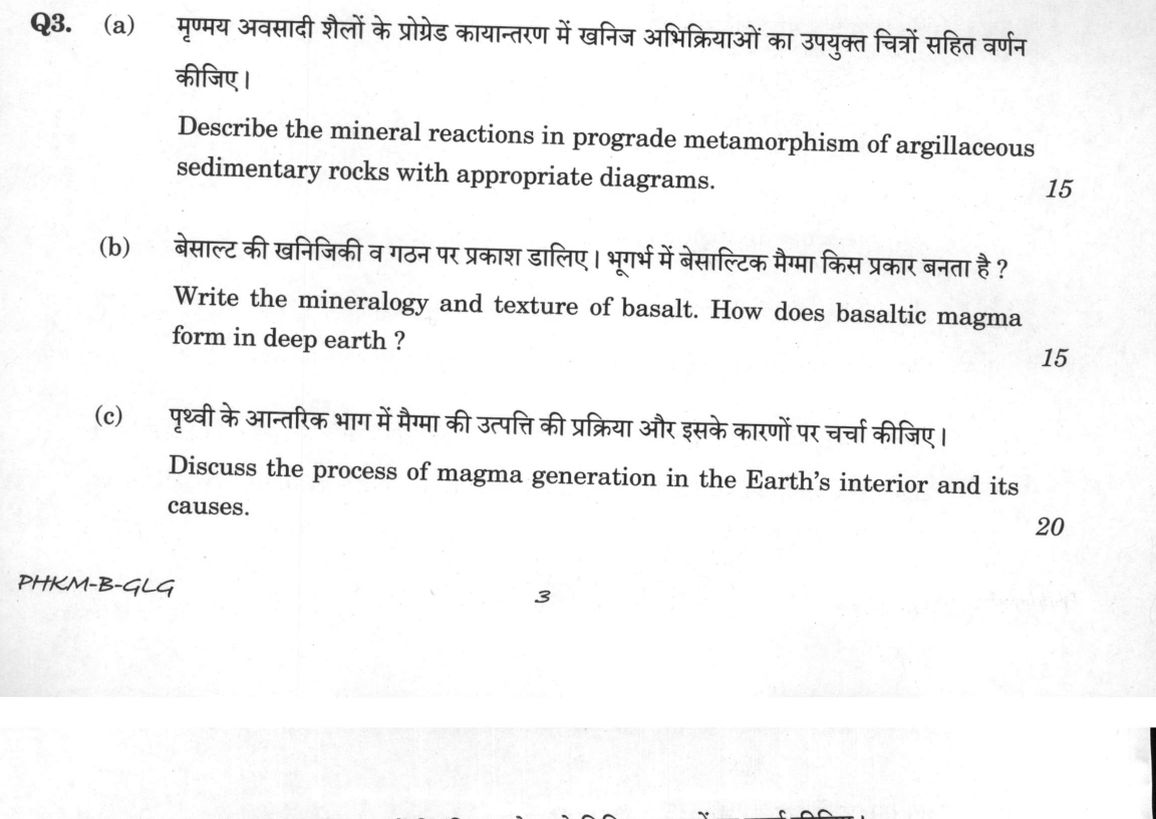
(a) Describe the mineral reactions in prograde metamorphism of argillaceous sedimentary rocks with appropriate diagrams. (15…
Describe the mineral reactions in prograde metamorphism of argillaceous sedimentary rocks with appropriate diagrams. 15 marks
Write the mineralogy and texture of basalt. How does basaltic magma form in deep earth ? 15 marks
Discuss the process of magma generation in the Earth's interior and its causes. 20 marks
हिंदी में प्रश्न पढ़ें
मृण्मय अवसादी शैलों के प्रोग्रेड कार्यान्तरण में खनिज अभिक्रियाओं का उपयुक्त चित्रों सहित वर्णन कीजिए । (15 अंक)
बेसाल्ट की खनिजीकी व गठन पर प्रकाश डालिए । भूगर्भ में बेसाल्टिक मैग्मा किस प्रकार बनता है ? (15 अंक)
पृथ्वी के आन्तरिक भाग में मैग्मा की उत्पत्ति की प्रक्रिया और इसके कारणों पर चर्चा कीजिए । (20 अंक)
Model answer
Written by UPSC Answer Check against this question's marking rubric, to the expected length. UPSC does not publish answers for Mains — this is one way to score well, not an official key.
(a) Prograde metamorphism of argillaceous rocks. In prograde Barrovian metamorphism, an argillaceous sediment evolves through predictable mineral isograds as temperature and pressure rise. A P–T diagram would show chlorite, biotite, garnet, staurolite, kyanite and sillimanite isograds trending to higher temperature with increasing pressure. Approximate conditions are pyrophyllite at 200–250°C and 2–3 kbar, chlorite at 200–300°C and 2–4 kbar, biotite at 300–400°C and 3–5 kbar, garnet at 400–500°C and 4–6 kbar, staurolite at 500–600°C and 5–7 kbar, kyanite at 550–650°C and 5–8 kbar, and sillimanite above 600–650°C and 4–8 kbar. The key reactions are: kaolinite + 3 quartz → pyrophyllite; chlorite + muscovite + quartz → biotite + Al-rich chlorite + H₂O; chlorite + muscovite + quartz → almandine garnet + biotite + H₂O; chlorite + muscovite + quartz → staurolite + biotite + H₂O; muscovite + quartz → kyanite + K-feldspar + H₂O; and muscovite + quartz → sillimanite + K-feldspar + H₂O. In the low-pressure Buchan series, staurolite and kyanite are replaced by cordierite, and sillimanite appears at lower pressure. The AFM diagram would show the Barrovian and Buchan stability fields; ACF is used for Ca-bearing mafic rocks, not for argillaceous rocks, so it is not the primary pelite diagram.
(b) Basalt mineralogy, texture and origin. Basalt is a mafic volcanic rock, commonly composed of labradorite–bytownite plagioclase (An₅₀₋₈₀), clinopyroxene augite, olivine, and a glassy or fine-grained groundmass. Its textures include ophitic, where pyroxene surrounds plagioclase laths; subophitic, where plagioclase dominates; intergranular and intersertal, where groundmass fills interstices; vesicular and amygdaloidal, from gas bubbles and their infill; and porphyritic, with phenocrysts in a fine matrix. Deccan trap basalts show ophitic and subophitic textures. In India, Deccan trap basalts record plume-related decompression melting. Basaltic magma forms mainly by decompression melting at mid-ocean ridges: hot peridotite rises adiabatically, pressure falls, and the material crosses its solidus. The mantle potential temperature, typically near 1350–1400°C, must exceed the solidus at ridge pressures; a small degree of partial melting yields basaltic melt.
(c) Magma generation in the Earth’s interior. Magma generation is controlled by pressure, temperature, composition and volatiles. Decompression melting occurs where mantle rises, such as at mid-ocean ridges, mantle plumes and continental rifts; no external heat is required, but the solidus is crossed because pressure drops. Flux melting is important above subduction zones, where water released from the subducting slab lowers the solidus of the overlying mantle wedge; CO₂, released mainly by decarbonation of carbonates, can also lower melting temperatures. Heat-transfer melting occurs where hot mantle or crustal rocks conduct or convectively heat adjacent material, as beneath plume heads or in thickened crust. The causes are therefore tectonic: ridge upwelling, plume activity (Hawaii, Deccan), subduction-related hydration, and rifting. Mantle convection supplies the long-term heat and motion that sustain these settings, while local tectonics control where melting is focused. Depth–temperature constraints are critical: asthenospheric melting commonly occurs near 1300–1400°C, while garnet lherzolite residues indicate deeper, higher-pressure melting and spinel lherzolite residues indicate shallower melting. The degree of partial melting and melt extraction determine melt composition: low degrees produce basalt, higher degrees more mafic or ultramafic melts, and extraction leaves depleted peridotite. These deep mantle processes differ from shallow crustal metamorphism, where prograde argillaceous reactions record lower pressures and temperatures. Yet they are linked: igneous intrusions raise the geothermal gradient and can drive regional metamorphism, while metamorphic dehydration and decarbonation supply volatiles that modify later melting. The way forward is to interpret every magma body by its pressure–temperature path, volatile content, residue, and tectonic setting, thereby connecting metamorphic grade, basaltic volcanism and global magma generation.
What "Discuss" is asking you to do
Lay the issue out from more than one side — how it arose, what is claimed for it, what is held against it, and where it now stands. UPSC attaches discuss to broad topics with several live dimensions, so coverage of the dimensions earns more than the strength of your opinion.
Structure that answers it
Set the issue up → the case as it is made → the case against → the dimension both sides leave out → where the balance now lies
Where marks are lost
Listing facts with no thread between them, or arguing one side throughout and calling it a discussion.
How this answer will be evaluated
Approach
Framework: Geology Paper 2: Define > Process > Field/Petrographic Evidence > Indian Example. (a) describe: define > structure or process in order > labelled diagram > significance | (b) explain: definition/context > points in order > small example > short close | (c) discuss: intro > 3-4 dimensions > example > balanced close Full marks: Precise mineral reactions, labelled diagrams, specific Indian examples, clear causal chains.
Key points expected
- Identify starting composition (clay, quartz, feldspar)
- List index minerals in order (Chlorite, Biotite, Garnet, Staurolite, Kyanite/Sillimanite)
- Provide labelled P-T diagram or facies sequence
- Mention specific mineral reactions (e.g., chlorite to biotite)
- State mineralogy (Plagioclase, Pyroxene, Olivine)
- Describe texture (Fine-grained, Aphanitic, Ophitic)
- Explain formation via partial melting of mantle
- Mention role of decompression or water flux
Evaluation rubric
Each sub-part is marked on its own, against the marks and word limit printed on the paper.
- (a) Sequence of mineral reactions in prograde metamorphism of argillaceous rocks with diagrams. 15 marks
describe— define → structure or process in order → labelled diagram → significance
Must cover
- Identify starting composition (clay, quartz, feldspar)
- List index minerals in order (Chlorite, Biotite, Garnet, Staurolite, Kyanite/Sillimanite)
- Provide labelled P-T diagram or facies sequence
- Mention specific mineral reactions (e.g., chlorite to biotite)
Loses marks
- Missing P-T diagram or facies sequence
- Listing minerals without reaction order
- Generic description without specific index minerals
Earns more
- Mention of Barrovian sequence
- Reference to specific facies (Greenschist, Amphibolite)
- Mention of porphyroblasts vs groundmass
Extra mark
- Named Indian occurrence (e.g., Aravalli or Eastern Ghats)
- Stratigraphic age of the formation
- (b) Mineralogy, texture of basalt, and mechanism of basaltic magma formation. 15 marks
explain— definition/context → points in order → small example → short close
Must cover
- State mineralogy (Plagioclase, Pyroxene, Olivine)
- Describe texture (Fine-grained, Aphanitic, Ophitic)
- Explain formation via partial melting of mantle
- Mention role of decompression or water flux
Loses marks
- Confusing basalt with gabbro (coarse-grained)
- Missing texture description
- Vague explanation of magma formation
Earns more
- Mention of specific pyroxene types (Augite, Enstatite)
- Reference to specific Indian basalt (Deccan Traps)
- Mention of specific tectonic setting (Mid-ocean ridge)
Extra mark
- Named Indian occurrence (e.g., Deccan Traps, Satpura)
- Stratigraphic age of the formation
- (c) Process of magma generation in Earth's interior and its causes. 20 marks
discuss— intro → 3-4 dimensions → example → balanced close
Must cover
- Define magma generation (partial melting)
- Explain causes: Decompression, Fluxing, Heat transfer
- Describe process in mantle vs crust
- Provide balanced conclusion on magma ascent
Loses marks
- Generic description without specific causes
- Missing process explanation
- No Indian example or field evidence
Earns more
- Mention of specific tectonic settings (Subduction, Rifting)
- Reference to specific Indian example (Deccan, Western Ghats)
- Mention of specific mineral assemblages
Extra mark
- Named Indian occurrence (e.g., Deccan Traps, Satpura)
- Stratigraphic age of the formation
Practice this exact question
Write your answer and it is marked point by point against the model answer above — what you covered, what you missed, what you got wrong.
Evaluate my answer →More from Geology 2024 Paper II
- Q1 Answer the following questions in about 150 words each. (a) What are the different types…
- Q2 (a) What are the symmetry elements present in the normal class of an isometric system ? W…
- Q3 (a) Describe the mineral reactions in prograde metamorphism of argillaceous sedimentary r…
- Q4 (a) Discuss the various factors that control the composition of sandstone. (15 marks) (b)…
- Q5 Answer the following questions in about 150 words each. (a) Give an account of the geolog…
- Q6 (a) Explain the various peculiarities inherent in the mineral industry. (15 marks) (b) Wh…