Paper I — Q3
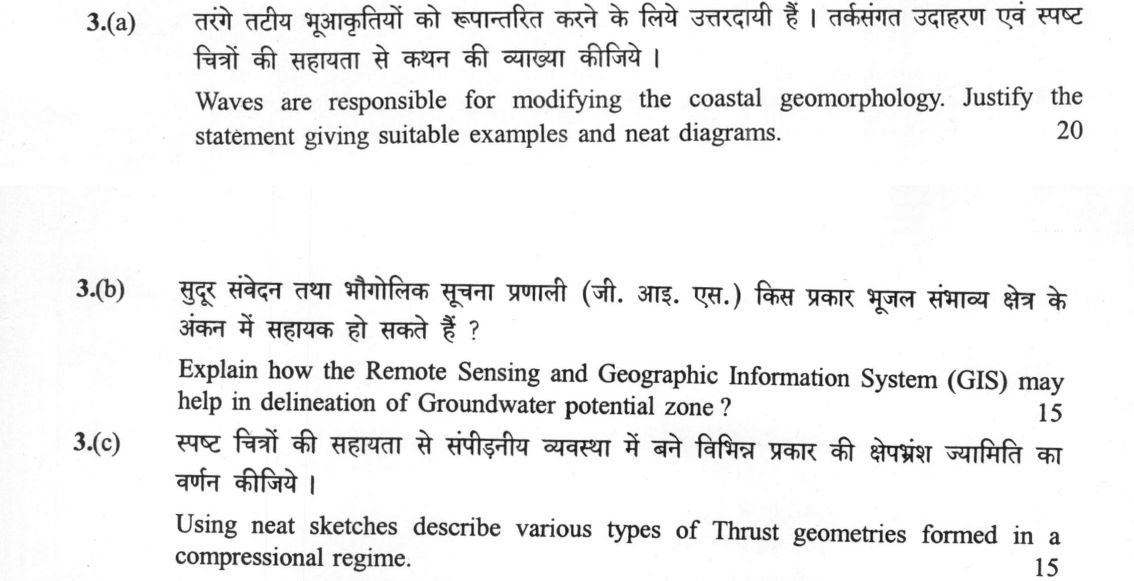
(a) Waves are responsible for modifying the coastal geomorphology. Justify the statement giving suitable examples and neat…
Waves are responsible for modifying the coastal geomorphology. Justify the statement giving suitable examples and neat diagrams. 20 marks
Explain how the Remote Sensing and Geographic Information System (GIS) may help in delineation of Groundwater potential zone ? 15 marks
Using neat sketches describe various types of Thrust geometries formed in a compressional regime. 15 marks
हिंदी में प्रश्न पढ़ें
तरंगे तटीय भूआकृतियों को रूपांतरित करने के लिए उत्तरदायी हैं । तर्कसंगत उदाहरण एवं स्पष्ट चित्रों की सहायता से कथन की व्याख्या कीजिये । (20 अंक)
सुदूर संवेदन तथा भौगोलिक सूचना प्रणाली (जी. आई. एस.) किस प्रकार भूजल संभाव्य क्षेत्र के अंकन में सहायक हो सकते हैं ? (15 अंक)
स्पष्ट चित्रों की सहायता से संपीड़नीय व्यवस्था में बने विभिन्न प्रकार की क्षेपभ्रंश ज्यामिति का वर्णन कीजिये । (15 अंक)
Model answer
Written by UPSC Answer Check against this question's marking rubric, to the expected length. UPSC does not publish answers for Mains — this is one way to score well, not an official key.
Coastal geomorphology is predominantly sculptured by wave energy through continuous mechanical action and sediment redistribution. While tides, wind, and river influxes act as secondary agents, waves supply the primary kinetic energy that drives shoreface dynamics. Wave transformation in shallow water governs this evolution: low-energy constructive waves with dominant swash deposit material to build wide berms, whereas high-energy destructive waves with strong backwash erode the coast. As waves encounter irregular coastlines, wave refraction concentrates wave energy on headlands and dissipates it in bays. Concurrently, oblique wave approach generates longshore drift, mobilizing littoral sediment along the shore.
[Diagram: Wave refraction concentrating energy on headland with converging orthogonals, and dissipating in bays; alongside littoral drift showing zig-zag swash and backwash]
Through hydraulic action, abrasion, and attrition, waves carve distinctive erosional landforms. Headland attack initiates sea caves along structural weaknesses, which breach into sea arches and eventually collapse into isolated sea stacks and stumps (seen along the Konkan coast and St. Mary’s Islands). At the base of cliffs, notch development promotes mass wasting, forming extensive wave-cut platforms. Depositional landforms emerge where refracted wave energy declines; longshore currents construct sand spits, baymouth bars, and barrier islands (prominent along the Kerala backwaters), while tombolos tie offshore islands to the mainland, and broad progradational beaches develop, exemplified by Chennai's Marina Beach.
[Diagram: Evolution of erosional coastal landforms—Notch, Cave, Arch, Stack, and Wave-cut Platform]
Remote Sensing and GIS in Groundwater Delineation
Remote Sensing (RS) and Geographic Information Systems (GIS) provide a multi-criteria spatial framework to evaluate groundwater potential zones (GWPZ) by integrating hydrogeological surface indicators. Multispectral and microwave sensors (such as Landsat-8/9, Sentinel-1/2, and ASTER DEM) are processed to delineate rock types, structural lineaments (faults, fractures), drainage networks, slope gradients, and land-use/land-cover (LULC) patterns. Lineaments identified from satellite imagery mark zones of enhanced secondary porosity and permeability, while drainage density and digital elevation models indicate surface runoff versus infiltration capacity.
[Diagram: GIS Multi-Criteria Overlay Workflow showing thematic layers (Lithology, Lineaments, Slope, Drainage Density, Rainfall, LULC) leading via AHP/WLC to GWPZ Map]
Within the GIS platform, these parameters are converted into thematic raster layers. Using Multi-Criteria Decision Analysis, such as the Analytical Hierarchy Process (AHP), weights and ranks are assigned to each layer based on hydrogeological significance:
GWPI = Σ (Wᵢ × Rᵢ)
where Wᵢ is the layer weight (e.g., lineament density, lithology) and Rᵢ is the internal class rank. The resulting continuous index is categorized into very high, high, moderate, and poor groundwater potential zones. This spatial model is subsequently validated against Central Ground Water Board (CGWB) observation well yields and piezometric head data.
Thrust Geometries in Compressional Regimes
In compressional tectonic regimes where maximum principal stress (σ₁) is horizontal, contraction is accommodated by thrust systems comprising sub-horizontal flats along incompetent décollement layers connected by inclined ramps cutting across competent strata.
[Diagram: Thrust Geometries—(i) Imbricate Fan showing emergent trailing imbricates; (ii) Duplex with floor thrust, roof thrust, and horses forming an antiformal stack; (iii) Triangle zone with opposing passive roof thrust]
Kinematic thrust progression yields distinct structural configurations:
- Imbricate Fan: A series of curved thrust splays branching off a basal decollement and dipping toward the hinterland. If splays terminate upward blindly, it forms a blind imbricate; if they breach the surface, it forms an emergent imbricate fan with a dominant foreland vergence.
- Duplex Structures: Formed when a package of rock (a horse) is completely bounded by a floor thrust (sole thrust) below and a roof thrust above. As successive horses are accreted, they stack vertically into an antiformal stack or culminations, accommodating high crustal shortening.
- Triangle Zones and Passive Roof Duplexes: Characterized by conjugate thrusting where a foreland-directed floor thrust interacts with a back-thrust (hinterland-verging passive roof thrust), creating a wedge-shaped, non-folded zone at the deformation front.
- Fault-Fold Relationships: As displacement occurs over non-planar fault planes, slip over ramps generates fault-bend folds, whereas fault propagation folding develops ahead of an advancing, blind thrust tip.
In summary, waves act as the definitive dynamic agents carving and building coastlines, while spatial RS-GIS tools map the hidden subsurface hydrological responses to structural and geomorphic architecture, itself rooted in compressive thrust systems that define regional geological evolution.
What "Justify" is asking you to do
Defend a position with reasons that carry evidence, and show why the contrary view does not hold. Where the stem runs as a question and asks you to justify your answer, the position is yours to choose and the marks lie wholly in the defence.
Structure that answers it
Position stated plainly → reason 1 with evidence → reason 2 with evidence → strongest objection, met → position restated as qualified
Where marks are lost
Reasons stated and none of them evidenced. The other standard loss is fence-sitting — an answer that finds merit on both sides and commits to neither has justified nothing.
How this answer will be evaluated
Approach
(a) justify: claim > 3-4 reasons > evidence > conclusion | (b) explain: definition/context > points in order > small example > short close | (c) describe: define > structure or process in order > labelled diagram > significance Full marks: Comprehensive, well-structured answers with clear diagrams, specific examples, and precise terminology.
Key points expected
- Mechanism of wave erosion and deposition
- Neat diagrams of coastal landforms
- Suitable examples of wave-modified features
- Causal link between wave action and landform
- Role of Remote Sensing in data acquisition
- Role of GIS in spatial analysis
- Integration of RS and GIS for delineation
- Specific parameters used (e.g., lineaments, drainage)
Evaluation rubric
Each sub-part is marked on its own, against the marks and word limit printed on the paper.
- (a) Justify the role of waves in modifying coastal geomorphology with examples and diagrams. 20 marks
justify— claim → 3-4 reasons → evidence → conclusion
Must cover
- Mechanism of wave erosion and deposition
- Neat diagrams of coastal landforms
- Suitable examples of wave-modified features
- Causal link between wave action and landform
Loses marks
- Generic description without specific examples
- Missing or unclear diagrams
- Failure to link process to landform
Earns more
- Mention of specific Indian coastal features
- Distinction between erosional and depositional forms
- Reference to wave energy and fetch
- Mention of specific Indian coastal features
Extra mark
- Specific Indian example (e.g., Konkan coast)
- Reference to specific wave parameters
- (b) Explain how Remote Sensing and GIS help in delineating groundwater potential zones. 15 marks
explain— definition/context → points in order → small example → short close
Must cover
- Role of Remote Sensing in data acquisition
- Role of GIS in spatial analysis
- Integration of RS and GIS for delineation
- Specific parameters used (e.g., lineaments, drainage)
Loses marks
- Vague description of RS and GIS roles
- Failure to explain the integration process
- Missing specific parameters or data types
Earns more
- Mention of specific satellite data (e.g., Landsat)
- Explanation of overlay analysis in GIS
- Reference to specific Indian groundwater studies
- Mention of specific satellite data (e.g., Landsat)
Extra mark
- Specific Indian case study
- Mention of specific software (e.g., ArcGIS)
- (c) Describe various types of thrust geometries formed in a compressional regime using sketches. 15 marks
describe— define → structure or process in order → labelled diagram → significance
Must cover
- Definition of thrust geometry
- Description of different types (e.g., simple, imbricate)
- Neat sketches of each type
- Context of compressional regime
Loses marks
- Missing or unclear sketches
- Failure to distinguish between different types
- Generic description without specific examples
Earns more
- Mention of specific Indian examples (e.g., Himalayan thrusts)
- Distinction between different thrust types
- Reference to specific geological settings
- Mention of specific Indian examples (e.g., Himalayan thrusts)
Extra mark
- Specific Indian example (e.g., Main Central Thrust)
- Reference to specific geological settings
Practice this exact question
Write your answer and it is marked point by point against the model answer above — what you covered, what you missed, what you got wrong.
Evaluate my answer →More from Geology 2025 Paper I
- Q1 Answer the following questions in about 150 words each: (a) Discuss the position of Astro…
- Q2 (a) What do you understand by continental drift ? Discuss various geological evidences in…
- Q3 (a) Waves are responsible for modifying the coastal geomorphology. Justify the statement…
- Q4 (a) On the basis of dip isogons describe the classification of folds with neat diagrams.…
- Q5 Answer the following questions in about 150 words each: (a) Discuss favourable conditions…
- Q6 (a) Discuss the evolutionary lineage of Equidae and comment on its migration. (20 marks)…