Paper I — Q8
(a) Discuss the interrelationship amongst Porosity, Permeability and Hydraulic conductivity. How they are important in…
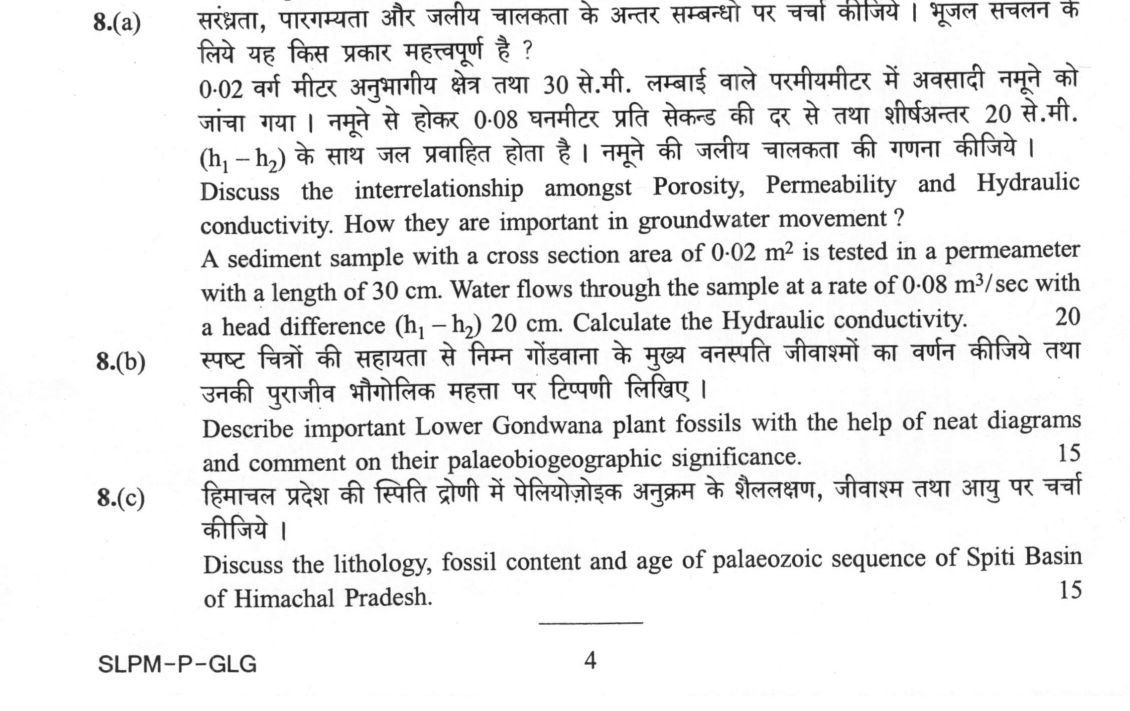
Discuss the interrelationship amongst Porosity, Permeability and Hydraulic conductivity. How they are important in groundwater movement ? A sediment sample with a cross section area of 0.02 m² is tested in a permeameter with a length of 30 cm. Water flows through the sample at a rate of 0.08 m³/sec with a head difference (h₁ – h₂) 20 cm. Calculate the Hydraulic conductivity. 20 marks
Describe important Lower Gondwana plant fossils with the help of neat diagrams and comment on their palaeobiogeographic significance. 15 marks
Discuss the lithology, fossil content and age of palaeozoic sequence of Spiti Basin of Himachal Pradesh. 15 marks
हिंदी में प्रश्न पढ़ें
संरंधता, पारगम्यता और जलीय चालकता के अन्तर सम्बन्धों पर चर्चा कीजिये । भूजल संचलन के लिये यह किस प्रकार महत्त्वपूर्ण है ? 0.02 वर्ग मीटर अनुप्रस्थीय क्षेत्र तथा 30 से.मी. लम्बाई वाले परमीयमीटर में अवसादी नमूने को जाँचा गया । नमूने से होकर 0.08 घनमीटर प्रति सेकंड की दर से तथा शीर्षान्तर 20 से.मी. (h₁ – h₂) के साथ जल प्रवाहित होता है । नमूने की जलीय चालकता की गणना कीजिये । (20 अंक)
स्पष्ट चित्रों की सहायता से निम्न गोंडवाना के मुख्य वनस्पति जीवाश्मों का वर्णन कीजिये तथा उनकी पुराजीव भौगोलिक महत्ता पर टिप्पणी लिखिए । (15 अंक)
हिमाचल प्रदेश की स्पिति घाटी में पैलियोजोइक अनुक्रम के शैललक्षण, जीवाश्म तथा आयु पर चर्चा कीजिये । (15 अंक)
Model answer
Written by UPSC Answer Check against this question's marking rubric, to the expected length. UPSC does not publish answers for Mains — this is one way to score well, not an official key.
(a) Groundwater movement is controlled by the coupled behaviour of porosity, permeability and hydraulic conductivity. Porosity is the fraction of void space in a rock or sediment; it may be primary in sedimentary rocks or secondary in fractured and cavernous rocks, and effective porosity is the connected fraction that participates in flow. It controls storage, but not flow if pores are isolated. Permeability is the intrinsic capacity of connected pore spaces to transmit fluid, governed by grain size, sorting, cementation, anisotropy and pore connectivity. Hydraulic conductivity, K, is the permeability expressed for a particular fluid: K = k ρ g / μ, where k is intrinsic permeability, ρ fluid density, g gravity and μ viscosity. Thus a high-porosity clay may have low permeability, while a well-sorted sand or fractured limestone may have high K. In Darcy’s law, Q = K A (h₁ – h₂)/L, K links head loss, area and length to discharge. For the permeameter sample, A = 0.02 m², L = 30 cm = 0.30 m, Q = 0.08 m³/s and Δh = 20 cm = 0.20 m. Therefore K = Q L / (A Δh) = (0.08 × 0.30)/(0.02 × 0.20) = 0.024/0.004 = 6.0 m/s. The units are dimensionally consistent: (m³/s × m)/(m² × m) = m/s. Porosity determines how much water an aquifer can hold, permeability determines how readily it moves, and K determines the rate and direction of groundwater flow, recharge, yield and contaminant transport. In Indian aquifers, K varies from low in clay-rich alluvium to high in weathered Deccan traps and fractured crystalline rocks.
(b) Lower Gondwana floras are best known from Glossopteris, Gangamopteris, Vertebraria and Noeggerathiopsis. A neat diagram would show Glossopteris as a simple tongue-shaped leaf with a prominent midrib, pinnate lateral veins and reticulate areoles; Gangamopteris as a broader fan-shaped or obcordate leaf with pinnate-reticulate venation; Vertebraria as a fan-shaped pinnatifid leaf with dichotomous to reticulate venation; and Noeggerathiopsis as a fan-shaped leaf with dichotomous venation. Glossopteris is an index fossil for the Permian Glossopteris flora, while Gangamopteris, Vertebraria and Noeggerathiopsis indicate coal-swamp and upland environments. These fossils occur in the Damuda Series coal-bearing formations, which are India’s prime Lower Gondwana coal resource. Their identical occurrence in India, Australia, Africa, Antarctica and South America provides the classic palaeobiogeographic evidence for Gondwanaland reconstruction, indicating a continuous low-latitude, cold, glaciated margin with extensive coal swamps during the Permian.
(c) The Palaeozoic sequence of the Spiti Basin is a Tethyan foreland succession. The Haimanta Group, Neoproterozoic to Cambrian in the Batal/Kunzam La interval, comprises quartzite, shale, siltstone and limestone; its Cambrian part contains archaeocyathids and trilobites. The Ordovician Thango Formation consists of limestone, shale and siltstone with trilobites, brachiopods and early corals. The Silurian-Devonian Takche Formation is a limestone-shale succession bearing brachiopods, corals, crinoids and trilobites, recording shallow marine Tethyan conditions. The Permian Umaria marine bed, represented by Productus limestone, contains Productus, brachiopods, corals and crinoids. This litho-bio-chronostratigraphic integration shows progressive Tethyan marine incursion and provides important Tethyan sections and candidate boundary sections, not a global stratotype for Tethyan evolution. The carbonate-shale alternations and organic-rich shales also indicate hydrocarbon potential, while associated strata host strategic metal mineralization.
Thus, porosity, permeability and K govern groundwater movement; Lower Gondwana plant fossils tie India to Gondwana coal basins; and the Spiti Palaeozoic sequence records Tethyan margin evolution. This synthesis links Gondwana coal basins with Tethyan margin basins, showing how palaeogeography controlled sedimentation and resource endowment. The way forward is integrated hydrogeological, palaeobotanical and stratigraphic analysis for groundwater, coal and hydrocarbon exploration.
What "Discuss" is asking you to do
Lay the issue out from more than one side — how it arose, what is claimed for it, what is held against it, and where it now stands. UPSC attaches discuss to broad topics with several live dimensions, so coverage of the dimensions earns more than the strength of your opinion.
Structure that answers it
Set the issue up → the case as it is made → the case against → the dimension both sides leave out → where the balance now lies
Where marks are lost
Listing facts with no thread between them, or arguing one side throughout and calling it a discussion.
How this answer will be evaluated
Approach
Framework: Geology Paper 1: Define > Process > Field/Petrographic Evidence > Indian Example. (a) discuss: intro > 3-4 dimensions > example > balanced close | (b) describe: define > structure or process in order > labelled diagram > significance | (c) discuss: intro > 3-4 dimensions > example > balanced close Full marks: Precise definitions, correct calculations, detailed diagrams, specific Indian examples, and clear palaeobiogeographic/lithological context.
Key points expected
- Define porosity, permeability, and hydraulic conductivity
- Explain interrelationship (e.g., Kozeny-Carman or qualitative)
- Apply Darcy's Law for calculation
- Correct substitution and result with units
- Name key Lower Gondwana plant fossils (e.g., Glossopteris)
- Provide neat diagrams of the fossils
- Explain palaeobiogeographic significance (Gondwana connection)
- Link to specific Indian formations (e.g., Mahakoshal)
Evaluation rubric
Each sub-part is marked on its own, against the marks and word limit printed on the paper.
- (a) Interrelationship of P, K, and K_h plus calculation of K_h from given data. 20 marks
discuss— intro → 3-4 dimensions → example → balanced close
Must cover
- Define porosity, permeability, and hydraulic conductivity
- Explain interrelationship (e.g., Kozeny-Carman or qualitative)
- Apply Darcy's Law for calculation
- Correct substitution and result with units
Loses marks
- Calculation error in Darcy's Law
- Confusing permeability with hydraulic conductivity
Earns more
- Mention importance in groundwater movement
- Distinguish intrinsic permeability from hydraulic conductivity
Extra mark
- Reference to specific Indian aquifer (e.g., Deccan Trap)
- (b) Lower Gondwana plant fossils with diagrams and palaeobiogeographic significance. 15 marks
describe— define → structure or process in order → labelled diagram → significance
Must cover
- Name key Lower Gondwana plant fossils (e.g., Glossopteris)
- Provide neat diagrams of the fossils
- Explain palaeobiogeographic significance (Gondwana connection)
- Link to specific Indian formations (e.g., Mahakoshal)
Loses marks
- Missing diagrams
- Generic description without Indian context
Earns more
- Mention specific genera (e.g., Ginkgo, Cycas)
- Reference to specific Indian basins (e.g., Mahakoshal, Mahanadi)
Extra mark
- Mention specific stratigraphic age (e.g., Permian-Carboniferous)
- (c) Lithology, fossil content, and age of Palaeozoic sequence in Spiti Basin. 15 marks
discuss— intro → 3-4 dimensions → example → balanced close
Must cover
- Describe lithology of Spiti Basin Palaeozoic sequence
- List key fossil content (e.g., trilobites, brachiopods)
- State the age of the sequence
- Link to specific Indian formations (e.g., Spiti Group)
Loses marks
- Generic description without Indian example
- Missing sections or specific formations
Earns more
- Mention specific formations (e.g., Spiti Group, Khechang Formation)
- Reference to specific fossils (e.g., Olenellus, Dalmanites)
Extra mark
- Mention specific stratigraphic age (e.g., Cambrian, Ordovician)
Practice this exact question
Write your answer and it is marked point by point against the model answer above — what you covered, what you missed, what you got wrong.
Evaluate my answer →More from Geology 2025 Paper I
- Q5 Answer the following questions in about 150 words each: (a) Discuss favourable conditions…
- Q6 (a) Discuss the evolutionary lineage of Equidae and comment on its migration. (20 marks)…
- Q7 (a) What do you understand by boundary problems in stratigraphy ? Discuss Cretaceous/Pala…
- Q8 (a) Discuss the interrelationship amongst Porosity, Permeability and Hydraulic conductivi…