Paper I — Q7
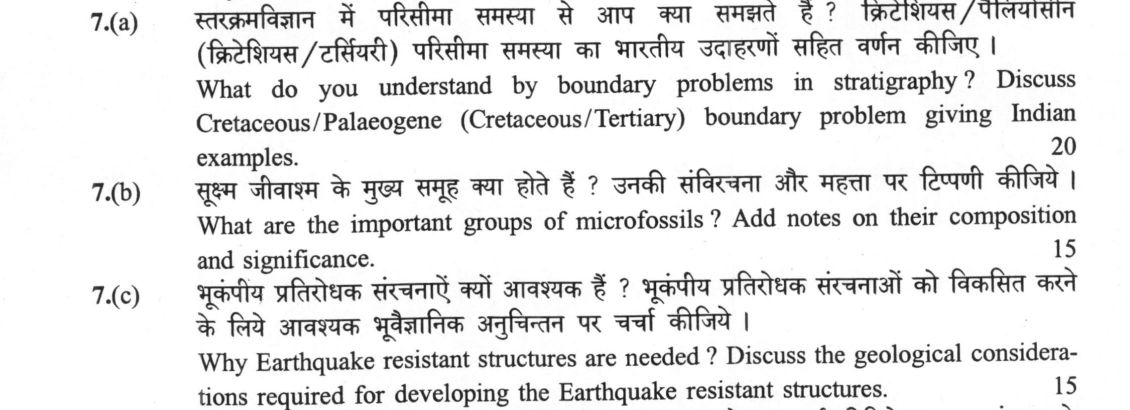
(a) What do you understand by boundary problems in stratigraphy ? Discuss Cretaceous/Palaeogene (Cretaceous/Tertiary) boundary…
What do you understand by boundary problems in stratigraphy ? Discuss Cretaceous/Palaeogene (Cretaceous/Tertiary) boundary problem giving Indian examples. 20 marks
What are the important groups of microfossils ? Add notes on their composition and significance. 15 marks
Why Earthquake resistant structures are needed ? Discuss the geological considerations required for developing the Earthquake resistant structures. 15 marks
हिंदी में प्रश्न पढ़ें
स्तरक्रमविज्ञान में परिसीमा समस्या से आप क्या समझते हैं ? क्रिटेशियस/पैलियोसीन (क्रिटेशियस/टर्सियरी) परिसीमा समस्या का भारतीय उदाहरणों सहित वर्णन कीजिए । (20 अंक)
सूक्ष्म जीवाश्म के मुख्य समूह क्या होते हैं ? उनकी संरचना और महत्ता पर टिप्पणी कीजिये । (15 अंक)
भूकंपीय प्रतिरोधक संरचनाएँ क्यों आवश्यक हैं ? भूकंपीय प्रतिरोधक संरचनाओं को विकसित करने के लिये आवश्यक भूवैज्ञानिक अनुचिंतन पर चर्चा कीजिये । (15 अंक)
Model answer
Written by UPSC Answer Check against this question's marking rubric, to the expected length. UPSC does not publish answers for Mains — this is one way to score well, not an official key.
Boundary problems and the K/Pg boundary. Boundary problems in stratigraphy occur where the rock record is incomplete, so that age, correlation and palaeoenvironmental interpretation become difficult. They include unconformities, angular or disconformable surfaces, hiatuses, diachronous facies changes, and biostratigraphic gaps caused by extinction, migration, or poor preservation. The Cretaceous/Palaeogene (K/Pg) boundary is a classic example because it marks a sharp global mass extinction at the end of the Cretaceous, with disappearance of non-avian dinosaurs, many marine reptiles, ammonites and planktonic foraminifera, and is recorded by an iridium anomaly, shocked quartz, microtektites, soot, and abrupt biostratigraphic turnover. In India, the boundary is preserved in several sections. The Um Sohryngkew River section in Meghalaya provides a well-studied K/Pg horizon with iridium enrichment and palaeontological evidence of extinction and recovery. The Anjar intertrappean beds in Kutch record the K/Pg interval within Deccan Trap volcanism, where intertrappean sediments, fossil floras and faunas and geochemical markers help constrain the timing of eruptions relative to extinction. The Rajahmundry traps in Andhra Pradesh similarly preserve intertrappean and boundary-related sediments with palynological and geochemical signatures that link the K/Pg crisis to Deccan volcanism. These sections show that the boundary problem is not merely a missing bed; it is a complex interface between volcanism, extinction, sedimentation and diachroneity.
Microfossils: groups, composition and significance. Microfossils are small fossils, usually microscopic, that are abundant, rapidly evolving and widely distributed, making them essential for stratigraphy. The important marine groups include Foraminifera, whose tests are mainly calcareous and sometimes agglutinated; Radiolaria, with siliceous tests; Ostracoda, small bivalved calcareous crustaceans; and Diatoms, with siliceous frustules. Calcareous foraminifera are especially useful in carbonate and mixed lithofacies, while siliceous radiolarians and diatoms are important in siliceous shales and deep-sea sediments; ostracoda are useful for palaeosalinity and shallow-marine correlation. Their composition controls preservation: calcareous tests dissolve below the carbonate compensation depth, whereas siliceous tests record opal compensation and paleoproductivity. Microfossils are significant biostratigraphically for age correlation and zonation, palaeoecologically for water depth, salinity, temperature and productivity, and economically in petroleum exploration for source-rock, reservoir and seal evaluation, basin analysis and hydrocarbon exploration. They also help reconstruct palaeoclimate and sea-level change.
Earthquake-resistant structures and geological considerations. Earthquake-resistant structures are needed because seismic shaking can cause ground failure, resonance, liquefaction, amplification and collapse, especially in populated and infrastructure-rich regions. India is divided into seismic zones II to V under BIS IS 1893, with Zone V indicating very high hazard and Zone II low hazard. Geological considerations must be site-specific. Soil type is critical: loose, saturated sands and silts may liquefy, while soft clays may amplify motion and settle. Bedrock depth controls site response; shallow bedrock generally transmits higher-frequency shaking, whereas thick soft cover can amplify long-period motion. Proximity to active faults requires avoidance of fault rupture zones, buffer distances, and special foundation design. Engineering-geological parameters such as shear wave velocity, standard penetration test values, bearing capacity, settlement, groundwater level and liquefaction potential must be assessed. Foundation recommendations vary: on competent bedrock, shallow foundations may be adequate with proper detailing; on soft or liquefiable soils, deep foundations such as piles should be used to transfer loads to competent strata; on faulted or highly liquefiable sites, ground improvement, drainage, seismic isolation or base isolation may be needed. Thus, earthquake-resistant design is not only structural engineering but also an applied geology problem.
Conclusion. The three issues are linked by the need to read the Earth accurately and apply that knowledge. Stratigraphic boundary problems, especially the K/Pg boundary, show how geochemical, palaeontological and sedimentological evidence must be integrated. Microfossils provide the tools for age, environment and basin interpretation. Geological site evaluation translates such understanding into hazard mitigation, ensuring that structures are placed and founded where the ground can safely carry them.
What "Discuss" is asking you to do
Lay the issue out from more than one side — how it arose, what is claimed for it, what is held against it, and where it now stands. UPSC attaches discuss to broad topics with several live dimensions, so coverage of the dimensions earns more than the strength of your opinion.
Structure that answers it
Set the issue up → the case as it is made → the case against → the dimension both sides leave out → where the balance now lies
Where marks are lost
Listing facts with no thread between them, or arguing one side throughout and calling it a discussion.
How this answer will be evaluated
Approach
Framework: Geology Paper 1: Define > Process > Field/Petrographic Evidence > Indian Example. (a) discuss: intro > 3-4 dimensions > example > balanced close | (b) describe: define > structure or process in order > labelled diagram > significance | (c) discuss: intro > 3-4 dimensions > example > balanced close Full marks: Precise definitions, specific Indian examples, clear causal chains, and accurate geological terminology.
Key points expected
- Define stratigraphic boundary problems (diachrony, unconformity)
- Identify K-Pg boundary as mass extinction event
- Mention iridium anomaly or impact evidence
- Cite specific Indian examples (e.g., Deccan Traps, K-Pg boundary in India)
- List key groups (e.g., Foraminifera, Radiolaria, Diatoms, Ostracods)
- State composition (e.g., calcareous, siliceous)
- Explain significance (biostratigraphy, paleoecology)
- Mention specific uses (e.g., oil exploration, climate change)
Evaluation rubric
Each sub-part is marked on its own, against the marks and word limit printed on the paper.
- (a) Define boundary problems and analyze the Cretaceous/Palaeogene (K-Pg) boundary with Indian examples. 20 marks
discuss— intro → 3-4 dimensions → example → balanced close
Must cover
- Define stratigraphic boundary problems (diachrony, unconformity)
- Identify K-Pg boundary as mass extinction event
- Mention iridium anomaly or impact evidence
- Cite specific Indian examples (e.g., Deccan Traps, K-Pg boundary in India)
Loses marks
- Generic description without Indian examples
- Confusing Cretaceous/Tertiary with other boundaries
- Missing the 'problem' aspect (diachrony/definition)
Earns more
- Mention Chicxulub crater
- Reference specific Indian formations (e.g., Kutch, Saurashtra)
- Discuss faunal turnover (ammonites, dinosaurs)
- Mention Deccan volcanism timing relative to impact
Extra mark
- Reference specific Indian stratigraphic sections (e.g., Kutch basin)
- Mention specific extinction percentages
- (b) List important microfossil groups and explain their composition and significance. 15 marks
describe— define → structure or process in order → labelled diagram → significance
Must cover
- List key groups (e.g., Foraminifera, Radiolaria, Diatoms, Ostracods)
- State composition (e.g., calcareous, siliceous)
- Explain significance (biostratigraphy, paleoecology)
- Mention specific uses (e.g., oil exploration, climate change)
Loses marks
- Listing groups without composition
- Missing significance (stratigraphic or paleoecological)
- Generic description without specific examples
Earns more
- Mention specific species or genera
- Discuss preservation and taphonomy
- Link to specific geological periods
- Mention specific Indian occurrences (e.g., Deccan, Kutch)
Extra mark
- Reference specific Indian microfossil studies
- Mention specific applications in Indian geology
- (c) Explain the need for earthquake-resistant structures and geological considerations for their development. 15 marks
discuss— intro → 3-4 dimensions → example → balanced close
Must cover
- State reasons for earthquake resistance (safety, economic loss)
- Identify geological considerations (seismic zones, soil type, fault proximity)
- Mention specific geological factors (e.g., liquefaction, amplification)
- Link to structural design (e.g., base isolation, damping)
Loses marks
- Generic description without geological specifics
- Missing the 'geological considerations' aspect
- Confusing earthquake resistance with other structural needs
Earns more
- Reference specific Indian seismic zones (e.g., Zone IV, V)
- Mention specific geological hazards (e.g., landslides, liquefaction)
- Discuss specific building codes (e.g., IS 1893)
- Mention specific Indian examples (e.g., 2001 Bhuj earthquake)
Extra mark
- Reference specific Indian seismic zones (e.g., Zone IV, V)
- Mention specific building codes (e.g., IS 1893)
Practice this exact question
Write your answer and it is marked point by point against the model answer above — what you covered, what you missed, what you got wrong.
Evaluate my answer →More from Geology 2025 Paper I
- Q4 (a) On the basis of dip isogons describe the classification of folds with neat diagrams.…
- Q5 Answer the following questions in about 150 words each: (a) Discuss favourable conditions…
- Q6 (a) Discuss the evolutionary lineage of Equidae and comment on its migration. (20 marks)…
- Q7 (a) What do you understand by boundary problems in stratigraphy ? Discuss Cretaceous/Pala…
- Q8 (a) Discuss the interrelationship amongst Porosity, Permeability and Hydraulic conductivi…