Paper I — Q6
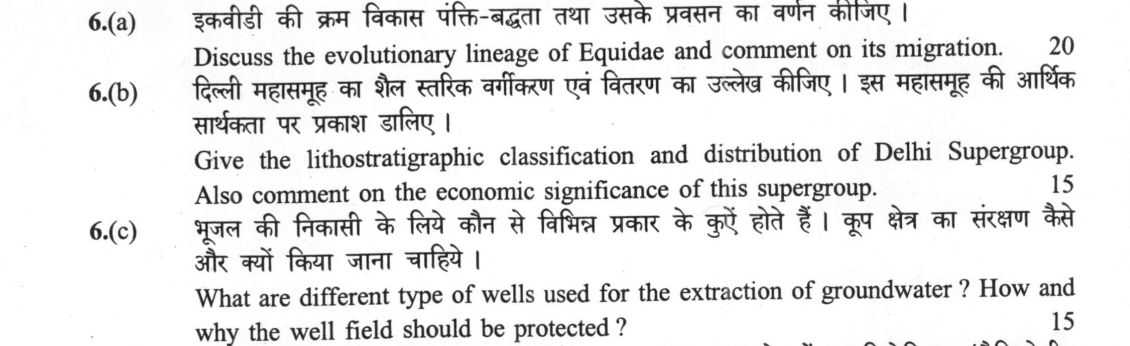
(a) Discuss the evolutionary lineage of Equidae and comment on its migration. (20 marks) (b) Give the lithostratigraphic…
Discuss the evolutionary lineage of Equidae and comment on its migration. 20 marks
Give the lithostratigraphic classification and distribution of Delhi Supergroup. Also comment on the economic significance of this supergroup. 15 marks
What are different type of wells used for the extraction of groundwater ? How and why the well field should be protected ? 15 marks
हिंदी में प्रश्न पढ़ें
इक्वीडी की क्रम विकास पंक्ति-बद्धता तथा उसके प्रवसन का वर्णन कीजिए । (20 अंक)
दिल्ली महासमूह का शैल स्तरीय वर्गीकरण एवं वितरण का उल्लेख कीजिए । इस महासमूह की आर्थिक सार्थकता पर प्रकाश डालिए । (15 अंक)
भूजल की निकासी के लिये कौन से विभिन्न प्रकार के कुएं होते हैं । कूप क्षेत्र का संरक्षण कैसे और क्यों किया जाना चाहिये । (15 अंक)
Model answer
Written by UPSC Answer Check against this question's marking rubric, to the expected length. UPSC does not publish answers for Mains — this is one way to score well, not an official key.
Equidae evolution and migration. The evolutionary lineage of Equidae is a classic example of adaptive radiation in response to changing vegetation and climate. It began in the Eocene of North America with small, forest-dwelling Hyracotherium/Eohippus, which had low-crowned brachydont teeth, four toes on the forefeet and three on the hindfeet, and a short body. Through the Oligocene and Miocene, forms such as Mesohippus and Merychippus show progressive reduction of lateral toes, lengthening of the limb, and increasing body size. This trend is often linked with Cope’s rule, understood not as a deterministic law but as a general tendency toward size increase over long evolutionary time. The adaptive significance was cursorial locomotion: a single functional hoof, longer limbs and efficient gait allowed faster running in open grasslands, while high-crowned hypsodont teeth evolved to withstand abrasive silica-rich grasses. By the Pliocene-Pleistocene, Equus was established, with the modern one-toed, grazing, high-crowned condition. Migration occurred mainly through the Bering land bridge into the Old World, where equids diversified in Eurasia and Africa. Hipparionine dispersal from North America into Eurasia is placed in the late Miocene, about 11–10 Ma, and later African stenonine zebras show a separate radiation in open habitats. In India, the Siwalik fossil record, especially the Gandak Formation of Nepal, preserves Equus sivalensis and Equus namadicus from the Pinjor stage, documenting the arrival and local evolution of equids in the Indian subcontinent.
Delhi Supergroup. The Delhi Supergroup is a Proterozoic sedimentary sequence exposed in the Delhi-Aravalli fold belt, especially in Delhi, Alwar, Jaipur and Ajmer. It is commonly divided into the older, predominantly arenaceous Alwar Group (quartzites, sandstones, shales) and the younger, calcareous-arenaceous Ajabgarh Group (limestones, sandstones, shales). In several Indian schemes the Raialo Group is recognised as a basal or locally important unit, particularly in the southern Aravalli, and must be considered in correlation. Its distribution is controlled by the Aravalli fold belt, where the rocks are folded and faulted, forming quartzite ridges and valleys. Economically, the Delhi Supergroup is significant for the Khetri copper belt, where copper mineralisation is hosted in its quartzites; for decorative stones, notably Alwar quartzite; and for groundwater storage in fractured quartzite aquifers. It should be distinguished from the neighbouring Aravalli/Bhilwara Supergroup, which hosts the Rajpura-Dariba and Zawar lead-zinc deposits and the Rampura-Agucha zinc-lead-silver deposits; these are often discussed in the same metallogenic province but are not Delhi Supergroup deposits.
Groundwater wells and well-field protection. Groundwater extraction uses well types matched to aquifer geometry. Dug wells are shallow hand-dug openings into unconfined aquifers, suited to low-yield domestic use. Shallow or deep tube wells are driven or bored into unconfined or confined aquifers where higher discharge is required. Artesian wells tap confined aquifers where water under pressure rises in the well. Infiltration galleries are horizontal collectors in shallow aquifers where the water table is near the surface. Radial collector wells combine a central well with radial ditches or tubes, giving larger capture and higher yield from shallow unconfined aquifers. Selection depends on aquifer type, depth to water, lithology, required discharge, and contamination risk. A well field, a group of wells drawing from one aquifer, must be protected for quantity and quality. Protection includes sanitary seals and casing, setback distances from contamination sources such as septic tanks, commonly at least 30 m, groundwater zoning with restricted discharge and land use, and artificial recharge structures such as percolation tanks, recharge pits and check dams. These measures prevent cone-of-depression interference, where excessive pumping lowers the water table, dries nearby wells and induces contamination, and in coastal areas prevent saline water intrusion into fresh aquifers. A way forward is to integrate evolutionary and stratigraphic evidence with aquifer zoning, recharge and monitoring, so that natural heritage and groundwater resources are managed sustainably.
What "Discuss" is asking you to do
Lay the issue out from more than one side — how it arose, what is claimed for it, what is held against it, and where it now stands. UPSC attaches discuss to broad topics with several live dimensions, so coverage of the dimensions earns more than the strength of your opinion.
Structure that answers it
Set the issue up → the case as it is made → the case against → the dimension both sides leave out → where the balance now lies
Where marks are lost
Listing facts with no thread between them, or arguing one side throughout and calling it a discussion.
How this answer will be evaluated
Approach
Framework: UPSC Geology Paper 1. (a) discuss: intro > 3-4 dimensions > example > balanced close | (b) describe: define > structure or process in order > labelled diagram > significance | (c) describe: define > structure or process in order > labelled diagram > significance Full marks: Precise technical detail with Indian examples, diagrams, and complete causal chains.
Key points expected
- Hypodactylus to Equus lineage sequence
- Tooth hypsodonty and cusp reduction
- Migration from North America to Eurasia
- Pliocene/Pleistocene faunal interchange
- Aravalli, Jaipur, and Delhi formations
- Distribution in Aravalli and Delhi basins
- Economic significance (iron, manganese, bauxite)
- Precambrian age context
Evaluation rubric
Each sub-part is marked on its own, against the marks and word limit printed on the paper.
- (a) Evolutionary lineage of Equidae and its migration. 20 marks
discuss— intro → 3-4 dimensions → example → balanced close
Must cover
- Hypodactylus to Equus lineage sequence
- Tooth hypsodonty and cusp reduction
- Migration from North America to Eurasia
- Pliocene/Pleistocene faunal interchange
Loses marks
- Generic mammal evolution without Equidae
- Missing migration component
Earns more
- Mesohippus and Merychippus stages
- Himalayan uplift effect on climate
- Indian fossil localities (e.g., Siwaliks)
Extra mark
- Sketch of tooth evolution
- Map of migration routes
- (b) Lithostratigraphic classification, distribution, and economic significance of Delhi Supergroup. 15 marks
describe— define → structure or process in order → labelled diagram → significance
Must cover
- Aravalli, Jaipur, and Delhi formations
- Distribution in Aravalli and Delhi basins
- Economic significance (iron, manganese, bauxite)
- Precambrian age context
Loses marks
- Generic Precambrian rocks without Delhi Supergroup
- Missing economic significance
Earns more
- Lithology of each formation
- Specific Indian mining locations
- Stratigraphic relationships
Extra mark
- Lithostratigraphic column sketch
- Map of distribution
- (c) Types of wells for groundwater extraction and well field protection. 15 marks
describe— define → structure or process in order → labelled diagram → significance
Must cover
- Dug, tube, and step wells
- Well field protection methods
- Reasons for protection (contamination, depletion)
- Groundwater extraction principles
Loses marks
- Generic wells without groundwater context
- Missing protection component
Earns more
- Well construction details
- Recharge protection measures
- Indian groundwater management context
Extra mark
- Well field layout sketch
- Specific Indian well field example
Practice this exact question
Write your answer and it is marked point by point against the model answer above — what you covered, what you missed, what you got wrong.
Evaluate my answer →More from Geology 2025 Paper I
- Q3 (a) Waves are responsible for modifying the coastal geomorphology. Justify the statement…
- Q4 (a) On the basis of dip isogons describe the classification of folds with neat diagrams.…
- Q5 Answer the following questions in about 150 words each: (a) Discuss favourable conditions…
- Q6 (a) Discuss the evolutionary lineage of Equidae and comment on its migration. (20 marks)…
- Q7 (a) What do you understand by boundary problems in stratigraphy ? Discuss Cretaceous/Pala…
- Q8 (a) Discuss the interrelationship amongst Porosity, Permeability and Hydraulic conductivi…