Paper I — Q5
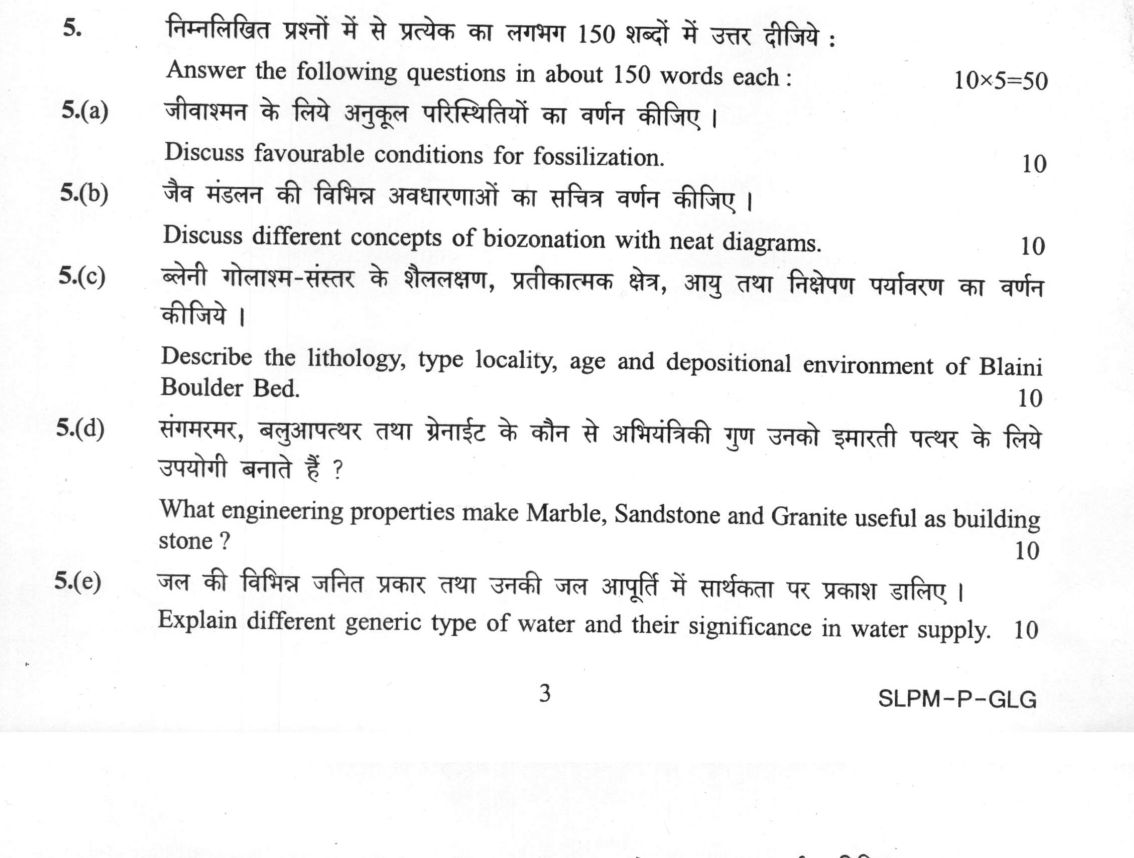
Answer the following questions in about 150 words each: (a) Discuss favourable conditions for fossilization. (10 marks) (b)…
Answer the following questions in about 150 words each: Discuss favourable conditions for fossilization. 10 marks
Discuss different concepts of biozonation with neat diagrams. 10 marks
Describe the lithology, type locality, age and depositional environment of Blaini Boulder Bed. 10 marks
What engineering properties make Marble, Sandstone and Granite useful as building stone ? 10 marks
Explain different generic type of water and their significance in water supply. 10 marks
हिंदी में प्रश्न पढ़ें
निम्नलिखित प्रश्नों में से प्रत्येक का लगभग 150 शब्दों में उत्तर दीजिये : जीवाश्मन के लिये अनुकूल परिस्थितियों का वर्णन कीजिए । (10 अंक)
जैव मंडलन की विभिन्न अवधारणाओं का सचित्र वर्णन कीजिए । (10 अंक)
ब्लैनी गोलाश्म-संस्तर के शैललक्षण, प्रतीकात्मक क्षेत्र, आयु तथा निक्षेपण पर्यावरण का वर्णन कीजिये । (10 अंक)
संगमरमर, बलुआपथर तथा ग्रेनाइट के कौन से अभियांत्रिकी गुण उनको इमारती पत्थर के लिये उपयोगी बनाते हैं ? (10 अंक)
जल की विभिन्न जनित प्रकार तथा उनकी जल आपूर्ति में सार्थकता पर प्रकाश डालिए । (10 अंक)
Model answer
Written by UPSC Answer Check against this question's marking rubric, to the 150-word length. UPSC does not publish answers for Mains — this is one way to score well, not an official key.
(a) Favourable Conditions for Fossilization
Fossilization requires a sequence of exceptional physical, chemical, and biological conditions to arrest the normal processes of organic decay.
The primary prerequisite is the possession of durable hard parts, such as mineralized skeletons, teeth, bones, or shells composed of calcite, aragonite, silica, or calcium phosphate. Soft-bodied organisms require extraordinary taphonomic conditions to be preserved.
Immediate post-mortem rapid burial by fine-grained clastic sediments is critical, as it shields the remains from predatory scavengers, mechanical fragmentation, and wave abrasion. Rapid sedimentation in quiet-water settings creates an anaerobic or dysaerobic microenvironment, severely curbing bacterial putrefaction and oxidation.
Physicochemical stability within the burial medium must be maintained to avoid diagenetic dissolution, high-grade metamorphism, or intense tectonic shearing that recrystallizes or pulverizes fossil matter. For instance, the mammalian skeletal remains of the Siwalik Group were rapidly buried under flood-basin silts, while carbonaceous macrofossils like Chuaria in the Vindhyan Supergroup survived due to anoxic conditions in quiescent, fine-grained shale basins.
`` [ Dead Organism ] ↓ (Rapid Burial) [ Anoxic / Low-Energy Mud ] ↓ (No Scavengers / Decay Arrested) [ Diagenetic Mineralization ] → FOSSIL ``
---
(b) Concepts of Biozonation
Biozonation utilizes fossil distributions to subdivide stratigraphic sections into distinct biostratigraphic units (biozones).
Taxon Range Zone: Represents the total stratigraphic and geographic range of occurrence of a single specified taxon between its first appearance datum (FAD) and last appearance datum (LAD).
Concurrent Range Zone: Defined by the overlapping stratigraphic range of two or more specified taxa, offering finer time resolution than individual range zones.
Assemblage Zone: Characterized by a distinctive association of three or more taxa occurring together, without requiring all components to be co-extensive.
Acme (Abundance) Zone: Marked by the maximum abundance or acme of a particular taxon, rather than its total range.
Oppel Zone: Characterized by an association of selected index species having overlapping concurrent ranges bounded by diagnostic FADs and LADs.
`` STRATIGRAPHIC BIOZONE SCHEMES: Strat. Height ▲ Species A Species B Species C │ |-----------| | │ |-----------| │ [ Concurrent Range Zone ] │ [======= Assemblage Zone ========] └────────────────────────────────────────► Taxa ``
These zones allow high-resolution inter-basinal correlation across variable sedimentary facies.
---
(c) Blaini Boulder Bed
The Blaini Boulder Bed is a key lithostratigraphic marker horizon in the Lesser Himalayan succession, reflecting Neoproterozoic palaeoclimatic shifts.
Lithology: It predominantly consists of diamictites (unsorted, non-stratified tillites) containing sub-angular to rounded, polished, and striated pebbles, cobbles, and boulders of quartzite, slate, and limestone set in a fine-grained, purplish to greenish-grey matrix of sandy to silty shale. It is capped by a distinct pink, thinly laminated cap carbonate.
Type Locality: Exposed prominently along the Blaini (Baliana) River section near Solan, and well developed across the Mussoorie and Krol synclines of Himachal Pradesh and Uttarakhand.
Age: Historically debated from Late Palaeozoic to Early Cambrian, current geochronological and isotopic data correlate it with the Cryogenian–Ediacaran transition (Terminal Neoproterozoic, ~635 Ma), representing the global Marinoan glaciation equivalent.
Depositional Environment: It represents a glaciomarine to periglacial dropstone facies deposited by floating ice shelves and calved icebergs into a shallow marine basin during a severe Snowball Earth glacial episode.
---
(d) Engineering Properties of Building Stones
The structural utility of building stones is governed by their mineralogical composition, texture, compressive strength, porosity, and environmental durability.
| Engineering Property | Granite | Sandstone | Marble | | :--- | :--- | :--- | :--- | | Rock Type & Texture | Plutonic igneous; interlocking crystalline | Sedimentary; clastic granular | Metamorphic; granoblastic (saccharoidal) | | Compressive Strength | High (100–250 MPa) | Moderate to High (20–170 MPa) | Moderate (70–140 MPa) | | Porosity & Water Absorption | Low porosity (<1%); absorption <0.5% | Porosity 5–25%; absorption 1.5–6% | Low porosity (<1.5%); absorption <0.5% | | Density (g/cm³) | 2.60–2.75 | 2.20–2.60 | 2.65–2.75 | | Workability & Polish | Difficult to dress; takes durable polish | High workability (freestone); lacks polish | Excellent dressability; takes high aesthetic polish | | Major Application | Heavy foundations, piers, exterior claddings | Structural masonry, monumental facades | Flooring, ornamental panels, interiors |
Granite provides superior mechanical strength and weathering resistance. Sandstone provides ease of dressing despite higher porosity, whereas marble offers aesthetic appeal, though it remains vulnerable to acidic chemical weathering.
---
(e) Generic Types of Water and Significance in Water Supply
Natural water is classified by origin into four genetic types, each exhibiting distinct quality and accessibility:
Meteoric Water: Originates from atmospheric precipitation (rain, snow) and infiltrates the subsurface. It is the primary dynamic, replenishable source for shallow unconfined aquifers, river baseflow, and domestic water supplies, characterized by low total dissolved solids (TDS).
Connate Water: Fossil water trapped in the pore spaces of sedimentary strata at the time of deposition. It is typically hyper-saline, mineralized, and associated with hydrocarbon reservoirs, rendering it unsuitable for potable or agricultural supply.
Juvenile Water: Primary magmatic water derived from the Earth's interior via mantle degassing, volcanic activity, or deep-seated hydrothermal springs. It contains high concentrations of dissolved salts and heavy metals, utilized primarily for geothermal energy and balneology.
Metamorphic Water: Released through dehydration reactions of hydrous minerals during regional orogenic metamorphism. Located at great depths, it plays a minor role in usable supplies.
Sustainable water management in India requires prioritising meteoric recharge, as excessive extraction exposes vulnerable alluvial and fractured hard-rock aquifers to mineralisation and depletion.
What "Discuss" is asking you to do
Lay the issue out from more than one side — how it arose, what is claimed for it, what is held against it, and where it now stands. UPSC attaches discuss to broad topics with several live dimensions, so coverage of the dimensions earns more than the strength of your opinion.
Structure that answers it
Set the issue up → the case as it is made → the case against → the dimension both sides leave out → where the balance now lies
Where marks are lost
Listing facts with no thread between them, or arguing one side throughout and calling it a discussion.
How this answer will be evaluated
Approach
Framework: Geology Paper 1: Define > Process > Field/Petrographic Evidence > Indian Example. (a) discuss: intro > 3-4 dimensions > example > balanced close | (b) discuss: intro > 3-4 dimensions > example > balanced close | (c) describe: define > structure or process in order > labelled diagram > significance | (d) explain: definition/context > points in order > small example > short close | (e) explain: definition/context > points in order > small example > short close Full marks: Precise definitions, specific Indian examples, clear diagrams, correct engineering properties
Key points expected
- Rapid burial in anoxic environment
- Presence of hard parts (mineralization)
- Quiescent water conditions
- Absence of scavengers
- Definition of range zone
- Definition of interval zone
- Definition of abundance zone
- Neat diagram of zone types
Evaluation rubric
Each sub-part is marked on its own, against the marks and word limit printed on the paper.
- (a) Intro > 3-4 dimensions of fossilization > example > balanced close 10 marks · 150 words
discuss— intro → 3-4 dimensions → example → balanced close
Must cover
- Rapid burial in anoxic environment
- Presence of hard parts (mineralization)
- Quiescent water conditions
- Absence of scavengers
Loses marks
- Generic description without specific conditions
- Confusing fossilization with diagenesis
Earns more
- Mention of permineralization or replacement
- Reference to Lagerstätten
- Distinction between body and trace fossils
Extra mark
- Named Indian fossil site (e.g., Bhima, Kutch)
- Specific taphonomic process (e.g., adpression)
- (b) Intro > 3-4 dimensions of biozonation > example > balanced close 10 marks · 150 words
discuss— intro → 3-4 dimensions → example → balanced close
Must cover
- Definition of range zone
- Definition of interval zone
- Definition of abundance zone
- Neat diagram of zone types
Loses marks
- Missing diagrams
- Confusing biozones with lithostratigraphic units
Earns more
- Mention of association zone
- Link to biostratigraphic correlation
- Example of index fossil
Extra mark
- Specific Indian biozone (e.g., Vindhyan)
- Reference to specific index taxa
- (c) Define > structure/process in order > labelled diagram > significance 10 marks · 150 words
describe— define → structure or process in order → labelled diagram → significance
Must cover
- Lithology: conglomerate with boulders
- Type locality: Blaini, Jammu
- Age: Late Eocene (Priabonian)
- Depositional environment: alluvial fan
Loses marks
- Wrong age (e.g., Oligocene)
- Confusing with Siwalik formation
Earns more
- Mention of matrix composition
- Reference to tectonic setting (Himalayan orogeny)
- Stratigraphic position (below Siwalik)
Extra mark
- Specific boulder lithology (e.g., quartzite)
- Reference to specific section (e.g., Tawi)
- (d) Definition/context > points in order > small example > short close 10 marks · 150 words
explain— definition/context → points in order → small example → short close
Must cover
- Marble: compressive strength, durability
- Sandstone: porosity, workability
- Granite: hardness, weathering resistance
- Comparison of engineering properties
Loses marks
- Generic description without specific properties
- Confusing building stone with aggregate
Earns more
- Mention of specific Indian quarries
- Reference to specific building applications
- Discussion of aesthetic properties
Extra mark
- Specific Indian marble (e.g., Makrana)
- Specific Indian granite (e.g., Khambhal)
- (e) Definition/context > points in order > small example > short close 10 marks · 150 words
explain— definition/context → points in order → small example → short close
Must cover
- Surface water (rivers, lakes)
- Groundwater (aquifers)
- Significance in water supply
- Comparison of sources
Loses marks
- Generic description without specific types
- Confusing water supply with water treatment
Earns more
- Mention of specific Indian water sources
- Reference to water quality issues
- Discussion of water management
Extra mark
- Specific Indian river (e.g., Ganga)
- Specific Indian aquifer (e.g., Deccan)
Practice this exact question
Write your answer and it is marked point by point against the model answer above — what you covered, what you missed, what you got wrong.
Evaluate my answer →More from Geology 2025 Paper I
- Q2 (a) What do you understand by continental drift ? Discuss various geological evidences in…
- Q3 (a) Waves are responsible for modifying the coastal geomorphology. Justify the statement…
- Q4 (a) On the basis of dip isogons describe the classification of folds with neat diagrams.…
- Q5 Answer the following questions in about 150 words each: (a) Discuss favourable conditions…
- Q6 (a) Discuss the evolutionary lineage of Equidae and comment on its migration. (20 marks)…
- Q7 (a) What do you understand by boundary problems in stratigraphy ? Discuss Cretaceous/Pala…
- Q8 (a) Discuss the interrelationship amongst Porosity, Permeability and Hydraulic conductivi…