Paper I — Q4
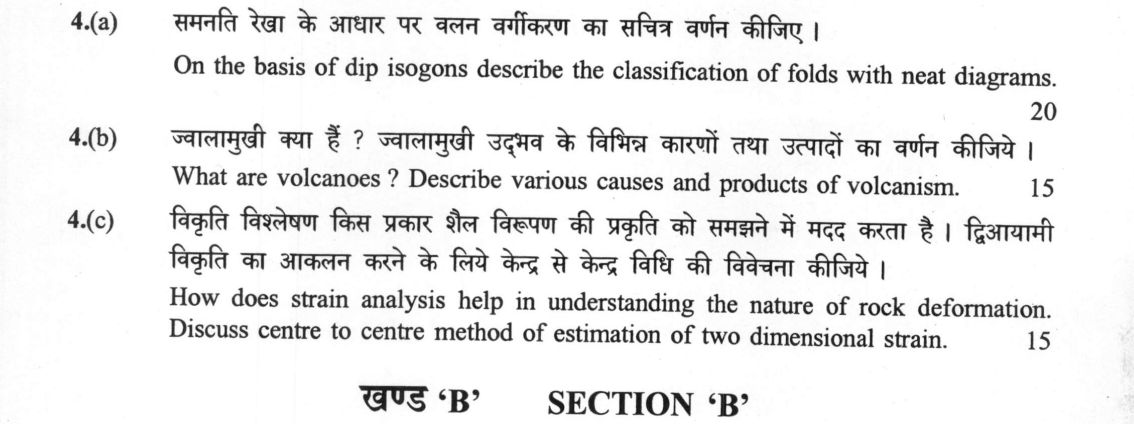
(a) On the basis of dip isogons describe the classification of folds with neat diagrams. (20 marks) (b) What are volcanoes ?…
On the basis of dip isogons describe the classification of folds with neat diagrams. 20 marks
What are volcanoes ? Describe various causes and products of volcanism. 15 marks
How does strain analysis help in understanding the nature of rock deformation. Discuss centre to centre method of estimation of two dimensional strain. 15 marks
हिंदी में प्रश्न पढ़ें
समनति रेखा के आधार पर वलन वर्गीकरण का सचित्र वर्णन कीजिए । (20 अंक)
ज्वालामुखी क्या है ? ज्वालामुखी उद्भव के विभिन्न कारणों तथा उत्पादों का वर्णन कीजिये । (15 अंक)
विकृति विश्लेषण किस प्रकार शैल विक्षेपण की प्रकृति को समझने में मदद करता है । द्विआयामी विकृति का आकलन करने के लिये केन्द्र से केन्द्र विधि की विवेचना कीजिये । (15 अंक)
Model answer
Written by UPSC Answer Check against this question's marking rubric, to the expected length. UPSC does not publish answers for Mains — this is one way to score well, not an official key.
Dip Isogon Classification of Folds
A dip isogon is a line connecting points of equal dip on the outer and inner bounding surfaces of a folded layer. J.G. Ramsay classified folds into three main classes based on the convergence, parallelism, or divergence of dip isogons drawn between bounding surfaces, utilizing tangent diagrams to analyze orthogonal thickness (t_α) and thickness parallel to the axial surface (T_α).
`` Class 1: Convergent Class 2: Parallel Class 3: Divergent | / | | | / | \ | / | | | / | \ (1A, 1B, 1C) (Similar) (Thick hinges) ``
Class 1 features dip isogons that converge towards the core of the fold, where the curvature of the outer arc is less than that of the inner arc. Class 1A exhibits strongly convergent isogons where orthogonal thickness at the limbs exceeds that at the hinge (t_α > t₀). Class 1B comprises parallel folds with orthogonal thickness remaining constant throughout (t_α = t₀), typically produced by flexural slip or buckling of competent layers. Class 1C shows weakly convergent isogons with moderate limb thinning (t_α < t₀), representing buckling modified by subsequent homogeneous flattening.
Class 2 comprises similar folds with parallel dip isogons across the profile. Here, T_α remains constant (T_α = T₀), and t_α = t₀ cosα. These develop via passive slip or intense pure shear flattening of incompetent multilayers.
Class 3 folds display divergent dip isogons towards the inner arc, where the curvature of the outer arc is greater than that of the inner arc. The limbs are markedly thinned relative to the hinge zone (t_α ll t₀). These folds form in incompetent layers interbedded between competent layers during buckling.
Volcanoes: Causes and Products
A volcano is a vent or fissure in the crust through which magma, gases, and pyroclastic materials erupt onto the surface. Volcanism is primarily driven by three geodynamic settings: decompression melting at divergent margins and continental rifting (such as the East African Rift), flux melting induced by water release from subducting oceanic slabs (such as the Barren Island arc in the Andaman Sea), and thermal upwelling via deep mantle plumes generating intraplate hotspot volcanism (as observed in the Reunion plume responsible for the Deccan Traps).
The products of volcanism comprise:
- Liquid products: Effusive lava flows ranging from low-viscosity, mafic pahoehoe and aa lavas to high-viscosity, felsic rhyolitic domes.
- Solid/pyroclastic products: Tephra generated by explosive fragmentation, categorized by particle size into volcanic ash, lapilli, volcanic blocks, and aerodynamically shaped volcanic bombs.
- Volatile products: Gases dominated by water vapor (H_2O), carbon dioxide (CO₂), sulfur dioxide (SO₂), hydrogen sulfide (H_2S), and halogen compounds.
- Hypabyssal intrusive bodies: Sub-volcanic feeder dykes, sills, and volcanic necks left as conduits solidify.
Strain Analysis and the Centre-to-Centre Method
Strain analysis quantifies the magnitude, geometry, and orientation of finite deformation in rocks. It helps identify the deformation regime (coaxial versus non-coaxial), orient the finite strain ellipsoid axes (X ≥ Y ≥ Z), and estimate the kinematic vorticity number (Wₖ) to differentiate pure shear from simple shear.
`` Fry Plot Construction: +---------------------+ | | Outer field of points | .-----. | | ( Rs ) | Empty central strain ellipse | '-----' | | | +---------------------+ ``
The centre-to-centre method, formalized as the Fry method, estimates two-dimensional finite strain (Rₛ) from statistically anticlustered, quasi-isotropic aggregates of rigid or deformable markers such as ooliths, sand grains, and reduction spots. Assuming an originally uniform distribution with an isotropic nearest-neighbor distance:
- The center of each marker on a polished thin section or rock slab is marked on an overlay sheet.
- The origin of a transparent grid is sequentially placed over the center of each object, and the relative positions of all neighboring centers are replotted on the sheet.
- As points accumulate, an elliptical vacancy (the "strain ellipse") appears at the core, devoid of plotted points.
- The aspect ratio of this central empty field directly yields the finite two-dimensional strain ratio (Rₛ = √(λ₁/λ₂)), while the orientation of its long axis defines the principal extension direction (X).
The method is limited by the requirement of initial isotropic spatial distribution, susceptibility to primary sedimentary fabrics, and marking errors in highly deformed or recrystallized fabrics.
Together, fold geometry, volcanic products, and finite strain markers provide an integrated record for reconstructing the kinematic and dynamic evolution of the crust.
What "Describe" is asking you to do
Give a full, ordered account of the thing named — its parts, stages or mechanism — in the sequence in which it actually exists or occurs. Most describe questions come from the science optionals, where the marks sit in correct technical detail and, where the stem says so, a labelled diagram.
Structure that answers it
One-line identification of the subject → the parts or stages in their real order, each with its defining detail → labelled diagram where the subject is structural → closing line on function or significance
Where marks are lost
Loose general prose where the examiner is ticking named parts, correct terminology and their sequence; and in the General Studies papers, turning to evaluation before the description is finished.
How this answer will be evaluated
Approach
Framework: Geology Paper 1: Define > Process > Field/Petrographic Evidence > Indian Example. (a) describe: define > structure or process in order > labelled diagram > significance | (b) describe: define > structure or process in order > labelled diagram > significance | (c) discuss: intro > 3-4 dimensions > example > balanced close Full marks: Comprehensive, accurate, and well-illustrated with Indian examples and precise terminology.
Key points expected
- Define dip isogons and their role in fold classification
- Classify folds: Symmetrical, Asymmetrical, Monoclinal, Recumbent
- Provide neat, labelled diagrams for each fold type
- Explain the relationship between isogon spacing and fold tightness
- Define volcanoes and their basic structure
- Describe various causes of volcanism (plate tectonics, hotspots)
- List and describe products of volcanism (lava, ash, gases)
- Provide a diagram of a typical volcano structure
Evaluation rubric
Each sub-part is marked on its own, against the marks and word limit printed on the paper.
- (a) Classification of folds based on dip isogons with diagrams. 20 marks
describe— define → structure or process in order → labelled diagram → significance
Must cover
- Define dip isogons and their role in fold classification
- Classify folds: Symmetrical, Asymmetrical, Monoclinal, Recumbent
- Provide neat, labelled diagrams for each fold type
- Explain the relationship between isogon spacing and fold tightness
Loses marks
- Missing or unclear diagrams
- Confusing dip isogons with strike isogons
- Generic description without specific fold types
Earns more
- Mention specific Indian fold examples (e.g., Narmada-Son lineament)
- Discuss the significance of isogon convergence in structural analysis
- Include a table summarizing fold types and isogon patterns
Extra mark
- Reference specific Indian craton or basin with fold structures
- Include a 3D block diagram illustrating fold geometry
- (b) Definition of volcanoes, causes, and products of volcanism. 15 marks
describe— define → structure or process in order → labelled diagram → significance
Must cover
- Define volcanoes and their basic structure
- Describe various causes of volcanism (plate tectonics, hotspots)
- List and describe products of volcanism (lava, ash, gases)
- Provide a diagram of a typical volcano structure
Loses marks
- Missing diagram of volcano structure
- Confusing volcanic and plutonic processes
- Generic description without specific causes or products
Earns more
- Mention specific Indian volcanic occurrences (e.g., Deccan Traps)
- Discuss the economic importance of volcanic products
- Include a phase diagram of magma differentiation
Extra mark
- Reference specific Indian volcanic formation with stratigraphic age
- Include a map showing global and Indian volcanic belts
- (c) Role of strain analysis in rock deformation and centre-to-centre method. 15 marks
discuss— intro → 3-4 dimensions → example → balanced close
Must cover
- Explain how strain analysis helps understand rock deformation
- Describe the centre-to-centre method for 2D strain estimation
- Provide a step-by-step procedure for the centre-to-centre method
- Include a diagram illustrating the method
Loses marks
- Missing diagram of the centre-to-centre method
- Confusing strain with stress
- Generic description without specific method details
Earns more
- Mention specific Indian geological formations where strain analysis is applied
- Discuss the limitations of the centre-to-centre method
- Include a table comparing different strain estimation methods
Extra mark
- Reference specific Indian craton or basin with strain analysis data
- Include a mathematical derivation of the strain tensor
Practice this exact question
Write your answer and it is marked point by point against the model answer above — what you covered, what you missed, what you got wrong.
Evaluate my answer →More from Geology 2025 Paper I
- Q1 Answer the following questions in about 150 words each: (a) Discuss the position of Astro…
- Q2 (a) What do you understand by continental drift ? Discuss various geological evidences in…
- Q3 (a) Waves are responsible for modifying the coastal geomorphology. Justify the statement…
- Q4 (a) On the basis of dip isogons describe the classification of folds with neat diagrams.…
- Q5 Answer the following questions in about 150 words each: (a) Discuss favourable conditions…
- Q6 (a) Discuss the evolutionary lineage of Equidae and comment on its migration. (20 marks)…
- Q7 (a) What do you understand by boundary problems in stratigraphy ? Discuss Cretaceous/Pala…