Paper II — Q1
Answer the following questions in about 150 words each: (a) Describe the symmetry elements shown by the normal class of the…
Answer the following questions in about 150 words each:
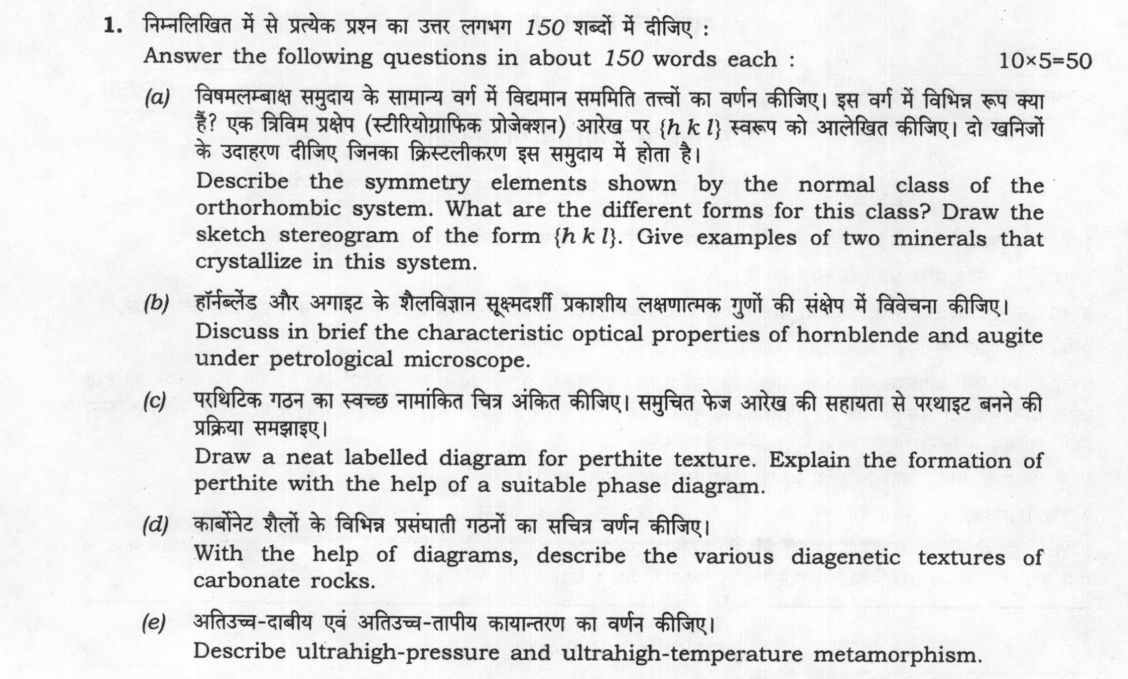
Describe the symmetry elements shown by the normal class of the orthorhombic system. What are the different forms for this class? Draw the sketch stereogram of the form {h k l}. Give examples of two minerals that crystallize in this system. 10 marks
Discuss in brief the characteristic optical properties of hornblende and augite under petrological microscope. 10 marks
Draw a neat labelled diagram for perthite texture. Explain the formation of perthite with the help of a suitable phase diagram. 10 marks
With the help of diagrams, describe the various diagenetic textures of carbonate rocks. 10 marks
Describe ultrahigh-pressure and ultrahigh-temperature metamorphism. 10 marks
हिंदी में प्रश्न पढ़ें
निम्नलिखित में से प्रत्येक प्रश्न का उत्तर लगभग 150 शब्दों में दीजिए :
विषमलम्बाक्ष समुदाय के सामान्य वर्ग में विद्यमान सममिति तत्त्वों का वर्णन कीजिए। इस वर्ग में विभिन्न रूप क्या हैं? एक विविम प्रक्षेप (स्टीरियोग्राफिक प्रोजेक्शन) आरेख पर {h k l} स्वरूप को आलेखित कीजिए। दो खनिजों के उदाहरण दीजिए जिनका क्रिस्टलीकरण इस समुदाय में होता है। (10 अंक)
हॉर्नब्लेंड और अगाइट के शैलविज्ञान सूक्ष्मदर्शी प्रकाशीय लक्षणात्मक गुणों की संक्षेप में विवेचना कीजिए। (10 अंक)
परथिटिक गठन का स्वच्छ नामांकित चित्र अंकित कीजिए। समुचित फेज आरेख की सहायता से परथाइट बनने की प्रक्रिया समझाइए। (10 अंक)
कार्बोनेट शैलों के विभिन्न प्रसंयाती गठनों का सचित्र वर्णन कीजिए। (10 अंक)
अतिउच्च-दाबीय एवं अतिउच्च-तापीय कायांतरण का वर्णन कीजिए। (10 अंक)
Model answer
Written by UPSC Answer Check against this question's marking rubric, to the 150-word length. UPSC does not publish answers for Mains — this is one way to score well, not an official key.
(a) Orthorhombic normal class. The normal class of the orthorhombic system is 2/m 2/m 2/m (or mmm). It is the holosymmetric class, so all crystal faces occur in symmetrically equivalent pairs. It is the most symmetric orthorhombic class. It has three mutually perpendicular twofold axes (3L2), three mirror planes (3P), and a centre of symmetry (C). The axes a, b and c are unequal and mutually perpendicular. The characteristic forms are pinacoid {h00}, prism {0kl}, dome {h0l}, and pyramid {hkl}. In a sketch stereogram of the general form {hkl}, the class mmm gives eight distinct poles: four in the upper hemisphere and four in the lower hemisphere. The sketch would show them as eight symmetrically placed points. The lower-hemisphere poles do not coincide with the upper-hemisphere poles; they are related by the centre of symmetry and by the three mirror planes. The poles are arranged symmetrically about the three twofold axes. Minerals that crystallize in this system include olivine, andalusite, barite, and topaz.
(b) Optical properties of hornblende and augite. Under the petrological microscope, hornblende and augite are distinguished by relief, cleavage, extinction and colour. Hornblende is an amphibole; it shows moderate relief, two cleavages, and inclined extinction of about 10-25° to the cleavage traces. It is strongly pleochroic, commonly passing from green to brown. Augite is a clinopyroxene; it shows high relief, two cleavages, and symmetric extinction. It has little or no pleochroism, and its cleavage/optic orientation is commonly described by a 45° angle, Z∧c ≈ 45°. In cross-polarised light, hornblende’s green-brown pleochroism is readily visible, whereas augite remains nearly colourless. Both minerals show two cleavage directions, but the extinction angle and pleochroism are the most useful diagnostic features. Augite’s higher relief makes its grain boundaries sharper, while hornblende’s inclined extinction is a key distinction in thin section for identification. These properties help identify them in igneous and metamorphic rocks.
(c) Perthite texture and formation. Perthite is an intergrowth in which alkali feldspar is the host and plagioclase occurs as exsolved lamellae; antiperthite is the reverse, with plagioclase host and alkali feldspar lamellae. A neat labelled diagram would show a host alkali feldspar grain containing thin, regularly spaced plagioclase lamellae, with labels for host, exsolution lamellae, and, if present, mesoperthite-scale lamellae. The formation is explained by the Ab-Or phase diagram. At high temperature, albite and orthoclase form a solid solution. On cooling, the composition enters the solvus, the miscibility gap, below about 700 °C. The homogeneous feldspar becomes unstable and separates into two feldspar phases. Slow cooling gives coarser mesoperthite lamellae, while rapid cooling gives finer cryptoperthite. The phase diagram would show the single-phase feldspar field above the solvus and the two-phase feldspar field below it, with a cooling path crossing the solvus. This exsolution records the cooling history of granitic rocks.
(d) Diagenetic textures of carbonate rocks. A labelled diagram of carbonate diagenesis would show grains and cements modified after deposition. Micrite envelopes are thin carbonate mud coatings around grains; micritization is the replacement or infilling of grains by micrite. Hardgrounds are cemented, erosion-resistant surfaces. Intraclasts are fragments of earlier carbonate sediment, and peloids are mud clots. Ooids may show diagenetic overgrowths. Cementation includes syntaxial overgrowths, where new calcite grows with the same crystal orientation as the host grain, and epitaxial cements, where new crystals grow with a different orientation. Pressure solution produces stylolites and sutured grain contacts, where soluble material is removed along grain boundaries. The diagram would label an ooid with micrite envelope, an intraclast, a peloid, syntaxial cement, and a stylolite. These features help distinguish marine, shallow-water, and burial diagenetic environments. They also indicate compaction, cementation, and fluid flow during burial. Such textures are common in limestones and dolostones.
(e) Ultrahigh-pressure and ultrahigh-temperature metamorphism. Ultrahigh-pressure metamorphism occurs at pressures above 2.5-4 GPa and temperatures of 600-800 °C, within the blueschist to eclogite facies. Its diagnostic assemblages include coesite and diamond, minerals stable only at such high pressures. These rocks record rapid subduction of crustal material to mantle depths and later exhumation. Ultrahigh-temperature metamorphism occurs at temperatures above 900 °C, up to 1050 °C, at pressures of 0.5-1.2 GPa, in the granulite facies. Characteristic assemblages include osumilite, sapphirine, and spinel plus quartz. UHT rocks record intense heating of the lower crust, often associated with mantle-derived magmatism or deep crustal extension. Both UHP and UHT metamorphism indicate extreme tectonic processes, but UHP reflects very high pressure with moderate temperature, while UHT reflects very high temperature at lower pressure. Such assemblages are used to reconstruct P-T paths and tectonic settings. They are important for understanding plate convergence, crustal recycling, and thermal structure. Their preservation requires fast exhumation and limited retrogression.
What "Describe" is asking you to do
Give a full, ordered account of the thing named — its parts, stages or mechanism — in the sequence in which it actually exists or occurs. Most describe questions come from the science optionals, where the marks sit in correct technical detail and, where the stem says so, a labelled diagram.
Structure that answers it
One-line identification of the subject → the parts or stages in their real order, each with its defining detail → labelled diagram where the subject is structural → closing line on function or significance
Where marks are lost
Loose general prose where the examiner is ticking named parts, correct terminology and their sequence; and in the General Studies papers, turning to evaluation before the description is finished.
How this answer will be evaluated
Approach
Framework: Geology, Paper 2. (a) describe: define > structure or process in order > labelled diagram > significance | (b) discuss: intro > 3-4 dimensions > example > balanced close | (c) explain: definition/context > points in order > small example > short close | (d) describe: define > structure or process in order > labelled diagram > significance | (e) describe: define > structure or process in order > labelled diagram > significance Full marks: Precise technical terms, correct diagrams, Indian examples, clear causal chains.
Key points expected
- List 3 mirror planes and 3 2-fold axes
- Identify class as 2/m 2/m 2/m
- Draw stereogram of {h k l} form
- Name two orthorhombic minerals
- Compare pleochroism (green vs brown)
- State 2V angle for both
- Describe cleavage angles (56/124 vs 87/93)
- Mention interference colors
Evaluation rubric
Each sub-part is marked on its own, against the marks and word limit printed on the paper.
- (a) Symmetry elements, forms, and stereogram of normal orthorhombic class. · 150 words
describe— define → structure or process in order → labelled diagram → significance
Must cover
- List 3 mirror planes and 3 2-fold axes
- Identify class as 2/m 2/m 2/m
- Draw stereogram of {h k l} form
- Name two orthorhombic minerals
Loses marks
- Confusing with monoclinic symmetry
- Missing stereogram sketch
Earns more
- Mention specific forms like prism or pinacoid
- Correct orientation of axes in sketch
Extra mark
- Mention specific Indian orthorhombic deposit
- (b) Optical properties of hornblende and augite under microscope. · 150 words
discuss— intro → 3-4 dimensions → example → balanced close
Must cover
- Compare pleochroism (green vs brown)
- State 2V angle for both
- Describe cleavage angles (56/124 vs 87/93)
- Mention interference colors
Loses marks
- Confusing augite with diopside
- Missing 2V values
Earns more
- Mention specific extinction angles
- Describe twinning in augite
Extra mark
- Link to specific Indian basalt formation
- (c) Diagram of perthite and its formation via phase diagram. · 150 words
explain— definition/context → points in order → small example → short close
Must cover
- Draw labelled perthite texture diagram
- Show exsolution process
- Use K-Na feldspar phase diagram
- Explain cooling rate effect
Loses marks
- Missing phase diagram
- Confusing with myrmekite
Earns more
- Distinguish antiperthite if relevant
- Mention specific grain size
Extra mark
- Mention specific Indian granitic occurrence
- (d) Diagenetic textures of carbonate rocks with diagrams. · 150 words
describe— define → structure or process in order → labelled diagram → significance
Must cover
- Describe neomorphism
- Describe cementation types
- Describe dolomitization
- Provide labelled diagrams
Loses marks
- Missing diagrams
- Confusing with metamorphic textures
Earns more
- Mention specific cement types (calcite, dolomite)
- Describe stylolites
Extra mark
- Mention specific Indian carbonate basin
- (e) Ultrahigh-pressure and ultrahigh-temperature metamorphism. · 150 words
describe— define → structure or process in order → labelled diagram → significance
Must cover
- Define UHP conditions (>2.5 GPa)
- Define UHT conditions (>750°C)
- Mention index minerals (coesite, diamond)
- Explain tectonic setting
Loses marks
- Confusing with high-pressure metamorphism
- Missing index minerals
Earns more
- Mention specific UHP terranes
- Describe exhumation processes
Extra mark
- Mention specific Indian UHP occurrence
Practice this exact question
Write your answer and it is marked point by point against the model answer above — what you covered, what you missed, what you got wrong.
Evaluate my answer →More from Geology 2025 Paper II
- Q1 Answer the following questions in about 150 words each: (a) Describe the symmetry element…
- Q2 (a) Give a detailed account related to the classification of crystals into different crys…
- Q3 (a) What are migmatites? Describe the important types of migmatites and the processes of…
- Q4 (a) Discuss the genesis of any four sedimentary structures which are helpful in palaeocur…