Paper II — Q7
(a) Discuss the direct and indirect geochemical methods used for prospecting of hydrocarbon deposits. (20 marks) (b) What are…
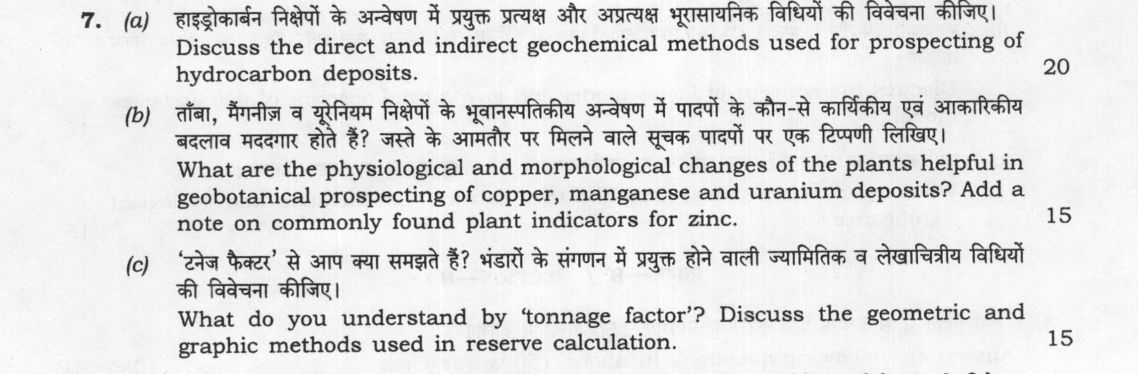
Discuss the direct and indirect geochemical methods used for prospecting of hydrocarbon deposits. 20 marks
What are the physiological and morphological changes of the plants helpful in geobotanical prospecting of copper, manganese and uranium deposits? Add a note on commonly found plant indicators for zinc. 15 marks
What do you understand by 'tonnage factor'? Discuss the geometric and graphic methods used in reserve calculation. 15 marks
हिंदी में प्रश्न पढ़ें
हाइड्रोकार्बन निक्षेपों के अन्वेषण में प्रयुक्त प्रत्यक्ष और अप्रत्यक्ष भूरसायनिक विधियों की विवेचना कीजिए। (20 अंक)
तांबा, मैंगनीज व युरेनियम निक्षेपों के भूवनस्पतिकीय अन्वेषण में पादपों के कौन-से कार्यिकीय एवं आकारिकीय बदलाव मददगार होते हैं? जस्ते के आमतौर पर मिलने वाले सूचक पादपों पर एक टिप्पणी लिखिए। (15 अंक)
'टनेज फैक्टर' से आप क्या समझते हैं? भंडारों के संगणन में प्रयुक्त होने वाली ज्यामितिक व लेखाचित्रीय विधियों की विवेचना कीजिए। (15 अंक)
Model answer
Written by UPSC Answer Check against this question's marking rubric, to the expected length. UPSC does not publish answers for Mains — this is one way to score well, not an official key.
Hydrocarbon geochemical prospecting operates on the principle that volatile light hydrocarbons migrate vertically via microseepage from deep subsurface reservoirs to the surface, creating both direct hydrocarbon concentrations and secondary physicochemical alterations in overlying soils and rocks.
Direct Geochemical Methods Direct methods measure upward-migrated light hydrocarbons (C₁–C₅) directly from soil, groundwater, or shallow sediments. Free soil gas analysis extracts interstitial vapors for headspace gas chromatographic analysis. Acid extraction desorbs carbonate-bound or clay-adsorbed hydrocarbons from soil samples, yielding high-resolution anomalies of thermogenic gas. Microbial Prospecting for Oil and Gas (MPOG) detects anomalous populations of specialized hydrocarbon-oxidizing bacteria (such as Mycobacterium and Pseudomonas) that thrive on seeping alkanes. These techniques have been successfully applied across India in the Cambay Basin, Assam-Arakan fold belt, and the Krishna-Godavari (KG) onland areas by the Oil and Natural Gas Corporation (ONGC).
Indirect Geochemical Methods Hydrocarbon chimneys generate localized reducing environments that alter the redox potential (Eh) and pH of near-surface strata. Trace element halos develop as mobile elements precipitate under reduced conditions, creating characteristic iodine, vanadium, and uranium anomalies. Radiometric surveys detect potassium, uranium, and thorium lows resulting from the leaching of radioactive salts in the seepage column. Furthermore, microseepage-induced reduction of ferric iron produces diagenetic minerals like pyrite, greigite, and magnetite, which manifest as near-surface geomagnetic and electrical conductivity anomalies.
Geobotanical Prospecting for Cu, Mn, and U Plants growing over metalliferous substrates undergo diagnostic physiological and morphological changes driven by toxicity, altered enzyme activity, and nutrient competition.
For copper, excess metal induces iron deficiency, causing interveinal chlorosis, stunted shoot growth, leaf size reduction, and root truncation. The classic universal indicator is Aeolanthus biformifolius (the copper flower), alongside regional indicators like Becium homblei. Manganese toxicity disrupts chlorophyll synthesis and activates destructive auxin oxidases, producing crinkling of leaves, marginal necrotic spotting, and stem deformation; the hyperaccumulator tree Macadamia neurophylla tolerates extreme manganese levels. Uranium deposits subject flora to heavy-metal toxicity and ionizing radiation, producing chromosomal mutations, morphological dwarfing, leaf chlorosis, and root malformations. The deep-rooting Astragalus pattersoni acts as an indirect indicator by hyperaccumulating associated selenium, while select aquatic bryophytes and lichens accumulate uranium directly.
Zinc Indicator Plants: Zinc toxicity restricts plant transpiration and induces severe dwarfing, chlorosis, and rosetting of leaves. Well-known global plant indicators for zinc include Viola calaminaria (the zinc violet) and Thlaspi caerulescens (now Noccaea caerulescens), which thrive exclusively on calamine-rich soils.
Tonnage Factor and Reserve Calculation The tonnage factor is the volume of ore required to yield one unit mass (expressed in m³/tonne or ft³/ton). Computed as the reciprocal of bulk density (TF = 1/Bulk Density), it accounts for the mineral specific gravity, structural porosity, and moisture content, serving as the fundamental scalar to transform geometric ore volume into commercial reserve tonnage.
Geometric Methods: Geometric estimation subdivides irregular ore zones into regular geometric prisms. The Cross-sectional (Trapezoidal) method calculates volume across parallel profiles separated by distance L via V = L/2(A₁ + A₂). The Polygonal method assigns each borehole a planar zone of influence via Voronoi polygons, multiplying area by borehole intersection thickness. The Triangular method constructs prisms between three adjacent drillholes (V = A/3Σ tᵢ). The Isopach method integrates areas between consecutive contour lines of equal thickness to compute slab volumes.
Graphic Methods: Graphic approaches determine surface boundaries directly from maps. The Planimeter method traces cross-sectional or isopach boundaries mechanically or digitally to measure true planar surface areas (A). The Graticule/Dot-Grid method superimposes a standardized dot or square grid over the orebody footprint, deriving area statistically from the count of intersection nodes enclosed by the boundary.
A successful mineral and energy appraisal relies on integrating surficial geochemical and geobotanical anomalies to constrain target limits, followed by rigorous geometric and graphic reserve computations to de-risk investment and optimize extraction design.
What "Discuss" is asking you to do
Lay the issue out from more than one side — how it arose, what is claimed for it, what is held against it, and where it now stands. UPSC attaches discuss to broad topics with several live dimensions, so coverage of the dimensions earns more than the strength of your opinion.
Structure that answers it
Set the issue up → the case as it is made → the case against → the dimension both sides leave out → where the balance now lies
Where marks are lost
Listing facts with no thread between them, or arguing one side throughout and calling it a discussion.
How this answer will be evaluated
Approach
Framework: Geology, Paper 2. (a) discuss: intro > 3-4 dimensions > example > balanced close | (b) explain: definition/context > points in order > small example > short close | (c) explain: definition/context > points in order > small example > short close Full marks: Comprehensive, accurate, with specific Indian examples and clear diagrams.
Key points expected
- Define direct methods (e.g., soil gas, fluid inclusions)
- Define indirect methods (e.g., vegetation, water chemistry)
- Explain the geochemical basis of each method
- Provide a named Indian basin or field example
- List physiological changes (e.g., chlorosis, necrosis)
- List morphological changes (e.g., stunted growth, leaf shape)
- Identify specific indicator plants for Cu, Mn, U
- Name common plant indicators for zinc
Evaluation rubric
Each sub-part is marked on its own, against the marks and word limit printed on the paper.
- (a) Compare direct and indirect geochemical prospecting methods for hydrocarbons. 20 marks
discuss— intro → 3-4 dimensions → example → balanced close
Must cover
- Define direct methods (e.g., soil gas, fluid inclusions)
- Define indirect methods (e.g., vegetation, water chemistry)
- Explain the geochemical basis of each method
- Provide a named Indian basin or field example
Loses marks
- Confusing direct and indirect methods
- Generic description without specific geochemical indicators
- Missing Indian example
Earns more
- Mention specific hydrocarbon indicators (e.g., methane, ethane)
- Discuss limitations of each method
- Reference specific Indian basins (e.g., Krishna-Godavari, Assam)
- Include a diagram or flowchart of the prospecting process
Extra mark
- Cite a specific Indian field study or case study
- Mention specific geochemical ratios or thresholds
- (b) Describe physiological/morphological plant changes for Cu, Mn, U prospecting; note Zn indicators. 15 marks
explain— definition/context → points in order → small example → short close
Must cover
- List physiological changes (e.g., chlorosis, necrosis)
- List morphological changes (e.g., stunted growth, leaf shape)
- Identify specific indicator plants for Cu, Mn, U
- Name common plant indicators for zinc
Loses marks
- Confusing physiological and morphological changes
- Listing plants without specifying which metal they indicate
- Missing the note on zinc indicators
Earns more
- Explain the mechanism of metal uptake in plants
- Provide a table of indicator plants for each metal
- Mention specific Indian locations where these plants are found
- Discuss the reliability of geobotanical prospecting
Extra mark
- Cite a specific Indian study on geobotanical prospecting
- Mention specific metal concentrations in plant tissues
- (c) Define 'tonnage factor' and discuss geometric/graphic methods for reserve calculation. 15 marks
explain— definition/context → points in order → small example → short close
Must cover
- Define 'tonnage factor' (ore tonnage per unit of metal)
- Explain geometric methods (e.g., block model, prism method)
- Explain graphic methods (e.g., planimeter, cross-section)
- Provide a simple example or diagram of a calculation
Loses marks
- Incorrect definition of 'tonnage factor'
- Confusing geometric and graphic methods
- Missing the example or diagram
Earns more
- Discuss the accuracy and limitations of each method
- Mention software used for reserve calculation (e.g., Surpac, Datamine)
- Provide a specific example of a mine or deposit
- Explain the difference between reserves and resources
Extra mark
- Cite a specific Indian mine or deposit where these methods are used
- Mention specific software or tools used in the industry
Practice this exact question
Write your answer and it is marked point by point against the model answer above — what you covered, what you missed, what you got wrong.
Evaluate my answer →More from Geology 2025 Paper II
- Q4 (a) Discuss the genesis of any four sedimentary structures which are helpful in palaeocur…
- Q5 Answer the following questions in about 150 words each: (a) What do you understand by met…
- Q6 (a) Give an account of geology, mode of occurrence, genesis and distribution of Pb-Zn dep…
- Q7 (a) Discuss the direct and indirect geochemical methods used for prospecting of hydrocarb…
- Q8 (a) What do you understand by isomorphism and polymorphism? Discuss monotropy by citing e…