Paper II — Q6
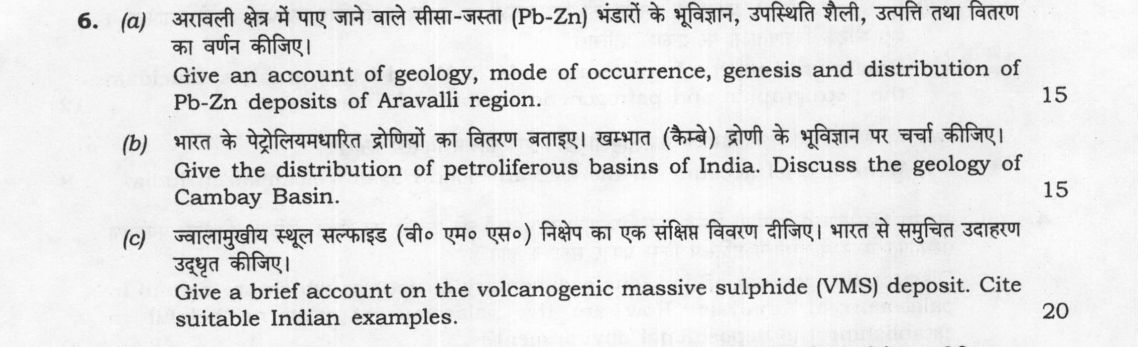
(a) Give an account of geology, mode of occurrence, genesis and distribution of Pb-Zn deposits of Aravalli region. (15…
Give an account of geology, mode of occurrence, genesis and distribution of Pb-Zn deposits of Aravalli region. 15 marks
Give the distribution of petroliferous basins of India. Discuss the geology of Cambay Basin. 15 marks
Give a brief account on the volcanogenic massive sulphide (VMS) deposit. Cite suitable Indian examples. 20 marks
हिंदी में प्रश्न पढ़ें
अरावली क्षेत्र में पाए जाने वाले सीसा-जस्ता (Pb-Zn) भंडारों के भूविज्ञान, उपस्थिति शैली, उत्पत्ति तथा वितरण का वर्णन कीजिए। (15 अंक)
भारत के पेट्रोलियमधारित क्रोड़ियों का वितरण बताइए। खम्भात (कैम्बे) क्रोड़ी के भूविज्ञान पर चर्चा कीजिए। (15 अंक)
ज्वालामुखीय स्थूल सल्फाइड (वी० एम० एस०) निक्षेप का एक संक्षिप्त विवरण दीजिए। भारत से समुचित उदाहरण उद्धृत कीजिए। (20 अंक)
Model answer
Written by UPSC Answer Check against this question's marking rubric, to the expected length. UPSC does not publish answers for Mains — this is one way to score well, not an official key.
Aravalli Pb-Zn deposits The Aravalli Pb-Zn province of Rajasthan is a classic Proterozoic sediment-hosted metallogenic belt. The deposits are largely stratiform or semi-stratiform, developed in Precambrian metasediments of the Aravalli and Bhilwara supergroups, with mineralization controlled by carbonate-rich horizons, red beds and faulted contacts. Rampura-Agucha, hosted in the Bhilwara Supergroup, and the Rajpura-Dariba-Bethumni belt in the Zawar belt, generally hosted by the Aravalli Supergroup, are type examples. Genesis is debated between syngenetic-diagenetic models, where metals were deposited from basinal brines or seawater during sedimentation, and epigenetic models, where later hydrothermal fluids remobilized and concentrated metals along faults and bedding. In practice, most deposits show a mixed history: primary sedimentary mineralization followed by tectono-thermal reworking during Aravalli orogeny. Distribution is concentrated in the southern Aravalli, especially the Zawar belt and Bhilwara district, making Rajasthan India’s principal Zn-Pb province.
Petroliferous basins and Cambay Basin India’s petroliferous basins are distributed across onshore and offshore sedimentary provinces. Geographically, they span the northeast, western, central, southern and offshore margins. Onshore, the major producing basins include Assam-Arakan in the northeast, Kutch, Saurashtra, Cambay, Rajasthan (Barmer), Mahanadi, Krishna-Godavari and Cauvery; important exploration or potential basins include Ganga, Vindhyan, Bengal and Jaisalmer. Offshore, the Mumbai offshore (Mumbai High), Krishna-Godavari offshore and Cauvery offshore are the key hydrocarbon provinces. Category-wise, Assam, Kutch, Saurashtra, Cambay, Rajasthan, Mahanadi, Krishna-Godavari, Cauvery and Mumbai offshore are generally treated as producing Category-I basins, while Ganga, Vindhyan, Bengal and Jaisalmer remain important Category-II or exploration targets. The Cambay Basin is a Tertiary rift basin developed along the Narmada-Tapti lineament in Gujarat. Its geology is dominated by Eocene-Oligocene sediments, with Olpad Formation volcanics and volcaniclastics, the organic-rich Cambay Shale as the principal source rock, and Kalol and Ankleshwar sandstones as the main reservoirs. Hydrocarbons are trapped in fault-block, anticlinal and stratigraphic traps, and the basin illustrates a rift-related, thermogenic petroleum system.
VMS deposits Volcanogenic massive sulphide deposits are formed by seafloor hydrothermal systems in submarine volcanic settings. They are commonly associated with bimodal volcanics, where intermediate to felsic magmatism drives metal-rich fluids that precipitate sulphides on the seafloor. The classic Cyprus, Kuroko and Besshi types differ in tectonic setting, ore texture and metal endowment, but all share massive sulphide lenses, footwall alteration and mineralization linked to volcanic-hosted hydrothermal circulation. In India, VMS occurrences include the Ambaji-Deri belt in the Aravalli region, Sargipalli in the Singhbhum craton and the Betul belt in Madhya Pradesh. The Ambaji-Deri belt lies in the South Delhi Fold Belt and is Mesoproterozoic, thus younger than the Paleoproterozoic Aravalli SEDEX-type Zn-Pb deposits; Sargipalli is linked with Archaean greenstone-related volcanism, while Betul is another Indian volcanogenic province. These deposits are important for Cu-Zn, giving them critical-mineral relevance.
Comparative synthesis The three systems contrast genetically and temporally. Aravalli Pb-Zn is sediment-hosted, developed in Proterozoic metasediments and linked to basinal brines and diagenetic-epigenetic processes. VMS deposits are volcanogenic, formed by hydrothermal seafloor systems in Archaean to Proterozoic volcanic terrains, with India’s examples spanning Archaean Singhbhum and Mesoproterozoic Ambaji-Deri. Petroleum systems are biogenic/thermogenic, dependent on organic-rich source rocks, reservoirs and traps, and are largely Tertiary in the Cambay and other basins. Economically, Aravalli Zn-Pb contributes significantly to India’s Zn-Pb self-sufficiency, while petroleum remains import-dependent, making basin exploration and offshore development strategic. VMS deposits offer potential for critical Cu-Zn resources. A way forward is integrated exploration: re-evaluating Aravalli SEDEX and VMS belts with geophysics, geochemistry and deep drilling, expanding Cambay and other onshore basins, and linking metallogenic mapping with critical-mineral policy.
What "Discuss" is asking you to do
Lay the issue out from more than one side — how it arose, what is claimed for it, what is held against it, and where it now stands. UPSC attaches discuss to broad topics with several live dimensions, so coverage of the dimensions earns more than the strength of your opinion.
Structure that answers it
Set the issue up → the case as it is made → the case against → the dimension both sides leave out → where the balance now lies
Where marks are lost
Listing facts with no thread between them, or arguing one side throughout and calling it a discussion.
How this answer will be evaluated
Approach
(a) account for: state the phenomenon > the causes in order of weight > conclusion | (b) discuss: intro > 3-4 dimensions > example > balanced close | (c) account for: state the phenomenon > the causes in order of weight > conclusion Full marks: Precise, specific, and well-structured answers with named examples and diagrams.
Key points expected
- Aravalli Supergroup stratigraphy (Bhilwara, Khetri, or Chitgarh)
- Sedimentary exhalative (SEDEX) or replacement genesis
- Specific mineralogy (galena, sphalerite, fluorite, barite)
- Geographic distribution (Rajasthan, MP, UP, Haryana)
- List of major basins (Gujarat, Assam, Krishna-Godavari, etc.)
- Cambay Basin location (Gujarat, Saurashtra, Kutch)
- Cambay stratigraphy (Cambay Group, Deccan Traps)
- Cambay tectonic setting (rift basin, graben)
Evaluation rubric
Each sub-part is marked on its own, against the marks and word limit printed on the paper.
- (a) Geology, occurrence, genesis, and distribution of Aravalli Pb-Zn deposits. 15 marks
account for— state the phenomenon → the causes in order of weight → conclusion
Must cover
- Aravalli Supergroup stratigraphy (Bhilwara, Khetri, or Chitgarh)
- Sedimentary exhalative (SEDEX) or replacement genesis
- Specific mineralogy (galena, sphalerite, fluorite, barite)
- Geographic distribution (Rajasthan, MP, UP, Haryana)
Loses marks
- Generic description without naming Aravalli formations
- Confusing SEDEX with magmatic or hydrothermal genesis
- Missing the distribution map or specific locations
Earns more
- Mention of specific ore bodies (Khetri, Zawar, Chitgarh)
- Description of host rock lithology (dolomites, limestones)
- Discussion of structural controls (folds, faults)
Extra mark
- Sketch of a typical Pb-Zn ore body cross-section
- Reference to specific stratigraphic horizons (e.g., Khetri Formation)
- (b) Distribution of Indian petroliferous basins and geology of Cambay Basin. 15 marks
discuss— intro → 3-4 dimensions → example → balanced close
Must cover
- List of major basins (Gujarat, Assam, Krishna-Godavari, etc.)
- Cambay Basin location (Gujarat, Saurashtra, Kutch)
- Cambay stratigraphy (Cambay Group, Deccan Traps)
- Cambay tectonic setting (rift basin, graben)
Loses marks
- Listing basins without geographic context
- Confusing Cambay with other basins (e.g., Krishna-Godavari)
- Missing the tectonic evolution of Cambay
Earns more
- Mention of specific Cambay fields (Surat, Vadodara, etc.)
- Discussion of Cambay source rocks (shales)
- Comparison with other rift basins
Extra mark
- Map showing distribution of all major basins
- Cross-section of Cambay Basin structure
- (c) Volcanogenic massive sulphide (VMS) deposits with Indian examples. 20 marks
account for— state the phenomenon → the causes in order of weight → conclusion
Must cover
- Definition of VMS (volcanic-hosted, massive sulphides)
- Genesis (hydrothermal fluids, volcanic activity)
- Mineralogy (pyrite, chalcopyrite, sphalerite, galena)
- Indian examples (e.g., Kolar, Bellary, or specific VMS occurrences)
Loses marks
- Confusing VMS with other sulphide deposit types
- Missing the volcanic/hydrothermal genesis
- No specific Indian examples or generic description
Earns more
- Description of VMS structure (stratiform, massive, disseminated)
- Discussion of VMS tectonic setting (mid-ocean ridges, back-arc basins)
- Comparison with other sulphide deposit types
Extra mark
- Sketch of VMS deposit structure
- Reference to specific Indian VMS fields (e.g., Kolar Gold Field)
Practice this exact question
Write your answer and it is marked point by point against the model answer above — what you covered, what you missed, what you got wrong.
Evaluate my answer →More from Geology 2025 Paper II
- Q3 (a) What are migmatites? Describe the important types of migmatites and the processes of…
- Q4 (a) Discuss the genesis of any four sedimentary structures which are helpful in palaeocur…
- Q5 Answer the following questions in about 150 words each: (a) What do you understand by met…
- Q6 (a) Give an account of geology, mode of occurrence, genesis and distribution of Pb-Zn dep…
- Q7 (a) Discuss the direct and indirect geochemical methods used for prospecting of hydrocarb…
- Q8 (a) What do you understand by isomorphism and polymorphism? Discuss monotropy by citing e…