Paper II — Q8
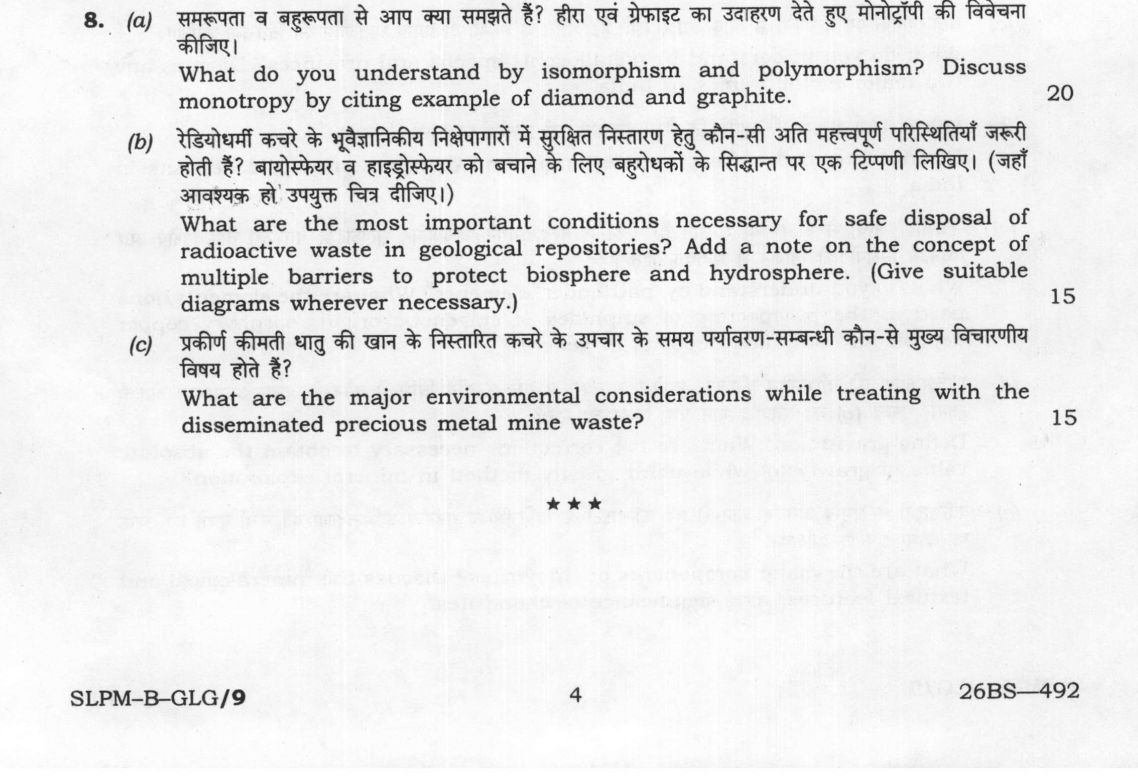
(a) What do you understand by isomorphism and polymorphism? Discuss monotropy by citing example of diamond and graphite. (20…
What do you understand by isomorphism and polymorphism? Discuss monotropy by citing example of diamond and graphite. 20 marks
What are the most important conditions necessary for safe disposal of radioactive waste in geological repositories? Add a note on the concept of multiple barriers to protect biosphere and hydrosphere. (Give suitable diagrams wherever necessary.) 15 marks
What are the major environmental considerations while treating with the disseminated precious metal mine waste? 15 marks
हिंदी में प्रश्न पढ़ें
समरूपता व बहुरूपता से आप क्या समझते हैं? हीरा एवं ग्रेफाइट का उदाहरण देते हुए मोनोट्रॉपी की विवेचना कीजिए। (20 अंक)
रेडियोधर्मी कचरे के भूवैज्ञानिकीय निक्षेपागारों में सुरक्षित निस्तारण हेतु कौन-सी अति महत्वपूर्ण परिस्थितियाँ जरूरी होती हैं? बायोस्फीयर व हाइड्रोस्फीयर को बचाने के लिए बहुरोधकों के सिद्धांत पर एक टिप्पणी लिखिए। (जहाँ आवश्यक हो उपयुक्त चित्र दीजिए।) (15 अंक)
प्रकीर्ण कीमती धातु की खान के निस्तारित कचरे के उपचार के समय पर्यावरण-संबंधी कौन-से मुख्य विचारणीय विषय होते हैं? (15 अंक)
Model answer
Written by UPSC Answer Check against this question's marking rubric, to the expected length. UPSC does not publish answers for Mains — this is one way to score well, not an official key.
Part (a) Isomorphism denotes minerals with different chemical compositions but the same crystal structure, usually because ions of similar size and charge substitute in the lattice. Calcite (CaCO3) and rhodochrosite (MnCO3) are both trigonal carbonates and illustrate this structural similarity despite different cations. Polymorphism denotes the same chemical composition occurring in different crystal structures, as in diamond and graphite, both pure carbon, or in quartz, cristobalite and tridymite. The distinction is practical: isomorphism controls substitution and solid solution, while polymorphism controls stability, density and reactivity. Monotropy is a polymorphic relationship in which one phase is thermodynamically stable at a given temperature and pressure, while the others are metastable and transform irreversibly toward the stable phase. In a ΔG–T diagram, the Gibbs free energy line for graphite lies below that of diamond at ambient conditions, so graphite is the stable monotropic phase; diamond becomes stable only at high pressure and temperature. Diamond has sp3-bonded tetrahedral carbon in a three-dimensional covalent network, giving high hardness and a density of about 3.51 g/cm3. Graphite has sp2-bonded carbon arranged in layered sheets held by weak van der Waals forces, with a density of about 2.26 g/cm3. Although diamond is metastable at surface conditions, the kinetic barrier to breaking and reorganizing its strong covalent bonds is so high that conversion to graphite is negligible over geological time. Thus diamond-graphite illustrates monotropy: structure, bonding and density differ, but thermodynamics favours graphite while kinetics preserve diamond.
Part (b) Safe disposal of radioactive waste in geological repositories requires deep, stable host rock with low permeability and low groundwater flow, such as granite, salt or clay, in a tectonically quiet setting with no active faulting, seismic hazards, or exploitable resources like mining, geothermal or water extraction. The site must maintain long-term groundwater chemistry that limits radionuclide mobility, with controlled redox conditions, low temperature, and limited microbial or organic activity. A critical issue is the oxidizing front: as canister corrosion consumes oxygen, the advancing oxidizing zone can alter bentonite, host rock and radionuclide speciation, potentially increasing mobility. A KBS-3-style diagram would show, from centre outward, vitrified waste in a canister, bentonite buffer, backfill, host rock, and further buffer/cover layers. Engineered barriers include the waste matrix, canister, buffer and backfill; natural barriers include host rock and the surrounding geosphere. Together they form multiple barriers that retard migration, maintain reducing conditions, and protect the biosphere and hydrosphere over thousands to millions of years. In India, a deep repository would require host-rock selection, a long-term safety case, institutional control, and regulatory oversight by the Atomic Energy Regulatory Board (AERB).
Part (c) Disseminated precious-metal mine waste is usually low-grade, sulfide-rich and finely dispersed, giving high reactive surface area. Major environmental considerations include acid mine drainage from pyrite, arsenopyrite and other sulfides; cyanide residues from CIL/CIP or amalgamation mercury from older processing; tailings dam stability, seepage, erosion and dust; mobilization of heavy metals such as As, Sb, Hg, Pb, Cu and Zn under acidic or reducing conditions; and revegetation challenges caused by low fertility, metal toxicity and salinity. Treatment must therefore combine AMD neutralization, sulfide precipitation, passive treatment, cyanide destruction by advanced oxidation or biological methods, mercury removal, and robust tailings storage facility design with liners, seepage collection, covers and monitoring. In India, Kolar and Hutti are lode/orogenic gold systems rather than typical disseminated deposits, but their waste illustrates cyanide, arsenic and mercury controls. For disseminated precious-metal waste, analogous concerns apply to porphyry Cu-Au and PGM-bearing ultramafic settings, such as PGM occurrences in the Deccan traps. A way forward is to integrate mineralogical characterization, water-quality monitoring, engineered barriers and post-closure stewardship, so that mineral structure, repository design and mine-waste treatment are managed as one geochemical risk chain.
What "Discuss" is asking you to do
Lay the issue out from more than one side — how it arose, what is claimed for it, what is held against it, and where it now stands. UPSC attaches discuss to broad topics with several live dimensions, so coverage of the dimensions earns more than the strength of your opinion.
Structure that answers it
Set the issue up → the case as it is made → the case against → the dimension both sides leave out → where the balance now lies
Where marks are lost
Listing facts with no thread between them, or arguing one side throughout and calling it a discussion.
How this answer will be evaluated
Approach
Framework: Geology Paper 2: Define > Process > Field/Petrographic Evidence > Indian Example. (a) discuss: intro > 3-4 dimensions > example > balanced close | (b) explain: definition/context > points in order > small example > short close | (c) highlight: name the salient points > one line of substance each > close Full marks: Precise definitions, clear diagrams, specific examples, and strong causal links.
Key points expected
- Precise definitions of isomorphism and polymorphism
- Explanation of monotropy (irreversible transformation)
- Comparison of diamond and graphite structures
- Sketch of diamond (tetrahedral) vs graphite (hexagonal) lattices
- Conditions: geological stability, low permeability, depth
- Concept of multiple barriers (waste, container, buffer, host rock)
- Diagram showing the barrier system
- Protection of biosphere and hydrosphere
Evaluation rubric
Each sub-part is marked on its own, against the marks and word limit printed on the paper.
- (a) Define isomorphism and polymorphism; explain monotropy using diamond and graphite. 20 marks
discuss— intro → 3-4 dimensions → example → balanced close
Must cover
- Precise definitions of isomorphism and polymorphism
- Explanation of monotropy (irreversible transformation)
- Comparison of diamond and graphite structures
- Sketch of diamond (tetrahedral) vs graphite (hexagonal) lattices
Loses marks
- Confusing isomorphism with polymorphism
- Missing structural diagrams of allotropes
- Failing to explain the 'irreversible' nature of monotropy
Earns more
- Mention of specific bond angles (109.5° vs 120°)
- Reference to pressure-temperature conditions for transformation
- Mention of other allotropes like lonsdaleite
Extra mark
- Reference to specific Indian diamond occurrences (e.g., Panna)
- Phase diagram showing stability fields
- (b) Conditions for safe radioactive waste disposal in geological repositories and multiple barriers. 15 marks
explain— definition/context → points in order → small example → short close
Must cover
- Conditions: geological stability, low permeability, depth
- Concept of multiple barriers (waste, container, buffer, host rock)
- Diagram showing the barrier system
- Protection of biosphere and hydrosphere
Loses marks
- Missing the 'multiple barriers' diagram
- Failing to link barriers to biosphere/hydrosphere protection
- Vague description of 'safe disposal' without specific conditions
Earns more
- Mention of specific host rock types (e.g., granite, salt)
- Reference to specific repository sites (e.g., Onkalo, Yucca Mountain)
- Discussion of long-term isolation timescales
Extra mark
- Reference to Indian geological conditions for disposal
- Specific IAEA safety standards
- (c) Major environmental considerations for disseminated precious metal mine waste. 15 marks
highlight— name the salient points → one line of substance each → close
Must cover
- Acid Mine Drainage (AMD) generation
- Heavy metal leaching (As, Hg, Pb)
- Tailings management and stability
- Impact on local water resources
Loses marks
- Generic environmental talk without specific mine waste issues
- Ignoring the 'disseminated' nature of the deposit
- Failing to mention specific pollutants
Earns more
- Mention of specific Indian mines (e.g., Kolar, Hutti)
- Discussion of remediation techniques (passive treatment)
- Reference to specific environmental regulations
Extra mark
- Case study of a specific environmental disaster
- Economic cost of remediation
Practice this exact question
Write your answer and it is marked point by point against the model answer above — what you covered, what you missed, what you got wrong.
Evaluate my answer →More from Geology 2025 Paper II
- Q5 Answer the following questions in about 150 words each: (a) What do you understand by met…
- Q6 (a) Give an account of geology, mode of occurrence, genesis and distribution of Pb-Zn dep…
- Q7 (a) Discuss the direct and indirect geochemical methods used for prospecting of hydrocarb…
- Q8 (a) What do you understand by isomorphism and polymorphism? Discuss monotropy by citing e…