Paper II — Q3
(a) What are migmatites? Describe the important types of migmatites and the processes of their formation. (15 marks) (b) Draw a…
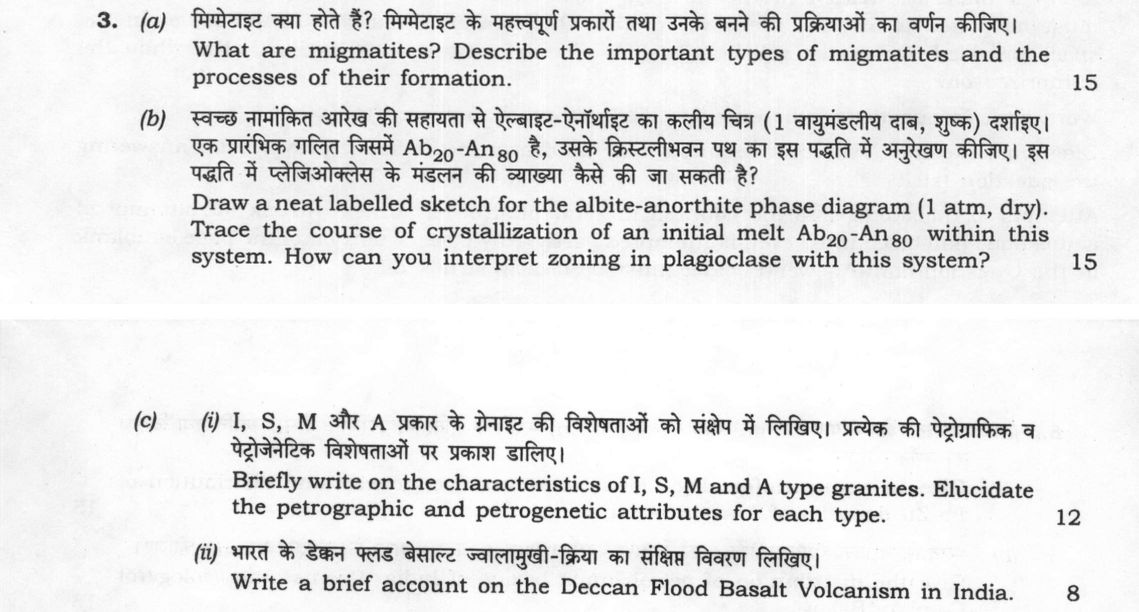
What are migmatites? Describe the important types of migmatites and the processes of their formation. 15 marks
Draw a neat labelled sketch for the albite-anorthite phase diagram (1 atm, dry). Trace the course of crystallization of an initial melt Ab₂₀-An₈₀ within this system. How can you interpret zoning in plagioclase with this system? 15 marks
Briefly write on the characteristics of I, S, M and A type granites. Elucidate the petrographic and petrogenetic attributes for each type. 12 marks
Write a brief account on the Deccan Flood Basalt Volcanism in India. 8 marks
हिंदी में प्रश्न पढ़ें
मिग्मेटाइट क्या होते हैं? मिग्मेटाइट के महत्त्वपूर्ण प्रकारों तथा उनके बनने की प्रक्रियाओं का वर्णन कीजिए। (15 अंक)
स्वच्छ नामांकित आरेख की सहायता से एल्बाइट-एनॉर्थाइट का कल्पित चित्र (1 वायुमंडलीय दाब, शुष्क) दर्शाइए। एक प्रारंभिक गलित जिसमें Ab₂₀-An₈₀ है, उसके क्रिस्टलीभवन पथ का इस पद्धति में अनुरेखण कीजिए। इस पद्धति में प्लेजियोक्लेज के मंडलन की व्याख्या कैसे की जा सकती है? (15 अंक)
I, S, M और A प्रकार के ग्रेनाइट की विशेषताओं को संक्षेप में लिखिए। प्रत्येक की पेट्रोग्राफिक व पेट्रोजेनेटिक विशेषताओं पर प्रकाश डालिए। (12 अंक)
भारत के डेक्कन फ्लड बेसाल्ट ज्वालामुखी-क्रिया का संक्षिप्त विवरण लिखिए। (8 अंक)
Model answer
Written by UPSC Answer Check against this question's marking rubric, to the expected length. UPSC does not publish answers for Mains — this is one way to score well, not an official key.
(a) Migmatites Migmatites are common in high-grade metamorphic belts and are mixed rocks produced when a metamorphic rock is partially melted and the melt remains partly segregated. The light felsic melt is leucosome; the dark mafic residue is melanosome; together they form neosome, while the unmelted metamorphic restite is paleosome. The important types are metatexites, coherent rocks in which leucosome forms veins, bands or layers within paleosome, and diatexites or nebulitic migmatites, in which high melt fraction gives a granitic texture and paleosome occurs as enclaves. Formation involves partial melting of metapelites, paragneisses or amphibolites at high temperature and pressure, metamorphic differentiation by melt segregation, and metasomatism or fluid-assisted melting that changes residual composition. The leucosome is commonly granitic to tonalitic, while the melanosome may contain biotite, garnet, amphibole or mafic restite. Indian examples include the Aravalli–Bhilwara and Dharwar cratonic terrains of Rajasthan and Karnataka, where migmatites record crustal anatexis and granite genesis. They thus grade from low-melt metatexites to high-melt diatexites, preserving the transition from metamorphism to igneous melt.
(b) Albite–anorthite diagram The dry 1 atm albite–anorthite diagram is a continuous solid-solution diagram. Sketch: x-axis composition from Ab100 (An0) on the left to An100 on the right; Ab20-An80 is plotted at 80% An, close to the An end. y-axis temperature: Ab100 melts at 1118°C and An100 at 1553°C. The upper curve is the liquidus, the lower curve the solidus, and a low-temperature invariant, often labelled a eutectic point, near An50 (about 1350°C) is marked. For an initial melt Ab20-An80, crystallization begins at the liquidus with plagioclase richer in anorthite than the melt, about An90–An95. On cooling, the crystal follows the solidus toward lower An while the residual melt follows the liquidus toward higher Ab. Under equilibrium, crystals re-equilibrate and the final plagioclase approaches the bulk Ab20-An80 composition. Under fractional crystallization, removed crystals make the residual melt move faster toward albite, producing more strongly zoned crystals. The lever rule, fraction solid = (C0-CL)/(CS-CL), is applied using a tie-line between liquidus and solidus at any temperature. Normal zoning, An-rich cores and Ab-rich rims, records continuous cooling and melt evolution; reverse zoning, Ab-rich cores and An-rich rims, implies late addition of anorthite-rich melt, assimilation, volatile effects, or crystal reaction. If diffusion is slow, zoning is preserved; if fast, it is erased.
(c) Granites and Deccan (i) I-type granites are igneous-source, usually metaluminous, with hornblende, biotite, quartz and plagioclase, and little excess aluminium; they form by melting of mafic to intermediate crust or mantle-derived material, typical of Cordilleran arcs. I-type may contain mafic enclaves. S-type granites are sedimentary-source, peraluminous, with muscovite, garnet, cordierite or K-feldspar, and form by anatexis of metasediments, as in Himalayan leucogranites. S-type may contain xenocrysts. M-type granites are mantle-derived, oceanic, high in Mg and Fe, with olivine, pyroxene and spinel, and form from partial melting of mantle or ultramafic crust. M-type may be associated with ophiolites. A-type granites are anorogenic, alkaline, often high in incompatible elements, with K-feldspar, Na-plagioclase, biotite, hornblende or pyroxene, and form in rift or post-collisional extensional settings. A-type may be quartz-poor. (ii) The Deccan Traps are Cretaceous–Paleogene continental flood basalts, erupted near 66 Ma, linked to the Reunion mantle plume. The sequence is among the largest flood-basalt provinces on Earth. They are tholeiitic, layered in formations such as Jawhar, Igatpuri and Wai, with thick lava flows, sills and volcaniclastic beds, and their massive volcanism is linked to environmental stress and mass-extinction effects at the K–Pg boundary. CO2 and H2S emissions are linked to climate change and ocean acidification.
Thus, migmatites preserve crustal melting stages that feed granites; the albite–anorthite diagram quantifies plagioclase evolution and zoning; and Indian examples tie global petrogenetic models to local geology.
What "Describe" is asking you to do
Give a full, ordered account of the thing named — its parts, stages or mechanism — in the sequence in which it actually exists or occurs. Most describe questions come from the science optionals, where the marks sit in correct technical detail and, where the stem says so, a labelled diagram.
Structure that answers it
One-line identification of the subject → the parts or stages in their real order, each with its defining detail → labelled diagram where the subject is structural → closing line on function or significance
Where marks are lost
Loose general prose where the examiner is ticking named parts, correct terminology and their sequence; and in the General Studies papers, turning to evaluation before the description is finished.
How this answer will be evaluated
Approach
Framework: Geology Paper 2: Define > Process > Field/Petrographic Evidence > Indian Example. (a) describe: define > structure or process in order > labelled diagram > significance | (b) trace: start point > the stages in sequence > end point > what changed | (c(i)) write short notes: define > 3-4 key features > one example > one-line significance | (c(ii)) account for: state the phenomenon > the causes in order of weight > conclusion Full marks: Precise definitions, accurate diagrams, specific Indian examples, and clear petrogenetic links.
Key points expected
- Define migmatite as a rock with partial melt and solid matrix
- Distinguish types: gneissic, granitic, and anatectic
- Explain formation via partial melting (anatexis) and metamorphism
- Describe textures like leucosome, leucogranite, and restite
- Draw labelled phase diagram with liquidus and solidus curves
- Identify eutectic point and peritectic point
- Trace crystallization path for Ab20-An80 composition
- Explain zonation in plagioclase (core to rim composition change)
Evaluation rubric
Each sub-part is marked on its own, against the marks and word limit printed on the paper.
- (a) Define migmatites, classify types, and explain formation processes. 15 marks
describe— define → structure or process in order → labelled diagram → significance
Must cover
- Define migmatite as a rock with partial melt and solid matrix
- Distinguish types: gneissic, granitic, and anatectic
- Explain formation via partial melting (anatexis) and metamorphism
- Describe textures like leucosome, leucogranite, and restite
Loses marks
- Confusing migmatite with simple gneiss or granite
- Failing to distinguish between restite and leucosome
- Generic description without specific formation mechanisms
Earns more
- Mention specific metamorphic facies (e.g., granulite facies)
- Reference specific Indian occurrences (e.g., Aravalli or Dharwar)
- Discuss the role of volatile components in melting
Extra mark
- Sketch of migmatite texture (leucosome/leucocryst)
- Mention specific mineral assemblages (e.g., cordierite, sillimanite)
- (b) Draw Albite-Anorthite phase diagram and trace crystallization of Ab20-An80 melt. 15 marks
trace— start point → the stages in sequence → end point → what changed
Must cover
- Draw labelled phase diagram with liquidus and solidus curves
- Identify eutectic point and peritectic point
- Trace crystallization path for Ab20-An80 composition
- Explain zonation in plagioclase (core to rim composition change)
Loses marks
- Incorrect phase diagram (missing eutectic or peritectic)
- Failing to trace the specific Ab20-An80 path
- Confusing the liquidus and solidus curves
Earns more
- Correctly label the eutectic temperature and composition
- Explain the role of the peritectic reaction in crystallization
- Mention the specific mineral phases (Albite, Anorthite, Melt)
Extra mark
- Precise calculation of liquid composition at specific temperatures
- Detailed explanation of the lever rule application
- (c(i)) Characterize I, S, M, and A type granites with petrographic and petrogenetic attributes. 12 marks
write short notes— define → 3-4 key features → one example → one-line significance
Must cover
- Define I-type (igneous) and S-type (sedimentary) granites
- Define M-type (mantle) and A-type (anorogenic) granites
- List key petrographic features for each type
- Explain petrogenetic origins (source rocks and tectonic settings)
Loses marks
- Confusing I-type and S-type characteristics
- Failing to distinguish A-type from other types
- Generic description without specific petrogenetic links
Earns more
- Mention specific mineral assemblages (e.g., biotite vs. hornblende)
- Reference specific geochemical indices (e.g., A/CNK ratio)
- Link types to specific tectonic environments (e.g., subduction vs. extension)
Extra mark
- Mention specific Indian examples for each granite type
- Reference specific geochemical plots (e.g., Rb-Y-Nb)
- (c(ii)) Provide a brief account of Deccan Flood Basalt Volcanism in India. 8 marks
account for— state the phenomenon → the causes in order of weight → conclusion
Must cover
- State the timing (Late Cretaceous/Early Paleogene)
- Describe the extent and volume of the Deccan Traps
- Explain the tectonic setting (rifting, hotspot, or mantle plume)
- Mention the impact on global climate and biodiversity
Loses marks
- Incorrect timing (e.g., Jurassic or Miocene)
- Failing to mention the tectonic setting
- Generic description without specific Indian context
Earns more
- Reference specific formations (e.g., Mahabaleshwar Formation)
- Mention the role of the Kerguelen Plume
- Discuss the link to the K-Pg mass extinction
Extra mark
- Mention specific mineralogical features of Deccan basalts
- Reference specific geochemical signatures (e.g., high Ti basalts)
Practice this exact question
Write your answer and it is marked point by point against the model answer above — what you covered, what you missed, what you got wrong.
Evaluate my answer →More from Geology 2025 Paper II
- Q1 Answer the following questions in about 150 words each: (a) Describe the symmetry element…
- Q2 (a) Give a detailed account related to the classification of crystals into different crys…
- Q3 (a) What are migmatites? Describe the important types of migmatites and the processes of…
- Q4 (a) Discuss the genesis of any four sedimentary structures which are helpful in palaeocur…
- Q5 Answer the following questions in about 150 words each: (a) What do you understand by met…
- Q6 (a) Give an account of geology, mode of occurrence, genesis and distribution of Pb-Zn dep…