Paper II — Q4
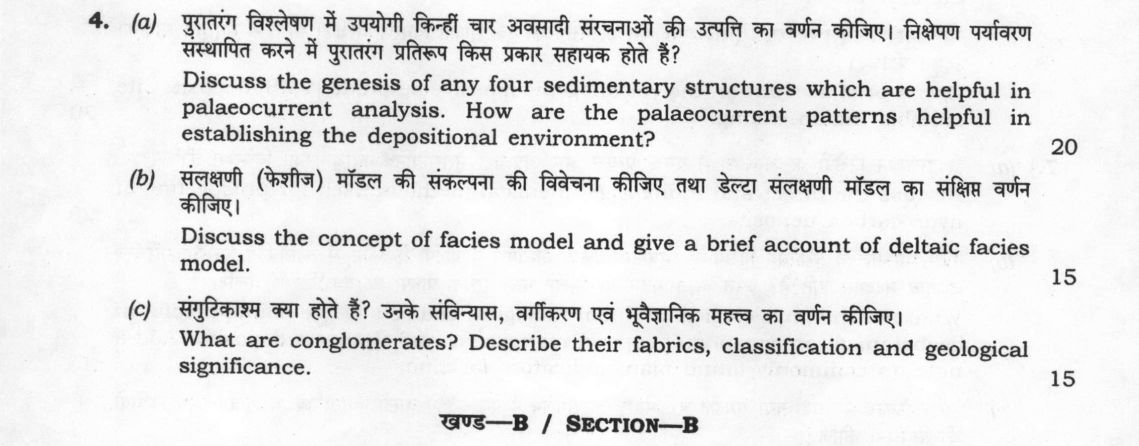
(a) Discuss the genesis of any four sedimentary structures which are helpful in palaeocurrent analysis. How are the palaeocurrent…
Discuss the genesis of any four sedimentary structures which are helpful in palaeocurrent analysis. How are the palaeocurrent patterns helpful in establishing the depositional environment? 20 marks
Discuss the concept of facies model and give a brief account of deltaic facies model. 15 marks
What are conglomerates? Describe their fabrics, classification and geological significance. 15 marks
हिंदी में प्रश्न पढ़ें
पुरातरंग विश्लेषण में उपयोगी किन्हीं चार अवसादी संरचनाओं की उत्पत्ति का वर्णन कीजिए। निक्षेपण पर्यावरण स्थापित करने में पुरातरंग प्रतिरूप किस प्रकार सहायक होते हैं? (20 अंक)
संलक्षणी (फेसीज) मॉडल की संकल्पना की विवेचना कीजिए तथा डेल्टा संलक्षणी मॉडल का संक्षिप्त वर्णन कीजिए। (15 अंक)
संगुटिकाश्म क्या होते हैं? उनके संविन्यास, वर्गीकरण एवं भूवैज्ञानिक महत्व का वर्णन कीजिए। (15 अंक)
Model answer
Written by UPSC Answer Check against this question's marking rubric, to the expected length. UPSC does not publish answers for Mains — this is one way to score well, not an official key.
Sedimentary structures, facies models and conglomerates are key tools for reconstructing ancient flow, basin geometry and source areas.
Palaeocurrent structures. Four useful structures are ripple marks, cross-bedding, flute casts and clast imbrication. Unidirectional current ripple marks form on migrating bedforms; the stoss side faces upstream and the slip face dips downstream, so the vector is taken from stoss to slip face. Cross-bedding records inclined foresets deposited on migrating dunes or bars; the foresets dip downstream, and the palaeocurrent is down the foreset, perpendicular to the strike of the cross-bedding surface. Flute casts are streamlined grooves formed by turbulent flow eroding a mud surface and later filled by sand; the head points upstream and the tail downstream, giving a clear flow vector. In clast imbrication, pebbles lie with their long axes transverse to flow and their intermediate axes dipping upstream; the ab plane dips upstream, so the current flowed opposite to the clast dip. Parting lineation, formed by suspended load settling on a bed surface, may also give a vector parallel to flow. These vectors are measured in the field, plotted as rose diagrams, and analysed as mean resultant vectors. A unimodal pattern suggests a single dominant current, as in fluvial channels or deep-marine turbidites; a bimodal pattern, especially with herringbone cross-bedding, indicates tidal flow; eolian systems may be unimodal to bimodal according to wind regime; shallow-marine and estuarine patterns can be unimodal, bimodal or polymodal depending on wave, storm and tidal processes. The pattern, with grain size and facies, establishes the depositional environment.
Facies and deltaic models. A facies model is a generalised summary of lithofacies, grain size, sedimentary structures, facies associations and vertical successions that characterise a depositional system. Such models are used to correlate outcrops and wells, identify reservoirs and traps, and assess basin evolution. It links lateral facies changes to vertical successions and helps predict reservoir sandbodies. The deltaic facies model distinguishes river-dominated, wave-dominated and tide-dominated systems, and also separates proximal distributary-channel, mouth-bar, shoreface, offshore and basin-floor facies. River-dominated Gilbert-type deltas are coarse-grained, progradational clinoforms with steep foresets; low-gradient bird-foot deltas, such as the Mississippi, are different, having elongate distributary-mouth bars and finer sediment. Wave-dominated deltas are reworked, shallow, and show swash bars, fining-upward sand and onlapping facies. Tide-dominated deltas contain herringbone cross-bedding, tidal flats, muds and intertidal structures. Vertical profiles are commonly progradational and fining-upward; Walther’s Law links vertical facies succession to lateral facies changes, helping predict reservoir sandbodies. Indian examples include Kutch deltaic sequences used to interpret progradation and shoreline migration.
Conglomerates. Conglomerates are coarse-grained sedimentary rocks with clasts larger than 2 mm, usually rounded to subrounded, and may be clast-supported or matrix-supported. Angular clasts define breccia, whereas rounded clasts indicate longer transport or reworking. Clast-supported types show clast-to-clast contacts, while matrix-supported types have clasts suspended in finer sediment. Their fabrics include clast orientation, imbrication, packing, sorting, clast shape and matrix composition, such as sand, silt, clay or cement. They are classified by genesis as residual, lag, till, fluvial, alluvial-fan or turbiditic, and by composition as petromict or oligomict, the latter indicating a more restricted source. Geologically, conglomerates indicate high-energy transport, proximity to source, tectonic setting and palaeogeographic connections; they are important for provenance studies, placer deposits and aquifers. Indian examples include Siwalik conglomerates, which record fluvial palaeocurrents and Himalayan provenance, and Karewa conglomerates, used for palaeocurrent and source-area analysis. Together with Kutch deltaic sequences, they help reconstruct Himalayan foreland basin evolution.
Together, palaeocurrent structures, facies models and conglomerate fabrics allow reconstruction of basin evolution, sediment routing, source-area tectonics and hydrocarbon exploration targets.
What "Discuss" is asking you to do
Lay the issue out from more than one side — how it arose, what is claimed for it, what is held against it, and where it now stands. UPSC attaches discuss to broad topics with several live dimensions, so coverage of the dimensions earns more than the strength of your opinion.
Structure that answers it
Set the issue up → the case as it is made → the case against → the dimension both sides leave out → where the balance now lies
Where marks are lost
Listing facts with no thread between them, or arguing one side throughout and calling it a discussion.
How this answer will be evaluated
Approach
Framework: Geology Paper 2: Define > Process > Field/Petrographic Evidence > Indian Example. (a) discuss: intro > 3-4 dimensions > example > balanced close | (b) discuss: intro > 3-4 dimensions > example > balanced close | (c) describe: define > structure or process in order > labelled diagram > significance Full marks: Precise definitions, clear sketches, named Indian examples, and strong causal links between structures and environments.
Key points expected
- Genesis of four structures (e.g., cross-bedding, ripple marks, flute casts, grooves)
- Mechanism of palaeocurrent determination for each structure
- Link between palaeocurrent patterns and depositional environment
- Sketches or diagrams illustrating the structures
- Definition of facies and facies model concept
- Components of deltaic facies (prodelta, front, plain)
- Vertical and lateral facies succession in deltas
- Sketch of deltaic facies model
Evaluation rubric
Each sub-part is marked on its own, against the marks and word limit printed on the paper.
- (a) Genesis of four sedimentary structures for palaeocurrent analysis and their role in environment identification. 20 marks
discuss— intro → 3-4 dimensions → example → balanced close
Must cover
- Genesis of four structures (e.g., cross-bedding, ripple marks, flute casts, grooves)
- Mechanism of palaeocurrent determination for each structure
- Link between palaeocurrent patterns and depositional environment
- Sketches or diagrams illustrating the structures
Loses marks
- Listing structures without explaining genesis
- Confusing palaeocurrent with palaeoslope
- Missing diagrams or sketches
Earns more
- Distinction between primary and secondary structures
- Mention of specific environments (fluvial, aeolian, tidal)
- Reference to Indian fluvial sequences (e.g., Ganga-Brahmaputra)
Extra mark
- Specific Indian formation example (e.g., Siwalik sandstones)
- Quantitative palaeocurrent data interpretation
- (b) Concept of facies model and a brief account of the deltaic facies model. 15 marks
discuss— intro → 3-4 dimensions → example → balanced close
Must cover
- Definition of facies and facies model concept
- Components of deltaic facies (prodelta, front, plain)
- Vertical and lateral facies succession in deltas
- Sketch of deltaic facies model
Loses marks
- Generic description without specific deltaic components
- Missing facies model sketch
- Confusing facies with lithofacies
Earns more
- Mention of delta types (river-dominated, wave-dominated)
- Reference to specific deltaic sequences (e.g., Ganges-Brahmaputra)
- Discussion of sedimentary structures in deltaic facies
Extra mark
- Named Indian deltaic basin (e.g., Krishna-Godavari delta)
- Stratigraphic age of the deltaic sequence
- (c) Definition of conglomerates, their fabrics, classification, and geological significance. 15 marks
describe— define → structure or process in order → labelled diagram → significance
Must cover
- Definition of conglomerates (clast size, shape)
- Description of fabrics (clast support, matrix support)
- Classification of conglomerates (e.g., by clast shape, matrix)
- Geological significance (palaeocurrent, tectonic setting)
Loses marks
- Confusing conglomerates with breccias
- Missing fabric description
- Generic geological significance without specific examples
Earns more
- Mention of specific conglomerate types (e.g., pebbly, brecciated)
- Reference to Indian conglomerate occurrences (e.g., Vindhyan)
- Discussion of clast provenance and transport
Extra mark
- Named Indian conglomerate formation (e.g., Rewa Sandstone)
- Stratigraphic age of the conglomerate
Practice this exact question
Write your answer and it is marked point by point against the model answer above — what you covered, what you missed, what you got wrong.
Evaluate my answer →More from Geology 2025 Paper II
- Q1 Answer the following questions in about 150 words each: (a) Describe the symmetry element…
- Q2 (a) Give a detailed account related to the classification of crystals into different crys…
- Q3 (a) What are migmatites? Describe the important types of migmatites and the processes of…
- Q4 (a) Discuss the genesis of any four sedimentary structures which are helpful in palaeocur…
- Q5 Answer the following questions in about 150 words each: (a) What do you understand by met…
- Q6 (a) Give an account of geology, mode of occurrence, genesis and distribution of Pb-Zn dep…
- Q7 (a) Discuss the direct and indirect geochemical methods used for prospecting of hydrocarb…