Paper II — Q5
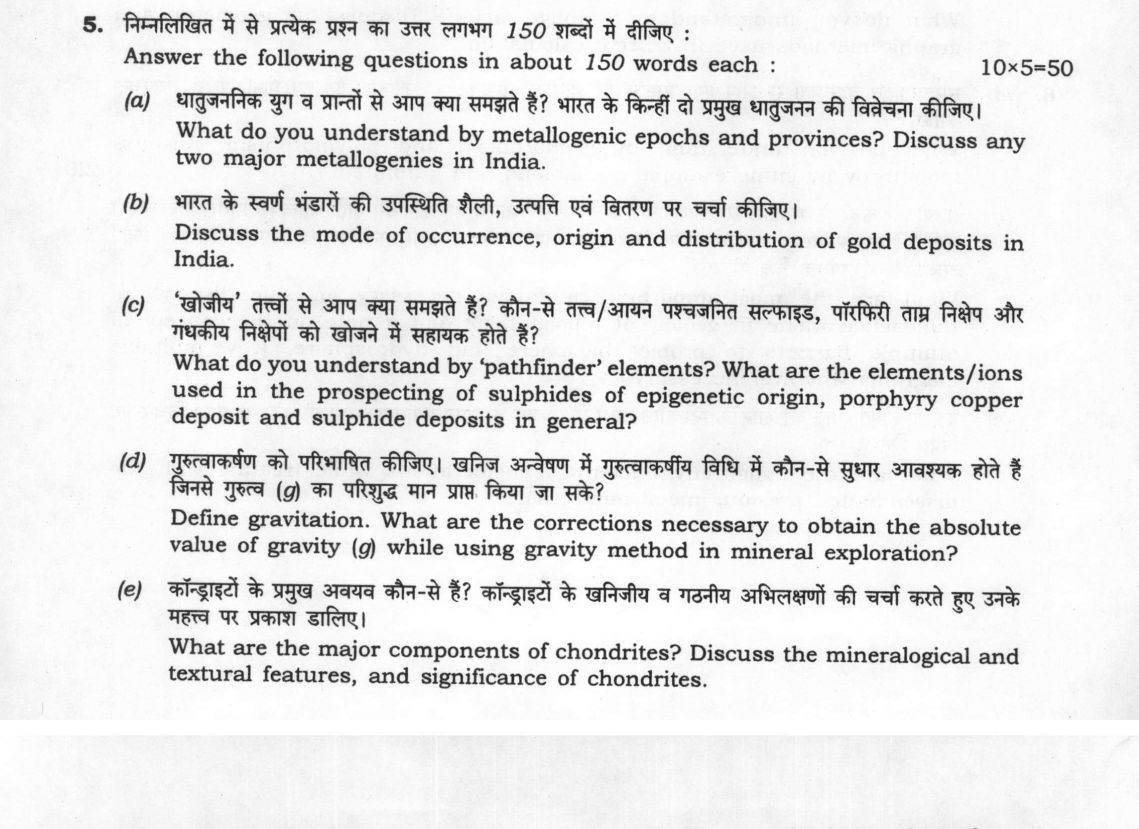
Answer the following questions in about 150 words each: (a) What do you understand by metallogenic epochs and provinces? Discuss…
Answer the following questions in about 150 words each:
What do you understand by metallogenic epochs and provinces? Discuss any two major metallogenies in India. 10 marks
Discuss the mode of occurrence, origin and distribution of gold deposits in India. 10 marks
What do you understand by 'pathfinder' elements? What are the elements/ions used in the prospecting of sulphides of epigenetic origin, porphyry copper deposit and sulphide deposits in general? 10 marks
Define gravitation. What are the corrections necessary to obtain the absolute value of gravity (g) while using gravity method in mineral exploration? 10 marks
What are the major components of chondrites? Discuss the mineralogical and textural features, and significance of chondrites. 10 marks
हिंदी में प्रश्न पढ़ें
निम्नलिखित में से प्रत्येक प्रश्न का उत्तर लगभग 150 शब्दों में दीजिए :
धातुजननिक युग व प्रान्तों से आप क्या समझते हैं? भारत के किन्हीं दो प्रमुख धातुजनन की विवेचना कीजिए। (10 अंक)
भारत के स्वर्ण भण्डारों की उपस्थिति शैली, उत्पत्ति एवं वितरण पर चर्चा कीजिए। (10 अंक)
'खोजीय' तत्वों से आप क्या समझते हैं? कौन-से तत्व/आयन पश्चजनित सल्फाइड, पोरफिरी ताम्र निक्षेप और गन्धकीय निक्षेपों को खोजने में सहायक होते हैं? (10 अंक)
गुरुत्वाकर्षण को परिभाषित कीजिए। खनिज अन्वेषण में गुरुत्वाकर्षीय विधि में कौन-से सुधार आवश्यक होते हैं जिनसे गुरुत्व (g) का परिशुद्ध मान प्राप्त किया जा सके? (10 अंक)
कोंड्राइटों के प्रमुख अवयव कौन-से हैं? कोंड्राइटों के खनिजीय व गठनीय अभिलक्षणों की चर्चा करते हुए उनके महत्व पर प्रकाश डालिए। (10 अंक)
Model answer
Written by UPSC Answer Check against this question's marking rubric, to the 150-word length. UPSC does not publish answers for Mains — this is one way to score well, not an official key.
(a) Metallogenic epochs and provinces. A metallogenic epoch is a time-bound interval in Earth history when a particular style of mineralisation was generated, controlled by tectonic, thermal and fluid conditions. A metallogenic province is a spatially restricted area where similar mineralisation occurs repeatedly because of common basement, structures and magmatism. In India, the Dharwar Craton is a major Archaean metallogenic province, hosting gold, iron and manganese, with gold in greenstone belts and banded iron formations. The Singhbhum Craton is another key province, characterised by copper, uranium and iron mineralisation, linked to Proterozoic basin development, shear zones and hydrothermal activity. These examples show that epochs define when mineralisation occurred, while provinces define where it is concentrated.
(b) Gold in India. Gold in India occurs mainly as lode deposits in quartz veins and shear zones, and as placer deposits in alluvial and eluvial settings. The Kolar and Hutti fields in Karnataka are classic lode gold localities, where gold is associated with quartz, pyrite, arsenopyrite and carbonate minerals in Archaean greenstone belts. Hutti is a mesothermal epithermal type deposit, while Kolar is linked to deep-seated shear zones and hydrothermal replacement. Placer gold occurs in the Subarnarekha basin in Jharkhand, where alluvial gold is derived from upstream lode sources and concentrated by density. The origin is broadly hydrothermal, with mesothermal to epithermal fluids depositing gold during cooling, mixing, pressure changes or reaction with host rocks. Distribution is concentrated in Karnataka, Andhra Pradesh and Jharkhand, reflecting Archaean cratonic rocks, Proterozoic shear zones and favourable sedimentary basins. Thus Indian gold is not a single deposit type but a combination of primary lodes and secondary placers controlled by structure and fluid history.
(c) Pathfinder elements. Pathfinder elements are mobile elements or ions that migrate farther than the main ore elements and therefore indicate the presence or proximity of a hidden ore body. In prospecting epigenetic sulphide deposits, arsenic, antimony, mercury and barium are commonly used because they can be transported by hydrothermal fluids and appear in soil, water or vegetation anomalies ahead of the sulphide source. For porphyry copper deposits, molybdenum, rhenium and silver are important pathfinders, as they are associated with the potassic and advanced argillic alteration zones and with the copper mineralisation itself. In sulphide deposits in general, copper, lead, zinc, silver and cadmium are useful pathfinder elements, especially where they occur in secondary enrichment zones or in weathered profiles. Their value lies in tracing fluid pathways, identifying alteration halos and narrowing exploration targets. However, pathfinder anomalies must be interpreted with care, because they can be dispersed by weathering, transported by groundwater, or produced by non-ore processes.
(d) Gravitation and gravity corrections. Gravitation is the attractive force between masses, expressed in exploration as acceleration due to gravity, governed by Newton's law of universal gravitation. In gravity prospecting, variations reflect density contrasts; dense ore bodies or massive sulphides produce positive anomalies, while cavities or low-density rocks produce negative anomalies. To obtain the absolute value of gravity, g, from field measurements, several corrections are necessary. The latitude correction adjusts the observed value to the theoretical normal gravity for the latitude of the station. The free-air correction, about 0.3086 mGal per metre, removes the effect of elevation above a reference surface. The Bouguer correction, in slab or complete form, accounts for the mass of rock between the station and the reference surface. The terrain correction compensates for irregular topography around the station. Tidal and drift corrections remove effects of lunar-solar attraction and instrument drift. Only after these corrections can residual anomalies be interpreted for mineral exploration.
(e) Chondrites. Chondrites are primitive meteorites whose major components are chondrules, matrix, calcium-aluminium inclusions, or CAIs, and metal. Chondrules are small rounded objects composed mainly of olivine and pyroxene, formed by brief high-temperature melting in the solar nebula. The matrix is fine-grained material containing silicates, sulphides and organic compounds. CAIs are among the oldest solids, made of refractory minerals, while metal is mainly iron-nickel. Chondrites are classified into carbonaceous, ordinary and enstatite groups, commonly abbreviated C, H, L, LL and E. Mineralogically, they show varying oxidation states, metal content and alteration; texturally, they display chondrules in a fine matrix, sometimes with shock veins or brecciation. Their significance is cosmochemical: they preserve near-primitive solar-system composition, provide isotopic ages for dating the early solar system, and constrain models of planetary differentiation, nebular temperature and the origin of terrestrial planets. Together, these concepts show that mineral exploration and planetary science depend on tracing spatial, temporal, geochemical and physical signatures.
What "Discuss" is asking you to do
Lay the issue out from more than one side — how it arose, what is claimed for it, what is held against it, and where it now stands. UPSC attaches discuss to broad topics with several live dimensions, so coverage of the dimensions earns more than the strength of your opinion.
Structure that answers it
Set the issue up → the case as it is made → the case against → the dimension both sides leave out → where the balance now lies
Where marks are lost
Listing facts with no thread between them, or arguing one side throughout and calling it a discussion.
How this answer will be evaluated
Approach
Framework: Geology Paper 2: Define > Process > Field/Petrographic Evidence > Indian Example. (a) discuss: intro > 3-4 dimensions > example > balanced close | (b) discuss: intro > 3-4 dimensions > example > balanced close | (c) explain: definition/context > points in order > small example > short close | (d) explain: definition/context > points in order > small example > short close | (e) discuss: intro > 3-4 dimensions > example > balanced close Full marks: Precise definitions, specific Indian examples, correct technical terminology, clear structure
Key points expected
- Define metallogenic epoch and province
- Identify two major Indian metallogenies
- Link metallogeny to specific geological age
- Name specific Indian craton or basin
- Describe mode of occurrence (vein/placer)
- Explain origin (hydrothermal/alluvial)
- Name specific Indian gold fields
- Mention stratigraphic or geological setting
Evaluation rubric
Each sub-part is marked on its own, against the marks and word limit printed on the paper.
- (a) Define metallogenic epochs/provinces and detail two Indian metallogenies. · 150 words
discuss— intro → 3-4 dimensions → example → balanced close
Must cover
- Define metallogenic epoch and province
- Identify two major Indian metallogenies
- Link metallogeny to specific geological age
- Name specific Indian craton or basin
Loses marks
- Generic description without Indian examples
- Confusing epoch with province
Earns more
- Mention specific mineral assemblage
- Reference specific tectonic event
Extra mark
- Sketch of metallogenic map
- (b) Explain occurrence, origin, and distribution of Indian gold deposits. · 150 words
discuss— intro → 3-4 dimensions → example → balanced close
Must cover
- Describe mode of occurrence (vein/placer)
- Explain origin (hydrothermal/alluvial)
- Name specific Indian gold fields
- Mention stratigraphic or geological setting
Loses marks
- Missing specific Indian examples
- Confusing primary and secondary deposits
Earns more
- Reference specific host rock
- Mention specific mineral association
Extra mark
- Sketch of gold deposit structure
- (c) Define pathfinder elements and list those for specific sulphide types. · 150 words
explain— definition/context → points in order → small example → short close
Must cover
- Define pathfinder elements
- List elements for epigenetic sulphides
- List elements for porphyry copper
- List elements for general sulphides
Loses marks
- Missing specific element lists
- Confusing pathfinder with indicator
Earns more
- Explain mechanism of pathfinding
- Mention specific ion forms
Extra mark
- Table of pathfinder elements
- (d) Define gravitation and list corrections for absolute gravity value. · 150 words
explain— definition/context → points in order → small example → short close
Must cover
- Define gravitation
- List necessary corrections
- Explain purpose of corrections
- Mention specific correction types
Loses marks
- Missing specific correction types
- Confusing relative and absolute gravity
Earns more
- Reference Bouguer correction
- Mention terrain correction
Extra mark
- Formula for gravity correction
- (e) Describe chondrite components, features, and significance. · 150 words
discuss— intro → 3-4 dimensions → example → balanced close
Must cover
- List major components of chondrites
- Describe mineralogical features
- Describe textural features
- Explain significance of chondrites
Loses marks
- Missing textural features
- Confusing chondrites with achondrites
Earns more
- Mention specific chondrite types
- Reference specific mineral composition
Extra mark
- Sketch of chondrite texture
Practice this exact question
Write your answer and it is marked point by point against the model answer above — what you covered, what you missed, what you got wrong.
Evaluate my answer →More from Geology 2025 Paper II
- Q2 (a) Give a detailed account related to the classification of crystals into different crys…
- Q3 (a) What are migmatites? Describe the important types of migmatites and the processes of…
- Q4 (a) Discuss the genesis of any four sedimentary structures which are helpful in palaeocur…
- Q5 Answer the following questions in about 150 words each: (a) What do you understand by met…
- Q6 (a) Give an account of geology, mode of occurrence, genesis and distribution of Pb-Zn dep…
- Q7 (a) Discuss the direct and indirect geochemical methods used for prospecting of hydrocarb…
- Q8 (a) What do you understand by isomorphism and polymorphism? Discuss monotropy by citing e…