Paper II — Q2
(a) Give a detailed account related to the classification of crystals into different crystallographic systems based on symmetry…
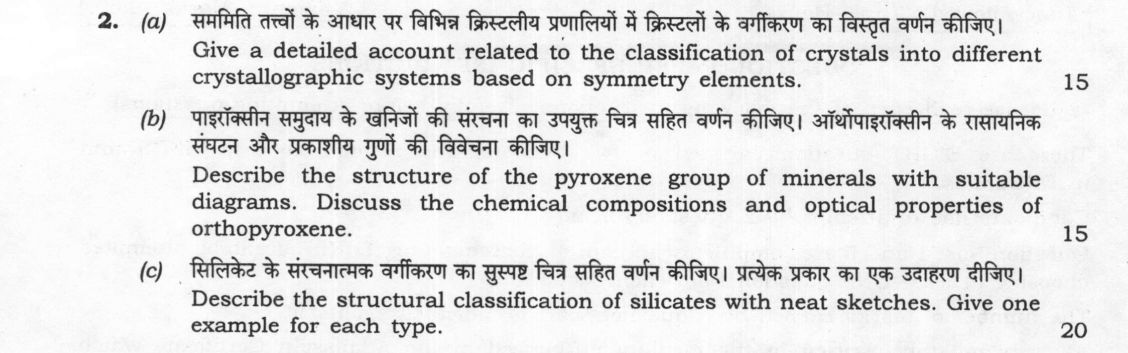
Give a detailed account related to the classification of crystals into different crystallographic systems based on symmetry elements. 15 marks
Describe the structure of the pyroxene group of minerals with suitable diagrams. Discuss the chemical compositions and optical properties of orthopyroxene. 15 marks
Describe the structural classification of silicates with neat sketches. Give one example for each type. 20 marks
हिंदी में प्रश्न पढ़ें
सममिति तत्त्वों के आधार पर विभिन्न क्रिस्टलीय प्रणालियों में क्रिस्टलों के वर्गीकरण का विस्तृत वर्णन कीजिए। (15 अंक)
पाइरोक्सीन समुदाय के खनिजों की संरचना का उपयुक्त चित्र सहित वर्णन कीजिए। ऑर्थोपाइरोक्सीन के रासायनिक संघटन और प्रकाशीय गुणों की विवेचना कीजिए। (15 अंक)
सिलिकेट के संरचनात्मक वर्गीकरण का सुस्पष्ट चित्र सहित वर्णन कीजिए। प्रत्येक प्रकार का एक उदाहरण दीजिए। (20 अंक)
Model answer
Written by UPSC Answer Check against this question's marking rubric, to the expected length. UPSC does not publish answers for Mains — this is one way to score well, not an official key.
Crystal chemistry is governed by two linked principles: the symmetry of the unit cell and the degree of polymerisation of SiO4 tetrahedra. The seven crystallographic systems are ordered from highest to lowest symmetry and are defined by their characteristic rotation axes, mirror planes and inversion centres; their Hermann-Mauguin symbols encode these elements, with m denoting a mirror plane and -1 an inversion centre. Cubic (m3m) has four 3-fold axes and a=b=c, α=β=γ=90°. Tetragonal (4/mmm) has one 4-fold axis, a=b≠c, all angles 90°. Hexagonal (6/mmm) has one 6-fold axis, a=b≠c, α=β=90°, γ=120°. Trigonal (3m or 32) has one 3-fold axis, a=b=c, α=β=γ≠90°. Orthorhombic (mmm) has three mutually perpendicular 2-fold axes, a≠b≠c, all angles 90°. Monoclinic (2/m) has one 2-fold axis or mirror plane, a≠b≠c, α=γ=90°, β≠90°. Triclinic (1 or -1) has at most an inversion centre, a≠b≠c, α≠β≠γ≠90°. The axial relationships can be visualised as a table, with cubic at the top and triclinic at the bottom; each step reduces symmetry and increases metric freedom. Holohedral forms possess the full symmetry of the system and show all crystal faces allowed by that symmetry; hemihedral forms lack some symmetry elements, often mirrors or inversion, and may occur as enantiomorphic pairs.
Pyroxene structure and orthopyroxene. Pyroxenes are inosilicates built from single chains of corner-sharing SiO4 tetrahedra, (SiO3)2−. A side-view diagram shows each tetrahedron sharing two basal oxygens with neighbours, producing a repeating chain parallel to the c-axis; Mg, Fe, Ca and Mn occupy octahedral sites between chains. In orthopyroxene the orthorhombic structure has two non-equivalent octahedral sites, M1 and M2, occupied mainly by Mg and Fe. The weak inter-chain bonding gives two cleavages at about 87° and 93°, reflecting chain periodicity. This differs from amphiboles, whose double chains (Si4O11)6− are made of two single chains sharing basal oxygens and cleave near 56° and 124°. Orthopyroxene is an orthorhombic MgSiO3–FeSiO3 solid solution, enstatite–ferrosilite, with minor Ca, Mn and Al. It is colourless to pale brown or green, pleochroic, and has low to moderate birefringence: enstatite δ≈0.009–0.011, hypersthene δ≈0.010–0.016, ferrosilite δ≈0.017–0.020. 2Vx is composition-dependent and diagnostic; ferrosilite is biaxial negative with 2Vx≈30–50°, while enstatite has a larger 2Vx. Optically, orthopyroxene shows straight extinction and low first-order interference colours, with 2Vx measured in the XZ section.
Silicate structural classification. Silicates are classified by tetrahedral polymerisation, and the Si:O ratios are the basis for distinguishing silicate classes in thin section and for predicting cleavage, density, petrogenetic behaviour and chemical compatibility in magmas. Nesosilicates have isolated SiO4^4− groups, Si:O=1:4, with no bridging oxygens; olivine (Mg,Fe)2SiO4 occurs in Indian ophiolites and cratonic ultramafics, while zircon is an accessory in peninsular granites. Sorosilicates have paired Si2O7^6− groups, Si:O=2:7, linked by one bridging oxygen; epidote occurs in Indian metamorphic rocks and pegmatites. Cyclosilicates form closed rings, commonly Si6O18^12−, Si:O=1:3; beryl, Al2Be3Si6O18, is found in Indian pegmatites. Inosilicates have chains: single chains (SiO3)2−, Si:O=1:3, as in pyroxenes such as diopside and enstatite, and double chains (Si4O11)6−, Si:O=4:11, as in amphiboles such as hornblende. Phyllosilicates form sheets of Si2O5^2−, Si:O=2:5, with tetrahedral sheets linked by octahedral M layers; muscovite and biotite are classic examples from Indian mica belts. Tectosilicates form three-dimensional frameworks, Si:O=1:2, in which all four apical oxygens are shared; quartz and feldspar dominate Indian granites and peninsular gneisses. Sketches would show isolated tetrahedra, a paired tetrahedron, a six-membered ring, a single chain, a double chain, a sheet, and a fully connected framework.
Thus, symmetry elements define crystal systems, while silicate polymerisation controls mineral structure, cleavage, chemistry and optical behaviour. This structural diversity underlies the petrogenetic significance of silicates in crustal rocks and their roles in magmatic differentiation, from ultramafic olivine to granitic quartz and feldspar.
What "Describe" is asking you to do
Give a full, ordered account of the thing named — its parts, stages or mechanism — in the sequence in which it actually exists or occurs. Most describe questions come from the science optionals, where the marks sit in correct technical detail and, where the stem says so, a labelled diagram.
Structure that answers it
One-line identification of the subject → the parts or stages in their real order, each with its defining detail → labelled diagram where the subject is structural → closing line on function or significance
Where marks are lost
Loose general prose where the examiner is ticking named parts, correct terminology and their sequence; and in the General Studies papers, turning to evaluation before the description is finished.
How this answer will be evaluated
Approach
(a) account for: state the phenomenon > the causes in order of weight > conclusion | (b) describe: define > structure or process in order > labelled diagram > significance | (c) describe: define > structure or process in order > labelled diagram > significance Full marks: Complete classification with all symmetry elements, accurate pyroxene structure with optical data, all 6 silicate types with sketches and examples.
Key points expected
- List 7 crystallographic systems
- Define symmetry elements (axis, plane, center)
- Map elements to specific systems
- Mention crystal classes or point groups
- Draw single chain silicate structure
- State orthopyroxene chemical formula
- List optical properties (biaxial, 2V)
- Mention cleavage and hardness
Evaluation rubric
Each sub-part is marked on its own, against the marks and word limit printed on the paper.
- (a) Classification of crystals into 7 systems based on symmetry elements. 15 marks
account for— state the phenomenon → the causes in order of weight → conclusion
Must cover
- List 7 crystallographic systems
- Define symmetry elements (axis, plane, center)
- Map elements to specific systems
- Mention crystal classes or point groups
Loses marks
- Confusing systems with lattices
- Missing symmetry element definitions
Earns more
- Mention 32 crystal classes
- Reference Indian mineral examples
Extra mark
- Mention 14 Bravais lattices
- Reference specific Indian crystallographic studies
- (b) Pyroxene structure, orthopyroxene composition and optical properties. 15 marks
describe— define → structure or process in order → labelled diagram → significance
Must cover
- Draw single chain silicate structure
- State orthopyroxene chemical formula
- List optical properties (biaxial, 2V)
- Mention cleavage and hardness
Loses marks
- Confusing pyroxene with amphibole
- Missing optical property details
Earns more
- Mention enstatite/ferrosilite series
- Reference Indian occurrences
Extra mark
- Mention specific Indian pyroxene deposits
- Reference stratigraphic age of occurrences
- (c) Structural classification of silicates with sketches and examples. 20 marks
describe— define → structure or process in order → labelled diagram → significance
Must cover
- List 6 silicate structural types
- Draw neat sketches for each type
- Give one example for each type
- Explain Si:O ratio for each
Loses marks
- Missing sketches or diagrams
- Confusing structural types
Earns more
- Mention specific mineral examples
- Reference Indian occurrences
Extra mark
- Mention specific Indian silicate deposits
- Reference economic importance
Practice this exact question
Write your answer and it is marked point by point against the model answer above — what you covered, what you missed, what you got wrong.
Evaluate my answer →More from Geology 2025 Paper II
- Q1 Answer the following questions in about 150 words each: (a) Describe the symmetry element…
- Q2 (a) Give a detailed account related to the classification of crystals into different crys…
- Q3 (a) What are migmatites? Describe the important types of migmatites and the processes of…
- Q4 (a) Discuss the genesis of any four sedimentary structures which are helpful in palaeocur…
- Q5 Answer the following questions in about 150 words each: (a) What do you understand by met…