Paper I — Q6
(a) Compare the major morphological characters which differentiate Hominidae from ape-like primates. Discuss the evolutionary…
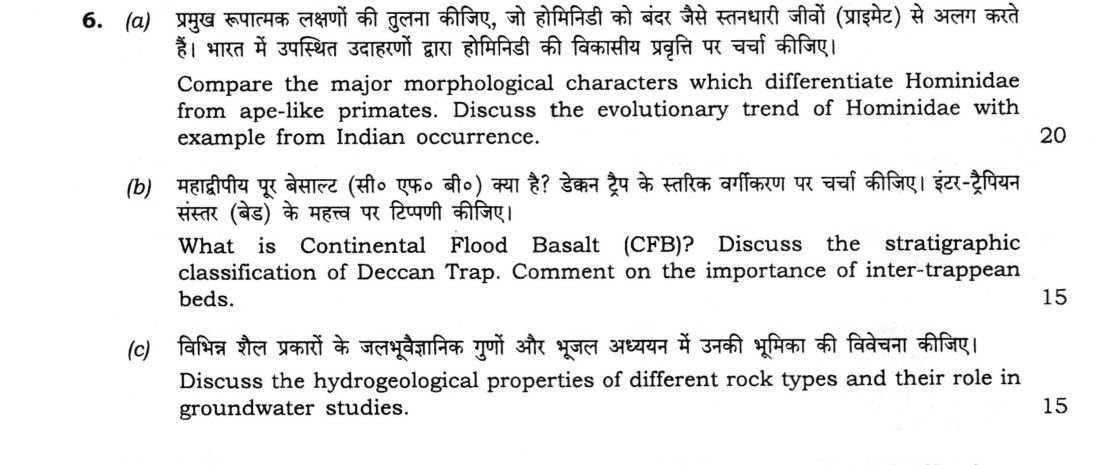
Compare the major morphological characters which differentiate Hominidae from ape-like primates. Discuss the evolutionary trend of Hominidae with example from Indian occurrence. 20 marks
What is Continental Flood Basalt (CFB)? Discuss the stratigraphic classification of Deccan Trap. Comment on the importance of inter-trappean beds. 15 marks
Discuss the hydrogeological properties of different rock types and their role in groundwater studies. 15 marks
हिंदी में प्रश्न पढ़ें
प्रमुख रूपात्मक लक्षणों की तुलना कीजिए, जो होमिनिडी को बंदर जैसे स्थानधारी जीवों (प्राइमेट) से अलग करते हैं। भारत में उपस्थित उदाहरणों द्वारा होमिनिडी की विकासीय प्रवृत्ति पर चर्चा कीजिए। (20 अंक)
महाद्वीपीय पूर बेसाल्ट (सी० एफ० बी०) क्या है? डेक्कन ट्रैप के स्तरिक वर्गीकरण पर चर्चा कीजिए। इंटर-ट्रैपियन संस्तर (बेड) के महत्व पर टिप्पणी कीजिए। (15 अंक)
विभिन्न शैल प्रकारों के जलभूवैज्ञानिक गुणों और भूजल अध्ययन में उनकी भूमिका की विवेचना कीजिए। (15 अंक)
Model answer
Drafted with AI by UPSC Answer Check against this question's marking rubric, to the expected length. UPSC does not publish answers for Mains — this is one way to score well, not an official key. How we build rubrics and answers.
(a) Hominidae versus ape-like primates, and hominid evolution (20 marks)
Comparison. Here Hominidae means the human family, the bipedal hominins.
- Locomotion: hominins are habitually bipedal, with a foramen magnum placed forward under the skull, an S-shaped spine, a short broad pelvis, valgus knees and an arched foot with a non-opposable big toe. Apes are quadrupedal or knuckle-walkers, with a backward foramen magnum, a C-shaped spine, a long narrow pelvis and a grasping foot.
- Brain: about 400–500 cc in apes, rising from about 450 cc in Australopithecus to about 1350 cc in modern humans, with a high forehead.
- Teeth and jaw: hominins have small canines with no diastema, a parabolic dental arch and thick enamel; apes have large canines, a diastema and a U-shaped arch.
- Face and skull: the hominin face is flat (orthognathous) with a chin and reduced brow ridges; ape faces are prognathous, with a sagittal crest and no chin.
- Limbs and hand: hominin legs are longer than arms, and the hand has a precision grip. Apes have long arms.
Evolutionary trend. The sequence runs from Ardipithecus and Australopithecus through Homo habilis and Homo erectus to archaic and modern Homo sapiens, with increasing brain size, perfected bipedalism, reduction of face and teeth, and growing use of tools, fire and speech.
Indian evidence. The Siwalik Miocene–Pliocene beds (Haritalyangar, Ramnagar) yielded Sivapithecus (once called Ramapithecus), a ground-adapted ape, now regarded as related to the orangutan rather than as a hominin ancestor, and the giant ape Gigantopithecus. The hominin record in India begins with the Acheulian tools of Attirampakkam and the Narmada skull cap of Hathnora (an archaic Homo, about 0.2–0.5 million years old).
(b) Continental flood basalt, stratigraphy of the Deccan Trap and inter-trappean beds (15 marks)
Continental flood basalt (CFB). A CFB is a very large volume of basalt lava (up to millions of cubic kilometres), poured out from fissures onto the continent in a geologically short time, often about a million years, covering hundreds of thousands of square kilometres. The flows are mainly tholeiitic, low in viscosity, nearly horizontal and stacked, forming stepped "trap" plateaus, with columnar jointing, vesicular and amygdaloidal tops, red boles between flows, and dyke swarms as feeders. They are linked with mantle plumes and continental break-up. Examples are the Deccan Traps (66 Ma), Siberian Traps (252 Ma), Columbia River Basalts, Paraná–Etendeka, Karoo–Ferrar and Ethiopian Traps.
Stratigraphy of the Deccan Trap. The classical division is into Lower, Middle and Upper Traps. In the Western Ghats it is the Sahyadri Group, which is divided from bottom to top into three subgroups.
- Kalsubai: Jawhar, Igatpuri, Neral, Thakurvadi and Bhimashankar Formations.
- Lonavala: Khandala and Bushe Formations.
- Wai: Poladpur, Ambenali and Mahabaleshwar Formations.
Inter-trappean beds. These thin freshwater sedimentary beds (limestone, chert, shale, clay) formed in the pauses between eruptions. Their importance is that they contain fossils (plants, molluscs, ostracods, fish, frogs), which give the age (Late Cretaceous to Early Paleocene) and the humid palaeoenvironment, show the gaps between flows, and act as marker horizons and local aquifers.
(c) Hydrogeological properties of rock types and their role in groundwater studies (15 marks)
Properties. Porosity is the fraction of void space; permeability, measured as hydraulic conductivity K, is the ease of flow; specific yield Sy is the volume of water that drains by gravity per unit volume of aquifer; transmissivity T = Kb is the flow through the full thickness b; and storativity S is the water released per unit area per unit fall of head (S ≈ Sy in an unconfined aquifer, and 10⁻⁵–10⁻³ in a confined one).
Rock types.
- Unconsolidated sand and gravel: porosity 25–40%, high K, Sy 15–30%, excellent aquifers. Clay has high porosity but negligible K, so it is an aquitard.
- Sandstone: porosity 5–30%, moderate K and Sy 5–15%, a good aquifer, with fractures adding to flow.
- Shale: low porosity and K, so an aquiclude unless fractured.
- Limestone: low primary porosity, but solution channels and joints in karst give very high K and yields.
- Crystalline hard rock: primary porosity below 1%. Groundwater lies in the weathered layer and in fractures, Sy is 0.5–3%, and yields are small and variable.
- Basalt: groundwater lies in vesicular flow tops, joints, weathered layers and inter-trappean beds; yields are low to moderate.
Use. These properties allow aquifers to be identified and wells sited and designed, T and S to be found by pumping tests, flow to be computed from Darcy's law, recharge and resources to be estimated (Sy × area × water-table fluctuation), and recharge structures to be designed.
How this answer will be evaluated
Evaluation rubric
Each sub-part is marked on its own, against the marks and word limit printed on the paper.
- (a) Compare the major morphological characters that differentiate Hominidae from ape-like primates, and discuss the evolutionary trend of Hominidae with examples from Indian occurrence (20 marks). 20 marks
Must cover
- Locomotion and posture: bipedalism, foramen magnum, S-shaped spine, pelvis and foot compared with apes
- Brain size (about 450 cc to 1350 cc), dentition (small canines, no diastema, parabolic arch), face and skull compared
- Evolutionary sequence from Australopithecus and Homo habilis through Homo erectus to Homo sapiens with increasing brain size and tool use
- Indian evidence: Siwalik Sivapithecus and Gigantopithecus, Narmada skull cap (Hathnora), and Acheulian tools
Loses marks
- Calling Sivapithecus or Ramapithecus a direct human ancestor.
- Describing hominid evolution with no Indian example.
- Confusing hominoids with hominins without stating the definition.
Earns more
- Clear point-by-point comparison, not a description of one group only.
- Correct interpretation that Sivapithecus is an ape allied to the orangutan.
Extra mark
- Mention of Attirampakkam or of Indian stone-tool cultures
- (b) What is a continental flood basalt (CFB)? Discuss the stratigraphic classification of the Deccan Trap and comment on the importance of inter-trappean beds (15 marks). 15 marks
Must cover
- CFB defined: huge volume of basalt from fissures in a short time, tholeiitic, horizontal flows, red boles, dyke feeders
- Global examples: Deccan, Siberian, Columbia River, Paraná–Etendeka, Karoo–Ferrar, Ethiopian
- Deccan stratigraphy: Lower, Middle and Upper Traps, and Sahyadri Group with Kalsubai, Lonavala and Wai subgroups and their formations
- Inter-trappean beds: freshwater sediments with fossils that give age and palaeoenvironment, mark pauses and act as aquifers
Loses marks
- Placing the formations in the wrong order.
- Calling the Deccan Trap rhyolitic or granitic.
- Confusing inter-trappean with infra-trappean (Lameta) beds.
Earns more
- Formations named in correct order.
- Age of the Deccan (Late Cretaceous to Early Paleocene, about 66 Ma).
Extra mark
- Link of CFBs with plumes, break-up or mass extinction
- (c) Discuss the hydrogeological properties of different rock types and their role in groundwater studies (15 marks). 15 marks
Must cover
- Definitions: porosity, permeability or hydraulic conductivity, specific yield, transmissivity and storativity
- Sand and gravel, sandstone and clay or shale with typical properties (aquifer versus aquitard)
- Limestone (karst), crystalline hard rock and basalt: secondary porosity in fractures, weathered zones and vesicular flow tops
- Uses: aquifer identification, well siting, pumping tests for T and S, Darcy flow, recharge and resource estimation
Loses marks
- Equating porosity with permeability.
- Treating clay as a good aquifer because of high porosity.
- Omitting the role in groundwater studies.
Earns more
- Numeric ranges of porosity, Sy or K for rock types.
- Distinction between primary and secondary porosity.
Extra mark
- Mention of confined versus unconfined storativity
What "Differentiate" is asking you to do
Fix the criteria on which the two differ and apply each criterion to both, so the pair can no longer be mixed up. Differentiate stems usually carry a further task attached — describe the mechanism, set out the principles, discuss the applications — and that task carries its own marks.
Structure that answers it
Criterion 1 applied to both → criterion 2 → criterion 3 → summary line or table → the attached second demand answered in full
Where marks are lost
Two standalone definitions placed side by side, leaving the reader to extract the difference. The second common loss is running out of space before the attached task, which is often worth as much as the differentiation.
Practice this exact question
Write your answer and it is marked point by point against the model answer above — what you covered, what you missed, what you got wrong.
Evaluate my answer →More from Geology 2026 Paper I
- Q3 (a) Discuss the importance of Remote Sensing (RS) and Geographic Information System (GIS)…
- Q4 (a) What is earthquake? How is the epicenter of an earthquake determined? Discuss on the…
- Q5 Answer the following questions in about 150 words each : (a) Discuss the conditions requi…
- Q6 (a) Compare the major morphological characters which differentiate Hominidae from ape-lik…
- Q7 (a) Discuss the stratigraphic classification and depositional environment of Cuddapah Sup…
- Q8 (a) What are landslides and avalanches? Discuss the causes and effects of landslides. Enu…