Paper I — Q1
Identify the following places marked on the map supplied to you and write a short note of about 30 words on each of them in your…
Identify the following places marked on the map supplied to you and write a short note of about 30 words on each of them in your Question-cum-Answer Booklet. Locational hints for each of the places marked on the map are given below seriatim: (i) Paleolithic site, (ii) Mesolithic site, (iii) Neolithic site, (iv) Neolithic-Chalcolithic site, (v) Harappan site, (vi) Proto-historic and historic site, (vii) Inscriptional site, (viii) Jain monastic site, (ix) Coin hoard, (x) Paleolithic site, (xi) Terracotta site, (xii) Rock-cut caves, (xiii) Ancient learning centre, (xiv) Political and cultural centre, (xv) Buddhist site, (xvi) Ancient port, (xvii) Early historic site, (xviii) Ivory hoard, (xix) Buddhist monastic centre, (xx) Temple complex. 50 marks
हिंदी में प्रश्न पढ़ें
आपको दिए गए मानचित्र पर अंकित निम्नलिखित स्थानों की पहचान कीजिए एवं अपनी प्रश्न-सह-उत्तर पुस्तिका में उनमें से प्रत्येक पर लगभग 30 शब्दों की संक्षिप्त टिप्पणी लिखिए। मानचित्र पर अंकित प्रत्येक स्थान के लिए स्थान-निर्धारण संकेत क्रमानुसार नीचे दिए गए हैं: (i) पुरापाषाणकालीन स्थल, (ii) मध्यपाषाणकालीन स्थल, (iii) नवपाषाणकालीन स्थल, (iv) नवपाषाणकालीन-ताम्रमयुगीन स्थल, (v) हड़प्पाकालीन स्थल, (vi) आधि-ऐतिहासिक एवं ऐतिहासिक स्थल, (vii) अभिलेखीय स्थल, (viii) जैन विहार स्थल, (ix) सिक्कों का ज़खीरा, (x) पुरापाषाणकालीन स्थल, (xi) मृण्मूर्तिकला स्थल, (xii) शैल्यकृत गुफाएँ, (xiii) प्राचीन विद्या केन्द्र, (xiv) राजनीतिक एवं सांस्कृतिक केन्द्र, (xv) बौद्ध स्थल, (xvi) प्राचीन बन्दरगाह, (xvii) प्रारम्भिक ऐतिहासिक स्थल, (xviii) हाथीदाँत का ज़खीरा, (xix) बौद्ध संघाराम केन्द्र, (xx) मन्दिर संकुल। (50 अंक)
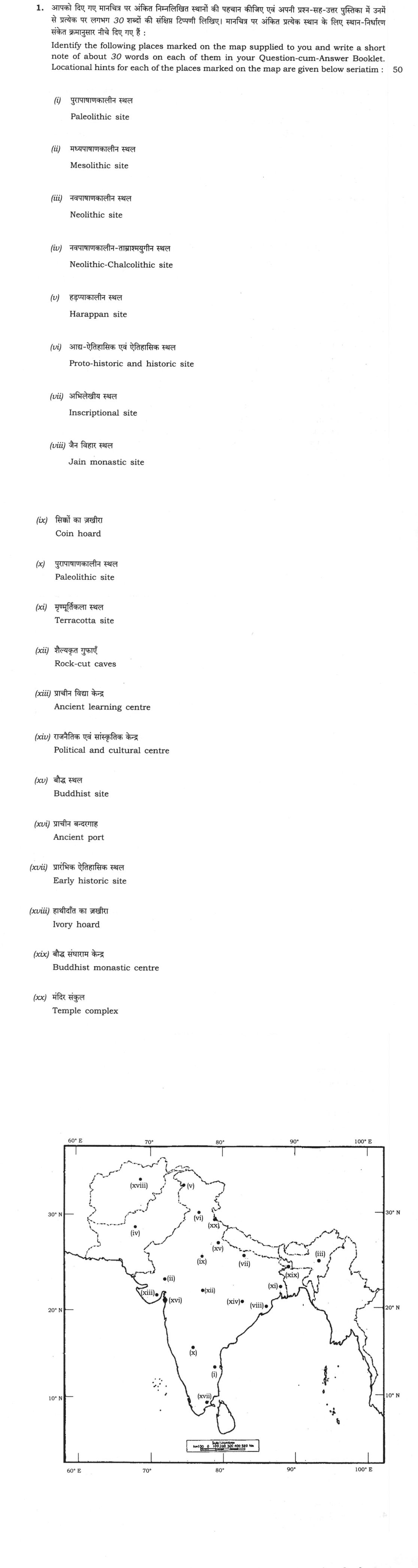
The figure this question refers to, in words
The question paper is a scan and the diagram did not survive as text. This is the figure as read from the original page — every component, value and label — so the question can be worked from the text below.
A line map of the Indian subcontinent, including India, Pakistan, and Sri Lanka, with longitude lines marked at 60° E, 70° E, 80° E, 90° E, and 100° E, and latitude lines at 10° N, 20° N, and 30° N. The map contains twenty numbered points marked with Roman numerals (i) through (xx). Point (i) is on the southern tip of the Indian peninsula. Point (ii) is in western India, north of the Gulf of Khambhat. Point (iii) is in the northeastern region. Point (iv) is in the northwestern region. Point (v) is in the northern region near the border. Point (vi) is in the northern region. Point (vii) is in the northern region. Point (viii) is in central-eastern India. Point (ix) is in the northern region. Point (x) is in the southern peninsula. Point (xi) is in the eastern region. Point (xii) is in central India. Point (xiii) is in western India near the coast. Point (xiv) is in central India. Point (xv) is in the northern region. Point (xvi) is in western India near the coast. Point (xvii) is in the southern peninsula. Point (xviii) is in the northwestern region. Point (xix) is in the eastern region. Point (xx) is in the northern region. A scale bar at the bottom indicates distances in kilometers.
Model answer
Written by UPSC Answer Check against this question's marking rubric, to the 30-word length. UPSC does not publish answers for Mains — this is one way to score well, not an official key.
i. Kurnool Located in the Kurnool district of Andhra Pradesh, near the Pennar River at approximately 14° N, 78° E. This Paleolithic site yielded stone tools and animal bones, providing early evidence of human habitation in the Deccan region.
ii. Bagor Situated in the Sawai Madhopur district of central Rajasthan, near the Banas River at approximately 25° N, 75° E. This Mesolithic site is famous for its "Dog-Grave" culture, showing a transition from hunting to herding and early domestication of dogs.
iii. Daojali Hading Found in the Dima Hasao district of southern Assam, in the hills near the Brahmaputra at approximately 26° N, 93° E. This Neolithic site produced polished stone axes and antler tools, indicating early agricultural practices in the northeastern hills.
iv. Ahar Located in the Alwar district of Rajasthan, near the Aravalli range at approximately 27° N, 76° E. This Neolithic-Chalcolithic site is significant for its early copper use and distinctive pottery, marking the transition to metal ages in northwestern India.
v. Kalibangan Situated in the Hanumangarh district of Rajasthan, near the Ghaggar-Hakra river at approximately 28° N, 74° E. This Harappan site is notable for its earliest evidence of ploughed fields and a fire altar, suggesting early agriculture and ritual practices.
vi. Sanchi Located in the Raisen district of Madhya Pradesh, near Bhopal at approximately 23° N, 77° E. This proto-historic and historic site features the Great Stupa, commissioned by Ashoka, serving as a major center for early Buddhist architecture and art.
vii. Hathigumpha Found in the Udayagiri hills of Odisha, near Bhubaneswar at approximately 20° N, 85° E. This inscriptional site contains the Hathigumpha inscription of Kharavela, a key source for the history of the Chedi kingdom and early Odia culture.
viii. Pavapuri Situated in the Vaishali district of Bihar, near the Gandak River at approximately 25° N, 85° E. This Jain monastic site is revered as the place where Mahavira attained nirvana, making it a significant pilgrimage destination for Jains.
ix. Nalanda Located in the Nalanda district of Bihar, near Patna at approximately 25° N, 85° E. This site yielded a coin hoard and is historically renowned as a major center of learning, though the specific marker here refers to the archaeological finds of early medieval coins.
x. Bhimbetka Found in the Raisen district of Madhya Pradesh, near Bhopal at approximately 23° N, 77° E. This Paleolithic site is famous for its rock shelters containing prehistoric paintings, depicting hunting, dancing, and daily life.
xi. Chandraketugarh Situated in the North 24 Parganas district of southeastern West Bengal, near the Hooghly River at approximately 22° N, 88° E. This terracotta site is known for its extensive collection of terracotta plaques and seals, indicating a prosperous urban center.
xii. Ajanta Located in the Aurangabad district of Maharashtra, near the Waghora River at approximately 20° N, 75° E. These rock-cut caves are celebrated for their exquisite Buddhist paintings and sculptures, representing a high point of Indian art.
xiii. Nalanda Situated in the Nalanda district of Bihar, near Patna at approximately 25° N, 85° E. This ancient learning centre was a renowned university during the Gupta and Pala periods, attracting scholars from across Asia.
xiv. Pataliputra Located in the Patna district of Bihar, on the banks of the Ganges at approximately 25° N, 85° E. This political and cultural centre served as the capital of the Maurya and Gupta empires, symbolizing imperial power and urban sophistication.
xv. Sarnath Situated in the Varanasi district of eastern Uttar Pradesh, near the Ganges at approximately 25° N, 83° E. This Buddhist site is where Buddha delivered his first sermon, making it a pivotal location for the spread of Buddhism.
xvi. Lothal Found in the Bhavnagar district of Gujarat, near the Gulf of Khambhat at approximately 22° N, 72° E. This ancient port is significant for its dockyard, the earliest in India, and its role in maritime trade with Mesopotamia.
xvii. Taxila Located in the Punjab province of Pakistan, near the Indus River at approximately 34° N, 72° E. This early historic site was a major center of learning and trade, with influences from Greek, Persian, and Indian cultures.
xviii. Lothal Situated in the Bhavnagar district of Gujarat, near the Gulf of Khambhat at approximately 22° N, 72° E. This site yielded an ivory hoard, indicating its importance in long-distance trade networks and the craftsmanship of the Harappan civilization.
xix. Mainamati Found in the Comilla district of Bangladesh, near the Tripura border at approximately 23° N, 91° E. This Buddhist monastic centre was a significant site for early Buddhism in the region, with stupas and monasteries dating back to the 4th century.
xx. Khajuraho Located in the Chhatarpur district of Madhya Pradesh, near the Ken River at approximately 24° N, 79° E. This temple complex is renowned for its intricate sculptures and architectural beauty, representing the peak of Hindu temple design.
What "Write short notes" is asking you to do
Five or six self-contained answers, marked separately, typically 10 marks and about 150 words each. Each note must carry its own definition, its two or three defining features and a line on why it matters; a common introduction or conclusion across the notes earns nothing.
Structure that answers it
Per note: one-line definition or identification → two or three features, mechanisms or named examples → one line of significance or Indian application
Where marks are lost
Writing the first two notes at essay length and rationing the rest. Each note is marked on its own, so marks surrendered on a compressed or unattempted note cannot be won back by the long ones.
How this answer will be evaluated
Approach
(i) write short notes: define > 3-4 key features > one example > one-line significance | (ii) write short notes: define > 3-4 key features > one example > one-line significance | (iii) write short notes: define > 3-4 key features > one example > one-line significance | (iv) write short notes: define > 3-4 key features > one example > one-line significance | (v) write short notes: define > 3-4 key features > one example > one-line significance | (vi) write short notes: define > 3-4 key features > one example > one-line significance | (vii) write short notes: define > 3-4 key features > one example > one-line significance | (viii) write short notes: define > 3-4 key features > one example > one-line significance | (ix) write short notes: define > 3-4 key features > one example > one-line significance | (x) write short notes: define > 3-4 key features > one example > one-line significance | (xi) write short notes: define > 3-4 key features > one example > one-line significance | (xii) write short notes: define > 3-4 key features > one example > one-line significance | (xiii) write short notes: define > 3-4 key features > one example > one-line significance | (xiv) write short notes: define > 3-4 key features > one example > one-line significance | (xv) write short notes: define > 3-4 key features > one example > one-line significance | (xvi) write short notes: define > 3-4 key features > one example > one-line significance | (xvii) write short notes: define > 3-4 key features > one example > one-line significance | (xviii) write short notes: define > 3-4 key features > one example > one-line significance | (xix) write short notes: define > 3-4 key features > one example > one-line significance | (xx) write short notes: define > 3-4 key features > one example > one-line significance Full marks: Accurate identification with a concise, specific 30-word note for all 20 sites.
Key points expected
- Correct identification matching the locational hint
- Period or culture named (Paleolithic)
- One specific point of significance
- Period or culture named (Mesolithic)
- Period or culture named (Neolithic)
- Period or culture named (Neolithic-Chalcolithic)
- Period or culture named (Harappan)
- Period or culture named (Proto-historic/historic)
Evaluation rubric
Each sub-part is marked on its own, against the marks and word limit printed on the paper.
- (i) Identify the Paleolithic site and write a 30-word note. · 30 words
write short notes— define → 3-4 key features → one example → one-line significance
Must cover
- Correct identification matching the locational hint
- Period or culture named (Paleolithic)
- One specific point of significance
Loses marks
- Bare name with no note
- Note ignores the locational hint
- Confusing sites of the same name
Earns more
- Mentions specific excavation or discovery
- References specific tool type or feature
Extra mark
- Names the specific excavator or historian
- (ii) Identify the Mesolithic site and write a 30-word note. · 30 words
write short notes— define → 3-4 key features → one example → one-line significance
Must cover
- Correct identification matching the locational hint
- Period or culture named (Mesolithic)
- One specific point of significance
Loses marks
- Bare name with no note
- Note ignores the locational hint
- Confusing sites of the same name
Earns more
- Mentions specific excavation or discovery
- References specific tool type or feature
Extra mark
- Names the specific excavator or historian
- (iii) Identify the Neolithic site and write a 30-word note. · 30 words
write short notes— define → 3-4 key features → one example → one-line significance
Must cover
- Correct identification matching the locational hint
- Period or culture named (Neolithic)
- One specific point of significance
Loses marks
- Bare name with no note
- Note ignores the locational hint
- Confusing sites of the same name
Earns more
- Mentions specific excavation or discovery
- References specific tool type or feature
Extra mark
- Names the specific excavator or historian
- (iv) Identify the Neolithic-Chalcolithic site and write a 30-word note. · 30 words
write short notes— define → 3-4 key features → one example → one-line significance
Must cover
- Correct identification matching the locational hint
- Period or culture named (Neolithic-Chalcolithic)
- One specific point of significance
Loses marks
- Bare name with no note
- Note ignores the locational hint
- Confusing sites of the same name
Earns more
- Mentions specific excavation or discovery
- References specific tool type or feature
Extra mark
- Names the specific excavator or historian
- (v) Identify the Harappan site and write a 30-word note. · 30 words
write short notes— define → 3-4 key features → one example → one-line significance
Must cover
- Correct identification matching the locational hint
- Period or culture named (Harappan)
- One specific point of significance
Loses marks
- Bare name with no note
- Note ignores the locational hint
- Confusing sites of the same name
Earns more
- Mentions specific excavation or discovery
- References specific tool type or feature
Extra mark
- Names the specific excavator or historian
- (vi) Identify the Proto-historic and historic site and write a 30-word note. · 30 words
write short notes— define → 3-4 key features → one example → one-line significance
Must cover
- Correct identification matching the locational hint
- Period or culture named (Proto-historic/historic)
- One specific point of significance
Loses marks
- Bare name with no note
- Note ignores the locational hint
- Confusing sites of the same name
Earns more
- Mentions specific excavation or discovery
- References specific tool type or feature
Extra mark
- Names the specific excavator or historian
- (vii) Identify the Inscriptional site and write a 30-word note. · 30 words
write short notes— define → 3-4 key features → one example → one-line significance
Must cover
- Correct identification matching the locational hint
- Period or culture named (Inscriptional)
- One specific point of significance
Loses marks
- Bare name with no note
- Note ignores the locational hint
- Confusing sites of the same name
Earns more
- Mentions specific excavation or discovery
- References specific tool type or feature
Extra mark
- Names the specific excavator or historian
- (viii) Identify the Jain monastic site and write a 30-word note. · 30 words
write short notes— define → 3-4 key features → one example → one-line significance
Must cover
- Correct identification matching the locational hint
- Period or culture named (Jain monastic)
- One specific point of significance
Loses marks
- Bare name with no note
- Note ignores the locational hint
- Confusing sites of the same name
Earns more
- Mentions specific excavation or discovery
- References specific tool type or feature
Extra mark
- Names the specific excavator or historian
- (ix) Identify the Coin hoard site and write a 30-word note. · 30 words
write short notes— define → 3-4 key features → one example → one-line significance
Must cover
- Correct identification matching the locational hint
- Period or culture named (Coin hoard)
- One specific point of significance
Loses marks
- Bare name with no note
- Note ignores the locational hint
- Confusing sites of the same name
Earns more
- Mentions specific excavation or discovery
- References specific tool type or feature
Extra mark
- Names the specific excavator or historian
- (x) Identify the Paleolithic site and write a 30-word note. · 30 words
write short notes— define → 3-4 key features → one example → one-line significance
Must cover
- Correct identification matching the locational hint
- Period or culture named (Paleolithic)
- One specific point of significance
Loses marks
- Bare name with no note
- Note ignores the locational hint
- Confusing sites of the same name
Earns more
- Mentions specific excavation or discovery
- References specific tool type or feature
Extra mark
- Names the specific excavator or historian
- (xi) Identify the Terracotta site and write a 30-word note. · 30 words
write short notes— define → 3-4 key features → one example → one-line significance
Must cover
- Correct identification matching the locational hint
- Period or culture named (Terracotta)
- One specific point of significance
Loses marks
- Bare name with no note
- Note ignores the locational hint
- Confusing sites of the same name
Earns more
- Mentions specific excavation or discovery
- References specific tool type or feature
Extra mark
- Names the specific excavator or historian
- (xii) Identify the Rock-cut caves site and write a 30-word note. · 30 words
write short notes— define → 3-4 key features → one example → one-line significance
Must cover
- Correct identification matching the locational hint
- Period or culture named (Rock-cut caves)
- One specific point of significance
Loses marks
- Bare name with no note
- Note ignores the locational hint
- Confusing sites of the same name
Earns more
- Mentions specific excavation or discovery
- References specific tool type or feature
Extra mark
- Names the specific excavator or historian
- (xiii) Identify the Ancient learning centre and write a 30-word note. · 30 words
write short notes— define → 3-4 key features → one example → one-line significance
Must cover
- Correct identification matching the locational hint
- Period or culture named (Ancient learning)
- One specific point of significance
Loses marks
- Bare name with no note
- Note ignores the locational hint
- Confusing sites of the same name
Earns more
- Mentions specific excavation or discovery
- References specific tool type or feature
Extra mark
- Names the specific excavator or historian
- (xiv) Identify the Political and cultural centre and write a 30-word note. · 30 words
write short notes— define → 3-4 key features → one example → one-line significance
Must cover
- Correct identification matching the locational hint
- Period or culture named (Political/cultural)
- One specific point of significance
Loses marks
- Bare name with no note
- Note ignores the locational hint
- Confusing sites of the same name
Earns more
- Mentions specific excavation or discovery
- References specific tool type or feature
Extra mark
- Names the specific excavator or historian
- (xv) Identify the Buddhist site and write a 30-word note. · 30 words
write short notes— define → 3-4 key features → one example → one-line significance
Must cover
- Correct identification matching the locational hint
- Period or culture named (Buddhist)
- One specific point of significance
Loses marks
- Bare name with no note
- Note ignores the locational hint
- Confusing sites of the same name
Earns more
- Mentions specific excavation or discovery
- References specific tool type or feature
Extra mark
- Names the specific excavator or historian
- (xvi) Identify the Ancient port and write a 30-word note. · 30 words
write short notes— define → 3-4 key features → one example → one-line significance
Must cover
- Correct identification matching the locational hint
- Period or culture named (Ancient port)
- One specific point of significance
Loses marks
- Bare name with no note
- Note ignores the locational hint
- Confusing sites of the same name
Earns more
- Mentions specific excavation or discovery
- References specific tool type or feature
Extra mark
- Names the specific excavator or historian
- (xvii) Identify the Early historic site and write a 30-word note. · 30 words
write short notes— define → 3-4 key features → one example → one-line significance
Must cover
- Correct identification matching the locational hint
- Period or culture named (Early historic)
- One specific point of significance
Loses marks
- Bare name with no note
- Note ignores the locational hint
- Confusing sites of the same name
Earns more
- Mentions specific excavation or discovery
- References specific tool type or feature
Extra mark
- Names the specific excavator or historian
- (xviii) Identify the Ivory hoard site and write a 30-word note. · 30 words
write short notes— define → 3-4 key features → one example → one-line significance
Must cover
- Correct identification matching the locational hint
- Period or culture named (Ivory hoard)
- One specific point of significance
Loses marks
- Bare name with no note
- Note ignores the locational hint
- Confusing sites of the same name
Earns more
- Mentions specific excavation or discovery
- References specific tool type or feature
Extra mark
- Names the specific excavator or historian
- (xix) Identify the Buddhist monastic centre and write a 30-word note. · 30 words
write short notes— define → 3-4 key features → one example → one-line significance
Must cover
- Correct identification matching the locational hint
- Period or culture named (Buddhist monastic)
- One specific point of significance
Loses marks
- Bare name with no note
- Note ignores the locational hint
- Confusing sites of the same name
Earns more
- Mentions specific excavation or discovery
- References specific tool type or feature
Extra mark
- Names the specific excavator or historian
- (xx) Identify the Temple complex and write a 30-word note. · 30 words
write short notes— define → 3-4 key features → one example → one-line significance
Must cover
- Correct identification matching the locational hint
- Period or culture named (Temple complex)
- One specific point of significance
Loses marks
- Bare name with no note
- Note ignores the locational hint
- Confusing sites of the same name
Earns more
- Mentions specific excavation or discovery
- References specific tool type or feature
Extra mark
- Names the specific excavator or historian
Practice this exact question
Write your answer and it is marked point by point against the model answer above — what you covered, what you missed, what you got wrong.
Evaluate my answer →More from History 2021 Paper I
- Q1 Identify the following places marked on the map supplied to you and write a short note of…
- Q2 (a) Do you agree that ecological factors influenced the flow and ebb of the Harappan Civi…
- Q3 (a) Will it be proper to consider the megaliths to represent a single, homogeneous or con…
- Q4 (a) "The political and economic needs of rulers, combined with economic and status needs…