Paper I — Q7
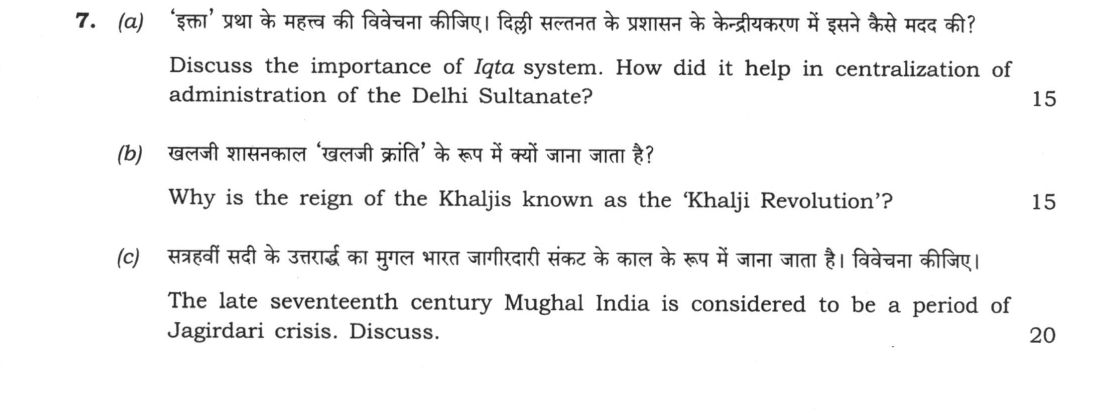
(a) Discuss the importance of Iqta system. How did it help in centralization of administration of the Delhi Sultanate? (15 marks)…
Discuss the importance of Iqta system. How did it help in centralization of administration of the Delhi Sultanate? 15 marks
Why is the reign of the Khaljis known as the 'Khalji Revolution'? 15 marks
The late seventeenth century Mughal India is considered to be a period of Jagirdari crisis. Discuss. 20 marks
हिंदी में प्रश्न पढ़ें
'इक़्ता' प्रथा के महत्व की विवेचना कीजिए। दिल्ली सल्तनत के प्रशासन के केन्द्रीकरण में इसने कैसे मदद की? (15 अंक)
खलजी शासनकाल 'खलजी क्रांति' के रूप में क्यों जाना जाता है? (15 अंक)
सत्रहवीं सदी के उत्तरार्ध का मुगल भारत जागीरदारी संकट के काल के रूप में जाना जाता है। विवेचना कीजिए। (20 अंक)
Model answer
Written by UPSC Answer Check against this question's marking rubric, to the expected length. UPSC does not publish answers for Mains — this is one way to score well, not an official key.
The Iqta System and Centralization Originating in the Abbasid world, the iqta was formalized in India by Iltutmish as a transferable revenue assignment rather than a proprietary land grant. Unlike the hereditary feudal estates of Europe, the iqta functioned as an instrument of state centralization. The Sultanate maintained control through periodic transfers of muqtis, preventing local power entrenchment, and by enforcing the submission of surplus revenue (fawazil) to the central treasury. Central auditing, regular troop reviews by the diwan-i-arz, and the surveillance network of imperial spies (barids) ensured that iqtadars remained accountable state functionaries rather than autonomous feudal barons.
The 'Khalji Revolution' The accession of the Khaljis marked a structural transformation of the Delhi Sultanate. It shattered the racial monopoly of the Ilbari-Turkic Chihalgani aristocracy, expanding the ruling elite into a meritocratic service nobility encompassing Indian Muslims and diverse ethnic groups. As recorded by Ziauddin Barani in Tarikh-i-Firuzshahi, Alauddin Khalji instituted a new conception of sovereignty (padshahi), subordinating religious orthodoxy to statecraft. Driven by the dual imperative of neutralizing the Mongol threat and suppressing internal noble rebellions, Alauddin executed comprehensive administrative reforms: abolishing hereditary iqta tenures, establishing a massive standing army paid strictly in cash, and creating a state-controlled market apparatus through the diwan-i-riyasat with rigidly enforced price ceilings.
The Seventeenth-Century Jagirdari Crisis The late seventeenth-century Jagirdari crisis signified an institutional breakdown of the structural correlation between the mansabdari military hierarchy and jagirdari revenue allocation. As established by Satish Chandra, prolonged Deccan campaigns under Aurangzeb led to an influx of Deccani and Maratha nobles into the imperial apparatus, precipitating a state of *be-jagiri*—an acute scarcity of unassigned crown lands (paibaqi).
This crisis was intensified by a widening gulf between estimated paper revenue (jama) and actual collections (hasil). Confronted with diminished incomes and uncertain tenures, jagirdars turned to ijara (revenue farming), squeezing the agrarian base. The resulting economic dislocation sparked widespread peasant distress and zamindari rebellions across the empire. Crucially, the scarcity of lucrative jagirs fueled intense factional rivalry among the Irani, Turani, and Hindustani nobility, eroding the institutional cohesion of the Mughal empire prior to 1707.
Conclusion The administrative trajectory of medieval India demonstrates that while centralized revenue mechanisms like the iqta successfully created bureaucratic imperial authority, their later derivatives like the jagirdari collapsed when state revenue expansion failed to sustain an over-expanded nobility, driving imperial decentralization.
What "Discuss" is asking you to do
Lay the issue out from more than one side — how it arose, what is claimed for it, what is held against it, and where it now stands. UPSC attaches discuss to broad topics with several live dimensions, so coverage of the dimensions earns more than the strength of your opinion.
Structure that answers it
Set the issue up → the case as it is made → the case against → the dimension both sides leave out → where the balance now lies
Where marks are lost
Listing facts with no thread between them, or arguing one side throughout and calling it a discussion.
How this answer will be evaluated
Approach
Framework: Context > Thesis > Evidence > Historiography. (a) discuss: intro > 3-4 dimensions > example > balanced close | (b) explain: definition/context > points in order > small example > short close | (c) discuss: intro > 3-4 dimensions > example > balanced close Full marks: Thesis-driven, cites specific sources/historians, and directly addresses the command word's analytical demand.
Key points expected
- Define Iqta as revenue assignment, not land ownership
- Explain Iltutmish's institutionalization of the system
- Link Iqta to the reduction of local feudal power
- Analyze the mechanism of revenue collection and transfer
- Identify the shift from slave to non-slave nobility
- Detail Alauddin's market control and price fixing
- Explain the 'Dagh' and 'Chehra' systems for horses
- Mention the abolition of the 'Chahalgani' (Forty) influence
Evaluation rubric
Each sub-part is marked on its own, against the marks and word limit printed on the paper.
- (a) Analytical assessment of Iqta's role in centralizing Delhi Sultanate administration. 15 marks
discuss— intro → 3-4 dimensions → example → balanced close
Must cover
- Define Iqta as revenue assignment, not land ownership
- Explain Iltutmish's institutionalization of the system
- Link Iqta to the reduction of local feudal power
- Analyze the mechanism of revenue collection and transfer
Loses marks
- Treating Iqta as a form of land ownership
- Chronological listing of Sultans without administrative analysis
- Ignoring the 'centralization' aspect of the question
Earns more
- Mention the 'Iqta-i-muqarrara' vs 'Iqta-i-muwaqqata' distinction
- Reference the 'Diwan-i-Iqta' or specific administrative roles
- Cite a specific chronicle (e.g., Minhaj-i-Siraj)
Extra mark
- Name a specific historian (e.g., Irfan Habib) on Iqta
- Provide a specific source quotation on Iqta administration
- (b) Justification for the 'Khalji Revolution' label based on administrative and economic shifts. 15 marks
explain— definition/context → points in order → small example → short close
Must cover
- Identify the shift from slave to non-slave nobility
- Detail Alauddin's market control and price fixing
- Explain the 'Dagh' and 'Chehra' systems for horses
- Mention the abolition of the 'Chahalgani' (Forty) influence
Loses marks
- Focusing only on military campaigns (e.g., Devagiri)
- Failing to link reforms to the 'Revolution' label
- Ignoring the economic dimension of the 'Revolution'
Earns more
- Reference the 'Diwan-i-Riyasat' or 'Diwan-i-Adl' reforms
- Mention the 'Sijillat' (registers) for trade control
- Cite Amir Khusrau or Ziauddin Barani as sources
Extra mark
- Name a specific historian (e.g., Satish Chandra) on Khalji reforms
- Provide a specific source quotation on market control
- (c) Critical analysis of the Jagirdari crisis in late 17th-century Mughal India. 20 marks
discuss— intro → 3-4 dimensions → example → balanced close
Must cover
- Define the 'Jagirdari crisis' (shortage of jagirs vs. demand)
- Explain the impact of Aurangzeb's expansion on jagir supply
- Analyze the 'Jagirdari' vs 'Jagirdar' conflict and its consequences
- Link the crisis to the decline of Mughal central authority
Loses marks
- Treating the crisis as a simple 'land shortage' without analysis
- Ignoring the 'late 17th century' specific context (Aurangzeb's reign)
- Failing to link the crisis to the broader Mughal decline
Earns more
- Mention the 'Jagirdari' system's role in Mughal administration
- Reference the 'Jagirdari' crisis's impact on the 'Mansabdari' system
- Cite a specific source (e.g., Ain-i-Akbari) on jagir allocation
Extra mark
- Name a specific historian (e.g., Irfan Habib) on the Jagirdari crisis
- Provide a specific source quotation on jagir shortages
Practice this exact question
Write your answer and it is marked point by point against the model answer above — what you covered, what you missed, what you got wrong.
Evaluate my answer →More from History 2021 Paper I
- Q4 (a) "The political and economic needs of rulers, combined with economic and status needs…
- Q5 Answer the following questions in about 150 words each: (a) Discuss the different stages…
- Q6 (a) Discuss the transformation of Sikh community from a Nirguna Bhakti sect into a politi…
- Q7 (a) Discuss the importance of Iqta system. How did it help in centralization of administr…
- Q8 (a) "The Chola rulers were not only mighty conquerors, efficient administrators but also…