Paper I — Q4
(a) "The political and economic needs of rulers, combined with economic and status needs of the merchant class, together provided…
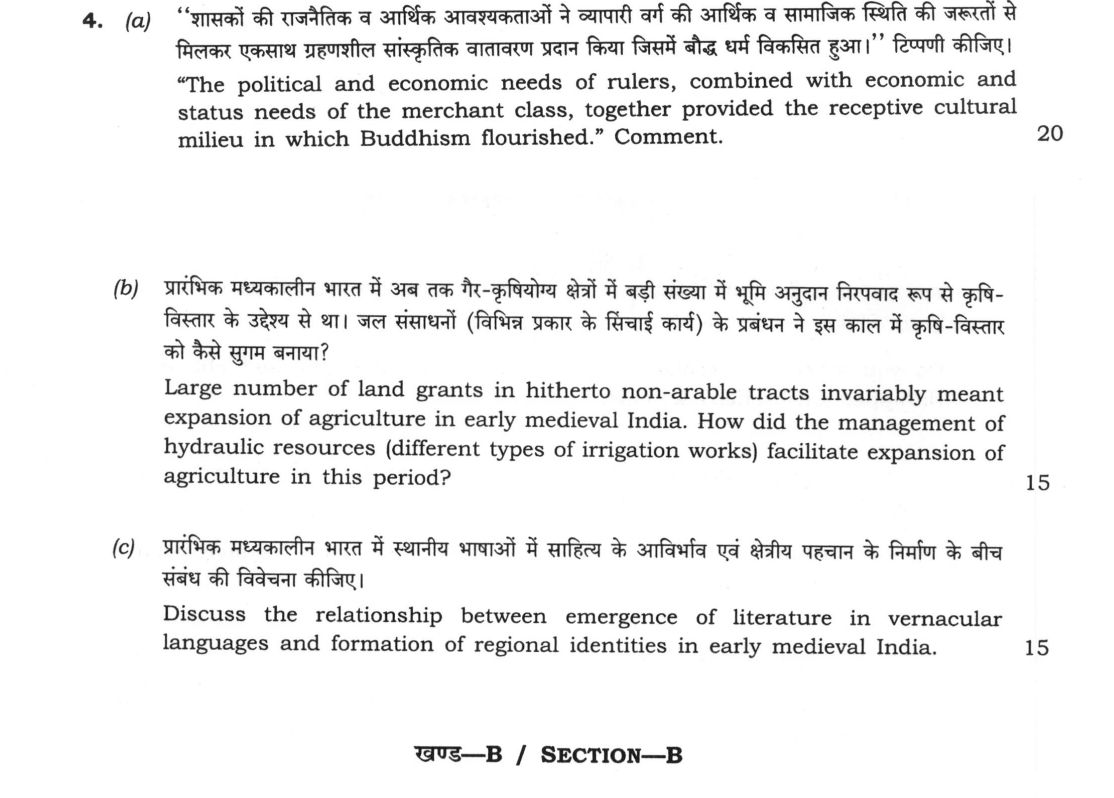
"The political and economic needs of rulers, combined with economic and status needs of the merchant class, together provided the receptive cultural milieu in which Buddhism flourished." Comment. 20 marks
Large number of land grants in hitherto non-arable tracts invariably meant expansion of agriculture in early medieval India. How did the management of hydraulic resources (different types of irrigation works) facilitate expansion of agriculture in this period? 15 marks
Discuss the relationship between emergence of literature in vernacular languages and formation of regional identities in early medieval India. 15 marks
हिंदी में प्रश्न पढ़ें
"शासकों की राजनीतिक व आर्थिक आवश्यकताओं ने व्यापारी वर्ग की आर्थिक व सामाजिक स्थिति की जरूरतों से मिलकर एकसाथ ग्रहणशील सांस्कृतिक वातावरण प्रदान किया जिसमें बौद्ध धर्म विकसित हुआ।" टिप्पणी कीजिए। (20 अंक)
प्रारंभिक मध्यकालीन भारत में अब तक गैर-कृषियोग्य क्षेत्रों में बड़ी संख्या में भूमि अनुदान निरपवाद रूप से कृषि-विस्तार के उद्देश्य से था। जल संसाधनों (विभिन्न प्रकार के सिंचाई कार्य) के प्रबंधन ने इस काल में कृषि-विस्तार को कैसे सुगम बनाया? (15 अंक)
प्रारंभिक मध्यकालीन भारत में स्थानीय भाषाओं में साहित्य के आविर्भाव एवं क्षेत्रीय पहचान के निर्माण के बीच संबंध की विवेचना कीजिए। (15 अंक)
Model answer
Written by UPSC Answer Check against this question's marking rubric, to the expected length. UPSC does not publish answers for Mains — this is one way to score well, not an official key.
Buddhism’s historical ascendancy was fundamentally rooted in a symbiotic sangha-dana nexus between heterodox ideology, monarchical statecraft, and mercantile enterprise. Politically, Mauryan rulers utilized Dhamma for universal legitimation and empire-building across heterogeneous territories, while post-Mauryan polities (Kushanas, Satavahanas) deployed Buddhist patronage as ideological glue amidst political fragmentation. Economically, the mercantile class (setthis, gahapatis), facing Vedic ritual subordination despite accumulating wealth, found in Buddhism a status-affirming, non-hierarchical ethos. The Sangha actively facilitated long-distance commerce along Central Asian Silk routes and Indo-Roman maritime circuits by serving as secure rest stops, information hubs, and monastic banking institutions. While the "urban decay" thesis posits Buddhism’s later decline with de-urbanization, its zenith undeniably reflected how rulers' legitimatory imperatives and merchants' economic networks converged within monastic institutions.
Hydraulic Management and Agrarian Expansion During the 6th–12th centuries CE, the proliferation of brahmadeya and agrahara land grants in non-arable, forested, and peripheral tracts drove systemic agrarian expansion. This frontier colonization relied directly on localized hydraulic management. In the peninsular South, village assemblies and royal grants developed interconnected tank cascades (eri in Tamil country, kere in Karnataka) that regulated runoff and recharged groundwater. In arid Western India (Gujarat and Rajasthan), expansion was facilitated by well-irrigation utilizing the araghatta (Persian wheel) and picottah lift systems. In Central India, major canal networks and vast reservoirs, exemplified by Paramara King Bhoja’s Bhojpur lake, harnessed riverine overflow. Crucially, early medieval temples functioned as agrarian corporations and hydraulic managers, mobilizing caste labor through collective jajmani obligations and customary dues to continuously maintain, desilt, and protect distribution channels.
Vernacular Literature and Regional Identity Formation The early medieval transition (6th–12th centuries CE) witnessed a structural shift from Sanskritic cosmopolitanism to regional particularism, primarily articulated through vernacular literature. Evolving from Prakrits and Apabhramsa, regional tongues became instruments of localized state-formation. Dynasties adopted vernacular idioms for royal prashastis (eulogies) and temple inscriptions to foster territorial cohesion—Tamil under the Pallavas and Cholas, Kannada under the Rashtrakutas (formalized in the Kavirajamarga), and early Apabhramsa-Gujarati under the Chaulukyas. Concurrently, popular religious movements—such as the Tamil Alvar and Nayanar devotional hymns and the later Kannada Virashaiva *vachanas*—fused local folk traditions into the scriptural mainstream.
Ultimately, the early medieval cultural landscape was defined by these interlinked transitions: as the pan-Indian mercantile base of Buddhism yielded to localized, agrarian-hydraulic economies driven by land grants, universalist Sanskrit gave way to vernacular literary cultures that crystallized enduring regional identities.
What "Comment" is asking you to do
Take a position on the statement and support it. Comment usually attaches to a quoted line in the short slots, so the reasoning must be compressed — an opening view, a few load-bearing reasons, and the limit of the claim.
Structure that answers it
Unpack what the statement asserts → your stance → two or three supporting reasons → the qualification that limits it
Where marks are lost
Neutral summary; a comment without a stance has not answered. Equally costly is accepting the quoted line wholesale and never testing where it fails.
How this answer will be evaluated
Approach
Framework: Context > Thesis > Evidence > Historiography. (a) comment: context > arguments both sides > judgment > close | (b) explain: definition/context > points in order > small example > short close | (c) discuss: intro > 3-4 dimensions > example > balanced close Full marks: Demonstrates deep understanding of the historiographical debate, cites specific sources, and provides a nuanced, well-argued response.
Key points expected
- Contextualize Mauryan/Gupta political and economic needs
- Analyze merchant class status and economic needs
- Explain the 'receptive cultural milieu' (e.g., anti-Brahmanical sentiment)
- Provide a balanced judgment on the quote's validity
- Define 'hitherto non-arable tracts' in this context
- Explain the link between land grants and irrigation
- Describe specific types of irrigation works (e.g., tanks, canals)
- Show how this led to agricultural expansion
Evaluation rubric
Each sub-part is marked on its own, against the marks and word limit printed on the paper.
- (a) Contextualize the quote and provide a balanced judgment on the socio-economic drivers of Buddhism's rise. 20 marks
comment— context → arguments both sides → judgment → close
Must cover
- Contextualize Mauryan/Gupta political and economic needs
- Analyze merchant class status and economic needs
- Explain the 'receptive cultural milieu' (e.g., anti-Brahmanical sentiment)
- Provide a balanced judgment on the quote's validity
Loses marks
- Narrating history without analyzing the quote
- Ignoring the 'merchant class' aspect of the prompt
- Failing to provide a clear judgment on the statement
Earns more
- Cite specific inscriptions or chronicles (e.g., Ashokan edicts)
- Name a specific historiographical school (e.g., Marxist vs. Traditional)
- Mention specific Buddhist texts or archaeological sites
- Discuss the role of trade routes in spreading Buddhism
Extra mark
- Quote a specific historian's view on the 'receptive milieu'
- Reference a specific archaeological find (e.g., Sanchi or Bharhut)
- (b) Explain how hydraulic management facilitated agricultural expansion in non-arable tracts. 15 marks
explain— definition/context → points in order → small example → short close
Must cover
- Define 'hitherto non-arable tracts' in this context
- Explain the link between land grants and irrigation
- Describe specific types of irrigation works (e.g., tanks, canals)
- Show how this led to agricultural expansion
Loses marks
- Listing irrigation types without linking to land grants
- Ignoring the 'non-arable' aspect of the prompt
- Failing to explain the mechanism of expansion
Earns more
- Cite specific inscriptions mentioning irrigation works
- Name specific dynasties (e.g., Chalukyas, Pallavas)
- Mention specific archaeological sites of irrigation
- Discuss the role of local communities in water management
Extra mark
- Quote a specific inscription on irrigation
- Reference a specific historian's work on hydraulic society
- (c) Discuss the relationship between vernacular literature and regional identity formation. 15 marks
discuss— intro → 3-4 dimensions → example → balanced close
Must cover
- Define 'vernacular languages' in the early medieval context
- Explain how literature contributed to regional identity
- Provide examples of specific vernacular literatures (e.g., Tamil, Kannada)
- Analyze the 'formation' of these identities
Loses marks
- Listing languages without discussing identity formation
- Ignoring the 'early medieval' timeframe
- Failing to link literature to political or social identity
Earns more
- Cite specific literary works (e.g., Sangam literature, Kavirajamarga)
- Name specific dynasties or regions (e.g., Cholas, Rashtrakutas)
- Discuss the role of patronage in vernacular literature
- Mention specific historians or scholars on this topic
Extra mark
- Quote a specific line from a vernacular text
- Reference a specific academic work on regional identity
Practice this exact question
Write your answer and it is marked point by point against the model answer above — what you covered, what you missed, what you got wrong.
Evaluate my answer →More from History 2021 Paper I
- Q1 Identify the following places marked on the map supplied to you and write a short note of…
- Q2 (a) Do you agree that ecological factors influenced the flow and ebb of the Harappan Civi…
- Q3 (a) Will it be proper to consider the megaliths to represent a single, homogeneous or con…
- Q4 (a) "The political and economic needs of rulers, combined with economic and status needs…
- Q5 Answer the following questions in about 150 words each: (a) Discuss the different stages…
- Q6 (a) Discuss the transformation of Sikh community from a Nirguna Bhakti sect into a politi…
- Q7 (a) Discuss the importance of Iqta system. How did it help in centralization of administr…