Paper I — Q3
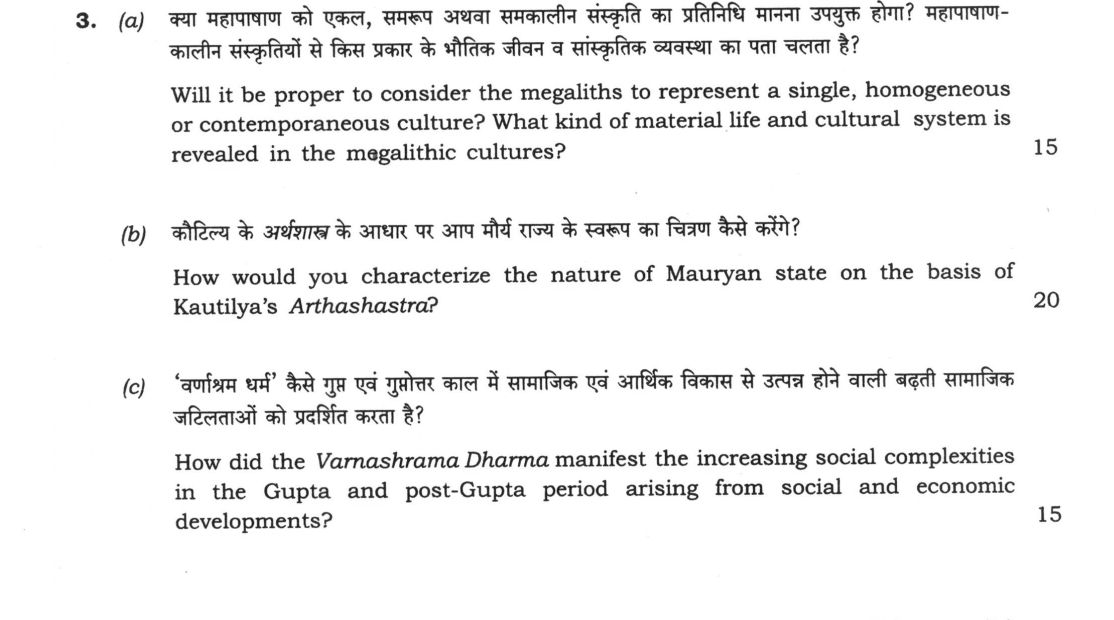
(a) Will it be proper to consider the megaliths to represent a single, homogeneous or contemporaneous culture? What kind of…
Will it be proper to consider the megaliths to represent a single, homogeneous or contemporaneous culture? What kind of material life and cultural system is revealed in the megalithic cultures? 15 marks
How would you characterize the nature of Mauryan state on the basis of Kautilya's Arthashastra? 20 marks
How did the Varnashrama Dharma manifest the increasing social complexities in the Gupta and post-Gupta period arising from social and economic developments? 15 marks
हिंदी में प्रश्न पढ़ें
क्या महापाषाण को एकल, समरूप अथवा समकालीन संस्कृति का प्रतिनिधि मानना उपयुक्त होगा? महापाषाण-कालीन संस्कृतियों से किस प्रकार के भौतिक जीवन व सांस्कृतिक व्यवस्था का पता चलता है? (15 अंक)
कौटिल्य के अर्थशास्त्र के आधार पर आप मौर्य राज्य के स्वरूप का चित्रण कैसे करेंगे? (20 अंक)
'वर्णाश्रम धर्म' कैसे गुप्त एवं गुप्तोत्तर काल में सामाजिक एवं आर्थिक विकास से उत्पन्न होने वाली बढ़ती सामाजिक जटिलताओं को प्रदर्शित करता है? (15 अंक)
Model answer
Written by UPSC Answer Check against this question's marking rubric, to the expected length. UPSC does not publish answers for Mains — this is one way to score well, not an official key.
Early Indian history reflects a dynamic dialectic between evolving material foundations, state structures, and normative social orders.
Megaliths: Heterogeneity and Material Culture
Megalithic monuments cannot be characterized as a single, homogeneous, or contemporaneous culture. Chronologically, they span from the Neolithic-Chalcolithic in the Northeast and Kashmir to the Iron Age and Early Historic periods in peninsular India and the Deccan. Structurally, they display striking typological diversity—including dolmens, cists, cairn circles, and stone circles across sites such as Brahmagiri, Maski, and Nagpur.
Material assemblages reveal a mixed agro-pastoral economy sustained by specialized iron tools (axes, sickles, weapons) and Black-and-Red Ware (BRW) pottery. Furthermore, marked disparities in the quantity and preciousness of mortuary grave goods reflect emerging social differentiation, ranked societies, and ancestral worship rather than a uniform, egalitarian community.
Nature of the Mauryan State in Kautilya’s Arthashastra
Kautilya’s Arthashastra conceptualizes the state through the organic Saptanga theory, articulating seven interlinked prakritis (Swami, Amatya, Janapada, Durga, Kosha, Danda, and Mitra). The text outlines an interventionist, bureaucratic monarchy where the ruler’s authority balances coercive force (Danda) with paternalistic welfare (Yogakshema).
The state strictly regulated economic life—managing mines, agriculture, and trade routes through specialized superintendents (Adhyakshas)—supported by an ubiquitous espionage network (Gudhapurushas). However, modern scholarship views the Arthashastra as a normative, prescriptive treatise rather than an exact blueprint of Mauryan administration. In contrast to Kautilya’s centralized theoretical construct, Ashokan epigraphic evidence indicates a differentiated, unevenly integrated imperial structure with directly administered core zones alongside autonomous peripheral regions.
Varnashrama Dharma and Post-Gupta Social Complexities
In the Gupta and post-Gupta epochs, Varnashrama Dharma adapted to structural shifts driven by de-urbanization, the rise of a land-grant economy, and feudalization. Widespread Brahmadeya and Agrahara grants into peripheral tracts facilitated the integration of indigenous tribal groups, who were assimilated into the Brahmanical fold as distinct occupational jatis within an expanded Shudra category.
This process led to a proliferation of sub-castes, alongside new functional groups such as the Kayasthas (scribes). Dharmashastra codifications, notably by Yajnavalkya and late commentaries on the Manusmriti, attempted to reconcile this growing divergence between rigid fourfold varna theory and complex jati reality via the doctrine of varnasamkara (intermixture). These legal texts institutionalized sanskritization processes for upwardly mobile local elites while enforcing strict purity-pollution boundaries.
Analysing early India demonstrates how shifting material bases—from megalithic metallurgy to agrarian land transfers—consistently reshaped the apparatus of political authority and compelled legal-normative frameworks like Varnashrama Dharma to adapt to changing socio-economic realities.
What "Analyse" is asking you to do
Break the subject into its working parts and show how they act on each other. The marks are in the interconnections — which factor drives which, and what the resulting structure explains — not in the inventory of factors.
Structure that answers it
Define the whole → separate it into its parts → show which part drives which → what that interaction produces → what the structure implies
Where marks are lost
A flat list of causes with no account of which drives which. An answer of neatly separated headings, each self-contained, scores as description.
How this answer will be evaluated
Approach
Framework: Context > Thesis > Evidence > Historiography. (a) comment: context > arguments both sides > judgment > close | (b) examine: intro > how/why with reasoning > evidence > conclusion | (c) explain: definition/context > points in order > small example > short close Full marks: Thesis-driven, specific sources, clear analytical structure, no narrative drift.
Key points expected
- Reject 'single homogeneous culture' thesis
- Cite regional variations (e.g., South vs. North)
- Detail material life (tools, agriculture, burial)
- Mention specific sites (e.g., Adichanallur, Brahmagiri)
- Define state as 'centralized, bureaucratic, secular'
- Detail administrative machinery (Saptanga, spies)
- Explain economic control (land, trade, mines)
- Discuss military organization and foreign policy
Evaluation rubric
Each sub-part is marked on its own, against the marks and word limit printed on the paper.
- (a) Assess the validity of the 'single culture' thesis and describe the material/cultural system. 15 marks
comment— context → arguments both sides → judgment → close
Must cover
- Reject 'single homogeneous culture' thesis
- Cite regional variations (e.g., South vs. North)
- Detail material life (tools, agriculture, burial)
- Mention specific sites (e.g., Adichanallur, Brahmagiri)
Loses marks
- Treating megaliths as a single chronological phase
- Ignoring the distinction between North and South
- Narrative without analytical judgment
Earns more
- Reference to 'Megalithic Horizon' debate
- Mention of specific burial types (cist, dolmen)
- Discussion of trade (carnelian, copper)
Extra mark
- Cite specific excavation report (e.g., R. S. Bisht)
- Mention specific artifact (e.g., iron spearhead)
- (b) Characterize the Mauryan state's nature using Arthashastra as the primary source. 20 marks
examine— intro → how/why with reasoning → evidence → conclusion
Must cover
- Define state as 'centralized, bureaucratic, secular'
- Detail administrative machinery (Saptanga, spies)
- Explain economic control (land, trade, mines)
- Discuss military organization and foreign policy
Loses marks
- Relying solely on Ashokan inscriptions
- Ignoring the 'secular' nature of the state
- Generalizing without specific Arthashastra evidence
Earns more
- Mention 'Mandala' theory of foreign policy
- Reference to 'Saptanga' theory of state
- Discussion of 'Danda' (force) as state instrument
Extra mark
- Quote specific Arthashastra sutra
- Mention specific official title (e.g., Mahamatras)
- (c) Explain how Varnashrama Dharma reflected social/economic complexities in Gupta/post-Gupta era. 15 marks
explain— definition/context → points in order → small example → short close
Must cover
- Link Varna to economic roles (land, trade)
- Link Shrama to social stratification
- Discuss 'Sanskritization' or social mobility
- Mention specific social changes (e.g., Shudra status)
Loses marks
- Treating Varnashrama as static/unchanging
- Ignoring economic basis of social hierarchy
- Failing to link to 'post-Gupta' developments
Earns more
- Reference to 'Gupta period' inscriptions
- Mention of 'Brahminical' dominance
- Discussion of 'Jati' system emergence
Extra mark
- Cite specific inscription (e.g., Allahabad Pillar)
- Mention specific social group (e.g., Vaisyas)
Practice this exact question
Write your answer and it is marked point by point against the model answer above — what you covered, what you missed, what you got wrong.
Evaluate my answer →More from History 2021 Paper I
- Q1 Identify the following places marked on the map supplied to you and write a short note of…
- Q2 (a) Do you agree that ecological factors influenced the flow and ebb of the Harappan Civi…
- Q3 (a) Will it be proper to consider the megaliths to represent a single, homogeneous or con…
- Q4 (a) "The political and economic needs of rulers, combined with economic and status needs…
- Q5 Answer the following questions in about 150 words each: (a) Discuss the different stages…
- Q6 (a) Discuss the transformation of Sikh community from a Nirguna Bhakti sect into a politi…