Paper I — Q6
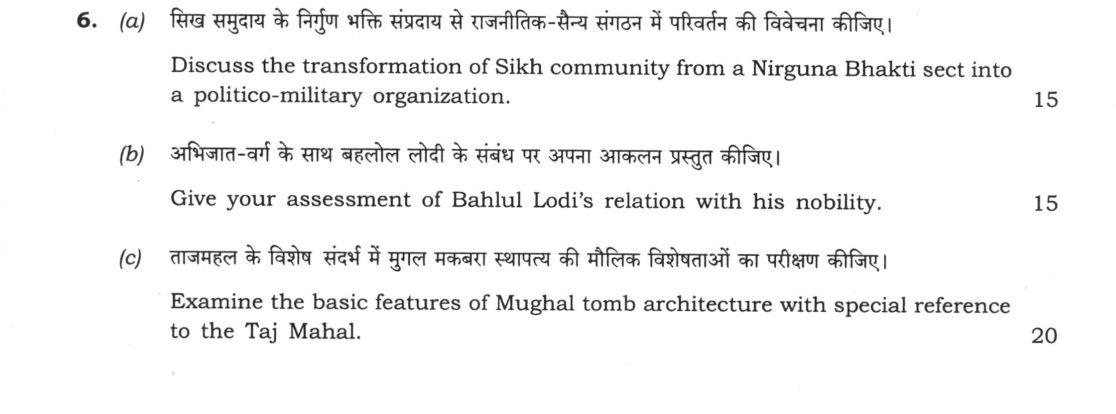
(a) Discuss the transformation of Sikh community from a Nirguna Bhakti sect into a politico-military organization. (15 marks) (b)…
Discuss the transformation of Sikh community from a Nirguna Bhakti sect into a politico-military organization. 15 marks
Give your assessment of Bahlul Lodi's relation with his nobility. 15 marks
Examine the basic features of Mughal tomb architecture with special reference to the Taj Mahal. 20 marks
हिंदी में प्रश्न पढ़ें
सिख समुदाय के निर्गुण भक्ति संप्रदाय से राजनीतिक-सैन्य संगठन में परिवर्तन की विवेचना कीजिए। (15 अंक)
अभिजात-वर्ग के साथ बहलोल लोदी के संबंध पर अपना आकलन प्रस्तुत कीजिए। (15 अंक)
ताजमहल के विशेष संदर्भ में मुगल मकबरा स्थापत्य की मौलिक विशेषताओं का परीक्षण कीजिए। (20 अंक)
Model answer
Written by UPSC Answer Check against this question's marking rubric, to the expected length. UPSC does not publish answers for Mains — this is one way to score well, not an official key.
These cases show how identity, power and memory became durable state forms.
Sikh transformation. Sikhism began as a Nirguna Bhakti movement under Guru Nanak in the fifteenth century, rejecting caste and ritual orthodoxy. Under Angad and Amar Das it acquired institutional discipline: Gurmukhi script, langar, and scriptural compilation. Langar and scriptural compilation institutionalized the community. Yet Mughal persecution—Jahangir’s execution of Guru Arjan in 1606 and Aurangzeb’s execution of Guru Tegh Bahadur in 1675—made armed self-defence necessary. Guru Hargobind’s miri-piri at Amritsar in 1606 separated spiritual and temporal authority; the Akal Takht, fortification, and the rakhi system marked political transformation. Guru Gobind Singh’s Khalsa in 1699 completed the change into a politico-military community, later strengthened by misls.
Bahlul Lodi’s nobility. Bahlul Lodi (1451–1489) ruled through an Afghan oligarchy rather than Delhi court centralization. He distributed iqtas to Lodi clan members, used matrimonial alliances, and relied on a council of forty, contrasting with the earlier Turk Chihalgani, which was a corps of Turkish nobles rather than a model of autocratic centralization. This avoidance of centralization meant power remained with provincial Afghan amirs. The council of forty provided consultation, not bureaucratic centralization. His reliance on clan and marriage ties made the nobility partners rather than mere servants. It gave loyalty and Afghan consolidation, but it also embedded regional power. The same oligarchic dependence produced succession disputes under Sikandar and Ibrahim, revealing the model’s brittleness.
Mughal tomb architecture. Mughal tombs developed a distinctive vocabulary: hasht-bihisht plan, charbagh garden, pishtaq portal, double dome, jali screens, and pietra dura inlay. The hasht-bihisht plan organized the tomb around a central chamber, while jali screens filtered light and privacy. The charbagh garden setting, divided by water channels, reinforced the idea of paradise. Humayun’s Tomb (1565) adapted the Persian prototype; Akbar’s tomb at Sikandra (1605) synthesized Persian, Hindu and Islamic elements. The Taj Mahal (1632–53) is the apex. Its Yamuna riverfront location, perfect bilateral symmetry, bulbous dome with finial, corner minarets, calligraphic decoration by Amanat Khan, white marble, and precious-stone inlay express imperial piety, dynastic memory and Mughal material control. The minarets frame the main structure and prevent visual crowding; the white marble and inlay symbolized purity, permanence, and imperial wealth. Its UNESCO World Heritage and ASI conservation context confirms its status as a monument of mature Mughal statecraft.
The verdict is that Sikh transformation institutionalized faith into polity, Bahlul’s oligarchy secured stability but limited central authority, and the Taj Mahal converted Mughal power into permanent aesthetic ideology.
What "Examine" is asking you to do
Test the proposition the question puts to you and return a finding on how far it holds. Examine stems carry a claim, or ask whether something has happened, and expect evidence weighed both ways before the extent is stated — often with remedial measures attached.
Structure that answers it
Restate the claim as the question frames it → evidence that supports it → evidence that undercuts it → the conditions under which it holds → verdict on how far it stands
Where marks are lost
Stopping at description. An examination has to reach a finding, and “examine with justification” means the extent must be stated, not implied.
How this answer will be evaluated
Approach
Framework: Context > Thesis > Evidence > Historiography. (a) discuss: intro > 3-4 dimensions > example > balanced close | (b) comment: context > arguments both sides > judgment > close | (c) examine: intro > how/why with reasoning > evidence > conclusion Full marks: Thesis-driven, specific evidence, historiographical depth
Key points expected
- Nirguna Bhakti origins and early Gurus
- Role of Guru Nanak and Guru Angad
- Guru Gobind Singh and Khalsa formation
- Political/military consolidation of Sikh identity
- Bahlul Lodi's rise to power
- Nature of Lodi nobility (Afghan vs. Indian)
- Bahlul's policies towards nobles
- Impact on Lodi dynasty stability
Evaluation rubric
Each sub-part is marked on its own, against the marks and word limit printed on the paper.
- (a) Analyze the transition from spiritual sect to Khalsa statehood. 15 marks
discuss— intro → 3-4 dimensions → example → balanced close
Must cover
- Nirguna Bhakti origins and early Gurus
- Role of Guru Nanak and Guru Angad
- Guru Gobind Singh and Khalsa formation
- Political/military consolidation of Sikh identity
Loses marks
- Chronological listing without analysis
- Ignoring the political/military aspect
- Textbook retelling of Guru lives
Earns more
- Reference to Dasam Granth
- Mention of Mughal-Sikh conflict
- Historiographical perspective on Sikh statehood
Extra mark
- Specific date of Khalsa creation (1699)
- Reference to specific Mughal edicts
- (b) Assess the nature of Bahlul Lodi's relationship with nobles. 15 marks
comment— context → arguments both sides → judgment → close
Must cover
- Bahlul Lodi's rise to power
- Nature of Lodi nobility (Afghan vs. Indian)
- Bahlul's policies towards nobles
- Impact on Lodi dynasty stability
Loses marks
- Generalizing without specific examples
- Ignoring the Afghan context
- Focusing only on Bahlul's personal traits
Earns more
- Reference to specific nobles (e.g., Daulat Khan)
- Comparison with previous dynasties
- Historiographical view on Lodi administration
Extra mark
- Specific incident of noble rebellion
- Reference to primary source (e.g., Baburnama)
- (c) Analyze Mughal tomb architecture features using Taj Mahal. 20 marks
examine— intro → how/why with reasoning → evidence → conclusion
Must cover
- Basic features of Mughal tomb architecture
- Specific architectural elements of Taj Mahal
- Symbolism and design principles
- Comparison with earlier Mughal tombs
Loses marks
- Descriptive listing without analysis
- Ignoring the 'special reference' to Taj Mahal
- Focusing only on aesthetic aspects
Earns more
- Reference to specific architectural terms (e.g., pishtaq)
- Mention of Persian/Indian influences
- Historiographical view on Mughal architecture
Extra mark
- Specific dimensions or measurements
- Reference to specific architect (e.g., Ustad Ahmad Lahori)
Practice this exact question
Write your answer and it is marked point by point against the model answer above — what you covered, what you missed, what you got wrong.
Evaluate my answer →More from History 2021 Paper I
- Q3 (a) Will it be proper to consider the megaliths to represent a single, homogeneous or con…
- Q4 (a) "The political and economic needs of rulers, combined with economic and status needs…
- Q5 Answer the following questions in about 150 words each: (a) Discuss the different stages…
- Q6 (a) Discuss the transformation of Sikh community from a Nirguna Bhakti sect into a politi…
- Q7 (a) Discuss the importance of Iqta system. How did it help in centralization of administr…
- Q8 (a) "The Chola rulers were not only mighty conquerors, efficient administrators but also…