Paper I — Q2
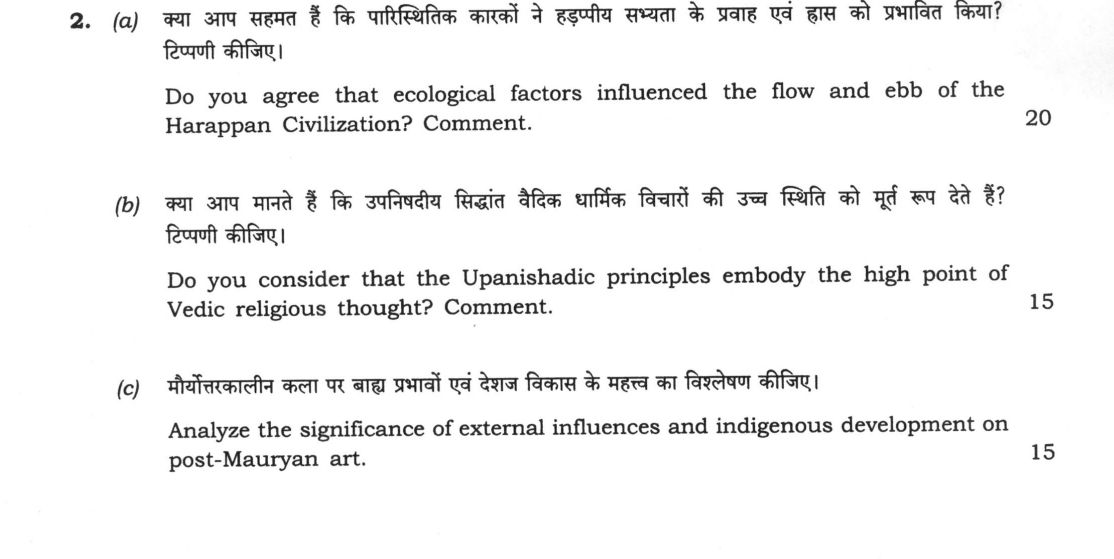
(a) Do you agree that ecological factors influenced the flow and ebb of the Harappan Civilization? Comment. (20 marks) (b) Do you…
Do you agree that ecological factors influenced the flow and ebb of the Harappan Civilization? Comment. 20 marks
Do you consider that the Upanishadic principles embody the high point of Vedic religious thought? Comment. 15 marks
Analyze the significance of external influences and indigenous development on post-Mauryan art. 15 marks
हिंदी में प्रश्न पढ़ें
क्या आप सहमत हैं कि पारिस्थितिक कारकों ने हड़प्पीय सभ्यता के प्रवाह एवं ह्रास को प्रभावित किया? टिप्पणी कीजिए। (20 अंक)
क्या आप मानते हैं कि उपनिषदीय सिद्धांत वैदिक धार्मिक विचारों की उच्च स्थिति को मूर्त रूप देते हैं? टिप्पणी कीजिए। (15 अंक)
मौर्योत्तरकालीन कला पर बाह्य प्रभावों एवं देशज विकास के महत्व का विश्लेषण कीजिए। (15 अंक)
Model answer
Written by UPSC Answer Check against this question's marking rubric, to the expected length. UPSC does not publish answers for Mains — this is one way to score well, not an official key.
Ecological Factors and the Harappan Trajectory
Ecological factors played a decisive, though not solitary, role in the flow and ebb of the Harappan Civilization. The initial urban expansion was sustained by predictable inundations and fertile alluvial plains. However, environmental destabilization critically undermined this urban matrix. Robert Raikes posited tectonic disturbances that caused geomorphological uplifts, damming the Indus and causing catastrophic, recurrent flooding at Mohenjodaro. Conversely, Gurdip Singh’s pollen analysis from Rajasthan salt lakes pointed to declining rainfall and desiccation around 2000 BCE. Recent paleoclimatic studies corroborate an eastward shift of the monsoons and the progressive drying of the Ghaggar-Hakra (palaeo-Saraswati) system, which precipitated the abandonment of major settlements like Kalibangan.
Nonetheless, ecological determinism alone cannot explain the decline. Overexploitation of fragile semi-arid ecologies, combined with the collapse of long-distance Persian Gulf trade affecting coastal centres like Lothal, compounded systemic stress. Thus, rather than a sudden catastrophic collapse, the archaeological record demonstrates a gradual de-urbanization and ruralisation driven by ecological fragility interacting with socio-economic vulnerabilities.
Upanishads as the Culmination of Vedic Thought
The Upanishads embody the philosophical high point of Vedic religion, marking a shift from the ritualistic orthopraxy of the Samhitas and Brahmanas to introspective mysticism. As speculative appendices to the Aranyakas, they relocated religious authority from the public sacrificial altar (yajna) dominated by the priesthood to forest-dwelling meditative inquiry. Central concepts crystallized: Brahman (the ultimate cosmic reality), Atman (the individual self), Maya (empirical illusion), and Moksha (liberation through knowledge).
While contemporary heterodox movements like Buddhism and Jainism rejected Vedic authority altogether, the Upanishads revolutionized the tradition from within. By subordinating ritual efficacy to self-realization, they acted as the philosophical culmination (Vedanta) of Vedic thought. Rather than representing a static terminus, they established the foundational monistic framework that animated subsequent classical Indian philosophy.
External Influences and Indigenous Synthesis in Post-Mauryan Art
Post-Mauryan art reflects an organic synthesis of external artistic idioms and indigenous aesthetic traditions. External influences were most pronounced in the Gandhara school under Indo-Greek and Kushana patronage, integrating Greco-Roman motifs such as Apollo Belvedere-like drapery, realistic musculature, and Corinthian capitals. Concurrently, thriving Indo-Roman maritime trade introduced subtle Hellenistic naturalism to the Amaravati school.
These foreign elements operated upon a mature indigenous foundation. The tradition drew heavily upon Mauryan monumental stone craft, folk yaksha and yakshi imagery, and the continuous narrative relief techniques seen at Bharhut and Sanchi. The Mathura school achieved a syncretic balance, carving the earliest indigenous Buddha figures directly modeled on colossal yaksha prototypes before assimilating northwestern Hellenistic traits. This hybridization catalyzed the transition from symbolic representation to anthropomorphic iconography, establishing the stylistic grammar for the classical Gupta phase.
Therefore, whether through environmental adaptation, philosophical reorientation, or artistic hybridization, ancient Indian civilization consistently transformed through the dynamic interplay of internal evolution and external stimuli.
What "Comment" is asking you to do
Take a position on the statement and support it. Comment usually attaches to a quoted line in the short slots, so the reasoning must be compressed — an opening view, a few load-bearing reasons, and the limit of the claim.
Structure that answers it
Unpack what the statement asserts → your stance → two or three supporting reasons → the qualification that limits it
Where marks are lost
Neutral summary; a comment without a stance has not answered. Equally costly is accepting the quoted line wholesale and never testing where it fails.
How this answer will be evaluated
Approach
Framework: Context > Thesis > Evidence > Historiography. (a) comment: context > arguments both sides > judgment > close | (b) comment: context > arguments both sides > judgment > close | (c) analyse: intro > causes > effects > stakeholders/linkages > way forward Full marks: Thesis-driven, cites specific sources/historians, balanced judgment, clear analysis
Key points expected
- Contextualize Harappan urbanism and its environmental setting
- Arguments for ecological determinism (e.g., river shifts, climate change)
- Arguments against ecological determinism (e.g., social, political, or trade factors)
- Balanced judgment on the extent of ecological influence
- Contextualize the transition from Vedic ritualism to Upanishadic philosophy
- Arguments supporting the 'high point' thesis (e.g., metaphysical depth, Atman-Brahman)
- Arguments against or nuances (e.g., continuity with Vedas, later developments)
- Balanced judgment on the significance of Upanishadic thought
Evaluation rubric
Each sub-part is marked on its own, against the marks and word limit printed on the paper.
- (a) Judgment on the role of ecological factors in the rise and fall of the Harappan Civilization. 20 marks
comment— context → arguments both sides → judgment → close
Must cover
- Contextualize Harappan urbanism and its environmental setting
- Arguments for ecological determinism (e.g., river shifts, climate change)
- Arguments against ecological determinism (e.g., social, political, or trade factors)
- Balanced judgment on the extent of ecological influence
Loses marks
- Purely descriptive narrative without analysis
- Ignoring the 'ebb' (decline) aspect of the question
- Textbook retelling of Harappan features
Earns more
- Cite specific archaeological evidence (e.g., Ghaggar-Hakra, Rann of Kutch)
- Reference specific climatic data or paleo-environmental studies
- Mention specific sites showing decline (e.g., Dholavira, Kalibangan)
- Discuss the 'drainage' vs 'drought' debate
Extra mark
- Name a specific historian (e.g., Kenoyer, Possehl)
- Quote a specific source or excavation report
- (b) Judgment on whether Upanishadic principles represent the peak of Vedic religious thought. 15 marks
comment— context → arguments both sides → judgment → close
Must cover
- Contextualize the transition from Vedic ritualism to Upanishadic philosophy
- Arguments supporting the 'high point' thesis (e.g., metaphysical depth, Atman-Brahman)
- Arguments against or nuances (e.g., continuity with Vedas, later developments)
- Balanced judgment on the significance of Upanishadic thought
Loses marks
- Confusing Upanishads with Vedas or Vedanta
- Ignoring the 'Vedic religious thought' context
- Vague generalizations without specific examples
Earns more
- Cite specific Upanishads (e.g., Brihadaranyaka, Chandogya)
- Reference specific concepts (e.g., Karma, Moksha, Dharma)
- Mention specific Vedic rituals being transcended
- Discuss the role of the Upanishads in later Hinduism
Extra mark
- Name a specific scholar (e.g., Radhakrishnan, Deussen)
- Quote a specific Upanishadic verse
- (c) Analysis of the significance of external influences and indigenous development on post-Mauryan art. 15 marks
analyse— intro → causes → effects → stakeholders/linkages → way forward
Must cover
- Contextualize post-Mauryan art (e.g., Shunga, Satavahana, Kushan periods)
- Causes/Drivers of external influences (e.g., Hellenistic, Central Asian)
- Effects/Manifestations of external influences (e.g., Gandhara, Mathura styles)
- Significance of indigenous development (e.g., regional styles, local materials)
Loses marks
- Ignoring the 'indigenous development' aspect
- Vague generalizations about 'influence' without specifics
- Chronology without analysis of significance
Earns more
- Cite specific art forms (e.g., sculpture, architecture, painting)
- Reference specific sites (e.g., Sanchi, Amaravati, Gandhara)
- Mention specific external cultures (e.g., Greek, Roman, Central Asian)
- Discuss the synthesis of external and indigenous elements
Extra mark
- Name a specific art historian (e.g., Coomaraswamy, Coomaraswamy)
- Quote a specific art historical source
Practice this exact question
Write your answer and it is marked point by point against the model answer above — what you covered, what you missed, what you got wrong.
Evaluate my answer →More from History 2021 Paper I
- Q1 Identify the following places marked on the map supplied to you and write a short note of…
- Q2 (a) Do you agree that ecological factors influenced the flow and ebb of the Harappan Civi…
- Q3 (a) Will it be proper to consider the megaliths to represent a single, homogeneous or con…
- Q4 (a) "The political and economic needs of rulers, combined with economic and status needs…
- Q5 Answer the following questions in about 150 words each: (a) Discuss the different stages…