Paper I — Q5
Answer the following questions in about 150 words each: (a) Discuss the different stages of Indian feudalism and analyze its…
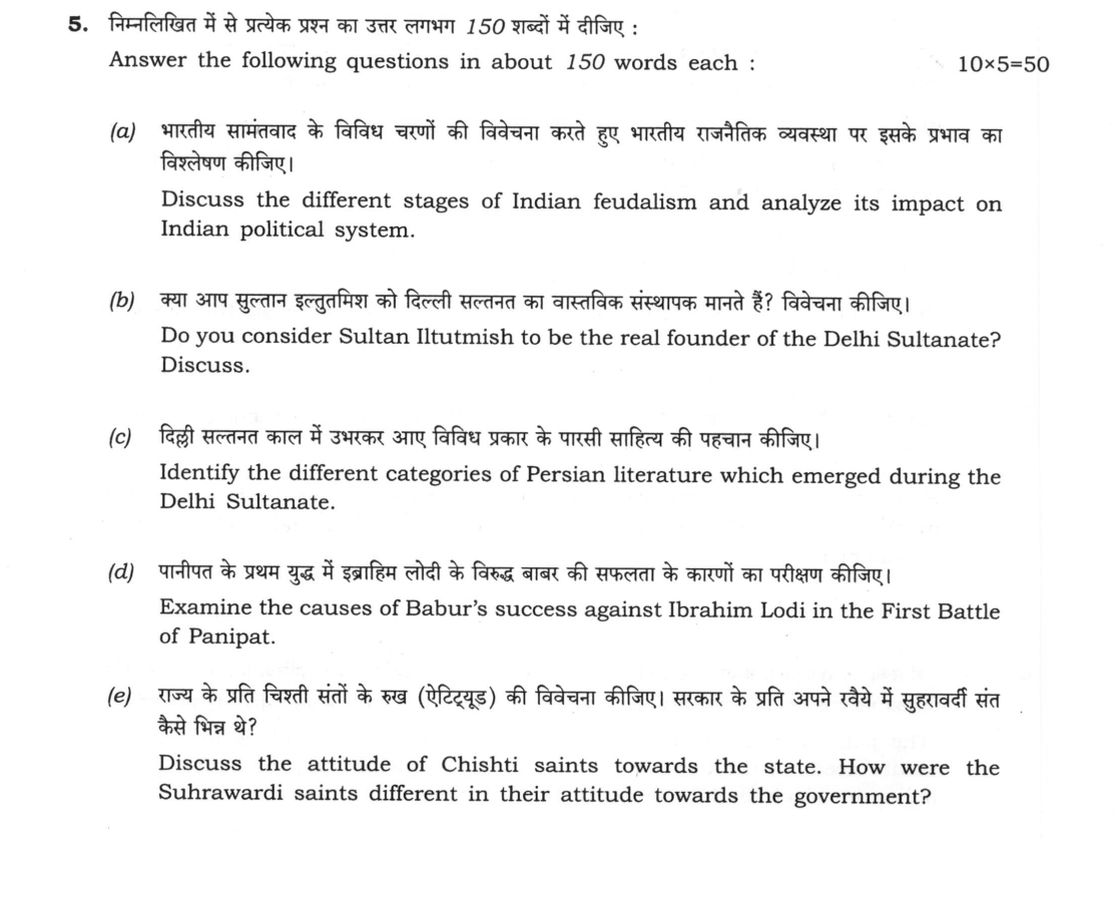
Answer the following questions in about 150 words each: (a) Discuss the different stages of Indian feudalism and analyze its impact on Indian political system. (b) Do you consider Sultan Iltutmish to be the real founder of the Delhi Sultanate? Discuss. (c) Identify the different categories of Persian literature which emerged during the Delhi Sultanate. (d) Examine the causes of Babur's success against Ibrahim Lodi in the First Battle of Panipat. (e) Discuss the attitude of Chishti saints towards the state. How were the Suhrawardi saints different in their attitude towards the government? (10×5=50 marks)
हिंदी में प्रश्न पढ़ें
निम्नलिखित में से प्रत्येक प्रश्न का उत्तर लगभग 150 शब्दों में दीजिए: (a) भारतीय सामंतवाद के विविध चरणों की विवेचना करते हुए भारतीय राजनीतिक व्यवस्था पर इसके प्रभाव का विश्लेषण कीजिए। (b) क्या आप सुल्तान इल्तुतमिश को दिल्ली सल्तनत का वास्तविक संस्थापक मानते हैं? विवेचना कीजिए। (c) दिल्ली सल्तनत काल में उभरकर आए विविध प्रकार के पारसी साहित्य की पहचान कीजिए। (d) पानीपत के प्रथम युद्ध में इब्राहीम लोदी के विरुद्ध बाबर की सफलता के कारणों का परीक्षण कीजिए। (e) राज्य के प्रति चिश्ती संतों के रुख (एटिट्यूड) की विवेचना कीजिए। सरकार के प्रति अपने रवैये में सुहरावर्दी संत कैसे भिन्न थे? (10×5=50 अंक)
Model answer
Written by UPSC Answer Check against this question's marking rubric, to the 150-word length. UPSC does not publish answers for Mains — this is one way to score well, not an official key.
(a) Stages of Indian Feudalism: R.S. Sharma traces three stages—pre-feudal (Gupta–early medieval), feudal (c. 600–1200), and post-feudal transition. Land grants, samantas, and sub-infeudation decentralized authority, weakening central power and fostering regional kingdoms.
(b) Iltutmish as Founder: He consolidated the iqta system, formed Turkan-i-Chahalgani, made Delhi the capital, and resisted Mongols. Yet Aibak's foundational role tempers this claim.
(c) Persian Literature: Historical (Tabaqat-i-Nasiri), biographical (tazkira), poetry (ghazal, qasida, masnavi), and administrative/insha works emerged.
(d) Babur's Success: Tulughma tactics, cart-wagon defence, artillery, Ibrahim's errors, and Afghan disaffection ensured victory at Panipat (1526).
(e) Chishti saints stayed aloof from the state, stressing poverty; Suhrawardis engaged politically, accepting grants and advising rulers.
Thus feudalism reshaped polity, Iltutmish institutionalized the Sultanate, Persian letters flourished, Babur's strategy triumphed, and Sufi orders diverged politically.
What "Discuss" is asking you to do
Lay the issue out from more than one side — how it arose, what is claimed for it, what is held against it, and where it now stands. UPSC attaches discuss to broad topics with several live dimensions, so coverage of the dimensions earns more than the strength of your opinion.
Structure that answers it
Set the issue up → the case as it is made → the case against → the dimension both sides leave out → where the balance now lies
Where marks are lost
Listing facts with no thread between them, or arguing one side throughout and calling it a discussion.
How this answer will be evaluated
Approach
Framework: Context > Thesis > Evidence > Historiography. (a) discuss: intro > 3-4 dimensions > example > balanced close | (b) discuss: intro > 3-4 dimensions > example > balanced close | (c) enumerate: list the items in order > one line each > no commentary | (d) examine: intro > how/why with reasoning > evidence > conclusion | (e) discuss: intro > 3-4 dimensions > example > balanced close Full marks: Argues thesis with specific evidence, names historians, cites sources, analyzes historiographical debates
Key points expected
- Identify distinct stages of Indian feudalism
- Analyze impact on Indian political system
- Cite inscriptions or chronicles as sources
- Name a historiographical school
- State thesis on Iltutmish's role
- Provide evidence for his contributions
- Address counter-arguments
- Cite specific administrative reforms
Evaluation rubric
Each sub-part is marked on its own, against the marks and word limit printed on the paper.
- (a) Stages of Indian feudalism and their impact on the political system. · 150 words
discuss— intro → 3-4 dimensions → example → balanced close
Must cover
- Identify distinct stages of Indian feudalism
- Analyze impact on Indian political system
- Cite inscriptions or chronicles as sources
- Name a historiographical school
Loses marks
- Chronology without analysis
- Textbook retelling of stages
- No impact analysis
Earns more
- Mention specific land grant inscriptions
- Reference specific political fragmentation
- Cite specific chronicle evidence
- Discuss regional variations
Extra mark
- Named historian on feudalism
- Specific source quotation
- (b) Whether Iltutmish is the real founder of the Delhi Sultanate. · 150 words
discuss— intro → 3-4 dimensions → example → balanced close
Must cover
- State thesis on Iltutmish's role
- Provide evidence for his contributions
- Address counter-arguments
- Cite specific administrative reforms
Loses marks
- Simple narrative without argument
- No counter-arguments addressed
- Vague claims without evidence
Earns more
- Mention Iqta system reforms
- Reference specific administrative innovations
- Cite specific chronicle evidence
- Discuss consolidation of power
Extra mark
- Named historian on Sultanate founding
- Specific source quotation
- (c) Different categories of Persian literature during Delhi Sultanate. · 150 words
enumerate— list the items in order → one line each → no commentary
Must cover
- Identify distinct categories of Persian literature
- Provide examples for each category
- Mention specific works or authors
- Contextualize within Delhi Sultanate period
Loses marks
- Vague categories without examples
- No specific works mentioned
- Generic literary discussion
Earns more
- Name specific Persian works
- Mention specific authors
- Discuss literary themes
- Reference specific historical context
Extra mark
- Named literary critic
- Specific text reference
- (d) Causes of Babur's success against Ibrahim Lodi in First Battle of Panipat. · 150 words
examine— intro → how/why with reasoning → evidence → conclusion
Must cover
- Identify causes of Babur's success
- Examine military tactics employed
- Analyze Ibrahim Lodi's weaknesses
- Cite specific battle evidence
Loses marks
- Simple narrative of battle
- No analysis of causes
- Vague military discussion
Earns more
- Mention gunpowder tactics
- Reference specific military strategies
- Discuss Lodi's internal weaknesses
- Cite specific battle chronicles
Extra mark
- Named military historian
- Specific tactical detail
- (e) Chishti saints' attitude towards state and difference from Suhrawardi saints. · 150 words
discuss— intro → 3-4 dimensions → example → balanced close
Must cover
- Discuss Chishti saints' attitude towards state
- Compare with Suhrawardi saints' attitude
- Provide specific examples of each order
- Analyze political implications
Loses marks
- Vague comparison without specifics
- No named saints mentioned
- Generic Sufi discussion
Earns more
- Name specific Chishti saints
- Mention specific Suhrawardi saints
- Reference specific political interactions
- Discuss theological differences
Extra mark
- Named Sufi scholar
- Specific hagiographic reference
Practice this exact question
Write your answer and it is marked point by point against the model answer above — what you covered, what you missed, what you got wrong.
Evaluate my answer →More from History 2021 Paper I
- Q2 (a) Do you agree that ecological factors influenced the flow and ebb of the Harappan Civi…
- Q3 (a) Will it be proper to consider the megaliths to represent a single, homogeneous or con…
- Q4 (a) "The political and economic needs of rulers, combined with economic and status needs…
- Q5 Answer the following questions in about 150 words each: (a) Discuss the different stages…
- Q6 (a) Discuss the transformation of Sikh community from a Nirguna Bhakti sect into a politi…
- Q7 (a) Discuss the importance of Iqta system. How did it help in centralization of administr…
- Q8 (a) "The Chola rulers were not only mighty conquerors, efficient administrators but also…