Paper I — Q8
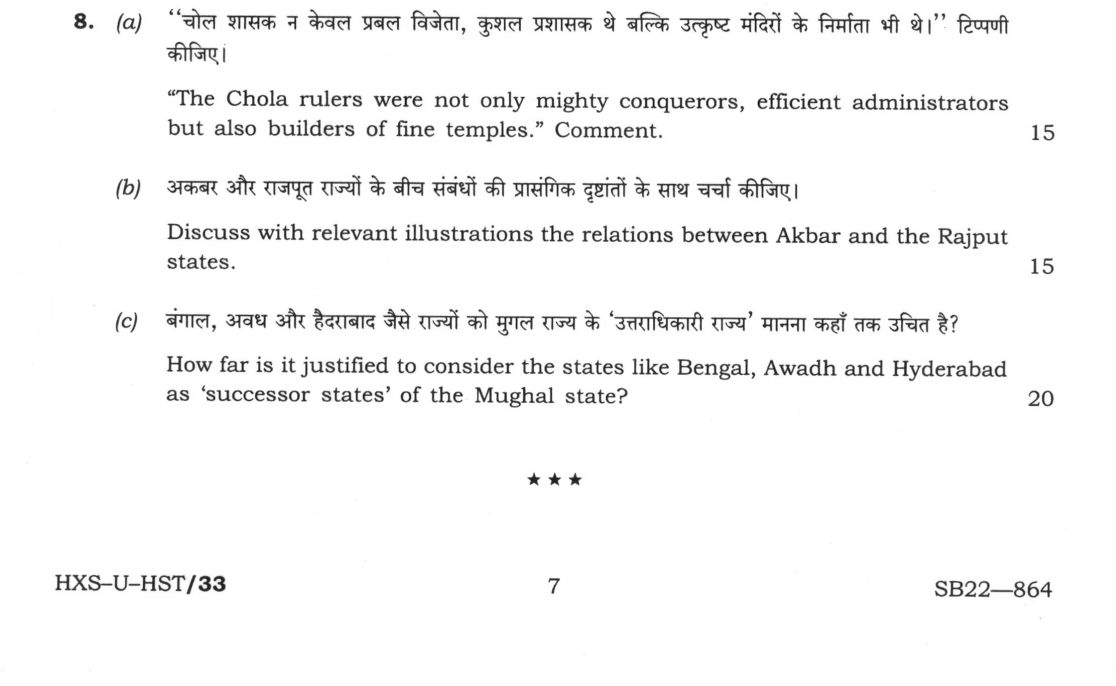
(a) "The Chola rulers were not only mighty conquerors, efficient administrators but also builders of fine temples." Comment. (15…
"The Chola rulers were not only mighty conquerors, efficient administrators but also builders of fine temples." Comment. 15 marks
Discuss with relevant illustrations the relations between Akbar and the Rajput states. 15 marks
How far is it justified to consider the states like Bengal, Awadh and Hyderabad as 'successor states' of the Mughal state? 20 marks
हिंदी में प्रश्न पढ़ें
"चोल शासक न केवल प्रबल विजेता, कुशल प्रशासक थे बल्कि उत्कृष्ट मंदिरों के निर्माता भी थे।" टिप्पणी कीजिए। (15 अंक)
अकबर और राजपूत राज्यों के बीच संबंधों की प्रासंगिक दृष्टांतों के साथ चर्चा कीजिए। (15 अंक)
बंगाल, अवध और हैदराबाद जैसे राज्यों को मुगल राज्य के 'उत्तराधिकारी राज्य' मानना कहाँ तक उचित है? (20 अंक)
Model answer
Written by UPSC Answer Check against this question's marking rubric, to the expected length. UPSC does not publish answers for Mains — this is one way to score well, not an official key.
Chola state Medieval Indian state formation combined conquest, ritual legitimacy and administrative incorporation. The Chola rulers were conquerors, administrators and temple builders. Rajaraja I and Rajendra I extended power through naval expeditions to Southeast Asia and conquest of Sri Lanka. Administration rested on ur, sabha and nagaram assemblies linking village, temple and merchant communities; brahmadeya and devadana inscriptions/grants tied land, labour and ritual to the state; land revenue, a standing army and kaditram sustained expansion. Temples such as Brihadeeswarar/Tanjore, Gangaikondacholapuram and Airavatesvara/Darasuram, UNESCO sites, with vimana, gopuram, mandapa and Nataraja bronze iconography, display Dravidian architecture and royal piety. The temple thus became a fiscal and political centre. Their “golden age” should be read critically: temple building consolidated agrarian surplus, not merely devotion.
Akbar and Rajputs Akbar’s Rajput policy, from 1562 to the 1590s, moved from conflict—Merta and Chittor 1567—to integration. Matrimonial alliances with Kachhwahas (Harkha Bai/Jodha Bai) and Rathores, but not Sisodias, tied elites to the court and shaped gendered court politics. Rajput women’s marriages created kinship networks that mediated disputes and courtly patronage. Rajputs such as Raja Bharmal, Bhagwant Das and Man Singh I entered mansabdari; Khatri/Kayastha Todar Mal exemplified non-Rajput revenue expertise. Abolition of jizya (1564) and pilgrimage tax, plus Rajput influence on Mughal painting, architecture and literature, made alliance durable. Akbar’s “secularism” was pragmatic elite bargaining, not uniform harmony; nationalist, Cambridge School and Subaltern Studies readings stress different aspects, while Aurangzeb’s policies later strained Rajput relations.
Successor states A “successor state” may mean formal recognition of Mughal sovereignty with de facto autonomy. Bengal under Murshid Quli Khan, Alivardi Khan and Siraj-ud-daulah held diwani rights, issued semi-independent coinage and paid tribute to Delhi; Awadh under Saadat Khan Burhan-ul-Mulk, Safdar Jung and Shuja-ud-daulah used wazir titles, expanded armies and patronised culture; Hyderabad under Nizam-ul-Mulk Asaf Jah, who first declared independence in 1724, created Deccan autonomy and later faced subsidiary alliances. Bengal’s diwani rights and Awadh’s wazir title show negotiated autonomy rather than mere rebellion. They retained mansabdari, jagirdari and revenue administration, yet developed new regional elites, vernacularization and, under British intervention, iqtadari-to-zamindari transitions. Satish Chandra’s “Mughal successor states” and Muzaffar Alam’s “regional polities” thus capture continuity and rupture.
Thus Chola temple-state, Akbar’s mansabdari incorporation and post-Mughal regionalization show different models: ritual-administrative consolidation, negotiated elite integration, and fragmented sovereignty. The “successor” label is justified where Mughal institutions and legitimacy persisted, but misleading if it ignores fiscal transformation, local patronage and colonial pressure.
What "Discuss" is asking you to do
Lay the issue out from more than one side — how it arose, what is claimed for it, what is held against it, and where it now stands. UPSC attaches discuss to broad topics with several live dimensions, so coverage of the dimensions earns more than the strength of your opinion.
Structure that answers it
Set the issue up → the case as it is made → the case against → the dimension both sides leave out → where the balance now lies
Where marks are lost
Listing facts with no thread between them, or arguing one side throughout and calling it a discussion.
How this answer will be evaluated
Approach
Framework: UPSC History Paper 1 (HXS-U-HST/33). (a) comment: context > arguments both sides > judgment > close | (b) discuss: intro > 3-4 dimensions > example > balanced close | (c) justify: claim > 3-4 reasons > evidence > conclusion Full marks: Argues a clear thesis, cites specific inscriptions/chronicles, names historians, and provides a balanced, analytical judgment.
Key points expected
- Cite specific military campaigns (e.g., Rameswaram, Sri Lanka)
- Detail administrative innovations (e.g., Uthiramerur inscription, village autonomy)
- Analyze architectural features of Brihadeeswarar or Gangaikonda Cholapuram
- Provide a balanced judgment on the 'builder' aspect
- Illustrate the shift from Akbar's early conquests (e.g., Chittor) to alliances
- Detail the 'Rajput Policy' (marriages, mansabdarships, jagirs)
- Analyze the impact of the policy on Mughal military strength
- Mention specific Rajput states (e.g., Mewar, Marwar, Bundi)
Evaluation rubric
Each sub-part is marked on its own, against the marks and word limit printed on the paper.
- (a) Contextualize Chola rule and judge the validity of the tripartite claim (conqueror/administrator/builder). 15 marks
comment— context → arguments both sides → judgment → close
Must cover
- Cite specific military campaigns (e.g., Rameswaram, Sri Lanka)
- Detail administrative innovations (e.g., Uthiramerur inscription, village autonomy)
- Analyze architectural features of Brihadeeswarar or Gangaikonda Cholapuram
- Provide a balanced judgment on the 'builder' aspect
Loses marks
- Generalizing without naming specific kings or temples
- Treating the three aspects as separate, unrelated lists
- Ignoring the 'administrative' aspect in favor of only temples
Earns more
- Reference to specific inscriptions (e.g., Leiden, Tanjore)
- Mention of specific Chola kings (Rajaraja I, Rajendra I)
- Discussion of the 'Chola Navy' or maritime trade
Extra mark
- Quotation from a specific Chola inscription
- Reference to a specific modern historian (e.g., K.A. Nilakanta Sastri)
- (b) Examine the evolution of Mughal-Rajput relations from conflict to integration with specific examples. 15 marks
discuss— intro → 3-4 dimensions → example → balanced close
Must cover
- Illustrate the shift from Akbar's early conquests (e.g., Chittor) to alliances
- Detail the 'Rajput Policy' (marriages, mansabdarships, jagirs)
- Analyze the impact of the policy on Mughal military strength
- Mention specific Rajput states (e.g., Mewar, Marwar, Bundi)
Loses marks
- Focusing only on the marriage alliances without political context
- Ignoring the military dimension of the relationship
- Treating all Rajput states as a monolithic entity
Earns more
- Reference to the Treaty of 1569 or 1570
- Discussion of the role of Rajput generals (e.g., Man Singh)
- Mention of the 'Sangrah' or 'Sangram' of Rajput states
Extra mark
- Reference to a specific Mughal chronicle (e.g., Ain-i-Akbari)
- Mention of a specific historian (e.g., Jadunath Sarkar)
- (c) Evaluate the extent to which Bengal, Awadh, and Hyderabad were 'successor states' of the Mughal empire. 20 marks
justify— claim → 3-4 reasons → evidence → conclusion
Must cover
- Define the concept of 'successor states' in the Mughal context
- Analyze the administrative and military continuity in these states
- Discuss the political fragmentation and the rise of local dynasties
- Provide a balanced judgment on the 'successor' label
Loses marks
- Treating the three states as identical in their relationship to the Mughals
- Ignoring the economic and social changes in these regions
- Failing to provide a clear judgment on the 'successor' label
Earns more
- Reference to the 'Nawabs' of Bengal and Awadh
- Discussion of the 'Nizam' of Hyderabad
- Mention of the 'Mansabdari' system's persistence
- Reference to the 'Mughal' cultural and administrative legacy
Extra mark
- Reference to a specific historian (e.g., Irfan Habib, Satish Chandra)
- Mention of a specific treaty or event (e.g., Battle of Buxar)
Practice this exact question
Write your answer and it is marked point by point against the model answer above — what you covered, what you missed, what you got wrong.
Evaluate my answer →More from History 2021 Paper I
- Q5 Answer the following questions in about 150 words each: (a) Discuss the different stages…
- Q6 (a) Discuss the transformation of Sikh community from a Nirguna Bhakti sect into a politi…
- Q7 (a) Discuss the importance of Iqta system. How did it help in centralization of administr…
- Q8 (a) "The Chola rulers were not only mighty conquerors, efficient administrators but also…