Paper II — Q1
Critically examine the following statements in about 150 words each: (a) The introduction of Western education transformed India…
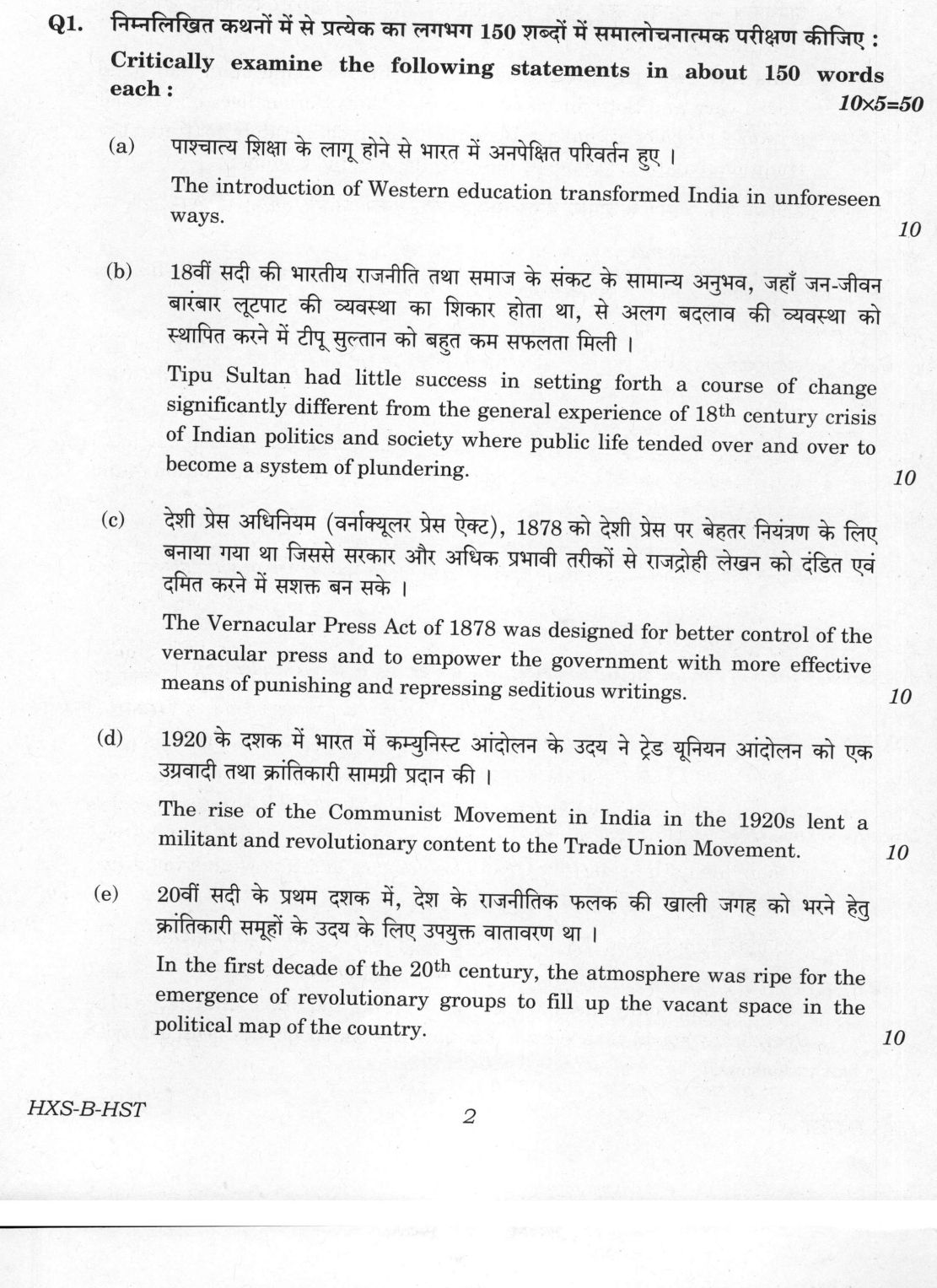
Critically examine the following statements in about 150 words each:
The introduction of Western education transformed India in unforeseen ways. 10 marks
Tipu Sultan had little success in setting forth a course of change significantly different from the general experience of 18th century crisis of Indian politics and society where public life tended over and over to become a system of plundering. 10 marks
The Vernacular Press Act of 1878 was designed for better control of the vernacular press and to empower the government with more effective means of punishing and repressing seditious writings. 10 marks
The rise of the Communist Movement in India in the 1920s lent a militant and revolutionary content to the Trade Union Movement. 10 marks
In the first decade of the 20th century, the atmosphere was ripe for the emergence of revolutionary groups to fill up the vacant space in the political map of the country. 10 marks
हिंदी में प्रश्न पढ़ें
निम्नलिखित कथनों में से प्रत्येक का लगभग 150 शब्दों में समालोचनात्मक परीक्षण कीजिए :
पाश्चात्य शिक्षा के लागू होने से भारत में अनपेक्षित परिवर्तन हुए । (10 अंक)
18वीं सदी की भारतीय राजनीति तथा समाज के संकट के सामान्य अनुभव, जहाँ जन-जीवन बारंबार लूटपाट की व्यवस्था का शिकार होता था, से अलग बदलाव की व्यवस्था को स्थापित करने में टीपू सुल्तान को बहुत कम सफलता मिली । (10 अंक)
देशी प्रेस अधिनियम (वर्नैक्यूलर प्रेस एक्ट), 1878 को देशी प्रेस पर बेहतर नियंत्रण के लिए बनाया गया था जिससे सरकार और अधिक प्रभावी तरीकों से राजद्रोही लेखन को दंडित एवं दमित करने में सशक्त बन सके । (10 अंक)
1920 के दशक में भारत में कम्युनिस्ट आंदोलन के उदय ने ट्रेड यूनियन आंदोलन को एक उग्रवादी तथा क्रांतिकारी सामग्री प्रदान की । (10 अंक)
20वीं सदी के प्रथम दशक में, देश के राजनीतिक फलक की खाली जगह को भरने हेतु क्रांतिकारी समूहों के उदय के लिए उपयुक्त वातावरण था । (10 अंक)
Model answer
Written by UPSC Answer Check against this question's marking rubric, to the 150-word length. UPSC does not publish answers for Mains — this is one way to score well, not an official key.
(a) The introduction of Western education transformed India in unforeseen ways.
Macaulay’s Minute (1835) sought to create a class "Indian in blood and colour, but English in taste" to serve colonial bureaucracy and consolidate cultural hegemony. However, this initiative triggered profound, unintended consequences. While critics correctly highlight how colonial education alienated elites from indigenous traditions and fostered intellectual dependency, it dialectically generated its own antithesis.
The new English-educated intelligentsia utilized Western rationalism, liberal philosophy, and Enlightenment ideals not to subserviently assimilate, but to critique British rule and re-evaluate indigenous social practices. Social reformers like Raja Rammohan Roy and Ishwar Chandra Vidyasagar weaponized rationalist inquiry to challenge orthodoxies such as Sati and promote widow remarriage. Furthermore, English served as a pan-Indian lingua franca, facilitating cross-regional political networking that birthed the Indian National Congress. Thus, rather than functioning merely as an instrument of cultural colonialism, Western education inadvertently equipped Indians with the intellectual tools for modern nationalism and social regeneration.
(b) Tipu Sultan had little success in setting forth a course of change significantly different from the general experience of 18th century crisis of Indian politics and society where public life tended over and over to become a system of plundering.
Tipu Sultan represented a dynamic break from contemporary feudal stagnation. He pioneered state-directed mercantilism, establishing state trading networks, state factories, sericulture, and advanced metallurgy demonstrated by the Mysorean rockets. His military modernizations, aided by French alliances, and administrative centralization aimed to eliminate revenue intermediaries and build a consolidated state.
Yet, structurally, Tipu remained trapped within the 18th-century framework of military-fiscalism. The exorbitant resource demands of continuous warfare forced heavy agrarian extractions and predatory campaigns, such as the punitive raids into Malabar and Coorg, mirroring the prevailing culture of regional plunder. Additionally, his inability to institutionalize these reforms or forge durable diplomatic coalitions with the Marathas and the Nizam against the East India Company left Mysore isolated. Therefore, while Tipu demonstrated remarkable institutional innovation, systemic contradictions and unrelenting warfare ultimately prevented him from completely transcending the crisis of 18th-century Indian polity.
(c) The Vernacular Press Act of 1878 was designed for better control of the vernacular press and to empower the government with more effective means of punishing and repressing seditious writings.
Lord Lytton enacted the Vernacular Press Act (1878) to stifle growing press criticism of the administration's mishandling of the 1876–78 famine and the ostentatious Imperial Delhi Durbar. The Act empowered district magistrates to demand punitive security deposits and seize printing presses without judicial appeal, deliberately discriminating between English and vernacular publications.
However, the Act’s repressive success was largely ephemeral. Nationalist newspapers outmaneuvered the law through ingenious tactics, notably the Amrita Bazar Patrika, which converted into an English weekly overnight. Rather than silencing dissent, the Act catalyzed nationalist consciousness, galvanized public meetings, and stimulated underground circulation. It exposed the illiberal foundations of colonial rule and laid the template for subsequent repressive legislation, such as the Indian Press Act of 1910. The legislation proved counterproductive, ultimately forcing Lord Ripon to repeal it in 1882 amid unified Indian resistance.
(d) The rise of the Communist Movement in India in the 1920s lent a militant and revolutionary content to the Trade Union Movement.
Before the 1920s, Indian trade unionism operated primarily along philanthropic and reformist lines, dominated by moderate leaders and Gandhian principles of arbitration and trusteeship. The entry of communist ideology, stimulated by M.N. Roy’s emigre initiatives, the Kanpur Bolshevik Conspiracy Case (1924), and the formal foundation of the Communist Party at the Kanpur Conference (1925), transformed this landscape.
Through the Workers’ and Peasants’ Parties (WPP), communists shifted working-class mobilization from purely "economist" demands (wages and hours) to anti-imperialist political struggle. They organized historic strikes across Bombay textile mills and the railways, radicalizing the All India Trade Union Congress (AITUC). The colonial state recognized this revolutionary threat, responding with severe crackdowns, notably the Meerut Conspiracy Case (1929). While internal ideological factionalism occasionally disrupted organizational cohesion, the communists irreversibly infused the labour movement with class consciousness, militant mass action, and direct linkage to the national liberation struggle.
(e) In the first decade of the 20th century, the atmosphere was ripe for the emergence of revolutionary groups to fill up the vacant space in the political map of the country.
The first decade of the 20th century witnessed a deep political void. The Moderate strategy of constitutional agitation stood discredited by the arbitrary Partition of Bengal (1905). Simultaneously, the Extremist leadership, despite generating mass energy through Swadeshi and boycott, failed to provide a sustained institutional structure or concrete action plan after government repression, Tilak's arrest, and the Surat Split (1907).
This vacuum was swiftly occupied by revolutionary secret societies like the Anushilan Samiti (1902) and Jugantar in Bengal, alongside Abhinav Bharat in Maharashtra. Drawing tactical inspiration from Russian nihilists and Irish Fenians, youth embraced heroic individual action, political dacoities, and assassinations, culminating in events like the Alipore Bomb Case (1908). While their elite cadre base and lack of broad mass organization limited their long-term military viability, these revolutionary groups successfully preserved the tempo of anti-colonial resistance during a period of acute political inertia.
What "Critically examine" is asking you to do
Test the proposition the question puts to you and return a finding on how far it holds. Examine stems carry a claim, or ask whether something has happened, and expect evidence weighed both ways before the extent is stated — often with remedial measures attached. “Critically” is not a section added at the end: name the yardstick you are judging by — the evidence, the stated objective, a constitutional principle, a rival explanation — and let a verdict close each part of the body. Where the question quotes a claim, that verdict must land on the claim itself, accepted, qualified or rejected, and not on the theme in general.
Structure that answers it
Restate the claim as the question frames it → evidence that supports it → evidence that undercuts it → the conditions under which it holds → verdict on how far it stands
Where marks are lost
Merits in one paragraph, demerits in the next, and a conclusion calling for a balanced and holistic approach. That is a survey with the judgement left out and it holds the answer in the middle band. The opposite error is reading “critically” as permission to attack — and with the odd pairings, critically describe or critically explain, the exposition still carries most of the marks, the judgement being a layer on it rather than a substitute for it.
How this answer will be evaluated
Approach
Framework: Context > Thesis > Evidence > Historiography. (a) critique: the claim > its strengths > its weaknesses > your judgment | (b) critique: the claim > its strengths > its weaknesses > your judgment | (c) critique: the claim > its strengths > its weaknesses > your judgment | (d) critique: the claim > its strengths > its weaknesses > your judgment | (e) critique: the claim > its strengths > its weaknesses > your judgment Full marks: Thesis-driven, cites specific sources/historians, directly addresses the 'critique' command word.
Key points expected
- Mention Macaulay's Minute or Wood's Despatch
- Identify the 'unforeseen' rise of nationalism
- Note the creation of a Westernized elite class
- Contrast colonial intent with actual outcome
- Define the 'system of plundering' (Nawabi/Maratha context)
- Detail Tipu's administrative or military innovations
- Assess the 'success' or failure of these changes
- Compare his state with the general 18th-century crisis
Evaluation rubric
Each sub-part is marked on its own, against the marks and word limit printed on the paper.
- (a) Assess the paradox of Western education creating the tools for its own destruction. 10 marks · 150 words
critique— the claim → its strengths → its weaknesses → your judgment
Must cover
- Mention Macaulay's Minute or Wood's Despatch
- Identify the 'unforeseen' rise of nationalism
- Note the creation of a Westernized elite class
- Contrast colonial intent with actual outcome
Loses marks
- Treating education as purely a 'gift' of the British
- Ignoring the social stratification caused by the system
Earns more
- Reference to the 'cultural imperialism' debate
- Mention of specific reformers (e.g., Tagore, Gandhi)
Extra mark
- Citation of a specific historian (e.g., R. E. F. Smith)
- (b) Evaluate Tipu Sultan's reforms against the backdrop of 18th-century political chaos. 10 marks · 150 words
critique— the claim → its strengths → its weaknesses → your judgment
Must cover
- Define the 'system of plundering' (Nawabi/Maratha context)
- Detail Tipu's administrative or military innovations
- Assess the 'success' or failure of these changes
- Compare his state with the general 18th-century crisis
Loses marks
- Treating Tipu as a modern state-builder without context
- Ignoring the 'plundering' aspect of the 18th-century crisis
Earns more
- Mention of the Tipu-Sultanate's centralized bureaucracy
- Reference to his naval or diplomatic efforts
Extra mark
- Citation of a specific source or historian (e.g., K. N. Chaudhuri)
- (c) Analyze the Vernacular Press Act's role in suppressing seditious writings. 10 marks · 150 words
critique— the claim → its strengths → its weaknesses → your judgment
Must cover
- Identify the Act's specific punitive powers
- Explain the target: the vernacular press
- Link the Act to the rise of nationalist agitation
- Assess its effectiveness in 'repressing' dissent
Loses marks
- Confusing it with the Press and Registration Act
- Failing to link it to the 'seditious' nature of the press
Earns more
- Mention of the 'Seditious Writings' clause
- Reference to the backlash or repeal of the Act
Extra mark
- Citation of a specific case or newspaper targeted
- (d) Explain how the Communist Movement radicalized the Trade Union Movement. 10 marks · 150 words
critique— the claim → its strengths → its weaknesses → your judgment
Must cover
- Identify the 'militant and revolutionary' content
- Link the 1920s rise of Communism to labor organizing
- Contrast with earlier, more moderate trade unionism
- Assess the impact on the nature of labor strikes
Loses marks
- Treating the Communist Movement as a separate entity from labor
- Ignoring the 'militant' aspect of the change
Earns more
- Mention of the Communist Party of India (CPI) or its precursors
- Reference to specific industrial centers (e.g., Bombay, Calcutta)
Extra mark
- Citation of a specific historian or source on labor history
- (e) Analyze the conditions that made the early 20th century ripe for revolutionary groups. 10 marks · 150 words
critique— the claim → its strengths → its weaknesses → your judgment
Must cover
- Identify the 'vacant space' in the political map
- Explain the 'atmosphere' (e.g., failure of moderates)
- Link the emergence of groups to this specific context
- Assess the 'ripeness' of the conditions for revolution
Loses marks
- Treating the revolutionary groups as a sudden, unexplained phenomenon
- Ignoring the 'vacant space' or 'atmosphere' mentioned in the prompt
Earns more
- Mention of the 'extremist' or 'revolutionary' factions
- Reference to specific groups (e.g., Anushilan Samiti, Ghadar Party)
Extra mark
- Citation of a specific historian or source on revolutionary history
Practice this exact question
Write your answer and it is marked point by point against the model answer above — what you covered, what you missed, what you got wrong.
Evaluate my answer →More from History 2021 Paper II
- Q1 Critically examine the following statements in about 150 words each: (a) The introduction…
- Q2 (a) India had been the world leader in the field of hand spun and hand woven yarn and clo…
- Q3 (a) How did English utilitarian thinking impact India in the British era? (20 marks) (b)…
- Q4 (a) Discuss the major constitutional developments in India after 1858 and their impact on…