Paper II — Q6
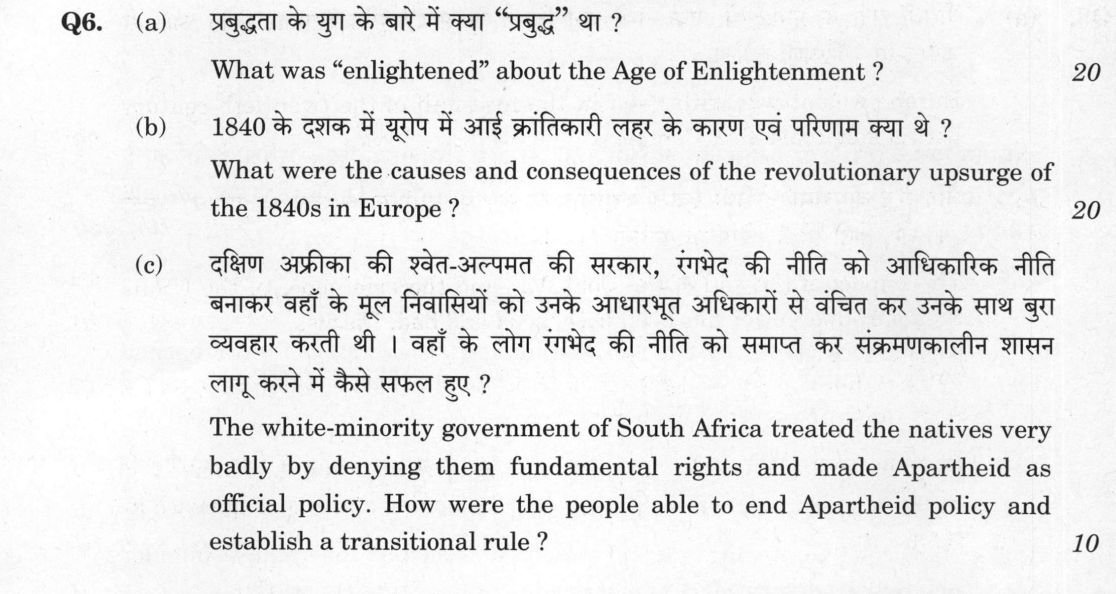
(a) What was "enlightened" about the Age of Enlightenment? (20 marks) (b) What were the causes and consequences of the…
What was "enlightened" about the Age of Enlightenment? 20 marks
What were the causes and consequences of the revolutionary upsurge of the 1840s in Europe? 20 marks
The white-minority government of South Africa treated the natives very badly by denying them fundamental rights and made Apartheid as official policy. How were the people able to end Apartheid policy and establish a transitional rule? 10 marks
हिंदी में प्रश्न पढ़ें
प्रबुद्धता के युग के बारे में क्या "प्रबुद्ध" था ? (20 अंक)
1840 के दशक में यूरोप में आई क्रांतिकारी लहर के कारण एवं परिणाम क्या थे ? (20 अंक)
दक्षिण अफ्रीका की श्वेत-अल्पमत की सरकार, रंगभेद की नीति को आधिकारिक नीति बनाकर वहाँ के मूल निवासियों को उनके आधारभूत अधिकारों से वंचित कर उनके साथ बुरा व्यवहार करती थी । वहाँ के लोग रंगभेद की नीति को समाप्त कर संक्रमणकालीन शासन लागू करने में कैसे सफल हुए ? (10 अंक)
Model answer
Written by UPSC Answer Check against this question's marking rubric, to the expected length. UPSC does not publish answers for Mains — this is one way to score well, not an official key.
Enlightenment. The Age of Enlightenment was “enlightened” because it replaced scholasticism and religious dogma with reason, empiricism, secularism and individual rights. Where pre-modern thought often derived authority from revelation, church hierarchy or custom, Enlightenment thinkers asked what could be known, what justified government, and what rights belonged to persons. Empiricism made experience the test of claims, secularism separated public policy from clerical authority, and Locke’s natural rights of life, liberty and property gave individuals a moral claim against arbitrary power. Kant’s “Sapere Aude” — dare to know — made autonomy and public reason the standard. This was not merely philosophical: it became applied reason in institutions. Montesquieu’s separation of powers checked arbitrary rule, Rousseau’s social contract located legitimacy in popular will, and Smith’s economic liberalism argued that free exchange and division of labour could raise general welfare. The causal mechanism was simple: once reason questioned divine right and privilege, rights-based claims became politically usable.
1848. The revolutionary upsurge of the 1840s followed because Enlightenment-derived liberal and nationalist aspirations met material crisis. Bad harvests of 1846-47, agrarian distress, industrial unemployment and the economic crisis of the 1840s made existing regimes seem incompetent. The February Revolution in Paris, which overthrew the July Monarchy, then produced a contagion effect across Europe: demands for constitutions, civil liberties, national self-determination and social reform spread to German states, Austria, Italy and Hungary. The contagion worked because newspapers, railways and mobile elites carried models of protest. In France, the new republic promised universal male suffrage; in German states, liberal parliaments were demanded; in Italy, Risorgimento linked national unity to constitutional liberty. The immediate consequences were mixed. The revolutions failed to unify Germany and Italy, and the Metternich system collapsed in 1848, though conservative forces restored much of it after 1849. Yet the old order was permanently weakened: constitutional and parliamentary reforms survived in many states, national movements gained momentum, and Marx and Engels’ Communist Manifesto, published in February 1848, gave a socialist response to the revolutionary ferment and class conflict of 1848.
End of Apartheid. Apartheid, made official policy in 1948, denied natives fundamental rights through racial segregation, pass laws, restricted voting and forced removals. The Group Areas Act and pass laws made daily life a site of racial control. It ended because internal mass mobilization and international pressure made the regime’s cost of rule unsustainable, while elite negotiation provided a way out. The ANC, formed in 1912, led the Defiance Campaign; Sharpeville in 1960 radicalized the struggle; Soweto in 1976 exposed the brutality of the system, though the deeper ungovernability emerged from the mass democratic movement of the 1980s, when strikes, boycotts and civic resistance paralysed townships. International isolation mattered: South Africa withdrew from the Commonwealth in 1961, the UN Security Council adopted arms embargoes—voluntary in 1963 and mandatory in 1977—and India, which had raised racial discrimination against Indians in South Africa at the UN General Assembly in 1946, supported anti-apartheid pressure in multilateral forums. The pressure was not merely diplomatic: multilateral and national trade measures, alongside the arms embargoes, compounded the isolation. Finally, Mandela’s release in 1990 and CODESA negotiations allowed the ANC, NP and other parties to agree on a transitional rule: the Interim Constitution of 1993, a transitional executive, and a 1994 universal franchise.
Thus the Enlightenment’s “enlightened” contribution was the universal claim of reason and rights. That claim powered 1848, and later, in South Africa, it helped turn anti-colonial and anti-apartheid resistance into a negotiated democratic transition. This continuum shows that Enlightenment ideas did not automatically produce democracy; they supplied the language of rights that movements could adapt to local conditions and thereby made transition possible.
What "Explain" is asking you to do
Make the working of something clear — what sets it off, what follows from what, and what it produces. Explain is the Commission's mechanism word: it dominates the technical papers and the “explain why” stems, where the marks sit in the causal chain and not in the label.
Structure that answers it
State what it is → the initiating condition → the chain of cause, step by step → an instance where it plays out → what the chain produces
Where marks are lost
Describing what something looks like instead of why it works that way. Naming the stages without linking them reads as description too.
How this answer will be evaluated
Approach
Framework: UPSC History Paper 2. (a) explain: definition/context > points in order > small example > short close | (b) analyse: intro > causes > effects > stakeholders/linkages > way forward | (c) trace: start point > the stages in sequence > end point > what changed Full marks: Precise historical terminology, clear causal links, and specific examples of thinkers/events.
Key points expected
- Define 'Enlightenment' as a movement of reason and rationalism
- Identify key thinkers (e.g., Voltaire, Rousseau, Kant) and their specific contributions
- Explain the shift from religious authority to secular, scientific thought
- Link the movement to the critique of absolute monarchy and feudalism
- Identify the 'Year of Revolutions' (1848) and its pan-European scope
- Cite causes: industrialization, urbanization, and the failure of the 1815 settlement
- Detail specific events: Paris (Feb), Vienna, Berlin, or Milan
- Explain the consequences: failure of radical goals but rise of nationalism/liberalism
Evaluation rubric
Each sub-part is marked on its own, against the marks and word limit printed on the paper.
- (a) Define the intellectual and political characteristics that distinguished the Age of Enlightenment. 20 marks
explain— definition/context → points in order → small example → short close
Must cover
- Define 'Enlightenment' as a movement of reason and rationalism
- Identify key thinkers (e.g., Voltaire, Rousseau, Kant) and their specific contributions
- Explain the shift from religious authority to secular, scientific thought
- Link the movement to the critique of absolute monarchy and feudalism
Loses marks
- Treating it as a mere chronological list of philosophers
- Ignoring the political implications of the intellectual shift
- Confusing the Enlightenment with the Renaissance
Earns more
- Mention the role of the Encyclopedie
- Reference the 'Republic of Letters' or salons as dissemination channels
- Contrast with the 'Dark Ages' or medieval scholasticism
Extra mark
- Quote a specific line from Kant's 'What is Enlightenment?'
- Mention the specific impact on the French Revolution
- (b) Analyze the economic, social, and political causes and the specific outcomes of the 1848 revolutions. 20 marks
analyse— intro → causes → effects → stakeholders/linkages → way forward
Must cover
- Identify the 'Year of Revolutions' (1848) and its pan-European scope
- Cite causes: industrialization, urbanization, and the failure of the 1815 settlement
- Detail specific events: Paris (Feb), Vienna, Berlin, or Milan
- Explain the consequences: failure of radical goals but rise of nationalism/liberalism
Loses marks
- Focusing only on France and ignoring the rest of Europe
- Confusing the 1848 upsurge with the 1830 revolutions
- Listing events without analyzing the underlying causes
Earns more
- Mention the role of the middle class (bourgeoisie) vs. the proletariat
- Reference the 'Springtime of Peoples'
- Discuss the specific demands (e.g., universal suffrage, constitutions)
Extra mark
- Mention the specific role of Karl Marx in the 1848 context
- Reference the specific failure of the Frankfurt Parliament
- (c) Trace the process of ending Apartheid and the establishment of the transitional government. 10 marks
trace— start point → the stages in sequence → end point → what changed
Must cover
- Identify the key actors: ANC, Mandela, and the N.P. Botha/De Klerk government
- Mention the unbanning of the ANC and the release of Mandela (1990)
- Explain the role of the Truth and Reconciliation Commission (TRC)
- Conclude with the 1994 democratic elections and the interim constitution
Loses marks
- Focusing only on the violence without the political negotiation
- Ignoring the role of the white minority government in the transition
- Confusing the end of Apartheid with the end of colonialism
Earns more
- Mention the 'Code of Conduct' or specific negotiation rounds (e.g., CODESA)
- Reference the role of international pressure/sanctions
- Mention the specific date of the first democratic election (April 1994)
Extra mark
- Mention the specific role of the 'Rainbow Nation' concept
- Reference the specific 'interim constitution' of 1993
Practice this exact question
Write your answer and it is marked point by point against the model answer above — what you covered, what you missed, what you got wrong.
Evaluate my answer →More from History 2021 Paper II
- Q3 (a) How did English utilitarian thinking impact India in the British era? (20 marks) (b)…
- Q4 (a) Discuss the major constitutional developments in India after 1858 and their impact on…
- Q5 Critically examine the following statements in about 150 words each: (a) There were many…
- Q6 (a) What was "enlightened" about the Age of Enlightenment? (20 marks) (b) What were the c…
- Q7 (a) The rise of nationalism across nations shattered the chains which held together the e…
- Q8 (a) Europe was at war with itself in the first half of the twentieth century with a long…