Paper II — Q5
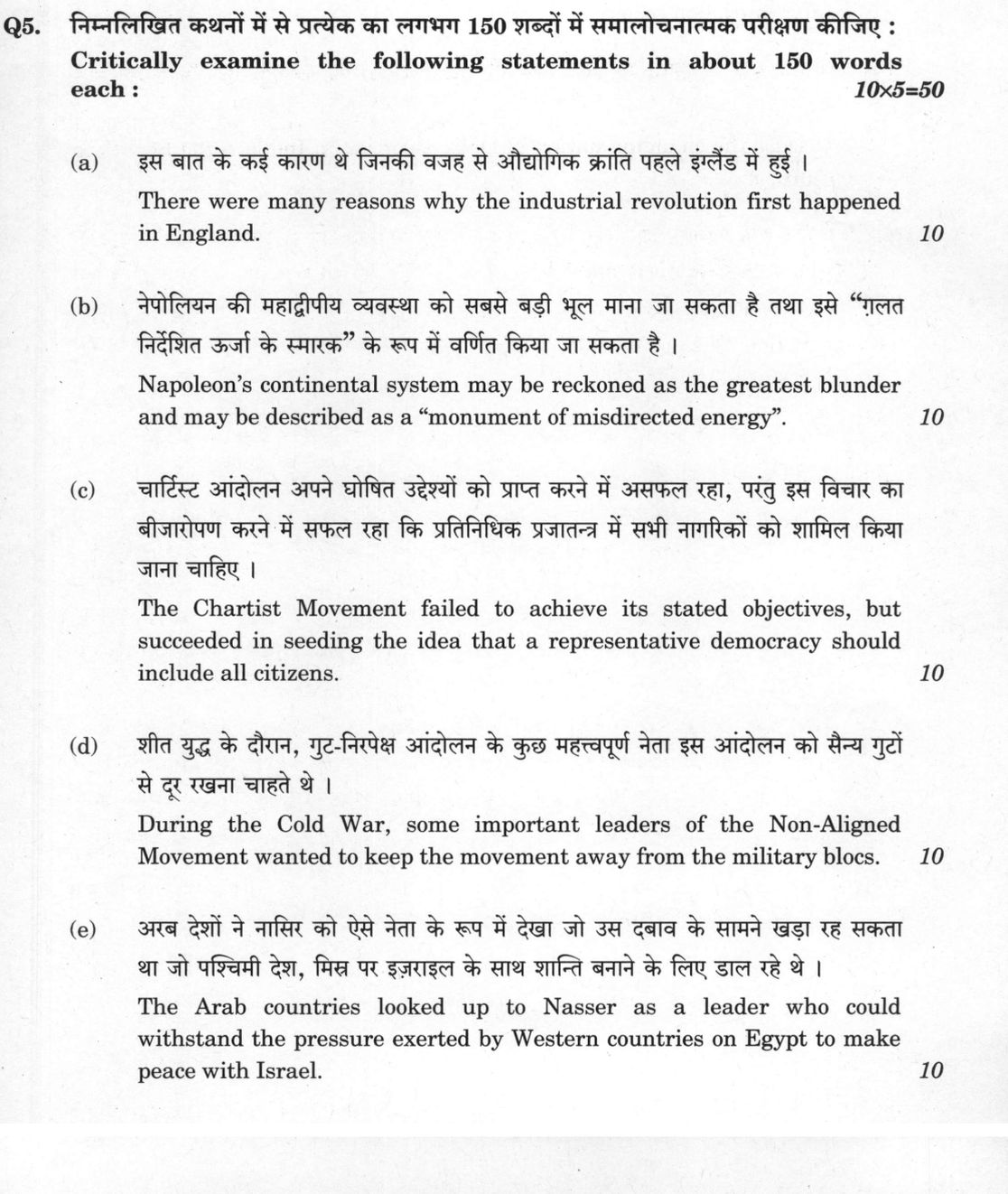
Critically examine the following statements in about 150 words each: (a) There were many reasons why the industrial revolution…
Critically examine the following statements in about 150 words each:
There were many reasons why the industrial revolution first happened in England. 10 marks
Napoleon's continental system may be reckoned as the greatest blunder and may be described as a "monument of misdirected energy". 10 marks
The Chartist Movement failed to achieve its stated objectives, but succeeded in seeding the idea that a representative democracy should include all citizens. 10 marks
During the Cold War, some important leaders of the Non-Aligned Movement wanted to keep the movement away from the military blocs. 10 marks
The Arab countries looked up to Nasser as a leader who could withstand the pressure exerted by Western countries on Egypt to make peace with Israel. 10 marks
हिंदी में प्रश्न पढ़ें
निम्नलिखित कथनों में से प्रत्येक का लगभग 150 शब्दों में समालोचनात्मक परीक्षण कीजिए :
इस बात के कई कारण थे जिनकी वजह से औद्योगिक क्रांति पहले इंग्लैंड में हुई । (10 अंक)
नेपोलियन की महाद्वीपीय व्यवस्था को सबसे बड़ी भूल माना जा सकता है तथा इसे "गलत निर्देशित ऊर्जा के स्मारक" के रूप में वर्णित किया जा सकता है । (10 अंक)
चार्टिस्ट आंदोलन अपने घोषित उद्देश्यों को प्राप्त करने में असफल रहा, परंतु इस विचार का बीजारोपण करने में सफल रहा कि प्रतिनिधिक प्रजातंत्र में सभी नागरिकों को शामिल किया जाना चाहिए । (10 अंक)
शीत युद्ध के दौरान, गुट-निरपेक्ष आंदोलन के कुछ महत्वपूर्ण नेता इस आंदोलन को सैन्य गुटों से दूर रखना चाहते थे । (10 अंक)
अरब देशों ने नासिर को ऐसे नेता के रूप में देखा जो उस दबाव के सामने खड़ा रह सकता था जो पश्चिमी देश, मिस्र पर इज़राइल के साथ शांति बनाने के लिए डाल रहे थे । (10 अंक)
Model answer
Written by UPSC Answer Check against this question's marking rubric, to the 150-word length. UPSC does not publish answers for Mains — this is one way to score well, not an official key.
(a) Reasons for the Industrial Revolution first happening in England
England’s emergence as the cradle of the Industrial Revolution was neither accidental nor monocausal; it resulted from a unique convergence of structural advantages. Geographically, rich and contiguous deposits of coal and iron ore, coupled with an extensive coastline and navigable rivers, facilitated cheap domestic transport. The preceding Agricultural Revolution and the Enclosure Movement augmented food production while dispossessing peasants, creating an abundant, mobile wage-labour force.
Simultaneously, commercial supremacy and colonial exploitation generated vast capital, while institutions post-1688 provided political stability, secure property rights, a robust patent system, and an absence of internal customs barriers. A vibrant culture of skilled artisans and the Puritan work ethic stimulated practical mechanical innovations.
Critically, while Continental nations possessed scientific knowledge and capital, they lacked Britain’s integrated domestic market, commercialized agriculture, and supply-demand nexus. Thus, Britain industrialized first because institutional liberty, colonial capital, and resource endowments uniquely aligned to make technological mechanization profitable.
(b) Napoleon's Continental System as a Blunder
Napoleon’s Continental System, inaugurated through the Berlin (1806) and Milan (1807) Decrees, aimed to wage economic warfare by closing European ports to British trade. Viewed through this strategic lens, it was an attempt to cripple Britain's commercial hegemony without directly confronting the Royal Navy after the defeat at Trafalgar (1805).
However, the policy proved to be a monument of misdirected energy. French industry lacked the manufacturing capacity and merchant shipping to replace British goods, resulting in widespread shortages, runaway inflation, and rampant smuggling. Enforcing the blockade forced Napoleon into unending territorial expansions: the Peninsular War in Portugal and Spain became his "Spanish Ulcer," and enforcing compliance against Tsar Alexander I precipitated the catastrophic 1812 invasion of Russia.
While the system temporarily strained British finance and stimulated select continental industries, it alienated Napoleon’s allies, exhausted his military, and fatally united Europe against him. It was fundamentally a strategic blunder that catalyzed his imperial collapse.
(c) The Chartist Movement: Failure vs Legacy
The Chartist Movement (1838–1848), framed around the People’s Charter, demanded six democratic reforms: universal male suffrage, equal electoral districts, abolition of property qualifications, annual parliaments, secret ballots, and payment for MPs.
In the immediate term, Chartism failed. Successive national petitions in 1839, 1842, and 1848 were overwhelmingly rejected by Parliament. The movement suffered from factional splits between "moral force" advocates (William Lovett) and "physical force" militants (Feargus O’Connor), a lack of middle-class alliance, and firm state repression at Kennington Common in 1848.
Yet, characterizing Chartism merely as a failure is historically inaccurate. It served as Britain’s first nationwide, working-class mass political mobilization. It permanently altered political discourse by asserting that political legitimacy rests upon universal citizen representation. Over the succeeding eight decades, five of the six demands (except annual parliaments) were enacted into law, vindicating Chartism as a foundational milestone for modern British representative democracy.
(d) NAM Leaders and Cold War Military Blocs
At the 1961 Belgrade Conference, the core founders of the Non-Aligned Movement—Jawaharlal Nehru, Josip Broz Tito, Gamal Abdel Nasser, Sukarno, and Kwame Nkrumah—sought to construct a collective shield for newly independent nations against Cold War bipolarity.
Their primary objective was insulating the Global South from entanglement in superpower alliances like NATO and the Warsaw Pact, as well as regional containment pacts like SEATO and CENTO. Nehru insisted that non-alignment was not passive neutrality, but an active assertion of strategic autonomy and independent foreign policy. This stood in sharp contrast to regional peers, such as Pakistan, which aligned with Western military treaties.
Critically, preserving total detachment proved difficult, as several member states later cultivated superpower alignments based on security compulsions. Nonetheless, the leadership’s initial commitment successfully delegitimized bloc politics, fostered Afro-Asian solidarity, and prevented the outright division of the post-colonial world into armed ideological camps.
(e) Nasser and Pan-Arab Resistance to Western Pressure
Following the 1952 Free Officers Revolution, Gamal Abdel Nasser emerged as the undisputed icon of Pan-Arab nationalism. His defiance of Western dictates was demonstrated during the 1956 Suez Crisis, where he nationalized the Suez Canal and turned an Anglo-French-Israeli military assault into a resounding diplomatic and political triumph for the Arab world.
Nasser reinforced this status by rejecting the Western-sponsored Baghdad Pact (1955), securing Soviet financing for the Aswan High Dam, and forming the United Arab Republic (1958). To the Arab masses, he personified anti-imperialist dignity, standing firm against Western pressures to force Arab states into unilateral reconciliations with Israel at the cost of Palestinian rights.
Critically, however, Nasser’s rhetoric frequently outstripped his military and institutional capabilities. His brinkmanship and overconfidence culminated in the disastrous Arab defeat in the 1967 Six-Day War. Thus, while Nasser succeeded symbolically as a defiant anti-imperialist leader, his resistance ultimately failed to deliver lasting geopolitical security for the Arab world.
What "Critically examine" is asking you to do
Test the proposition the question puts to you and return a finding on how far it holds. Examine stems carry a claim, or ask whether something has happened, and expect evidence weighed both ways before the extent is stated — often with remedial measures attached. “Critically” is not a section added at the end: name the yardstick you are judging by — the evidence, the stated objective, a constitutional principle, a rival explanation — and let a verdict close each part of the body. Where the question quotes a claim, that verdict must land on the claim itself, accepted, qualified or rejected, and not on the theme in general.
Structure that answers it
Restate the claim as the question frames it → evidence that supports it → evidence that undercuts it → the conditions under which it holds → verdict on how far it stands
Where marks are lost
Merits in one paragraph, demerits in the next, and a conclusion calling for a balanced and holistic approach. That is a survey with the judgement left out and it holds the answer in the middle band. The opposite error is reading “critically” as permission to attack — and with the odd pairings, critically describe or critically explain, the exposition still carries most of the marks, the judgement being a layer on it rather than a substitute for it.
How this answer will be evaluated
Approach
Framework: Context > Thesis > Evidence > Historiography. (a) critique: the claim > its strengths > its weaknesses > your judgment | (b) critique: the claim > its strengths > its weaknesses > your judgment | (c) critique: the claim > its strengths > its weaknesses > your judgment | (d) critique: the claim > its strengths > its weaknesses > your judgment | (e) critique: the claim > its strengths > its weaknesses > your judgment Full marks: Thesis-driven, cites specific historians/sources, critiques the statement with evidence, and provides a reasoned judgment.
Key points expected
- Identify specific economic or geographic factors
- Explain the mechanism of one key factor
- Critique the 'many reasons' generalization
- Provide a reasoned judgment on the statement
- Define the Continental System's strategic intent
- Analyze the economic impact on France
- Assess the military consequences (e.g., Russia)
- Judge the validity of the 'blunder' label
Evaluation rubric
Each sub-part is marked on its own, against the marks and word limit printed on the paper.
- (a) Assess the validity of the claim that multiple factors caused the Industrial Revolution in England. 10 marks · 150 words
critique— the claim → its strengths → its weaknesses → your judgment
Must cover
- Identify specific economic or geographic factors
- Explain the mechanism of one key factor
- Critique the 'many reasons' generalization
- Provide a reasoned judgment on the statement
Loses marks
- Narrative retelling without analysis
- Listing reasons without explaining mechanisms
- Ignoring the 'critically examine' instruction
Earns more
- Mention specific historian (e.g., Rostow, Crafts)
- Cite specific data (e.g., coal output)
- Reference a specific historiographical school
- Mention the role of the patent system
Extra mark
- Quote a specific primary source
- Reference a specific map or timeline
- (b) Evaluate the characterization of the Continental System as a 'greatest blunder' and 'misdirected energy'. 10 marks · 150 words
critique— the claim → its strengths → its weaknesses → your judgment
Must cover
- Define the Continental System's strategic intent
- Analyze the economic impact on France
- Assess the military consequences (e.g., Russia)
- Judge the validity of the 'blunder' label
Loses marks
- Chronology without analysis
- Textbook retelling of Napoleon's wars
- Failing to address the 'misdirected energy' phrase
Earns more
- Mention specific historian (e.g., Chandler, Hobsbawm)
- Cite specific trade data or blockade details
- Reference the 'monument of misdirected energy' quote source
- Discuss the impact on neutral nations
Extra mark
- Quote a specific primary source
- Reference a specific map of the blockade
- (c) Assess the claim that the Chartist Movement failed in objectives but succeeded in seeding democratic ideas. 10 marks · 150 words
critique— the claim → its strengths → its weaknesses → your judgment
Must cover
- List the specific Chartist objectives (People's Charter)
- Analyze the reasons for failure of objectives
- Explain the long-term impact on democratic ideas
- Judge the balance of failure vs. success
Loses marks
- Narrative retelling of the movement
- Failing to address the 'stated objectives' specifically
- Ignoring the 'seeding the idea' aspect
Earns more
- Mention specific historian (e.g., Gash, Briggs)
- Cite specific events (e.g., 1839 petition)
- Reference the 'seeding the idea' historiographical view
- Discuss the role of the working class
Extra mark
- Quote a specific primary source (e.g., Charter text)
- Reference a specific timeline of petitions
- (d) Evaluate the claim that Non-Aligned Movement leaders wanted to keep it away from military blocs during the Cold War. 10 marks · 150 words
critique— the claim → its strengths → its weaknesses → your judgment
Must cover
- Define the Non-Aligned Movement's core principles
- Identify specific leaders (e.g., Nehru, Nasser, Tito)
- Analyze the tension with military blocs (NATO/Warsaw Pact)
- Judge the extent to which the movement remained non-aligned
Loses marks
- Chronology without analysis
- Textbook retelling of the Cold War
- Failing to address the 'military blocs' aspect
Earns more
- Mention specific historian (e.g., Jansen, Srinivasan)
- Cite specific events (e.g., Bandung Conference)
- Reference the 'military blocs' historiographical debate
- Discuss the role of the UN
Extra mark
- Quote a specific primary source (e.g., Bandung Declaration)
- Reference a specific map of the movement
- (e) Assess the claim that Arab countries looked to Nasser to withstand Western pressure for peace with Israel. 10 marks · 150 words
critique— the claim → its strengths → its weaknesses → your judgment
Must cover
- Define Nasser's role in Arab nationalism
- Analyze the Western pressure on Egypt
- Explain the Arab countries' reliance on Nasser
- Judge the validity of the 'withstand pressure' claim
Loses marks
- Narrative retelling of the Arab-Israeli conflict
- Failing to address the 'Western pressure' specifically
- Ignoring the 'withstand pressure' aspect
Earns more
- Mention specific historian (e.g., Laffin, Seale)
- Cite specific events (e.g., Suez Crisis)
- Reference the 'Western pressure' historiographical view
- Discuss the impact on the Arab-Israeli conflict
Extra mark
- Quote a specific primary source (e.g., Nasser's speech)
- Reference a specific timeline of the conflict
Practice this exact question
Write your answer and it is marked point by point against the model answer above — what you covered, what you missed, what you got wrong.
Evaluate my answer →More from History 2021 Paper II
- Q2 (a) India had been the world leader in the field of hand spun and hand woven yarn and clo…
- Q3 (a) How did English utilitarian thinking impact India in the British era? (20 marks) (b)…
- Q4 (a) Discuss the major constitutional developments in India after 1858 and their impact on…
- Q5 Critically examine the following statements in about 150 words each: (a) There were many…
- Q6 (a) What was "enlightened" about the Age of Enlightenment? (20 marks) (b) What were the c…
- Q7 (a) The rise of nationalism across nations shattered the chains which held together the e…
- Q8 (a) Europe was at war with itself in the first half of the twentieth century with a long…