Paper II — Q2
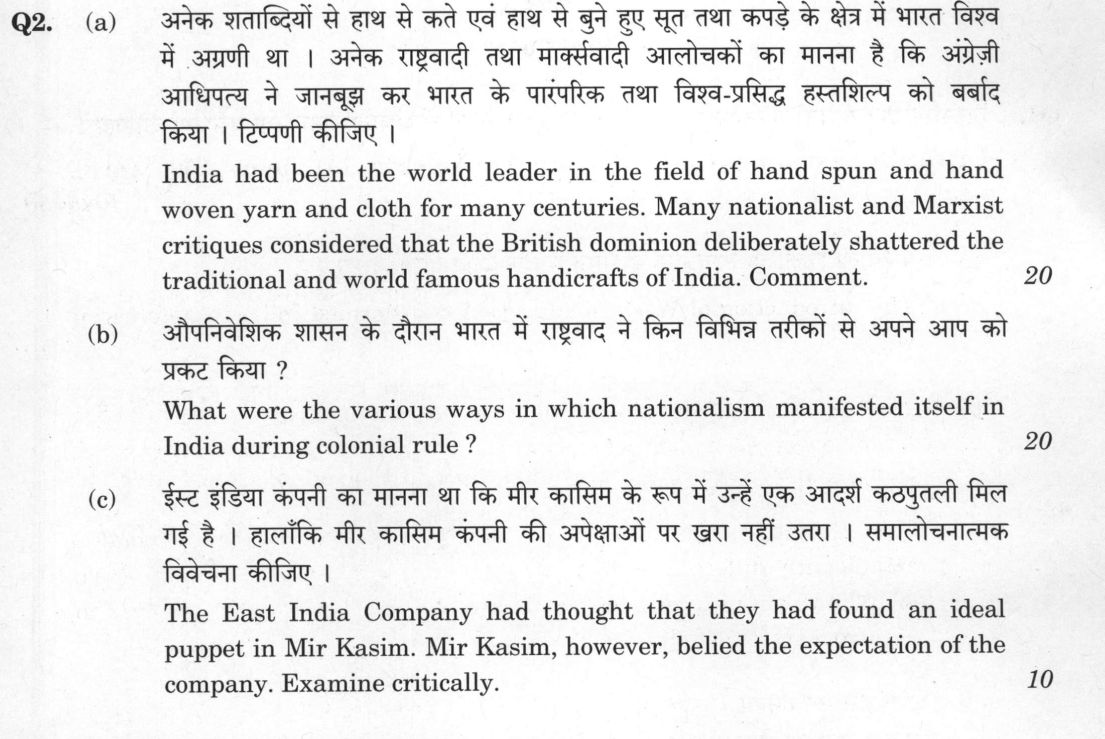
(a) India had been the world leader in the field of hand spun and hand woven yarn and cloth for many centuries. Many nationalist…
India had been the world leader in the field of hand spun and hand woven yarn and cloth for many centuries. Many nationalist and Marxist critiques considered that the British dominion deliberately shattered the traditional and world famous handicrafts of India. Comment. 20 marks
What were the various ways in which nationalism manifested itself in India during colonial rule? 20 marks
The East India Company had thought that they had found an ideal puppet in Mir Kasim. Mir Kasim, however, belied the expectation of the company. Examine critically. 10 marks
हिंदी में प्रश्न पढ़ें
अनेक शताब्दियों से हाथ से कते एवं हाथ से बुने हुए सूत तथा कपड़े के क्षेत्र में भारत विश्व में अग्रणी था । अनेक राष्ट्रवादी तथा मार्क्सवादी आलोचकों का मानना है कि अंग्रेजी आधिपत्य ने जानबूझ कर भारत के पारंपरिक तथा विश्व-प्रसिद्ध हस्तशिल्प को बर्बाद किया । टिप्पणी कीजिए । (20 अंक)
औपनिवेशिक शासन के दौरान भारत में राष्ट्रवाद ने किन विभिन्न तरीकों से अपने आप को प्रकट किया ? (20 अंक)
ईस्ट इंडिया कंपनी का मानना था कि मीर कासिम के रूप में उन्हें एक आदर्श कठपुतली मिल गई है । हालांकि मीर कासिम कंपनी की अपेक्षाओं पर खरा नहीं उतरा । समालोचनात्मक विवेचना कीजिए । (10 अंक)
Model answer
Written by UPSC Answer Check against this question's marking rubric, to the expected length. UPSC does not publish answers for Mains — this is one way to score well, not an official key.
The claim that British rule shattered India’s handicrafts is not merely sentimental; it identifies a deliberate and structural transformation of the Indian economy. Nationalist and Marxist critiques differ in emphasis but are broadly correct.
Deindustrialisation and its critiques India’s hand-spun and hand-woven yarn and cloth had long been world famous. Dadabhai Naoroji’s drain of wealth theory showed how profits, salaries and investments were siphoned to Britain, weakening domestic capital. R.C. Dutt traced how cheap machine-made cloth, backed by imperial tariffs, destroyed Indian textiles. Marx, in The British Rule in India, argued that colonialism dissolved ancient village communities and artisan economies. Nationalists stressed deliberate policy: the Charter Act of 1813 ended the Company’s monopoly of Indian trade, though it retained the tea and China trade until 1833, opening Indian markets to British manufacturers. Discriminatory tariffs—about 3.5 per cent on British imports against heavy internal transit duties—flooded India with cloth. Dhaka muslin and Surat calico disappeared, and spinners, weavers and dyers were reduced to pauperism. Marxists, however, saw this less as conscious conspiracy than as the structural logic of capitalist expansion: India was converted into a market for manufactures and a source of raw materials. The result was not accidental: it combined fiscal extraction, market opening and devaluation of artisan labour. The verdict is that the “shattering” was real and policy-enabled, even if “deliberate” should be understood as institutional design rather than a single plotted intent.
Manifestations of nationalism Nationalism emerged as a response to this economic and political subordination. Politically, the Indian National Congress (1885) began with Moderate petitions, then Extremist demands for self-rule and boycott. Revolutionary terrorism, through the Anushilan Samiti and the Ghadar Party, challenged the state through armed resistance and diaspora mobilisation. Mass nationalism crystallised in the Non-Cooperation and Civil Disobedience Movements, which combined political protest with social mobilisation. Culturally and socially, the Bengal Renaissance, the Swadeshi movement of 1905, educational initiatives, caste reform, religious revivalism such as the Arya Samaj and Deoband, and linguistic regionalism created a shared sense of Indian identity. Swadeshi gave economic boycott a cultural form; educational initiatives sought alternatives to colonial schooling; caste reform and religious revivalism broadened the social base of nationalism. These currents made nationalism not only a political programme but a cultural and moral assertion.
Mir Kasim and the Company’s expectations The Company had expected Mir Kasim to be a compliant Nawab of Bengal. He belied this by transferring his capital from Murshidabad to Munger in 1762, reorganising the army with European officers, and attempting to check Company corruption and arbitrary revenue demands. His move to Munger was intended to escape Company proximity and strengthen his military position. His resistance ended at the Battle of Buxar in 1764, after which the Treaty of Allahabad in 1765 granted the Company the Diwani and established a defensive alliance with Awadh. This should not be confused with the later Wellesley-era subsidiary alliance system. The historiographical debate over the nature of subsidiary alliances—defensive pacts or instruments of control—should not be projected back onto 1765. In Mir Kasim’s case, his autonomy was constrained by Afghan and Mughal threats as much as by British pressure. He was therefore less a simple puppet than a ruler caught between imperial demands and internal instability, whose defeat nonetheless opened the way to Company fiscal dominance.
In conclusion, the critiques of colonial deindustrialisation are substantially valid, nationalism was a multi-layered response to it, and Mir Kasim’s case shows that even a nominally subordinate ruler could resist Company expectations until structural power shifted decisively in 1765. Thus colonial economic rupture and nationalist assertion formed a dialectic: oppression generated resistance, while resistance forced the Company to consolidate fiscal and political control.
What "Comment" is asking you to do
Take a position on the statement and support it. Comment usually attaches to a quoted line in the short slots, so the reasoning must be compressed — an opening view, a few load-bearing reasons, and the limit of the claim.
Structure that answers it
Unpack what the statement asserts → your stance → two or three supporting reasons → the qualification that limits it
Where marks are lost
Neutral summary; a comment without a stance has not answered. Equally costly is accepting the quoted line wholesale and never testing where it fails.
How this answer will be evaluated
Approach
Framework: Context > Thesis > Evidence > Historiography. (a) comment: context > arguments both sides > judgment > close | (b) discuss: intro > 3-4 dimensions > example > balanced close | (c) critique: the claim > its strengths > its weaknesses > your judgment Full marks: Comprehensive, analytical, and well-supported with specific historical evidence and historiographical references.
Key points expected
- Contextualize pre-colonial handloom dominance
- Explain British policy of deindustrialization
- Cite specific tariff or trade policies
- Provide a balanced judgment on 'deliberate' intent
- Identify political manifestations (e.g., Congress)
- Identify cultural manifestations (e.g., Swadeshi)
- Identify economic manifestations (e.g., boycott)
- Show the interplay between these dimensions
Evaluation rubric
Each sub-part is marked on its own, against the marks and word limit printed on the paper.
- (a) Contextualize pre-colonial textile dominance and evaluate the nationalist/Marxist claim of deliberate British destruction. 20 marks
comment— context → arguments both sides → judgment → close
Must cover
- Contextualize pre-colonial handloom dominance
- Explain British policy of deindustrialization
- Cite specific tariff or trade policies
- Provide a balanced judgment on 'deliberate' intent
Loses marks
- Narrative retelling without analytical judgment
- Ignoring the 'deliberate' aspect of the claim
- Failing to distinguish nationalist vs. Marxist views
Earns more
- Mention specific historians (e.g., R.I. Moore)
- Reference specific trade acts or tariffs
- Contrast nationalist vs. Marxist interpretations
- Use specific data on textile imports
Extra mark
- Quote a specific primary source or historian
- Mention specific dates of key trade policies
- (b) Discuss the various dimensions (political, cultural, economic) of Indian nationalism during colonial rule. 20 marks
discuss— intro → 3-4 dimensions → example → balanced close
Must cover
- Identify political manifestations (e.g., Congress)
- Identify cultural manifestations (e.g., Swadeshi)
- Identify economic manifestations (e.g., boycott)
- Show the interplay between these dimensions
Loses marks
- Listing events without connecting them to nationalism
- Ignoring the cultural or economic dimensions
- Failing to show the evolution of nationalism
Earns more
- Mention specific movements (e.g., Non-Cooperation)
- Reference key leaders (e.g., Gandhi, Tilak)
- Discuss the role of the press
- Mention regional variations in nationalism
Extra mark
- Cite a specific primary source or speech
- Mention specific dates of key events
- (c) Critically examine the East India Company's perception of Mir Kasim as a puppet and his subsequent actions. 10 marks
critique— the claim → its strengths → its weaknesses → your judgment
Must cover
- Explain the Company's initial perception of Mir Kasim
- Detail Mir Kasim's actions against the Company
- Analyze the reasons for his defiance
- Provide a critical judgment on the Company's strategy
Loses marks
- Narrative retelling without critical analysis
- Ignoring the Company's perspective
- Failing to explain the reasons for Mir Kasim's defiance
Earns more
- Mention specific events (e.g., Battle of Buxar)
- Reference specific treaties or agreements
- Discuss the role of other Nawabs
- Mention the impact on Company's power
Extra mark
- Quote a specific primary source or historian
- Mention specific dates of key events
Practice this exact question
Write your answer and it is marked point by point against the model answer above — what you covered, what you missed, what you got wrong.
Evaluate my answer →More from History 2021 Paper II
- Q1 Critically examine the following statements in about 150 words each: (a) The introduction…
- Q2 (a) India had been the world leader in the field of hand spun and hand woven yarn and clo…
- Q3 (a) How did English utilitarian thinking impact India in the British era? (20 marks) (b)…
- Q4 (a) Discuss the major constitutional developments in India after 1858 and their impact on…
- Q5 Critically examine the following statements in about 150 words each: (a) There were many…