Paper II — Q8
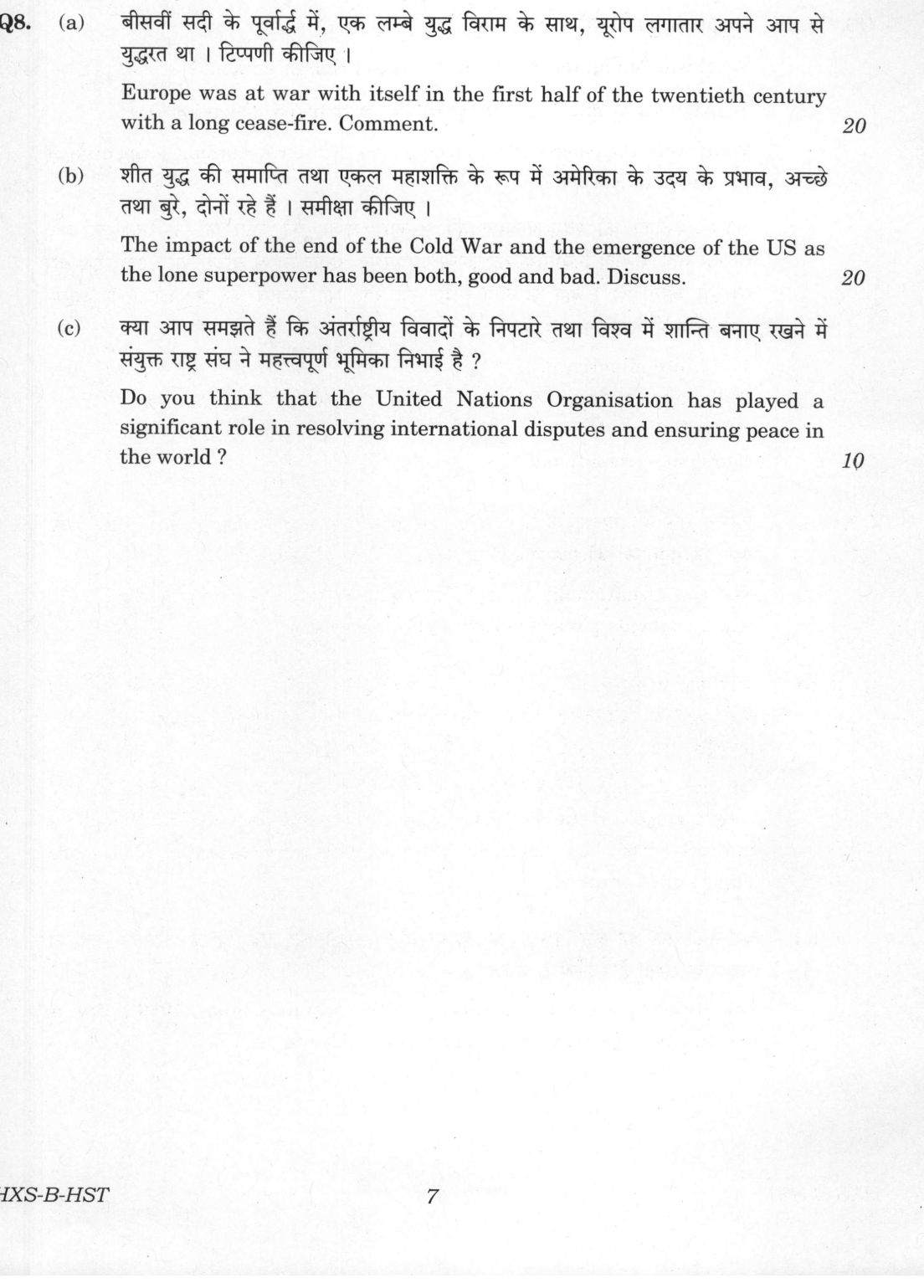
(a) Europe was at war with itself in the first half of the twentieth century with a long cease-fire. Comment. (20 marks) (b) The…
Europe was at war with itself in the first half of the twentieth century with a long cease-fire. Comment. 20 marks
The impact of the end of the Cold War and the emergence of the US as the lone superpower has been both, good and bad. Discuss. 20 marks
Do you think that the United Nations Organisation has played a significant role in resolving international disputes and ensuring peace in the world? 10 marks
हिंदी में प्रश्न पढ़ें
बीसवीं सदी के पूर्वार्द्ध में, एक लम्बे युद्ध विराम के साथ, यूरोप लगातार अपने आप से युद्धरत था । टिप्पणी कीजिए । (20 अंक)
शीत युद्ध की समाप्ति तथा एकल महाशक्ति के रूप में अमेरिका के उदय के प्रभाव, अच्छे तथा बुरे, दोनों रहे हैं । समीक्षा कीजिए । (20 अंक)
क्या आप समझते हैं कि अंतर्राष्ट्रीय विवादों के निपटारे तथा विश्व में शांति बनाए रखने में संयुक्त राष्ट्र संघ ने महत्त्वपूर्ण भूमिका निभाई है ? (10 अंक)
Model answer
Written by UPSC Answer Check against this question's marking rubric, to the expected length. UPSC does not publish answers for Mains — this is one way to score well, not an official key.
The twentieth century witnessed profound structural shifts in global governance, evolving from a self-destructive European balance-of-power system into American unipolarity and a contested multilateral architecture under the United Nations.
The European Civil War and the Long Cease-Fire (1914–1945)
Historians such as Eric Hobsbawm, in The Age of Extremes, and Ernst Nolte characterize the period between 1914 and 1945 as a single European civil war, with the interwar years functioning merely as a twenty-year armed truce. The 1919 Treaty of Versailles failed to build a durable equilibrium; its punitive indemnities and territorial amputations fostered deep revanchism in Germany and alienation in Italy.
This period was marked by stark structural continuities. The Great Depression of 1929 destroyed fragile economic stability, accelerating the collapse of parliamentary democracies and fueling totalitarian ideologies—Fascism, Nazism, and Stalinism. Concurrently, the League of Nations lacked an independent enforcement mechanism and suffered from American absence, rendering its collective security framework impotent against aggression in Manchuria (1931) and Abyssinia (1935). These unresolved geopolitical and ideological fractures directly propelled the resumption of total war in 1939.
The Post-Cold War Unipolarity: A Dual Legacy
The collapse of the Soviet Union in 1991 inaugurated a unipolar global order centered on the United States, producing mixed outcomes.
On the positive side, unipolarity facilitated democratic enlargement and the spread of liberal norms, captured in Francis Fukuyama's "End of History" thesis. It deepened economic interdependence through institutions like the World Trade Organization (1995), allowing developing economies, notably India following its 1991 balance-of-payments crisis and subsequent economic liberalization, to integrate into global markets. It also elevated multilateral norms around humanitarian intervention and arms control.
Conversely, unipolarity bred unrestrained unilateralism, most visibly in the 2003 invasion of Iraq without UN Security Council authorization. The steady eastward expansion of NATO created long-term security dilemmas that fueled contemporary Russian revanchism. The subsequent Global War on Terror destabilized West Asia, while the dogmatic application of the Washington Consensus through structural adjustment programmes imposed severe socioeconomic costs across the Global South.
The United Nations: Peacekeeping, Paralysis, and Reform
The United Nations Organisation has played a vital yet structurally constrained role in conflict resolution. It successfully facilitated twentieth-century decolonization, mediated the 1953 Korean armistice, authorized collective security during the 1991 Gulf War, and stabilized complex crises through peacekeeping missions such as the UN Operation in the Congo (ONUC).
However, systemic weaknesses have repeatedly undermined its core mission. Institutional inertia led to catastrophic failures to halt genocides in Rwanda (1994) and Srebrenica (1995). Today, great-power rivalry has paralyzed the Security Council through the exercise of the veto over conflicts in Syria and Ukraine, exposing the selective application of the Responsibility to Protect (R2P) doctrine. Sustaining UN relevance requires urgent institutional adaptation, primarily through expanding permanent Security Council membership to reflect contemporary realities—as advocated by the G4 nations, including India—and curbing unilateral vetoes in cases of mass atrocities.
Way Forward
While the post-1945 order successfully prevented another intra-European conflagration, navigating twenty-first-century multipolarity demands moving beyond the unilateral tendencies of the post-Cold War era. Lasting global stability requires reforming global institutions to ensure equitable representation for the Global South, thereby creating a resilient, rules-based multilateralism capable of reconciling major power rivalries.
What "Discuss" is asking you to do
Lay the issue out from more than one side — how it arose, what is claimed for it, what is held against it, and where it now stands. UPSC attaches discuss to broad topics with several live dimensions, so coverage of the dimensions earns more than the strength of your opinion.
Structure that answers it
Set the issue up → the case as it is made → the case against → the dimension both sides leave out → where the balance now lies
Where marks are lost
Listing facts with no thread between them, or arguing one side throughout and calling it a discussion.
How this answer will be evaluated
Approach
Framework: Context > Thesis > Evidence > Historiography. (a) comment: context > arguments both sides > judgment > close | (b) discuss: intro > 3-4 dimensions > example > balanced close | (c) evaluate: criteria > evidence > balanced judgment Full marks: Nuanced analysis with specific historical evidence and historiographical references.
Key points expected
- Define the 'long cease-fire' as the interwar period (1918-1939).
- Analyze the Treaty of Versailles as a 'non-peace' settlement.
- Link the rise of fascism to unresolved WWI grievances.
- Provide a judgment on the continuity of conflict.
- Identify 'good' impacts (e.g., end of nuclear brinkmanship, globalization).
- Identify 'bad' impacts (e.g., unilateralism, new regional conflicts).
- Analyze the shift from bipolarity to unipolarity.
- Provide a balanced conclusion on the net effect.
Evaluation rubric
Each sub-part is marked on its own, against the marks and word limit printed on the paper.
- (a) Contextualize the 'long cease-fire' (WWI-1939) and judge the validity of the 'war with itself' thesis. 20 marks
comment— context → arguments both sides → judgment → close
Must cover
- Define the 'long cease-fire' as the interwar period (1918-1939).
- Analyze the Treaty of Versailles as a 'non-peace' settlement.
- Link the rise of fascism to unresolved WWI grievances.
- Provide a judgment on the continuity of conflict.
Loses marks
- Narrating WWI and WWII events without analysis.
- Ignoring the 'cease-fire' aspect of the prompt.
Earns more
- Reference to the League of Nations' failure.
- Mention of the Spanish Civil War as a prelude.
- Citation of a specific historian (e.g., Hobsbawm).
Extra mark
- Specific date of the Munich Agreement (1938).
- Reference to the 'Short Twentieth Century' concept.
- (b) Evaluate the dual impact of the US becoming the sole superpower post-Cold War. 20 marks
discuss— intro → 3-4 dimensions → example → balanced close
Must cover
- Identify 'good' impacts (e.g., end of nuclear brinkmanship, globalization).
- Identify 'bad' impacts (e.g., unilateralism, new regional conflicts).
- Analyze the shift from bipolarity to unipolarity.
- Provide a balanced conclusion on the net effect.
Loses marks
- Focusing only on the 'good' or only the 'bad'.
- Vague generalizations without specific examples.
Earns more
- Reference to the 'End of History' thesis (Fukuyama).
- Mention of specific interventions (e.g., Kosovo, Iraq).
- Discussion of the rise of non-state actors.
Extra mark
- Citation of a specific treaty or UN resolution.
- Reference to the 'Pax Americana' concept.
- (c) Assess the UN's effectiveness in dispute resolution and peacekeeping. 10 marks
evaluate— criteria → evidence → balanced judgment
Must cover
- State a clear position (effective or ineffective).
- Cite a success (e.g., decolonization, specific peacekeeping).
- Cite a failure (e.g., Rwanda, Syria, Security Council veto).
- Conclude on the structural limitations (veto power).
Loses marks
- Listing UN agencies without evaluating their impact.
- Ignoring the Security Council's role in failures.
Earns more
- Reference to the UN Charter (Article 24).
- Mention of the 'Responsibility to Protect' (R2P).
- Comparison with pre-UN international bodies.
Extra mark
- Specific statistic on UN peacekeeping operations.
- Reference to a specific UN Secretary-General's report.
Practice this exact question
Write your answer and it is marked point by point against the model answer above — what you covered, what you missed, what you got wrong.
Evaluate my answer →More from History 2021 Paper II
- Q5 Critically examine the following statements in about 150 words each: (a) There were many…
- Q6 (a) What was "enlightened" about the Age of Enlightenment? (20 marks) (b) What were the c…
- Q7 (a) The rise of nationalism across nations shattered the chains which held together the e…
- Q8 (a) Europe was at war with itself in the first half of the twentieth century with a long…