Paper II — Q4
(a) Discuss the major constitutional developments in India after 1858 and their impact on society and polity. (20 marks) (b)…
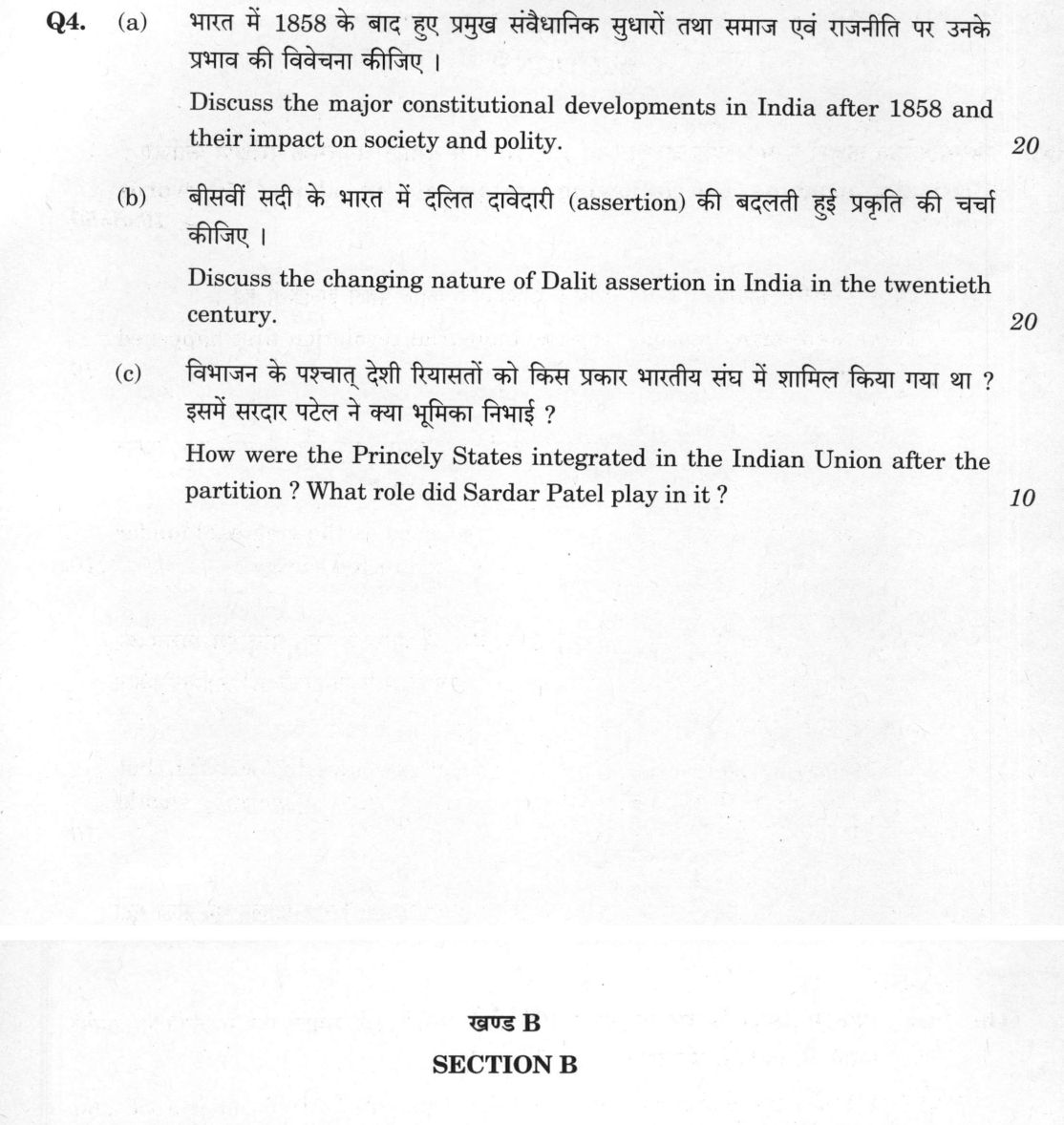
Discuss the major constitutional developments in India after 1858 and their impact on society and polity. 20 marks
Discuss the changing nature of Dalit assertion in India in the twentieth century. 20 marks
How were the Princely States integrated in the Indian Union after the partition? What role did Sardar Patel play in it? 10 marks
हिंदी में प्रश्न पढ़ें
भारत में 1858 के बाद हुए प्रमुख संवैधानिक सुधारों तथा समाज एवं राजनीति पर उनके प्रभाव की विवेचना कीजिए । (20 अंक)
बीसवीं सदी के भारत में दलित दावेदारी (assertion) की बदलती हुई प्रकृति की चर्चा कीजिए । (20 अंक)
विभाजन के पश्चात् देशी रियासतों को किस प्रकार भारतीय संघ में शामिल किया गया था ? इसमें सरदार पटेल ने क्या भूमिका निभाई ? (10 अंक)
Model answer
Written by UPSC Answer Check against this question's marking rubric, to the expected length. UPSC does not publish answers for Mains — this is one way to score well, not an official key.
The making of modern India cannot be separated from three linked processes: constitutional change under colonial rule, Dalit assertion, and the integration of princely states.
Constitutional developments after 1858 The Government of India Act 1858 ended Company rule and placed India under the Crown, while the Indian Councils Act 1861 began to admit Indian members to legislative councils. The 1892 Act introduced indirect elections and allowed limited discussion of the budget, giving the educated middle class a formal political arena. The Minto-Morley Reforms of 1909 expanded elected representation but introduced separate electorates for Muslims, institutionalising communal politics. The Government of India Act 1919, based on Montagu-Chelmsford reforms, created dyarchy in the provinces and a bicameral central legislature, extending communal electorates and making Indian participation more structured. The Government of India Act 1935 was the most important colonial statute: it provided provincial autonomy, a federal scheme, bicameralism, and legislative lists, many of which were later borrowed into the 1950 Constitution. Its separate electorates for Muslims, Sikhs and other communities deepened communal representation. The 1937 elections tested provincial autonomy; Congress ministries and the League’s weak electoral performance sharpened communal politics. The Independence Act 1947 ended British rule and created India and Pakistan. These developments produced a politically conscious middle class, intensified Hindu-Muslim divergence, experimented with provincial self-government, and laid the administrative foundations of federalism.
Dalit assertion Dalit assertion in the twentieth century moved from social protest to constitutional and political mobilisation. Before the 1920s, temple-entry movements, such as Ayyankali’s struggle in Kerala, challenged religious exclusion. In the 1920s and 1930s, B. R. Ambedkar emerged as a leader who linked Dalit dignity to political power. At the Round Table Conferences he demanded separate electorates; the Communal Award was announced by Ramsay MacDonald in August 1932, after the conferences, and the Poona Pact of 1932 replaced separate electorates for the Depressed Classes with reserved seats. This contrasted with Gandhi’s Harijan approach, which emphasised welfare, temple entry and moral reform within Hinduism, whereas Ambedkarite assertion insisted on separate identity, political representation and constitutionalism. In the 1940s, the debate between separate electorates and reserved seats sharpened, and Ambedkar’s threat to convert to Buddhism, later fulfilled in 1956, signalled a possible break from Hindu society. After Independence, the Constitution gave Dalits safeguards through Article 17, reservations under Articles 15(4) and 16(4), and special provisions, while later movements, including the roots of the Dalit Panther movement, continued to demand dignity, employment and cultural recognition.
Integration of princely states After partition, the princely states had to choose accession to India or Pakistan. The process mixed merger and integration. The instruments used were the Instrument of Accession, Standstill Agreements, and Patel’s diplomacy, often described as an iron fist in a velvet glove. V. P. Menon, as secretary, helped negotiate accessions. Many states were integrated through negotiation, with privy purses and other assurances. Junagadh was brought in after its ruler’s attempt to join Pakistan, and Hyderabad through police action in 1948 after the Nizam’s resistance; these were forced mergers. Kashmir’s accession was conditional, linked to its strategic position and the Maharaja’s instrument. Patel’s role was decisive: he negotiated with Mountbatten, managed Menon’s legal work, handled the Nizam’s defiance, and prevented the subcontinent from being Balkanised into hundreds of small units.
Together, constitutional frameworks, Dalit agency and territorial integration shaped the Indian republic: the first provided institutions, the second gave social legitimacy, and the third made the republic territorially coherent.
What "Discuss" is asking you to do
Lay the issue out from more than one side — how it arose, what is claimed for it, what is held against it, and where it now stands. UPSC attaches discuss to broad topics with several live dimensions, so coverage of the dimensions earns more than the strength of your opinion.
Structure that answers it
Set the issue up → the case as it is made → the case against → the dimension both sides leave out → where the balance now lies
Where marks are lost
Listing facts with no thread between them, or arguing one side throughout and calling it a discussion.
How this answer will be evaluated
Approach
Framework: UPSC History Paper 2 (Modern India). (a) discuss: intro > 3-4 dimensions > example > balanced close | (b) discuss: intro > 3-4 dimensions > example > balanced close | (c) explain: definition/context > points in order > small example > short close Full marks: Comprehensive, analytical, and well-structured with specific historical references.
Key points expected
- 1861 Act: Viceroy's legislative powers and Council expansion
- 1909 Act: Dyarchy in Executive Council and separate electorates
- 1919 Act: Provincial autonomy and bicameral legislature
- 1935 Act: Federal scheme and provincial autonomy
- Early phase: Jyotiba Phule and the Satyashodhak Samaj
- Gandhian phase: Mahatma Gandhi and the Harijan movement
- Ambedkarite phase: Poona Pact and the Independent Labour Party
- Post-1950: Constitutional safeguards and political mobilization
Evaluation rubric
Each sub-part is marked on its own, against the marks and word limit printed on the paper.
- (a) Analytical overview of constitutional changes post-1858 and their socio-political impact. 20 marks
discuss— intro → 3-4 dimensions → example → balanced close
Must cover
- 1861 Act: Viceroy's legislative powers and Council expansion
- 1909 Act: Dyarchy in Executive Council and separate electorates
- 1919 Act: Provincial autonomy and bicameral legislature
- 1935 Act: Federal scheme and provincial autonomy
Loses marks
- Chronological listing of acts without analysis
- Ignoring the 'impact on society' aspect
- Confusing dates of the various Acts
Earns more
- Impact on rise of Indian political nationalism
- Effect on communal politics and separate electorates
- Shift from autocracy to representative institutions
- Role of these acts in shaping the 1950 Constitution
Extra mark
- Reference to specific clauses of the 1935 Act
- Mention of the Simon Commission or Round Table Conferences
- (b) Evolution of Dalit political and social assertion from 1900 to 2000. 20 marks
discuss— intro → 3-4 dimensions → example → balanced close
Must cover
- Early phase: Jyotiba Phule and the Satyashodhak Samaj
- Gandhian phase: Mahatma Gandhi and the Harijan movement
- Ambedkarite phase: Poona Pact and the Independent Labour Party
- Post-1950: Constitutional safeguards and political mobilization
Loses marks
- Focusing only on Ambedkar and ignoring other leaders
- Treating Dalit assertion as a single static event
- Lack of historical context for the 20th century
Earns more
- Shift from social reform to political rights
- Role of the Constitution in Dalit empowerment
- Emergence of Dalit political parties (e.g., BSP)
- Changing nature of 'assertion' from petition to power
Extra mark
- Reference to the Poona Pact of 1932
- Mention of specific Dalit leaders like B.R. Ambedkar
- (c) Process of integrating Princely States and Sardar Patel's specific role. 10 marks
explain— definition/context → points in order → small example → short close
Must cover
- The 'three options' given to rulers (join, stay, or independent)
- Sardar Patel's strategy of 'carrot and stick'
- Role of the Instrument of Accession
- Handling of key states like Hyderabad and Jammu & Kashmir
Loses marks
- Ignoring the role of the British in the process
- Failing to mention the 'Instrument of Accession'
- Overstating Patel's role without mentioning the Congress
Earns more
- Use of the 'treaty' system for integration
- Role of the Indian Civil Service in administration
- Significance of the 'unified India' concept
- Patel's diplomatic skills in negotiations
Extra mark
- Mention of the 'Operation Polo' for Hyderabad
- Reference to the 'Maharaja of Patiala' as a model
Practice this exact question
Write your answer and it is marked point by point against the model answer above — what you covered, what you missed, what you got wrong.
Evaluate my answer →More from History 2021 Paper II
- Q1 Critically examine the following statements in about 150 words each: (a) The introduction…
- Q2 (a) India had been the world leader in the field of hand spun and hand woven yarn and clo…
- Q3 (a) How did English utilitarian thinking impact India in the British era? (20 marks) (b)…
- Q4 (a) Discuss the major constitutional developments in India after 1858 and their impact on…
- Q5 Critically examine the following statements in about 150 words each: (a) There were many…
- Q6 (a) What was "enlightened" about the Age of Enlightenment? (20 marks) (b) What were the c…
- Q7 (a) The rise of nationalism across nations shattered the chains which held together the e…