Paper II — Q3
(a) How did English utilitarian thinking impact India in the British era? (20 marks) (b) The same Gandhiji who withdrew the…
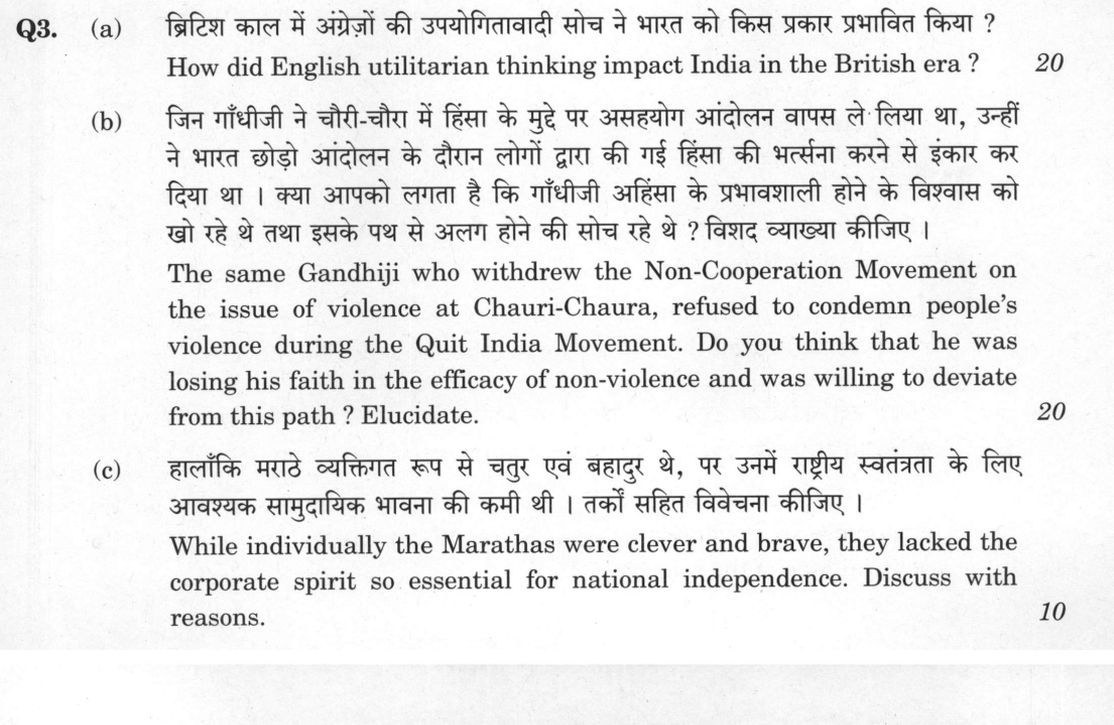
How did English utilitarian thinking impact India in the British era? 20 marks
The same Gandhiji who withdrew the Non-Cooperation Movement on the issue of violence at Chauri-Chaura, refused to condemn people's violence during the Quit India Movement. Do you think that he was losing his faith in the efficacy of non-violence and was willing to deviate from this path? Elucidate. 20 marks
While individually the Marathas were clever and brave, they lacked the corporate spirit so essential for national independence. Discuss with reasons. 10 marks
हिंदी में प्रश्न पढ़ें
ब्रिटिश काल में अंग्रेजों की उपयोगितावादी सोच ने भारत को किस प्रकार प्रभावित किया ? (20 अंक)
जिन गांधीजी ने चौरी-चौरा में हिंसा के मुद्दे पर असहयोग आंदोलन वापस ले लिया था, उन्हीं ने भारत छोड़ो आंदोलन के दौरान लोगों द्वारा की गई हिंसा की भर्त्सना करने से इंकार कर दिया था । क्या आपको लगता है कि गांधीजी अहिंसा के प्रभावशाली होने के विश्वास को खो रहे थे तथा इसके पथ से अलग होने की सोच रहे थे ? विसद व्याख्या कीजिए । (20 अंक)
हालांकि मराठे व्यक्तिगत रूप से चतुर एवं बहादुर थे, पर उनमें राष्ट्रीय स्वतंत्रता के लिए आवश्यक सामुदायिक भावना की कमी थी । तर्कों सहित विवेचना कीजिए । (10 अंक)
Model answer
Written by UPSC Answer Check against this question's marking rubric, to the expected length. UPSC does not publish answers for Mains — this is one way to score well, not an official key.
The three questions trace a common problem: how ideas, moral discipline and political organisation decide whether a society reforms, resists or fragments.
Utilitarian thinking in British India. Benthamite and Millite utilitarianism gave the British a rational language for rule. Bentham’s calculus of pain and pleasure, and Mill’s concern with liberty, representation and public opinion, shaped codification: Macaulay’s draft of the Indian Penal Code in 1837, enacted in 1860, replaced fragmented customary laws with a uniform code meant to make law predictable and administrable. It shaped education through Wood’s Dispatch of 1854, which expanded English education and carried forward Macaulay’s 1835 aim to create a class “Indian in blood and colour, but English in tastes, opinions, morals and intellect,” and to supply clerks and professionals. It also rationalised revenue administration through Ryotwari and Mahalwari settlements, which fixed land relations and made extraction more efficient. The result was a modern administrative state—courts, prisons, police and a trained bureaucracy—justified by utility. Yet the same “greatest good” logic could mask colonial exploitation: reforms were justified as benefiting Indians while serving imperial order. At the same time, utilitarian reform impulse produced genuine changes, such as the abolition of sati in 1829 and the suppression of thuggee, where calculated social benefit and humanitarian argument combined. Thus utilitarianism was both a tool of colonial governance and a source of legal, educational and social modernisation.
Gandhi and the limits of non-violence. Gandhi’s withdrawal of the Non-Cooperation Movement after Chauri Chaura in February 1922 was not a sign of weakness. The movement was then at its peak, after about eighteen months of mass mobilisation, and he stopped it because violence had broken the discipline of satyagraha. For him, non-violence was not a passive method but a moral test: the satyagrahi must remain brave, truthful and self-controlled. In 1942, however, the context was different. The British had used repression, detention and emergency powers to close ordinary channels of satyagraha, and the Quit India call of “Do or Die” acknowledged that the people might be driven beyond passive resistance. Gandhi did not abandon non-violence; he made a tactical distinction. In correspondence with Rajagopalachari and Vinoba Bhave, he explained that he was not condoning violence, but recognising that under extreme oppression the people’s anger might erupt. He distinguished the “violence of the brave,” which arises from dignity and resistance to humiliation, from the “violence of the coward,” which is driven by fear, revenge or self-interest. He still urged restraint, but he did not make non-violence a condition for participation when repression had already made passive resistance impossible. His refusal to condemn popular violence in 1942 was therefore conditional realism within a moral framework, not loss of faith in non-violence.
Maratha fragmentation. The Marathas were individually clever and brave, but their confederacy lacked the corporate spirit needed for national independence. The Peshwa at Pune, Gaekwad at Baroda, Holkar at Indore, Scindia at Gwalior and Bhonsle at Nagpur functioned as autonomous power centres, each pursuing separate jagirs, titles and rivalries rather than a common political vision. No single Maratha house could command the others, and no council bound their decisions. The Third Battle of Panipat in 1761 exposed this weakness: the Marathas could field large armies but could not coordinate command, logistics or strategy. Later internecine conflicts, including Pune-Nagpur rivalries and Peshwa-Gaekwad tensions, further divided them. This absence of corporate political identity allowed the British to use subsidiary alliances and divide-and-rule diplomacy, turning Maratha leaders into isolated clients rather than a united national force.
In conclusion, utilitarianism modernised British India but also exposed the limits of rule based on calculated benefit; Gandhi’s 1942 position shows that non-violence can be tested without being abandoned; and the Marathas’ failure shows that courage without collective organisation cannot secure independence.
What "Elucidate" is asking you to do
Make a stated proposition plain and then prove it with instances. Elucidate stems almost always carry a claim or a named concept, and very often the words “with examples” or “with suitable diagrams” — the illustration is part of the directive, not decoration.
Structure that answers it
Plain-language statement of what the proposition means → the part that is obscure, resolved → first illustration → second illustration → why the proposition holds
Where marks are lost
Adding terminology; elucidate rewards removing it. The commoner loss is a clean explanation with no example, when the stem asked for examples.
How this answer will be evaluated
Approach
Framework: Context > Thesis > Evidence > Historiography. (a) explain: definition/context > points in order > small example > short close | (b) comment: context > arguments both sides > judgment > close | (c) discuss: intro > 3-4 dimensions > example > balanced close Full marks: Thesis-driven, specific evidence, clear judgment, historiographical awareness
Key points expected
- Define utilitarianism and its core British proponents
- Link utilitarian logic to specific British administrative policies
- Analyze the impact on Indian social and legal reforms
- Critique the 'benevolent' nature of utilitarian governance
- Contrast the Chauri Chaura withdrawal with Quit India stance
- Analyze the specific context of the 1942 movement
- Assess the strategic logic behind not condemning violence
- Provide a judgment on the consistency of his philosophy
Evaluation rubric
Each sub-part is marked on its own, against the marks and word limit printed on the paper.
- (a) Explain the impact of English utilitarian thinking on India during the British era. 20 marks
explain— definition/context → points in order → small example → short close
Must cover
- Define utilitarianism and its core British proponents
- Link utilitarian logic to specific British administrative policies
- Analyze the impact on Indian social and legal reforms
- Critique the 'benevolent' nature of utilitarian governance
Loses marks
- Generalizing without specific policy examples
- Confusing utilitarianism with general liberalism
- Ignoring the negative impacts on Indian society
Earns more
- Reference to specific acts like the Widow Remarriage Act
- Mention of specific thinkers like Bentham or Mill
- Discussion of the 'civilizing mission' ideology
Extra mark
- Citation of a specific primary source or speech
- Reference to a specific historian's interpretation
- (b) Comment on whether Gandhi's stance on violence in Quit India signaled a loss of faith in non-violence. 20 marks
comment— context → arguments both sides → judgment → close
Must cover
- Contrast the Chauri Chaura withdrawal with Quit India stance
- Analyze the specific context of the 1942 movement
- Assess the strategic logic behind not condemning violence
- Provide a judgment on the consistency of his philosophy
Loses marks
- Treating the two events as identical in context
- Ignoring the strategic necessity of the 1942 stance
- Failing to provide a clear judgment on the issue
Earns more
- Reference to the 'Do or Die' call to action
- Mention of the 'Sarvodaya' or 'Seva' concept
- Discussion of the 'moral' vs 'political' violence distinction
Extra mark
- Citation of a specific letter or speech by Gandhi
- Reference to a specific historian's interpretation
- (c) Discuss the lack of corporate spirit among the Marathas despite individual bravery. 10 marks
discuss— intro → 3-4 dimensions → example → balanced close
Must cover
- Define 'corporate spirit' in the context of nation-building
- Identify specific structural weaknesses of the Maratha state
- Explain how individualism hindered collective national action
- Link this lack of unity to their eventual decline
Loses marks
- Focusing only on individual bravery without structural analysis
- Ignoring the role of the British in exploiting divisions
- Failing to define 'corporate spirit' clearly
Earns more
- Reference to the Peshwa system's fragmentation
- Mention of the 'Gaikwad' or 'Holkar' rivalries
- Discussion of the 'Sardar' system's limitations
Extra mark
- Citation of a specific treaty or battle outcome
- Reference to a specific historian's interpretation
Practice this exact question
Write your answer and it is marked point by point against the model answer above — what you covered, what you missed, what you got wrong.
Evaluate my answer →More from History 2021 Paper II
- Q1 Critically examine the following statements in about 150 words each: (a) The introduction…
- Q2 (a) India had been the world leader in the field of hand spun and hand woven yarn and clo…
- Q3 (a) How did English utilitarian thinking impact India in the British era? (20 marks) (b)…
- Q4 (a) Discuss the major constitutional developments in India after 1858 and their impact on…
- Q5 Critically examine the following statements in about 150 words each: (a) There were many…
- Q6 (a) What was "enlightened" about the Age of Enlightenment? (20 marks) (b) What were the c…