Paper II — Q7
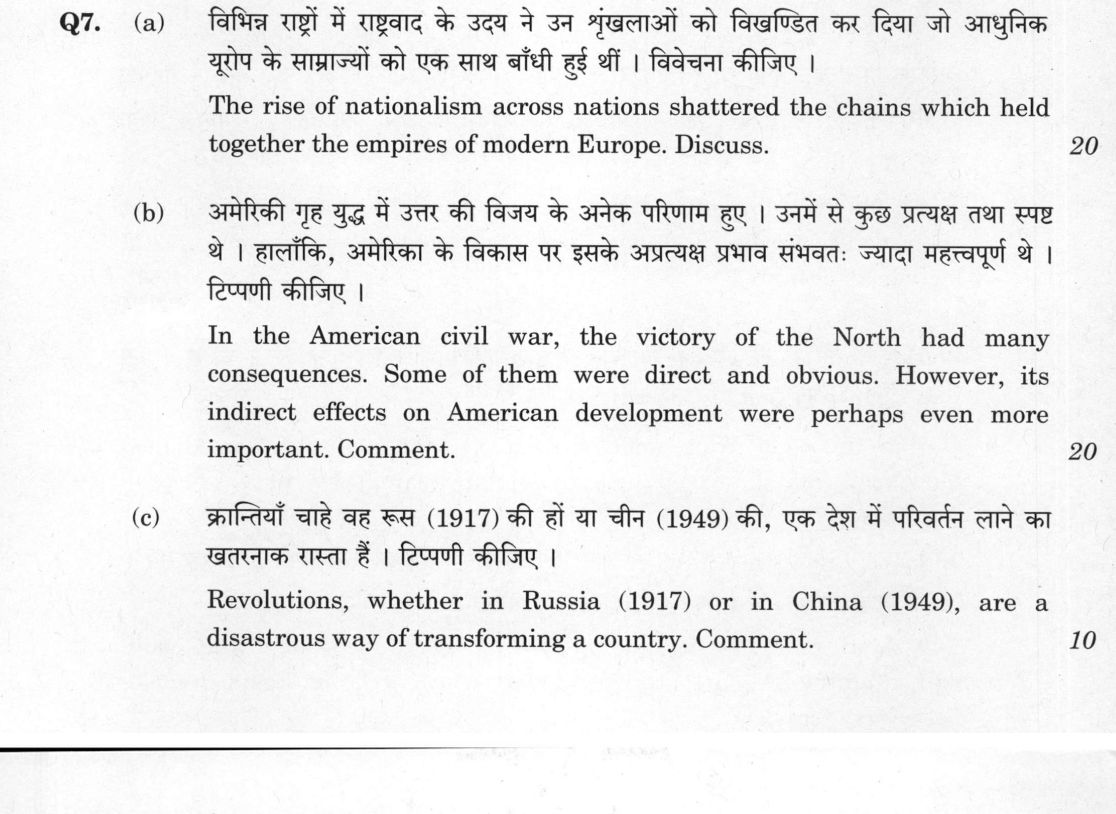
(a) The rise of nationalism across nations shattered the chains which held together the empires of modern Europe. Discuss. (20…
The rise of nationalism across nations shattered the chains which held together the empires of modern Europe. Discuss. 20 marks
In the American civil war, the victory of the North had many consequences. Some of them were direct and obvious. However, its indirect effects on American development were perhaps even more important. Comment. 20 marks
Revolutions, whether in Russia (1917) or in China (1949), are a disastrous way of transforming a country. Comment. 10 marks
हिंदी में प्रश्न पढ़ें
विभिन्न राष्ट्रों में राष्ट्रवाद के उदय ने उन शृंखलाओं को विखंडित कर दिया जो आधुनिक यूरोप के साम्राज्यों को एक साथ बाँधी हुई थीं । विवेचना कीजिए । (20 अंक)
अमेरिकी गृह युद्ध में उत्तर की विजय के अनेक परिणाम हुए । उनमें से कुछ प्रत्यक्ष तथा स्पष्ट थे । हालाँकि, अमेरिका के विकास पर इसके अप्रत्यक्ष प्रभाव संभवतः ज्यादा महत्त्वपूर्ण थे । टिप्पणी कीजिए । (20 अंक)
क्रांतियाँ चाहे वह रूस (1917) की हों या चीन (1949) की, एक देश में परिवर्तन लाने का खतरनाक रास्ता हैं । टिप्पणी कीजिए । (10 अंक)
Model answer
Written by UPSC Answer Check against this question's marking rubric, to the expected length. UPSC does not publish answers for Mains — this is one way to score well, not an official key.
The nineteenth and twentieth centuries witnessed fundamental reconfigurations of global political order, driven by the dual forces of nationalism and revolution.
Nationalism and the Dismantling of European Empires
The rise of modern nationalism altered the legitimacy of multi-ethnic dynastic rule. While Western Europe developed civic nationalism rooted in the French revolutionary ideals of popular sovereignty and citizenship, Central and Eastern Europe embraced ethnic nationalism rooted in the German Romantic tradition (Herder’s Volksgeist). This linguistic-cultural conception posed an existential threat to polyglot empires.
The Habsburg Empire was perpetually destabilized by internal national rivalries. The 1848 revolutions exposed its vulnerabilities, and the Ausgleich of 1867, creating the Austro-Hungarian Dual Monarchy, satisfied Magyar aspirations while alienating Slavic nationalities (Czechs, Croats, and Serbs). Similarly, the Ottoman Empire crumbled under Balkan nationalisms; Greek independence (1832) initiated a domino effect culminating in the Balkan Wars (1912–1913), as Young Turk centralization intensified peripheral secessions. In Tsarist Russia, state-sponsored Russification provoked fierce Polish resistance (1830, 1863) and Baltic self-assertion. Concurrently, the successful unifications of Italy and Germany provided potent alternative models, demonstrating that shared cultural identity could replace dynastic allegiances as the organizing principle of statehood.
Direct and Indirect Consequences of the American Civil War
The Union victory in 1865 produced immediate, monumental results: the constitutional preservation of the United States, the passage of the Thirteenth Amendment eradicating chattel slavery, and the devastation of the Southern plantation economy.
However, its indirect structural effects reshaped American development even more profoundly. As Charles Beard argued in his "Second American Revolution" thesis, the war permanently shifted political hegemony from the Southern agrarian aristocracy to Northern industrial capital. With Southern opposition removed from Congress, the Republican party enacted far-reaching developmental legislation: the Homestead Act (1862), the Morrill Land-Grant Act, and the Pacific Railway Acts. These measures established a unified continental market, accelerated westward expansion, and institutionalized high protective tariffs.
Furthermore, the war established absolute federal supremacy over states' rights doctrines. While revisionist historians emphasize that direct outcomes like emancipation remained incomplete due to subsequent Jim Crow legislation, the indirect emergence of corporate capitalism, mass industrialization, and infrastructural integration propelled the United States into a preeminent global economic power by the end of the nineteenth century.
Revolutions as Modes of Transformation: Russia and China
Revolutions in backward agrarian societies have historically entailed enormous human and institutional destruction. In Russia (1917) and China (1949), radical transformation arrived through civil war, terror, forced collectivization, and man-made famines—such as the Soviet collectivization crises and China’s Great Leap Forward—alongside purges and the erosion of individual liberties. Hannah Arendt observed in On Revolution that when revolutions focus primarily on the "social question" (poverty) through violent coercion, they inevitably foster authoritarianism.
Conversely, as Barrington Moore demonstrated, revolutionary violence in both nations forcefully dismantled entrenched semi-feudal landlordism, enabling rapid structural transformation. The USSR achieved comprehensive industrialization, universal literacy, and victory in the Second World War. Communist China restored national sovereignty, ending the "century of humiliation," and initiated radical social reforms, notably the 1950 Marriage Law liberating women.
Nevertheless, alternative evolutionary paths—such as Meiji Japan’s top-down modernization or India’s post-colonial democratic transformation through constitutional land reforms and state-directed planning—demonstrate that fundamental socioeconomic modernization could be pursued without the catastrophic human costs of violent societal rupture.
Nationalism and revolutionary upheavals thus served as double-edged instruments of historical change: while dismantling oppressive dynastic and imperial structures, their institutionalization often determined whether they resulted in democratic emancipation or devastating human tragedy.
What "Discuss" is asking you to do
Lay the issue out from more than one side — how it arose, what is claimed for it, what is held against it, and where it now stands. UPSC attaches discuss to broad topics with several live dimensions, so coverage of the dimensions earns more than the strength of your opinion.
Structure that answers it
Set the issue up → the case as it is made → the case against → the dimension both sides leave out → where the balance now lies
Where marks are lost
Listing facts with no thread between them, or arguing one side throughout and calling it a discussion.
How this answer will be evaluated
Approach
Framework: UPSC History Paper 2 Rubric. (a) discuss: intro > 3-4 dimensions > example > balanced close | (b) comment: context > arguments both sides > judgment > close | (c) comment: context > arguments both sides > judgment > close Full marks: Analytical, well-structured, cites specific historians/sources, addresses all parts of the prompt.
Key points expected
- Identify specific empires (Ottoman, Austro-Hungarian, Russian).
- Link nationalism to the 'shattering' of imperial cohesion.
- Discuss the role of 19th-century political movements.
- Provide a balanced conclusion on the outcome.
- Distinguish between direct (e.g., abolition) and indirect effects.
- Analyze the 'indirect effects' on American development (e.g., industrialization).
- Provide a judgment on the relative importance of these effects.
- Contextualize the victory within the broader war.
Evaluation rubric
Each sub-part is marked on its own, against the marks and word limit printed on the paper.
- (a) Analyze how nationalism dismantled multi-ethnic empires in modern Europe. 20 marks
discuss— intro → 3-4 dimensions → example → balanced close
Must cover
- Identify specific empires (Ottoman, Austro-Hungarian, Russian).
- Link nationalism to the 'shattering' of imperial cohesion.
- Discuss the role of 19th-century political movements.
- Provide a balanced conclusion on the outcome.
Loses marks
- Narrating events without analytical link to 'shattering'.
- Focusing only on one empire to the exclusion of others.
Earns more
- Mention specific nationalist leaders (e.g., Garibaldi, Metternich).
- Reference the Congress of Vienna context.
- Cite a specific historian's view on the process.
Extra mark
- Quote a primary source on national self-determination.
- Name a specific historiographical school (e.g., Gellner).
- (b) Evaluate the direct and indirect consequences of the North's victory in the American Civil War. 20 marks
comment— context → arguments both sides → judgment → close
Must cover
- Distinguish between direct (e.g., abolition) and indirect effects.
- Analyze the 'indirect effects' on American development (e.g., industrialization).
- Provide a judgment on the relative importance of these effects.
- Contextualize the victory within the broader war.
Loses marks
- Listing consequences without analyzing their impact on development.
- Ignoring the 'indirect effects' emphasized in the prompt.
Earns more
- Discuss the Reconstruction era as a direct consequence.
- Mention the shift in federal vs. state power.
- Reference the economic transformation of the South.
Extra mark
- Cite a specific historian (e.g., Eric Foner).
- Quote a primary source from the Reconstruction period.
- (c) Critique the assertion that revolutions in Russia and China were disastrous transformations. 10 marks
comment— context → arguments both sides → judgment → close
Must cover
- Address the 'disastrous' nature of the transformation.
- Compare or contrast the Russian (1917) and Chinese (1949) cases.
- Provide a balanced judgment on the 'disastrous' claim.
- Contextualize the revolutions within their specific historical moments.
Loses marks
- Simply narrating the events of the revolutions.
- Failing to address the 'disastrous' aspect of the prompt.
Earns more
- Mention specific outcomes (e.g., industrialization, social upheaval).
- Reference the role of key leaders (Lenin, Mao).
- Discuss the long-term impact on global politics.
Extra mark
- Cite a specific statistic on the human cost.
- Name a specific historiographical debate on these revolutions.
Practice this exact question
Write your answer and it is marked point by point against the model answer above — what you covered, what you missed, what you got wrong.
Evaluate my answer →More from History 2021 Paper II
- Q4 (a) Discuss the major constitutional developments in India after 1858 and their impact on…
- Q5 Critically examine the following statements in about 150 words each: (a) There were many…
- Q6 (a) What was "enlightened" about the Age of Enlightenment? (20 marks) (b) What were the c…
- Q7 (a) The rise of nationalism across nations shattered the chains which held together the e…
- Q8 (a) Europe was at war with itself in the first half of the twentieth century with a long…