Paper I — Q1
Identify the following places marked on the map supplied to you and write a short note of about 30 words on each of them in your…
Identify the following places marked on the map supplied to you and write a short note of about 30 words on each of them in your Question-cum-Answer Booklet. Locational hints for each of the places marked on the map are given below seriatim: (i) Palaeolithic site, (ii) Mesolithic site with burials, (iii) Neolithic pit-dwelling, (iv) Early village settlement, (v) Neolithic site, (vi) Neolithic-Chalcolithic site, (vii) Harappan UNESCO site, (viii) Megalithic burial site, (ix) Place of Second Sangam, (x) Earliest Satavahana capital, (xi) Place of inscribed statue of Ashoka, (xii) First Gupta hoard of coins, (xiii) Hoard of metal sculptures, (xiv) Ancient port, (xv) Oldest Jesuit church, (xvi) Centre of Gandhara art, (xvii) Buddhist monastery, (xviii) Place of earliest Vishnu temple, (xix) Shiva and Buddhist temple complex, (xx) Earliest Chaitya Griha.
हिंदी में प्रश्न पढ़ें
आपको दिए गए मानचित्र पर अंकित निम्नलिखित स्थानों की पहचान कीजिए एवं अपनी प्रश्न-सह-उत्तर पुस्तिका में उनमें से प्रत्येक पर लगभग 30 शब्दों की संक्षिप्ट टिप्पणी लिखिए। मानचित्र पर अंकित प्रत्येक स्थान के लिए स्थान-निर्धारण संकेत क्रमानुसार नीचे दिए गए हैं: (i) पुरापाषाणकालीन स्थल, (ii) शवाधान-युक्त मध्यपाषाणकालीन स्थल, (iii) नवपाषाणकालीन गर्तीवास, (iv) प्रारंभिक ग्रामीण बस्ती, (v) नवपाषाणकालीन स्थल, (vi) नवपाषाणकालीन-ताम्रपाषाणकालीन स्थल, (vii) हड़प्पन युनेस्को स्थल, (viii) महापाषाणकालीन शवाधान स्थल, (ix) द्वितीय संगम का स्थल, (x) प्रारम्भिक सातवाहन राजधानी, (xi) अशोक का अभिलिखित प्रतिमा स्थल, (xii) प्रथम गुप्तकालीन मुद्रा-निधि, (xiii) धात्विक प्रतिमा-निधि, (xiv) प्राचीन बन्दरगाह, (xv) प्राचीनतम जेजुइट चर्च, (xvi) गान्धार कला-केंद्र, (xvii) बौद्ध विहार, (xviii) प्रारम्भिक विष्णु मन्दिर स्थल, (xix) शैव एवं बौद्ध मन्दिर संकुल, (xx) प्रारम्भिक चैत्य गृह।
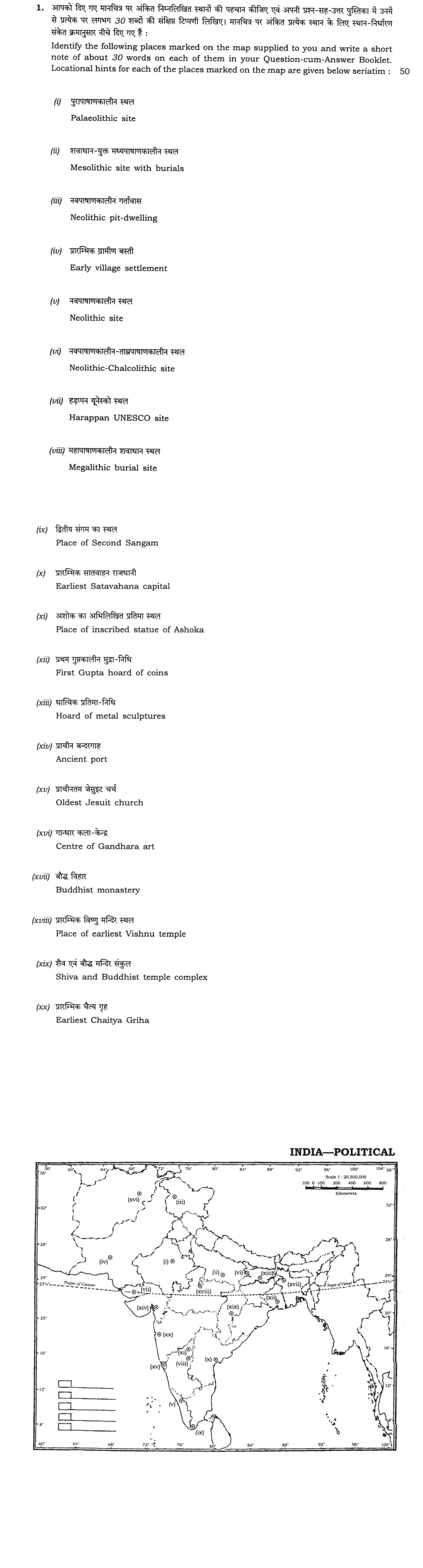
The figure this question refers to, in words
The question paper is a scan and the diagram did not survive as text. This is the figure as read from the original page — every component, value and label — so the question can be worked from the text below.
A political map of India titled 'INDIA—POLITICAL' with a scale of 1:20,500,000. The map displays state boundaries and is marked with 20 numbered locations (i through xx) indicated by circles. The locations are distributed across the country: (i) in the north-central region, (ii) in the central region, (iii) in the northeast, (iv) in the northwest, (v) in the southern peninsula, (vi) in the central-east, (vii) in the northwest, (viii) in the south-central, (ix) at the southern tip, (x) in the south-central, (xi) in the south-central, (xii) in the east, (xiii) in the east, (xiv) on the west coast, (xv) on the west coast, (xvi) in the far northwest, (xvii) in the east, (xviii) in the central region, (xix) in the central-east, and (xx) on the west coast. The Tropic of Cancer is marked as a dashed line across the map. Latitude and longitude lines are visible on the borders.
Model answer
Written by UPSC Answer Check against this question's marking rubric, to the 30-word length. UPSC does not publish answers for Mains — this is one way to score well, not an official key.
i. Bhimbetka Located in the Raisen district of Madhya Pradesh, near Bhopal, at approximately 23°N, 77°E. This is a major Palaeolithic rock shelter complex featuring over 700 caves with prehistoric paintings. It was chosen for the question as a UNESCO World Heritage Site representing the earliest human artistic expression in India.
ii. Bagor Situated in the Tonk district of Rajasthan, near the Aravalli range, at approximately 25°N, 74°E. This is a significant Mesolithic site known for its pit burials and evidence of the transition from hunting-gathering to pastoralism. It is included to highlight the cultural shift during the Mesolithic period in the subcontinent.
iii. Chirand Located in the Muzaffarpur district of Bihar, on the banks of the Ganges, at approximately 26°N, 85°E. This is a Neolithic site characterized by pit-dwellings and early agriculture. It is marked to illustrate the development of settled life and the beginning of the Neolithic revolution in the Gangetic plain.
iv. Mehrgarh Situated in the Kachhi district of Balochistan, Pakistan, near the Bolan Pass, at approximately 29°N, 67°E. This is one of the earliest known village settlements in the Indian subcontinent, showing evidence of farming and pottery. It is included as a precursor to the Indus Valley Civilization, marking the dawn of urbanization.
v. Burzahom Located in the Srinagar district of Jammu and Kashmir, on the banks of the Dal Lake, at approximately 34°N, 74°E. This is a Neolithic site famous for its pit-dwellings and dog burials. It is selected to represent the Neolithic culture of the Kashmir Valley, distinct from the southern and eastern sites.
vi. Inamgaon Situated in the Pune district of Maharashtra, near the Bhima river, at approximately 19°N, 74°E. This is a Neolithic-Chalcolithic site with extensive evidence of agriculture, metallurgy, and trade. It is marked to show the continuity of culture from the Neolithic to the Chalcolithic period in western India.
vii. Dholavira Located in the Rann of Kutch, Gujarat, at approximately 23°N, 70°E. This is a major Harappan site and a UNESCO World Heritage Site, known for its unique water management system and large city layout. It is included to highlight the geographical extent and engineering prowess of the Indus Valley Civilization.
viii. Adichanallur Situated in the Tirunelveli district of Tamil Nadu, at approximately 8°N, 77°E. This is a significant Megalithic burial site with hundreds of stone monuments. It is marked to represent the Megalithic culture of South India, which persisted well into the historic period.
ix. Kancipuram Located in the Kancheepuram district of Tamil Nadu, at approximately 12°N, 79°E. This is the place of the Second Sangam, a legendary Tamil literary assembly. It is included to connect the geographical location with the literary and cultural history of the Sangam period.
x. Pratishthana Situated in the Aurangabad district of Maharashtra, near the Godavari river, at approximately 19°N, 75°E. This is the earliest capital of the Satavahana dynasty. It is marked to identify the political center of the Satavahanas, a key power in the Deccan during the early centuries CE.
xi. Sarnath Located in the Varanasi district of Uttar Pradesh, near the Ganges, at approximately 25°N, 83°E. This is the place where an inscribed statue of Ashoka was found, along with the site of the First Sermon. It is included to highlight the Buddhist significance and the epigraphic evidence of Ashoka’s reign.
xii. Vidisha Situated in the Raisen district of Madhya Pradesh, at approximately 24°N, 78°E. This is the site where the first Gupta hoard of coins was discovered. It is marked to indicate the economic prosperity and numismatic evidence of the Gupta period, a golden age of Indian history.
xiii. Buxar Located in the Buxar district of Bihar, on the banks of the Ganges, at approximately 25°N, 84°E. This is the site where a hoard of metal sculptures, including a famous Buddha image, was found. It is included to represent the artistic and religious developments in the region during the early medieval period.
xiv. Muziris Situated in the Thrissur district of Kerala, near the Periyar river, at approximately 10°N, 76°E. This is an ancient port that was a major hub for trade with Rome. It is marked to highlight the maritime history and international trade connections of ancient India.
xv. Goa Located in the state of Goa, at approximately 15°N, 74°E. This is the site of the oldest Jesuit church, the Church of Bom Jesus. It is included to represent the early European colonial presence and the architectural legacy of the Portuguese in India.
xvi. Taxila Situated in the Punjab province of Pakistan, near the Indus river, at approximately 34°N, 72°E. This is a major centre of Gandhara art, blending Greek and Indian styles. It is marked to illustrate the cultural synthesis and artistic achievements of the Gandhara region under Kushan rule.
xvii. Nalanda Located in the Nalanda district of Bihar, at approximately 25°N, 85°E. This is a renowned Buddhist monastery and university. It is included to represent the height of Buddhist learning and the international academic center that attracted scholars from across Asia.
xviii. Deogarh Situated in the Jhansi district of Uttar Pradesh, at approximately 26°N, 79°E. This is the place of the earliest known Vishnu temple, the Dashavatara Temple. It is marked to highlight the early development of Vaishnavism and temple architecture in India.
xix. Bhubaneswar Located in the Khordha district of Odisha, at approximately 20°N, 85°E. This is a complex of Shiva and Buddhist temples, including the Lingaraja Temple. It is included to represent the religious diversity and architectural evolution of the Kalinga region.
xx. Karla Situated in the Lonavala area of Maharashtra, at approximately 18°N, 73°E. This is the site of the earliest known Chaitya Griha, a rock-cut Buddhist prayer hall. It is marked to highlight the early development of Buddhist rock-cut architecture in the Deccan.
What "Identify" is asking you to do
Pick out the particular instances that satisfy the question's test and name them precisely, with just enough against each to show it qualifies. A wrong pick earns nothing however well written, so the selection itself is the exercise.
Structure that answers it
The test an instance has to meet → instance named → the single line showing it meets the test → the same for each further instance
Where marks are lost
Describing the instances at length while never establishing why each one belongs in the set.
How this answer will be evaluated
Approach
Framework: UPSC History Paper 1 Map Identification. (i) map: locate accurately > label > one line on why it matters | (ii) map: locate accurately > label > one line on why it matters | (iii) map: locate accurately > label > one line on why it matters | (iv) map: locate accurately > label > one line on why it matters | (v) map: locate accurately > label > one line on why it matters | (vi) map: locate accurately > label > one line on why it matters | (vii) map: locate accurately > label > one line on why it matters | (viii) map: locate accurately > label > one line on why it matters | (ix) map: locate accurately > label > one line on why it matters | (x) map: locate accurately > label > one line on why it matters | (xi) map: locate accurately > label > one line on why it matters | (xii) map: locate accurately > label > one line on why it matters | (xiii) map: locate accurately > label > one line on why it matters | (xiv) map: locate accurately > label > one line on why it matters | (xv) map: locate accurately > label > one line on why it matters | (xvi) map: locate accurately > label > one line on why it matters | (xvii) map: locate accurately > label > one line on why it matters | (xviii) map: locate accurately > label > one line on why it matters | (xix) map: locate accurately > label > one line on why it matters | (xx) map: locate accurately > label > one line on why it matters Full marks: All 20 sites correctly identified with accurate 30-word notes.
Key points expected
- Identification consistent with locational hint
- Period or culture named
- One specific point of significance
Evaluation rubric
Each sub-part is marked on its own, against the marks and word limit printed on the paper.
- (i) Identify Palaeolithic site and write a 30-word note. 2.5 marks · 30 words
map— locate accurately → label → one line on why it matters
Must cover
- Identification consistent with locational hint
- Period or culture named
- One specific point of significance
Loses marks
- Bare name with no note
- Note ignores the locational hint
Earns more
- Mentions specific excavation or discovery
- References associated tool type
Extra mark
- Names the specific excavator
- (ii) Identify Mesolithic site with burials and write a 30-word note. 2.5 marks · 30 words
map— locate accurately → label → one line on why it matters
Must cover
- Identification consistent with locational hint
- Period or culture named
- One specific point of significance
Loses marks
- Bare name with no note
- Note ignores the locational hint
Earns more
- Mentions specific excavation or discovery
- References associated tool type
Extra mark
- Names the specific excavator
- (iii) Identify Neolithic pit-dwelling and write a 30-word note. 2.5 marks · 30 words
map— locate accurately → label → one line on why it matters
Must cover
- Identification consistent with locational hint
- Period or culture named
- One specific point of significance
Loses marks
- Bare name with no note
- Note ignores the locational hint
Earns more
- Mentions specific excavation or discovery
- References associated tool type
Extra mark
- Names the specific excavator
- (iv) Identify Early village settlement and write a 30-word note. 2.5 marks · 30 words
map— locate accurately → label → one line on why it matters
Must cover
- Identification consistent with locational hint
- Period or culture named
- One specific point of significance
Loses marks
- Bare name with no note
- Note ignores the locational hint
Earns more
- Mentions specific excavation or discovery
- References associated tool type
Extra mark
- Names the specific excavator
- (v) Identify Neolithic site and write a 30-word note. 2.5 marks · 30 words
map— locate accurately → label → one line on why it matters
Must cover
- Identification consistent with locational hint
- Period or culture named
- One specific point of significance
Loses marks
- Bare name with no note
- Note ignores the locational hint
Earns more
- Mentions specific excavation or discovery
- References associated tool type
Extra mark
- Names the specific excavator
- (vi) Identify Neolithic-Chalcolithic site and write a 30-word note. 2.5 marks · 30 words
map— locate accurately → label → one line on why it matters
Must cover
- Identification consistent with locational hint
- Period or culture named
- One specific point of significance
Loses marks
- Bare name with no note
- Note ignores the locational hint
Earns more
- Mentions specific excavation or discovery
- References associated tool type
Extra mark
- Names the specific excavator
- (vii) Identify Harappan UNESCO site and write a 30-word note. 2.5 marks · 30 words
map— locate accurately → label → one line on why it matters
Must cover
- Identification consistent with locational hint
- Period or culture named
- One specific point of significance
Loses marks
- Bare name with no note
- Note ignores the locational hint
Earns more
- Mentions specific excavation or discovery
- References associated tool type
Extra mark
- Names the specific excavator
- (viii) Identify Megalithic burial site and write a 30-word note. 2.5 marks · 30 words
map— locate accurately → label → one line on why it matters
Must cover
- Identification consistent with locational hint
- Period or culture named
- One specific point of significance
Loses marks
- Bare name with no note
- Note ignores the locational hint
Earns more
- Mentions specific excavation or discovery
- References associated tool type
Extra mark
- Names the specific excavator
- (ix) Identify Place of Second Sangam and write a 30-word note. 2.5 marks · 30 words
map— locate accurately → label → one line on why it matters
Must cover
- Identification consistent with locational hint
- Period or culture named
- One specific point of significance
Loses marks
- Bare name with no note
- Note ignores the locational hint
Earns more
- Mentions specific excavation or discovery
- References associated tool type
Extra mark
- Names the specific excavator
- (x) Identify Earliest Satavahana capital and write a 30-word note. 2.5 marks · 30 words
map— locate accurately → label → one line on why it matters
Must cover
- Identification consistent with locational hint
- Period or culture named
- One specific point of significance
Loses marks
- Bare name with no note
- Note ignores the locational hint
Earns more
- Mentions specific excavation or discovery
- References associated tool type
Extra mark
- Names the specific excavator
- (xi) Identify Place of inscribed statue of Ashoka and write a 30-word note. 2.5 marks · 30 words
map— locate accurately → label → one line on why it matters
Must cover
- Identification consistent with locational hint
- Period or culture named
- One specific point of significance
Loses marks
- Bare name with no note
- Note ignores the locational hint
Earns more
- Mentions specific excavation or discovery
- References associated tool type
Extra mark
- Names the specific excavator
- (xii) Identify First Gupta hoard of coins and write a 30-word note. 2.5 marks · 30 words
map— locate accurately → label → one line on why it matters
Must cover
- Identification consistent with locational hint
- Period or culture named
- One specific point of significance
Loses marks
- Bare name with no note
- Note ignores the locational hint
Earns more
- Mentions specific excavation or discovery
- References associated tool type
Extra mark
- Names the specific excavator
- (xiii) Identify Hoard of metal sculptures and write a 30-word note. 2.5 marks · 30 words
map— locate accurately → label → one line on why it matters
Must cover
- Identification consistent with locational hint
- Period or culture named
- One specific point of significance
Loses marks
- Bare name with no note
- Note ignores the locational hint
Earns more
- Mentions specific excavation or discovery
- References associated tool type
Extra mark
- Names the specific excavator
- (xiv) Identify Ancient port and write a 30-word note. 2.5 marks · 30 words
map— locate accurately → label → one line on why it matters
Must cover
- Identification consistent with locational hint
- Period or culture named
- One specific point of significance
Loses marks
- Bare name with no note
- Note ignores the locational hint
Earns more
- Mentions specific excavation or discovery
- References associated tool type
Extra mark
- Names the specific excavator
- (xv) Identify Oldest Jesuit church and write a 30-word note. 2.5 marks · 30 words
map— locate accurately → label → one line on why it matters
Must cover
- Identification consistent with locational hint
- Period or culture named
- One specific point of significance
Loses marks
- Bare name with no note
- Note ignores the locational hint
Earns more
- Mentions specific excavation or discovery
- References associated tool type
Extra mark
- Names the specific excavator
- (xvi) Identify Centre of Gandhara art and write a 30-word note. 2.5 marks · 30 words
map— locate accurately → label → one line on why it matters
Must cover
- Identification consistent with locational hint
- Period or culture named
- One specific point of significance
Loses marks
- Bare name with no note
- Note ignores the locational hint
Earns more
- Mentions specific excavation or discovery
- References associated tool type
Extra mark
- Names the specific excavator
- (xvii) Identify Buddhist monastery and write a 30-word note. 2.5 marks · 30 words
map— locate accurately → label → one line on why it matters
Must cover
- Identification consistent with locational hint
- Period or culture named
- One specific point of significance
Loses marks
- Bare name with no note
- Note ignores the locational hint
Earns more
- Mentions specific excavation or discovery
- References associated tool type
Extra mark
- Names the specific excavator
- (xviii) Identify Place of earliest Vishnu temple and write a 30-word note. 2.5 marks · 30 words
map— locate accurately → label → one line on why it matters
Must cover
- Identification consistent with locational hint
- Period or culture named
- One specific point of significance
Loses marks
- Bare name with no note
- Note ignores the locational hint
Earns more
- Mentions specific excavation or discovery
- References associated tool type
Extra mark
- Names the specific excavator
- (xix) Identify Shiva and Buddhist temple complex and write a 30-word note. 2.5 marks · 30 words
map— locate accurately → label → one line on why it matters
Must cover
- Identification consistent with locational hint
- Period or culture named
- One specific point of significance
Loses marks
- Bare name with no note
- Note ignores the locational hint
Earns more
- Mentions specific excavation or discovery
- References associated tool type
Extra mark
- Names the specific excavator
- (xx) Identify Earliest Chaitya Griha and write a 30-word note. 2.5 marks · 30 words
map— locate accurately → label → one line on why it matters
Must cover
- Identification consistent with locational hint
- Period or culture named
- One specific point of significance
Loses marks
- Bare name with no note
- Note ignores the locational hint
Earns more
- Mentions specific excavation or discovery
- References associated tool type
Extra mark
- Names the specific excavator
Practice this exact question
Write your answer and it is marked point by point against the model answer above — what you covered, what you missed, what you got wrong.
Evaluate my answer →More from History 2022 Paper I
- Q1 Identify the following places marked on the map supplied to you and write a short note of…
- Q2 (a) The urban character of the Harappan Civilization was a result neither of any outside…
- Q3 (a) The economic achievements of the Guptas were the culmination of a process which began…
- Q4 (a) Evaluate the importance of tripartite struggle for the domination over North India du…