Paper I — Q7
(a) The Virashaiva Movement of Southern Deccan in the twelfth century was essentially an attempt at social reform. Discuss. (15…
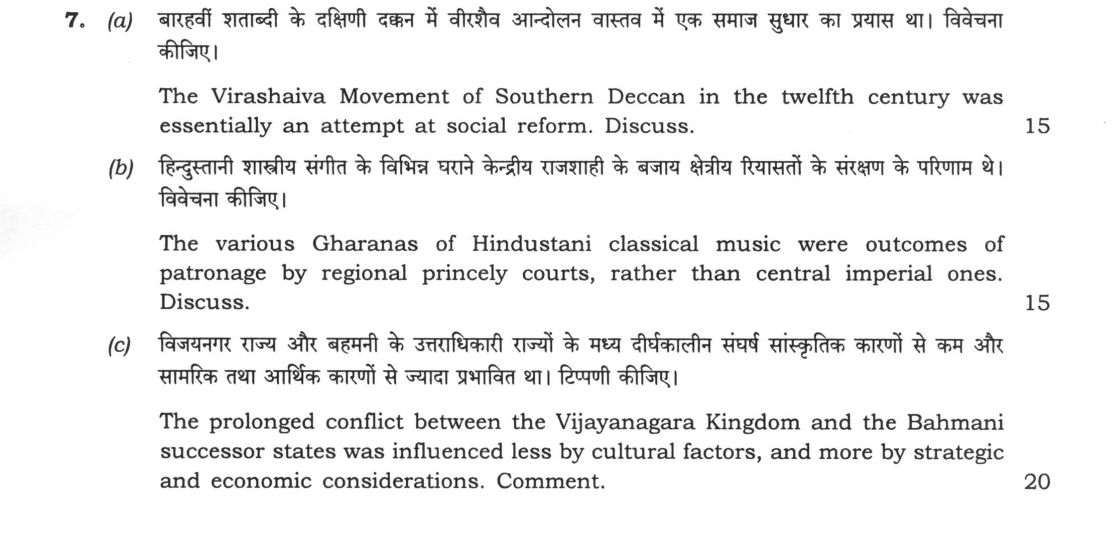
The Virashaiva Movement of Southern Deccan in the twelfth century was essentially an attempt at social reform. Discuss. 15 marks
The various Gharanas of Hindustani classical music were outcomes of patronage by regional princely courts, rather than central imperial ones. Discuss. 15 marks
The prolonged conflict between the Vijayanagara Kingdom and the Bahmani successor states was influenced less by cultural factors, and more by strategic and economic considerations. Comment. 20 marks
हिंदी में प्रश्न पढ़ें
बारहवीं शताब्दी के दक्षिणी दक्कन में वीरशैव आंदोलन वास्तव में एक समाज सुधार का प्रयास था। विवेचना कीजिए। (15 अंक)
हिंदुस्तानी शास्त्रीय संगीत के विभिन्न घराने केंद्रीय राजशाही के बजाय क्षेत्रीय रियासतों के संरक्षण के परिणाम थे। विवेचना कीजिए। (15 अंक)
विजयनगर राज्य और बहमनी के उत्तराधिकारी राज्यों के मध्य दीर्घकालीन संघर्ष सांस्कृतिक कारणों से कम और सामरिक तथा आर्थिक कारणों से ज्यादा प्रभावित था। टिप्पणी कीजिए। (20 अंक)
Model answer
Written by UPSC Answer Check against this question's marking rubric, to the expected length. UPSC does not publish answers for Mains — this is one way to score well, not an official key.
The Virashaiva Movement: Social Reform and Beyond
The 12th-century Virashaiva movement led by Basavanna (c. 1130–1167) in the Kalachuri kingdom was fundamentally an egalitarian social critique. By rejecting Vedic ritualism, temple-centric worship, pollution taboos, and caste hierarchies, it instituted radical social egalitarianism through the Anubhava Mantapa (hall of spiritual experience) and championed gender equality, epitomised by women mystics like Akka Mahadevi. However, characterising it purely as social reform understates its theological core—monotheistic Ishtalinga devotion and the Shatsthala path—as well as its linguistic assertion via vernacular Kannada Vachanas. Furthermore, the radical casteless ideal faced internal contradictions, as the movement eventually underwent institutionalisation into the distinct Lingayat community with its own social stratification.
Regional Courts and the Emergence of Musical Gharanas
While imperial Mughal courts provided foundational synthesis—exemplified by Tansen’s lineage—the distinct gharanas of Hindustani classical music (Gwalior, Agra, Kirana, Jaipur-Atrauli, Patiala) were primarily products of 18th- and 19th-century regional patronage. Following Mughal decline, regional princely courts across Awadh, Rajputana, and the Maratha states sheltered migrating musicians, fostering specialised vocal idioms nurtured through hereditary guru-shishya parampara. Nonetheless, imperial Delhi initially established the cross-regional classical idiom that these regional nodes diversified. By the early 20th century, court dependence dissolved as urban public platforms, recording technology, and V.N. Bhatkhande’s musicological documentation institutionalised classical music into modern national pedagogy.
Vijayanagara-Bahmani Conflict: Strategic and Economic Imperatives
The prolonged warfare between Vijayanagara and the Bahmani kingdom (and its successor sultanates) was driven by geopolitical and resource competition rather than civilizational antagonism. The primary material driver was control over the fertile Raichur Doab and the Konkan-Goa coastal corridor, crucial for customs revenue, pepper trade, and the strategic import of Arabian warhorses—a trade later complicated by Portuguese naval dominance. The diamond mines of the Krishna valley further intensified this rivalry.
Contemporary chronicles by Firishta and Fernão Nuniz reveal a pragmatic realpolitik marked by shifting coalitions, cross-confessional mercenary employment (such as Deva Raya II employing Muslim archers and Vijayanagara generals commanding Sultanate troops), dynastic marriages, and shared courtly aesthetics. The climactic Battle of Talikota (1565) was thus the culmination of balance-of-power diplomacy and territorial containment, not religious warfare.
Synthesis
These historical trajectories illustrate how regional dynamics shaped medieval and early modern India: Virashaivism represented an anti-Brahmanical socio-religious articulation, the gharana system reflected decentralized cultural regionalism, and the Deccan wars embodied resource-driven territorial state formation.
What "Discuss" is asking you to do
Lay the issue out from more than one side — how it arose, what is claimed for it, what is held against it, and where it now stands. UPSC attaches discuss to broad topics with several live dimensions, so coverage of the dimensions earns more than the strength of your opinion.
Structure that answers it
Set the issue up → the case as it is made → the case against → the dimension both sides leave out → where the balance now lies
Where marks are lost
Listing facts with no thread between them, or arguing one side throughout and calling it a discussion.
How this answer will be evaluated
Approach
Framework: Context > Thesis > Evidence > Historiography. (a) discuss: intro > 3-4 dimensions > example > balanced close | (b) discuss: intro > 3-4 dimensions > example > balanced close | (c) comment: context > arguments both sides > judgment > close Full marks: Argues a clear thesis, cites specific sources, and names historiographical schools.
Key points expected
- Identify Basavanna and the Lingayat reform agenda
- Detail rejection of caste hierarchy and ritualism
- Explain the role of the Anubhava Mantapa
- Cite specific social reforms like widow remarriage
- Define the concept of a Gharana
- Link specific Gharanas to specific courts (e.g., Gwalior, Agra)
- Contrast with the central Mughal imperial patronage
- Explain how regional styles developed distinctively
Evaluation rubric
Each sub-part is marked on its own, against the marks and word limit printed on the paper.
- (a) Argue the Virashaiva movement as a social reform attempt in 12th-century Southern Deccan. 15 marks
discuss— intro → 3-4 dimensions → example → balanced close
Must cover
- Identify Basavanna and the Lingayat reform agenda
- Detail rejection of caste hierarchy and ritualism
- Explain the role of the Anubhava Mantapa
- Cite specific social reforms like widow remarriage
Loses marks
- Treating it purely as a theological movement
- Ignoring the political context of the Kalachuris
- Chronology without analysis of social impact
Earns more
- Reference to the Sharanas and their social status
- Mention of the Lingayat code of conduct
- Comparison with the Bhakti movement in the North
- Reference to the Kaveri inscription
Extra mark
- Quotation from Vachanas
- Reference to a specific historian like R.S. Sharma
- (b) Analyze the role of regional princely courts in the formation of Hindustani Gharanas. 15 marks
discuss— intro → 3-4 dimensions → example → balanced close
Must cover
- Define the concept of a Gharana
- Link specific Gharanas to specific courts (e.g., Gwalior, Agra)
- Contrast with the central Mughal imperial patronage
- Explain how regional styles developed distinctively
Loses marks
- Confusing Hindustani with Carnatic music
- Ignoring the role of the Mughal court entirely
- Listing Gharanas without explaining their origin
Earns more
- Mention of the Gwalior, Agra, and Kirana Gharanas
- Reference to the role of the Nawabs of Awadh
- Discussion of the 'Gat' and 'Jor' styles
- Mention of the transition from Mughal to Maratha patronage
Extra mark
- Reference to a specific musician like Tansen or Allauddin Khan
- Mention of a specific court like the court of the Marathas
- (c) Evaluate the strategic and economic drivers of the Vijayanagara-Bahmani conflict. 20 marks
comment— context → arguments both sides → judgment → close
Must cover
- Identify the strategic importance of the Deccan plateau
- Analyze the economic value of the region (trade, agriculture)
- Discuss the role of the 'Tulu Nadu' and 'Rayalaseema' regions
- Explain the military dynamics of the conflict
Loses marks
- Focusing only on religious differences
- Ignoring the economic and strategic factors
- Chronology without analysis of the conflict's causes
Earns more
- Reference to the Battle of Talikota
- Mention of the role of the 'Nayakas' in the conflict
- Discussion of the 'Zamindari' system and its role in the conflict
- Reference to the 'Sultans of Bijapur' and 'Golconda'
Extra mark
- Reference to a specific historian like K.S. Lal
- Mention of a specific treaty or agreement
Practice this exact question
Write your answer and it is marked point by point against the model answer above — what you covered, what you missed, what you got wrong.
Evaluate my answer →More from History 2022 Paper I
- Q4 (a) Evaluate the importance of tripartite struggle for the domination over North India du…
- Q5 Answer the following questions in about 150 words each: (a) What were 'Brahmadeya' grants…
- Q6 (a) The market regulations of Ala-ud-din Khilji were useful for the Sultan's military mig…
- Q7 (a) The Virashaiva Movement of Southern Deccan in the twelfth century was essentially an…
- Q8 (a) Trade and commerce in the Mughal Empire brought about the integration of the Indian s…