Paper I — Q4
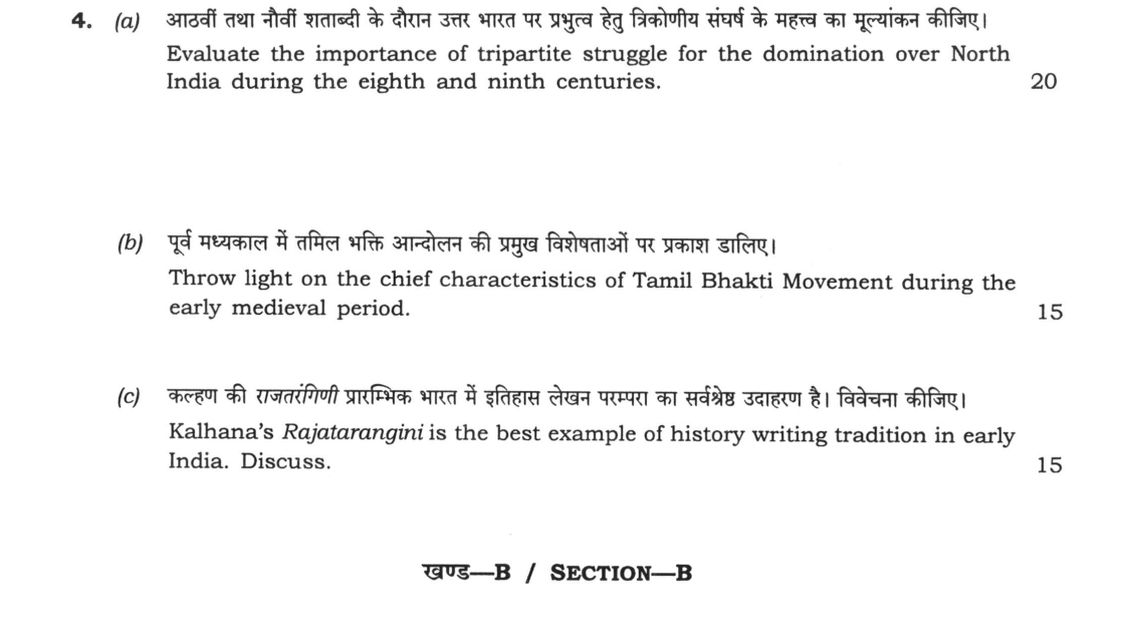
(a) Evaluate the importance of tripartite struggle for the domination over North India during the eighth and ninth centuries. (20…
Evaluate the importance of tripartite struggle for the domination over North India during the eighth and ninth centuries. 20 marks
Throw light on the chief characteristics of Tamil Bhakti Movement during the early medieval period. 15 marks
Kalhana's Rajatarangini is the best example of history writing tradition in early India. Discuss. 15 marks
हिंदी में प्रश्न पढ़ें
आठवीं तथा नौवीं शताब्दी के दौरान उत्तर भारत पर प्रभुत्व हेतु त्रिकोणीय संघर्ष के महत्त्व का मूल्यांकन कीजिए। (20 अंक)
पूर्व मध्यकाल में तमिल भक्ति आंदोलन की प्रमुख विशेषताओं पर प्रकाश डालिए। (15 अंक)
कल्हण की राजतरंगिणी प्रारंभिक भारत में इतिहास लेखन परंपरा का सर्वश्रेष्ठ उदाहरण है। विवेचना कीजिए। (15 अंक)
Model answer
Written by UPSC Answer Check against this question's marking rubric, to the expected length. UPSC does not publish answers for Mains — this is one way to score well, not an official key.
The early medieval period marked a structural shift across the Indian subcontinent, characterized by regional political competition, localized religious transformation, and maturing historiographical traditions.
The Tripartite Struggle and Northern Hegemony
The prolonged conflict for Kanauj—the geopolitical nucleus of the fertile middle-Gangetic basin and the paramount symbol of imperial sovereignty—pitted the Gurjara-Pratiharas under Vatsaraja and Nagabhata II, the Palas under Dharmapala and Devapala, and the Deccan-based Rashtrakutas under Dhruva and Govinda III against one another.
Evaluated against the standard of long-term political consolidation, the struggle yielded a largely counterproductive outcome. While individual monarchs secured ephemeral victories, no single power could establish enduring pan-Indian dominion. Instead, the continuous military friction exhausted imperial treasuries, accelerated feudal decentralization, and catalyzed political fragmentation. Consequently, the struggle expedited the definitive transition from a pan-Indian imperial structure to a landscape of segmented, competing regional polities across Northern India.
Characteristics of the Tamil Bhakti Movement
In peninsular India, early medieval socio-religious life was reshaped by the Tamil Bhakti movement, spearheaded by the Shaiva Nayanars and Vaishnava Alvars. Its chief characteristics included:
- Vernacular Devotion: Replacing elite Sanskrit with emotive Tamil hymns (Tevaram, Nalayira Divya Prabandham).
- Social Inclusivity: Directly challenging rigid Brahmanical orthodoxy and caste hierarchies by incorporating saints across diverse castes, including women like Karaikkal Ammaiyar and Andal.
- Temple-Centric Culture: Anchoring personal devotion (bhakti) to local pilgrimage networks and shrine rituals.
This movement acted as a vehicle for social mobility, fostered Tamil linguistic-cultural integration, and laid the socio-religious foundation for the institutional temple traditions later patronized by the Cholas, Vijayanagara, and Nayaka rulers.
Historiographical Rigour of Kalhana’s Rajatarangini
Composed in the twelfth century, Kalhana’s Rajatarangini stands as the most sophisticated expression of history-writing in early India. Unlike the mytho-genealogical focus of the Puranas or the didactic nature of Buddhist chronicles like the Mahavamsa, Kalhana adopted an advanced, evidence-based methodology. He consulted inscriptions, copper-plate grants, coins, monumental ruins, and earlier written chronicles, explicitly emphasizing an objective, impartial stance (raga-dvesha-vinirmuktah) aimed at reconstructing the past verified by sources (pramana).
However, it was not entirely modern: its early sections accept mythical chronologies, employ kavya (poetic) embellishments, and occasionally ascribe political fortunes to divine retribution. Nonetheless, its critical scrutiny of administrative misconduct and source-critical approach place it at the apex of pre-modern Indian historical scholarship.
Conclusion
Taken together, the three phenomena underline the defining features of early medieval India: the political decentralization resulting from the Tripartite struggle paralleled the vernacularization and localization of faith in the Tamil South, while Kalhana's chronicle mirrored the rise of a self-conscious, regional historiographical tradition.
What "Evaluate" is asking you to do
Judge how well something has performed against the standard it set for itself — its stated aim, mandate or promise — and commit to a verdict. Name the yardstick before you judge; an unanchored judgement reads as opinion.
Structure that answers it
Name the yardstick — stated aim, mandate or benchmark → performance against it → shortfall against it → why the gap exists → verdict
Where marks are lost
Presenting both sides and then declining to decide, or delivering a verdict against a standard you never stated, which makes it look arbitrary.
How this answer will be evaluated
Approach
Framework: Context > Thesis > Evidence > Historiography. (a) evaluate: criteria > evidence > balanced judgment | (b) highlight: name the salient points > one line of substance each > close | (c) discuss: intro > 3-4 dimensions > example > balanced close Full marks: Thesis-driven, cites specific sources/historians, deep analysis of causes/effects, clear structure.
Key points expected
- Identify the three contending powers: Palas, Pratiharas, Rashtrakutas
- Explain the strategic importance of Kannauj as the prize
- Analyze the impact on the political map of North India
- Evaluate the long-term consequences for regional power structures
- Distinguish between the Shaiva (Nayanmars) and Vaishnava (Alvars) streams
- Mention the use of Tamil language (Tamil Sangam tradition)
- Explain the social impact: challenge to caste hierarchy
- Note the role of temple worship and patronage
Evaluation rubric
Each sub-part is marked on its own, against the marks and word limit printed on the paper.
- (a) Assess the strategic and political significance of the Tripartite Struggle for North Indian control. 20 marks
evaluate— criteria → evidence → balanced judgment
Must cover
- Identify the three contending powers: Palas, Pratiharas, Rashtrakutas
- Explain the strategic importance of Kannauj as the prize
- Analyze the impact on the political map of North India
- Evaluate the long-term consequences for regional power structures
Loses marks
- Chronological listing of battles without political analysis
- Confusing the three powers or their territories
- Ignoring the significance of Kannauj's location
Earns more
- Reference to specific battles or key rulers (e.g., Dharmapala, Vatsaraja)
- Mention of the role of trade routes in the conflict
- Discussion of the decline of the Gupta legacy
- Reference to the 'Tripartite Struggle' as a historiographical term
Extra mark
- Citation of a specific inscription or chronicle (e.g., Allahabad Pillar)
- Mention of a specific historian's interpretation (e.g., R.C. Majumdar)
- (b) Outline the key features of the Tamil Bhakti Movement in the early medieval period. 15 marks
highlight— name the salient points → one line of substance each → close
Must cover
- Distinguish between the Shaiva (Nayanmars) and Vaishnava (Alvars) streams
- Mention the use of Tamil language (Tamil Sangam tradition)
- Explain the social impact: challenge to caste hierarchy
- Note the role of temple worship and patronage
Loses marks
- Treating Shaiva and Vaishnava streams as identical
- Ignoring the linguistic significance of Tamil
- Focusing only on theology without social context
Earns more
- Names of key figures: Appar, Sambandar, Manikkavasar, Andal
- Reference to the 'Tirumurai' or 'Divya Prabandham' texts
- Mention of the Chola or Pandya patronage
- Comparison with the North Indian Bhakti movement
Extra mark
- Citation of a specific hymn or verse
- Mention of a specific temple (e.g., Rameshwaram, Madurai)
- (c) Discuss why Kalhana's Rajatarangini is considered a prime example of early Indian historiography. 15 marks
discuss— intro → 3-4 dimensions → example → balanced close
Must cover
- Identify the work as a 'Rajatarangini' (River of Kings)
- Highlight its critical approach to sources (distinguishing fact from legend)
- Mention its chronological structure and coverage of Kashmir
- Note its secular tone compared to other contemporary texts
Loses marks
- Treating it as a mere chronicle without critical analysis
- Confusing it with other Rajatarangini texts
- Ignoring its unique methodological approach
Earns more
- Reference to Kalhana's use of 'Saptapada' or other sources
- Mention of the 'Rajatarangini' as a 'mirror for princes'
- Comparison with other Rajatarangini texts (e.g., Kashmiri vs. others)
- Note on its influence on later Kashmiri historiography
Extra mark
- Citation of a specific passage or chapter
- Mention of a specific historian's analysis (e.g., Stein, Grewal)
Practice this exact question
Write your answer and it is marked point by point against the model answer above — what you covered, what you missed, what you got wrong.
Evaluate my answer →More from History 2022 Paper I
- Q1 Identify the following places marked on the map supplied to you and write a short note of…
- Q2 (a) The urban character of the Harappan Civilization was a result neither of any outside…
- Q3 (a) The economic achievements of the Guptas were the culmination of a process which began…
- Q4 (a) Evaluate the importance of tripartite struggle for the domination over North India du…
- Q5 Answer the following questions in about 150 words each: (a) What were 'Brahmadeya' grants…
- Q6 (a) The market regulations of Ala-ud-din Khilji were useful for the Sultan's military mig…
- Q7 (a) The Virashaiva Movement of Southern Deccan in the twelfth century was essentially an…