Paper I — Q6
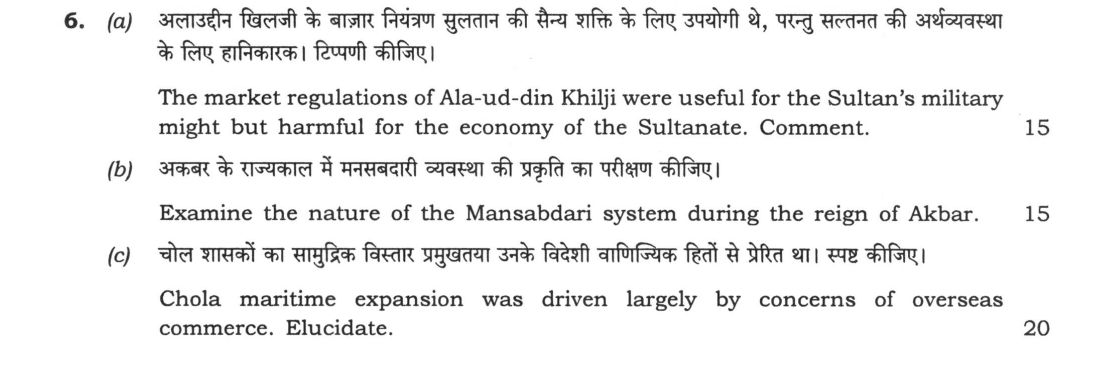
(a) The market regulations of Ala-ud-din Khilji were useful for the Sultan's military might but harmful for the economy of the…
The market regulations of Ala-ud-din Khilji were useful for the Sultan's military might but harmful for the economy of the Sultanate. Comment. 15 marks
Examine the nature of the Mansabdari system during the reign of Akbar. 15 marks
Chola maritime expansion was driven largely by concerns of overseas commerce. Elucidate. 20 marks
हिंदी में प्रश्न पढ़ें
अलाउद्दीन खिलजी के बाजार नियंत्रण सुलतान की सैन्य शक्ति के लिए उपयोगी थे, परंतु सल्तनत की अर्थव्यवस्था के लिए हानिकारक। टिप्पणी कीजिए। (15 अंक)
अकबर के राज्यकाल में मनसबदारी व्यवस्था की प्रकृति का परीक्षण कीजिए। (15 अंक)
चोल शासकों का सामुद्रिक विस्तार प्रमुखतया उनके विदेशी वाणिज्यिक हितों से प्रेरित था। स्पष्ट कीजिए। (20 अंक)
Model answer
Written by UPSC Answer Check against this question's marking rubric, to the expected length. UPSC does not publish answers for Mains — this is one way to score well, not an official key.
Market Regulations of Ala-ud-din Khilji
Ziauddin Barani’s Tarikh-i-Firuzshahi notes that Ala-ud-din Khilji’s market controls were conceived primarily to maintain a massive standing army against Mongol incursions without exhausting state revenues. Through strict price-fixing across centralized markets (shahi mandi), rationing, state grain reserves, and rigorous control over commodities ranging from grain and cloth to horses and slaves, the Sultan maintained soldiers on modest cash salaries.
However, this military utility undermined the Sultanate's broader economy. Direct grain levies and depressed producer prices squeezed the agrarian peasantry, while draconian state surveillance (shahna-i-mandi, munhiyans) and fixed profit margins stifled merchant enterprise and long-distance trade. The suppression of free market incentives caused economic stagnation, proving unsustainable and collapsing immediately after Khilji’s death.
Nature of Akbar’s Mansabdari System
Akbar transformed the military-administrative structure by replacing the decentralized, semi-hereditary Iqtadari framework with the centralized Mansabdari system. An individual’s mansab (rank) determined both hierarchical status and salary, which was disbursed either in cash (naqd) or through non-hereditary revenue assignments (jagirs).
The system was refined through the dual-rank mechanism: zat (personal status and baseline salary) and sawar (the mandated cavalry contingent). By enforcing branding (dagh) and descriptive rolls (chehra), Akbar forged a bureaucratic-military tool that diluted primordial clan loyalties. The institution integrated a heterogeneous nobility—Turanis, Iranis, Rajputs, and Indian Muslims (Shaikhzadas)—into a unified imperial framework. While remarkably effective under Akbar, the system later deteriorated under Jahangir and Shah Jahan through mechanisms like du-aspa sih-aspa and growing revenue mismatches (jama versus hasil).
Chola Maritime Expansion and Overseas Commerce
Chola naval projection under Rajaraja I and Rajendra I was driven significantly by the imperatives of international maritime trade. The annexation of northern Sri Lanka, conquest of the Maldives, and naval thrusts toward Bengal and across the Bay of Bengal culminated in Rajendra I’s expedition against the Srivijaya Empire (Kadaram). This campaign secured strategic choke-points along the Malacca Straits, eliminating navigational bottlenecks for maritime trade with Song China.
This naval expansion functioned alongside powerful merchant guilds such as the Ayyavole (Ainurruvar) and Manigramam. Chola temple networks operated as commercial hubs, mobilizing agrarian surplus and financing overseas merchant ventures in high-value goods like Arabian warhorses, Southeast Asian spices, and south Indian textiles. Diplomatic embassies to China reinforced these economic linkages.
Historiographically, K.A. Nilakanta Sastri characterized this as the state-backed protection of a "commercial empire." Although alternative perspectives highlight the role of predatory raiding, imperial prestige, and symbolic oceanic sovereignty (digvijaya), the deliberate targeting of vital transit ports demonstrates that overseas commercial interests remained central to Chola naval strategy.
Conclusion
Medieval Indian statecraft repeatedly balanced military mobilization with economic viability, whether through Khilji's coercive market controls, Akbar's institutionalized Mansabdari bureaucracy, or the Cholas' commercially oriented naval power.
What "Elucidate" is asking you to do
Make a stated proposition plain and then prove it with instances. Elucidate stems almost always carry a claim or a named concept, and very often the words “with examples” or “with suitable diagrams” — the illustration is part of the directive, not decoration.
Structure that answers it
Plain-language statement of what the proposition means → the part that is obscure, resolved → first illustration → second illustration → why the proposition holds
Where marks are lost
Adding terminology; elucidate rewards removing it. The commoner loss is a clean explanation with no example, when the stem asked for examples.
How this answer will be evaluated
Approach
Framework: Context > Thesis > Evidence > Historiography. (a) comment: context > arguments both sides > judgment > close | (b) examine: intro > how/why with reasoning > evidence > conclusion | (c) explain: definition/context > points in order > small example > short close Full marks: Thesis-driven, cites specific sources (inscriptions/chronicles), names historians, and provides a clear judgment/analysis.
Key points expected
- Context of the 1299 market reforms
- Argument for military utility (stable prices)
- Argument for economic harm (monopoly/inefficiency)
- Final judgment on the net effect
- Definition of the dual rank system (Zat/Sawar)
- Explanation of the 'Taqavi' (salary) mechanism
- Nature of the system (merit vs patronage)
- Role of the 'Mansabdar' in administration
Evaluation rubric
Each sub-part is marked on its own, against the marks and word limit printed on the paper.
- (a) Balanced judgment on the dual impact of market regulations on military vs economy. 15 marks
comment— context → arguments both sides → judgment → close
Must cover
- Context of the 1299 market reforms
- Argument for military utility (stable prices)
- Argument for economic harm (monopoly/inefficiency)
- Final judgment on the net effect
Loses marks
- Narrating events without analytical judgment
- Ignoring the economic harm aspect
- Treating the reforms as purely benevolent
Earns more
- Citation of Amir Khusrau's chronicle
- Mention of the 'Shahi Mandi' system
- Reference to the 'Dagh' system
- Mention of the 'Munshi' officials
Extra mark
- Reference to Irfan Habib's economic analysis
- Specific quote from the Tarikh-i-Firishta
- (b) Analysis of the structural nature and functioning of the Mansabdari system. 15 marks
examine— intro → how/why with reasoning → evidence → conclusion
Must cover
- Definition of the dual rank system (Zat/Sawar)
- Explanation of the 'Taqavi' (salary) mechanism
- Nature of the system (merit vs patronage)
- Role of the 'Mansabdar' in administration
Loses marks
- Confusing Mansabdari with the Iqta system
- Failing to explain the Zat/Sawar distinction
- Treating it as a purely feudal system
Earns more
- Mention of the 'Ghar-i-Sanad' (payroll)
- Reference to the 'Dagh' (branding) of horses
- Distinction between 'Mansab' and 'Raj' (feudal rights)
- Mention of the 'Mansab-i-1000' cap
Extra mark
- Reference to Abul Fazl's Ain-i-Akbari
- Comparison with the 'Iqta' system
- (c) Detailed explanation of how overseas commerce drove Chola maritime expansion. 20 marks
explain— definition/context → points in order → small example → short close
Must cover
- Context of the Chola naval power
- Link between trade routes and military expeditions
- Specific examples of overseas trade (Srivijaya, etc.)
- Role of the 'Navy' in protecting commerce
Loses marks
- Focusing only on military conquests
- Ignoring the commercial motivation
- Failing to link trade to expansion
Earns more
- Mention of the 'Tamilakam' inscriptions
- Reference to the 'Kulottunga' inscriptions
- Mention of the 'Srivijaya' expedition
- Reference to the 'Pallava' trade links
Extra mark
- Reference to the 'Tiruvallur' inscriptions
- Specific mention of the 'Chola' coinage
Practice this exact question
Write your answer and it is marked point by point against the model answer above — what you covered, what you missed, what you got wrong.
Evaluate my answer →More from History 2022 Paper I
- Q3 (a) The economic achievements of the Guptas were the culmination of a process which began…
- Q4 (a) Evaluate the importance of tripartite struggle for the domination over North India du…
- Q5 Answer the following questions in about 150 words each: (a) What were 'Brahmadeya' grants…
- Q6 (a) The market regulations of Ala-ud-din Khilji were useful for the Sultan's military mig…
- Q7 (a) The Virashaiva Movement of Southern Deccan in the twelfth century was essentially an…
- Q8 (a) Trade and commerce in the Mughal Empire brought about the integration of the Indian s…