Paper I — Q2
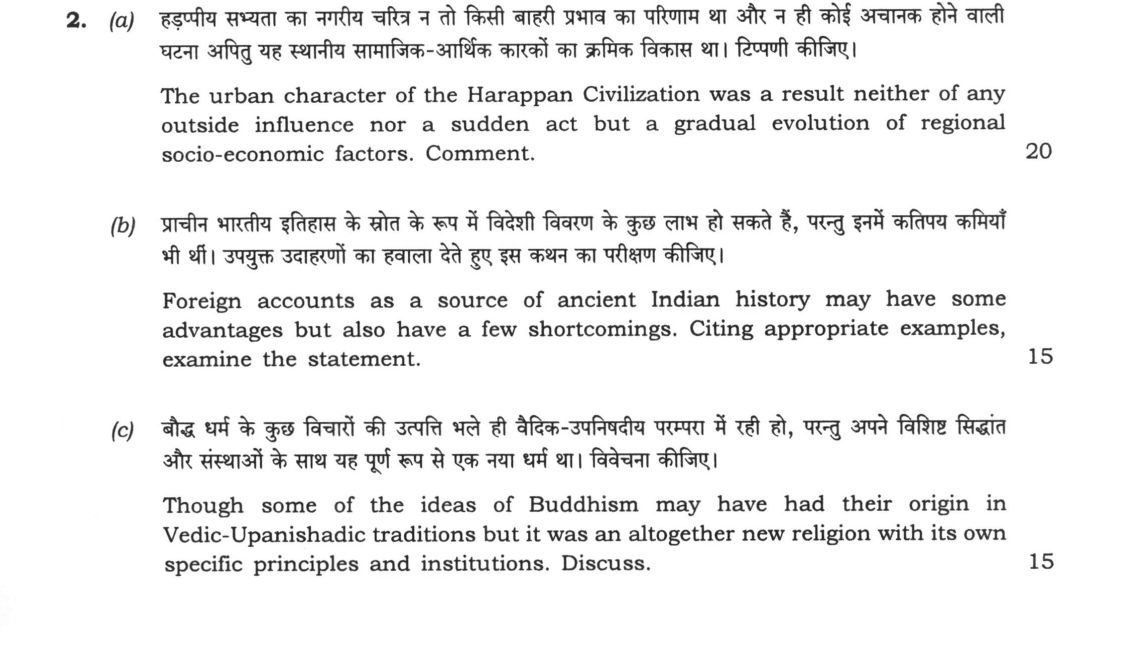
(a) The urban character of the Harappan Civilization was a result neither of any outside influence nor a sudden act but a gradual…
The urban character of the Harappan Civilization was a result neither of any outside influence nor a sudden act but a gradual evolution of regional socio-economic factors. Comment. 20 marks
Foreign accounts as a source of ancient Indian history may have some advantages but also have a few shortcomings. Citing appropriate examples, examine the statement. 15 marks
Though some of the ideas of Buddhism may have had their origin in Vedic-Upanishadic traditions but it was an altogether new religion with its own specific principles and institutions. Discuss. 15 marks
हिंदी में प्रश्न पढ़ें
हड़प्पीय सभ्यता का नगरीय चरित्र न तो किसी बाहरी प्रभाव का परिणाम था और न ही कोई अचानक होने वाली घटना अपितु यह स्थानीय सामाजिक-आर्थिक कारकों का क्रमिक विकास था। टिप्पणी कीजिए। (20 अंक)
प्राचीन भारतीय इतिहास के स्रोत के रूप में विदेशी विवरण के कुछ लाभ हो सकते हैं, परन्तु इनमें कतिपय कमियाँ भी थीं। उपयुक्त उदाहरणों का हवाला देते हुए इस कथन का परीक्षण कीजिए। (15 अंक)
बौद्ध धर्म के कुछ विचारों की उत्पत्ति भले ही वैदिक-उपनिषदीय परम्परा में रही हो, परन्तु अपने विशिष्ट सिद्धान्त और संस्थाओं के साथ यह पूर्ण रूप से एक नया धर्म था। विवेचना कीजिए। (15 अंक)
Model answer
Written by UPSC Answer Check against this question's marking rubric, to the expected length. UPSC does not publish answers for Mains — this is one way to score well, not an official key.
The material and cultural trajectories of ancient India demonstrate an endogenous civilizational momentum, where socio-economic transitions and religious shifts evolved primarily from internal dynamics rather than external impositions.
Indigenous Genesis of Harappan Urbanism
The urban character of the Harappan Civilization was an indigenous, incremental achievement rather than a result of Mesopotamian diffusion or sudden transformation. Stratigraphic records from Mehrgarh (c. 7000 BCE) through regional Early Harappan phases like Kot Diji, Amri, and Kalibangan reveal a continuous transition from the pastoral-agrarian economy of the Baluchistan highlands to intensive alluvial farming on the Indus plains. This shift generated substantial agricultural surpluses, enabling non-agrarian craft specialization (metallurgy, bead-making) and organized internal exchange systems. The mature urbanism seen at Mohenjodaro and Harappa—marked by standardized weights, measures, brick ratios (4:2:1), and planned civic grids—was the culmination of these regional socio-economic processes, invalidating diffusionist or sudden-colonization theories.
Utility and Limitations of Foreign Accounts
Foreign accounts provide indispensable external synchronization and socio-administrative details for reconstructing ancient Indian history. Megasthenes’ Indica offers granular descriptions of Mauryan municipal and military administration; Chinese pilgrims Fa-Hien and Xuanzang (Yuan Chwang) provide critical observations on monastic institutions, society, and religious landscape; and Al-Biruni’s Kitab-al-Hind presents a rigorous analysis of early medieval Indian sciences and social customs.
However, these sources suffer from distinct shortcomings. Megasthenes viewed Indian society through a classical Hellenistic lens, erroneously claiming the absence of slavery, inventing a seven-caste system, and indulging in utopian exaggerations. Chinese travelers filtered Indian reality predominantly through a Buddhist lens, often exaggerating the patronage of rulers like Harsha while ignoring broader non-Buddhist developments. Linguistic barriers, reliance on hearsay, and chronological inaccuracies make foreign accounts unreliable unless cross-referenced with indigenous epigraphic and archaeological records.
Buddhism: Vedic Roots and Distinct Institutional Identity
While Buddhism drew upon the contemporary Sramanic and late-Vedic intellectual climate—inheriting concepts of karma, samsara (rebirth), and the Upanishadic disillusionment with sacrificial ritualism—it was fundamentally an autonomous, revolutionary movement.
Philosophically, Buddhism rejected the authority of the Vedas, Brahmanical supremacy, and the concept of an eternal soul, replacing them with Anatmavada (non-self), Pratityasamutpada (dependent origination), the Four Noble Truths, and the Eightfold Path. Institutionally, it broke from the caste-bound social order by extending universal spiritual accessibility to all varnas and women. Furthermore, it established novel socio-religious structures: the *Sangha*—a democratic monastic institution governed by the *Vinaya Pitaka*—and an independent architectural idiom centered on stupas and viharas.
Thus, ancient Indian history reveals a resilient continuum where urban forms arose from local agrarian adaptations, historical narratives require critical reconciliation of external impressions with material data, and religious reformulations generated entirely distinct philosophical systems.
What "Comment" is asking you to do
Take a position on the statement and support it. Comment usually attaches to a quoted line in the short slots, so the reasoning must be compressed — an opening view, a few load-bearing reasons, and the limit of the claim.
Structure that answers it
Unpack what the statement asserts → your stance → two or three supporting reasons → the qualification that limits it
Where marks are lost
Neutral summary; a comment without a stance has not answered. Equally costly is accepting the quoted line wholesale and never testing where it fails.
How this answer will be evaluated
Approach
Framework: Context > Thesis > Evidence > Historiography. (a) comment: context > arguments both sides > judgment > close | (b) examine: intro > how/why with reasoning > evidence > conclusion | (c) discuss: intro > 3-4 dimensions > example > balanced close Full marks: Argues a clear thesis, cites specific sources/artifacts, and balances the prompt's dual aspects.
Key points expected
- Contextualize Harappan urbanism (planning, drainage, standardization).
- Argue against 'outside influence' (e.g., Mesopotamia) with evidence.
- Argue against 'sudden act' (e.g., Aryan invasion) with evidence.
- Link urban features to regional socio-economic factors (trade, agriculture).
- Identify specific foreign accounts (e.g., Megasthenes, Fa-Hien, Xuanzang).
- Explain advantages (e.g., external perspective, filling gaps).
- Explain shortcomings (e.g., bias, translation errors, limited scope).
- Provide appropriate examples for both advantages and shortcomings.
Evaluation rubric
Each sub-part is marked on its own, against the marks and word limit printed on the paper.
- (a) Contextualize Harappan urbanism and judge the thesis of indigenous socio-economic evolution. 20 marks
comment— context → arguments both sides → judgment → close
Must cover
- Contextualize Harappan urbanism (planning, drainage, standardization).
- Argue against 'outside influence' (e.g., Mesopotamia) with evidence.
- Argue against 'sudden act' (e.g., Aryan invasion) with evidence.
- Link urban features to regional socio-economic factors (trade, agriculture).
Loses marks
- Narrating history without analyzing the 'evolution' claim.
- Ignoring the 'outside influence' or 'sudden act' parts of the prompt.
- Textbook retelling of features without socio-economic linkage.
Earns more
- Mention specific sites (Mohenjo-daro, Harappa, Dholavira).
- Reference specific artifacts (weights, seals, granaries).
- Discuss the 'gradual evolution' aspect (Mature Harappan phase).
Extra mark
- Name a specific historian (e.g., R.S. Bisht, B.B. Lal).
- Cite a specific archaeological discovery (e.g., Lothal dockyard).
- (b) Examine the utility and limitations of foreign accounts (Greek, Chinese, Arab) for Indian history. 15 marks
examine— intro → how/why with reasoning → evidence → conclusion
Must cover
- Identify specific foreign accounts (e.g., Megasthenes, Fa-Hien, Xuanzang).
- Explain advantages (e.g., external perspective, filling gaps).
- Explain shortcomings (e.g., bias, translation errors, limited scope).
- Provide appropriate examples for both advantages and shortcomings.
Loses marks
- Listing accounts without analyzing their 'advantages' or 'shortcomings'.
- Ignoring the 'appropriate examples' requirement.
- Treating foreign accounts as infallible or entirely useless.
Earns more
- Mention specific details from Indica (e.g., no slavery, no meat-eating).
- Discuss the 'ethnocentric' bias of foreign observers.
- Reference the 'Silk Route' context for Chinese accounts.
Extra mark
- Name a specific historian who used these sources (e.g., A.B. Keith).
- Cite a specific translation error or misinterpretation.
- (c) Discuss the continuity with Vedic traditions and the distinctiveness of Buddhist principles/institutions. 15 marks
discuss— intro → 3-4 dimensions → example → balanced close
Must cover
- Identify Vedic-Upanishadic origins (e.g., Karma, Rebirth, Samsara).
- Explain the 'new' principles (e.g., Middle Path, Four Noble Truths).
- Describe specific institutions (e.g., Sangha, Monasticism).
- Balance the 'origin' and 'new religion' aspects of the statement.
Loses marks
- Focusing only on the 'new' aspects and ignoring the 'origins'.
- Focusing only on the 'origins' and ignoring the 'new' aspects.
- Failing to mention specific 'institutions' (e.g., Sangha).
Earns more
- Mention the rejection of Vedic rituals and caste system.
- Discuss the 'Middle Path' as a distinct principle.
- Reference the 'Sangha' as a specific institution.
Extra mark
- Name a specific Buddhist text (e.g., Dhammapada, Tripitaka).
- Cite a specific Upanishad for comparison (e.g., Brihadaranyaka).
Practice this exact question
Write your answer and it is marked point by point against the model answer above — what you covered, what you missed, what you got wrong.
Evaluate my answer →More from History 2022 Paper I
- Q1 Identify the following places marked on the map supplied to you and write a short note of…
- Q2 (a) The urban character of the Harappan Civilization was a result neither of any outside…
- Q3 (a) The economic achievements of the Guptas were the culmination of a process which began…
- Q4 (a) Evaluate the importance of tripartite struggle for the domination over North India du…
- Q5 Answer the following questions in about 150 words each: (a) What were 'Brahmadeya' grants…