Paper I — Q5
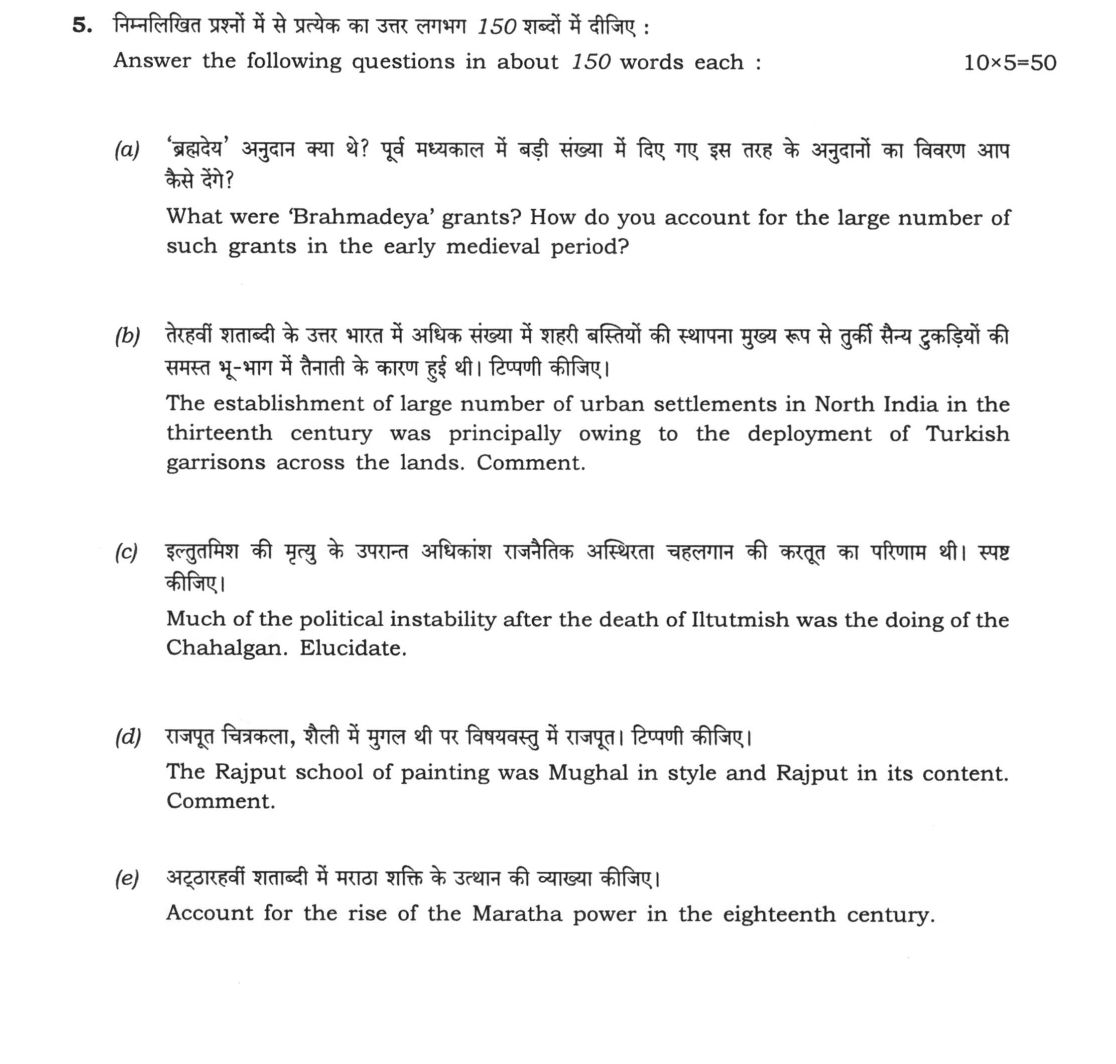
Answer the following questions in about 150 words each: (a) What were 'Brahmadeya' grants? How do you account for the large…
Answer the following questions in about 150 words each: (a) What were 'Brahmadeya' grants? How do you account for the large number of such grants in the early medieval period? (10 marks) (b) The establishment of large number of urban settlements in North India in the thirteenth century was principally owing to the deployment of Turkish garrisons across the lands. Comment. (10 marks) (c) Much of the political instability after the death of Iltutmish was the doing of the Chahalgan. Elucidate. (10 marks) (d) The Rajput school of painting was Mughal in style and Rajput in its content. Comment. (10 marks) (e) Account for the rise of the Maratha power in the eighteenth century. 10 marks
हिंदी में प्रश्न पढ़ें
निम्नलिखित प्रश्नों में से प्रत्येक का उत्तर लगभग 150 शब्दों में दीजिए: (a) 'ब्रह्मदेय' अनुदान क्या थे? पूर्व मध्यकाल में बड़ी संख्या में दिए गए इस तरह के अनुदानों का विवरण आप कैसे देंगे? (10 अंक) (b) तेरहवीं शताब्दी के उत्तर भारत में अधिक संख्या में शहरी बस्तियों की स्थापना मुख्य रूप से तुर्की सैन्य टुकड़ियों की समस्त भू-भाग में तैनाती के कारण हुई थी। टिप्पणी कीजिए। (10 अंक) (c) इल्तुतमिश की मृत्यु के उपरांत अधिकांश राजनीतिक अस्थिरता चहलगान की करतूत का परिणाम थी। स्पष्ट कीजिए। (10 अंक) (d) राजपूत चित्रकला, शैली में मुगल थी पर विषयवस्तु में राजपूत। टिप्पणी कीजिए। (10 अंक) (e) अठारहवीं शताब्दी में मराठा शक्ति के उत्थान की व्याख्या कीजिए। (10 अंक)
Model answer
Written by UPSC Answer Check against this question's marking rubric, to the 150-word length. UPSC does not publish answers for Mains — this is one way to score well, not an official key.
Brahmadeya grants were tax-free lands donated to Brahmanas, often with rights over revenue and inhabitants. Their proliferation in the early medieval period is explained by royal legitimation needs, agrarian expansion into new tracts, and temple-building patronage, especially in peninsular India.
Urban settlements in thirteenth-century North India grew largely around Turkish garrison towns (qasbas), which became nuclei of administration and trade. Yet military deployment alone was insufficient; commercial revival, mint establishment, and integration with existing trade networks were equally vital.
Chahalgan, Iltutmish's corps of forty slave nobles, dominated politics after his death. Their factional rivalries and succession disputes, notably against Raziyya, eroded centralized authority between 1236 and 1246, making them chiefly responsible for the instability.
Rajput painting adopted Mughal style—naturalism, perspective, Persian techniques—while retaining Rajput content: mythological narratives and courtly life, patronized at Mewar, Marwar, and Bundi.
Maratha power rose through Shivaji's military innovations, Peshwa administrative consolidation, the chauth and sardeshmukhi revenue system, and exploitation of the Mughal power vacuum in the eighteenth century.
What "Elucidate" is asking you to do
Make a stated proposition plain and then prove it with instances. Elucidate stems almost always carry a claim or a named concept, and very often the words “with examples” or “with suitable diagrams” — the illustration is part of the directive, not decoration.
Structure that answers it
Plain-language statement of what the proposition means → the part that is obscure, resolved → first illustration → second illustration → why the proposition holds
Where marks are lost
Adding terminology; elucidate rewards removing it. The commoner loss is a clean explanation with no example, when the stem asked for examples.
How this answer will be evaluated
Approach
Framework: Context > Thesis > Evidence > Historiography. (a) explain: definition/context > points in order > small example > short close | (b) comment: context > arguments both sides > judgment > close | (c) explain: definition/context > points in order > small example > short close | (d) comment: context > arguments both sides > judgment > close | (e) explain: definition/context > points in order > small example > short close Full marks: Argues a clear thesis with specific evidence and historiographical context.
Key points expected
- Brahmadeya grants and agrarian expansion
- Turkish garrisons and 13th-century urbanization
- Chahalgani and post-Iltutmish instability
- Rajput painting: Mughal style, Rajput content
- Maratha rise: military strategy and administration
Evaluation rubric
Each sub-part is marked on its own, against the marks and word limit printed on the paper.
- (a) Define Brahmadeya and explain the socio-economic drivers of their proliferation. 10 marks · 150 words
explain— definition/context → points in order → small example → short close
Must cover
- Define Brahmadeya as tax-free land grants
- Cite specific inscriptions (e.g., Talagunda, Nannalagundi)
- Link grants to agrarian expansion in forested areas
- Explain the role of Brahmins as land managers
Loses marks
- Narrating grants without economic analysis
- Ignoring the 'Brahmadeya' vs 'Agrahara' distinction
Earns more
- Mention the 'Brahmadeya' vs 'Agrahara' distinction
- Reference the 'Brahmadeya' thesis of R. S. Sharma
- Note the shift from royal to local grants
- Mention the 'Brahmadeya' grants in the Deccan
Extra mark
- Cite a specific inscription date
- Mention the 'Brahmadeya' grants in the South
- (b) Evaluate the role of Turkish garrisons in 13th-century urbanization. 10 marks · 150 words
comment— context → arguments both sides → judgment → close
Must cover
- Define the 'Turkish garrison' (Qila) concept
- Link garrisons to the rise of 'Qila' towns
- Mention the role of trade and commerce
- Provide a specific example (e.g., Delhi, Agra)
Loses marks
- Ignoring the role of trade and commerce
- Failing to provide a specific example
Earns more
- Mention the 'Turkish' vs 'Indic' urban model
- Reference the 'Turkish' administrative structure
- Note the role of the 'Turkish' military
- Mention the 'Turkish' impact on urban planning
Extra mark
- Cite a specific 'Turkish' chronicle
- Mention the 'Turkish' impact on urban economy
- (c) Explain the Chahalgani's role in post-Iltutmish political instability. 10 marks · 150 words
explain— definition/context → points in order → small example → short close
Must cover
- Define the 'Chahalgani' (Forty) group
- Explain their origin as Iltutmish's nobles
- Detail their conflict with the 'Chahalgani' rivals
- Mention the 'Chahalgani' impact on the Sultanate
Loses marks
- Ignoring the 'Chahalgani' vs 'Chahalgani' conflict
- Failing to explain their origin
Earns more
- Mention the 'Chahalgani' vs 'Chahalgani' conflict
- Reference the 'Chahalgani' administrative role
- Note the 'Chahalgani' military power
- Mention the 'Chahalgani' impact on the economy
Extra mark
- Cite a specific 'Chahalgani' chronicle
- Mention the 'Chahalgani' impact on the Sultanate's stability
- (d) Evaluate the Mughal style and Rajput content of the Rajput school. 10 marks · 150 words
comment— context → arguments both sides → judgment → close
Must cover
- Define the 'Rajput' school of painting
- Explain the 'Mughal' stylistic influence
- Detail the 'Rajput' thematic content
- Provide a specific example (e.g., Mewar, Bundi)
Loses marks
- Ignoring the 'Rajput' vs 'Mughal' conflict
- Failing to provide a specific example
Earns more
- Mention the 'Rajput' vs 'Mughal' conflict
- Reference the 'Rajput' artistic tradition
- Note the 'Rajput' use of color
- Mention the 'Rajput' impact on the Mughal court
Extra mark
- Cite a specific 'Rajput' painting
- Mention the 'Rajput' impact on the Mughal style
- (e) Explain the factors behind the rise of Maratha power in the 18th century. 10 marks · 150 words
explain— definition/context → points in order → small example → short close
Must cover
- Define the 'Maratha' power structure
- Explain the 'Maratha' military strategy
- Detail the 'Maratha' administrative system
- Mention the 'Maratha' impact on the Mughal Empire
Loses marks
- Ignoring the 'Maratha' vs 'Mughal' conflict
- Failing to explain the 'Maratha' military strategy
Earns more
- Mention the 'Maratha' vs 'Mughal' conflict
- Reference the 'Maratha' economic base
- Note the 'Maratha' use of guerrilla warfare
- Mention the 'Maratha' impact on the Mughal economy
Extra mark
- Cite a specific 'Maratha' battle
- Mention the 'Maratha' impact on the Mughal administration
Practice this exact question
Write your answer and it is marked point by point against the model answer above — what you covered, what you missed, what you got wrong.
Evaluate my answer →More from History 2022 Paper I
- Q2 (a) The urban character of the Harappan Civilization was a result neither of any outside…
- Q3 (a) The economic achievements of the Guptas were the culmination of a process which began…
- Q4 (a) Evaluate the importance of tripartite struggle for the domination over North India du…
- Q5 Answer the following questions in about 150 words each: (a) What were 'Brahmadeya' grants…
- Q6 (a) The market regulations of Ala-ud-din Khilji were useful for the Sultan's military mig…
- Q7 (a) The Virashaiva Movement of Southern Deccan in the twelfth century was essentially an…
- Q8 (a) Trade and commerce in the Mughal Empire brought about the integration of the Indian s…