Paper I — Q3
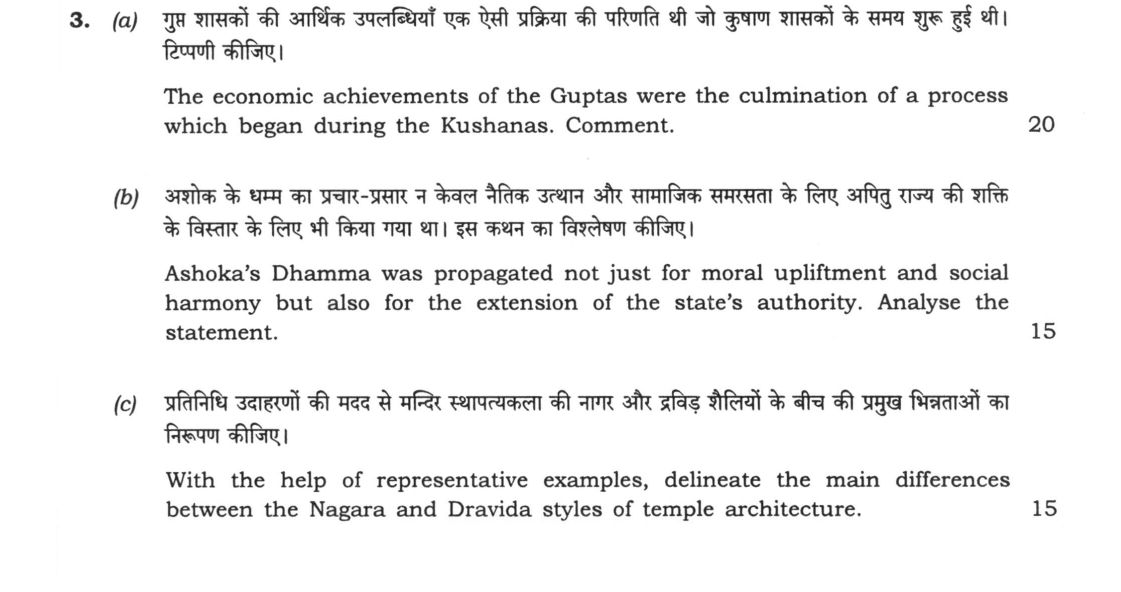
(a) The economic achievements of the Guptas were the culmination of a process which began during the Kushanas. Comment. (20…
The economic achievements of the Guptas were the culmination of a process which began during the Kushanas. Comment. 20 marks
Ashoka's Dhamma was propagated not just for moral upliftment and social harmony but also for the extension of the state's authority. Analyse the statement. 15 marks
With the help of representative examples, delineate the main differences between the Nagara and Dravida styles of temple architecture. 15 marks
हिंदी में प्रश्न पढ़ें
गुप्त शासकों की आर्थिक उपलब्धियाँ एक ऐसी प्रक्रिया की परिणति थी जो कुषाण शासकों के समय शुरू हुई थी। टिप्पणी कीजिए। (20 अंक)
अशोक के धम्म का प्रचार-प्रसार न केवल नैतिक उत्थान और सामाजिक समरसता के लिए अपितु राज्य की शक्ति के विस्तार के लिए भी किया गया था। इस कथन का विश्लेषण कीजिए। (15 अंक)
प्रतिनिधि उदाहरणों की मदद से मन्दिर स्थापत्यकला की नागर और द्रविड़ शैलियों के बीच की प्रमुख भिन्नताओं का निरूपण कीजिए। (15 अंक)
Model answer
Written by UPSC Answer Check against this question's marking rubric, to the expected length. UPSC does not publish answers for Mains — this is one way to score well, not an official key.
Kushana–Gupta economy The Gupta economic achievements were not an abrupt invention but the culmination of a cumulative Kushana process. The Kushanas introduced a gold dinara, linked the Gangetic basin to Silk Route and Roman contact, and encouraged urbanization patterns and agrarian expansion. The Guptas refined this: their coinage became more standardized, external trade reached a high point, guilds (shrenis) organized craft and commerce, and land grants tied revenue to local elites. Yet the “culmination” thesis is qualified by regional diversification and debates over urban decline; as D.D. Kosambi, R.S. Sharma and B.D. Chattopadhyaya show in their readings of economic transitions, continuity coexisted with change, with Gupta land grants marking a shift toward agrarian surplus and localised authority rather than a simple peak.
Ashoka’s Dhamma Ashoka’s Dhamma was both a moral-ethical project and a political instrument. Its content—ahimsa, tolerance, social responsibility, and welfare measures such as medical facilities, tree planting—sought harmony and social cohesion. Yet it also extended state authority: dhamma-mahamattas administered moral and bureaucratic duties, rock and pillar edicts served as territorial markers, and the message integrated diverse populations across an expanding empire. This created tension between universalist ethics and state consolidation. Romila Thapar stresses its instrumental role in legitimising Maurya rule, while Upinder Singh emphasises Ashoka’s genuine ethical commitment; the analytical point is that moral language became a medium of governance.
Nagara and Dravida temples Nagara and Dravida styles differ in plan, massing and patronage. Nagara temples, in Adam Hardy’s architectural taxonomy, have a square garbhagriha, vertical emphasis and generally no enclosing walls; their types are Latina, with a curvilinear shikhara, Phamsana, with a stepped pyramidal roof, and Valabhi, with a barrel-vaulted roof. Examples are Kandariya Mahadeva at Khajuraho, Lingaraja at Bhubaneswar and the Sun Temple at Modhera. Dravida temples have a pyramidal vimana, multiple prakaras, gopurams and horizontal emphasis, as at Brihadesvara at Tanjore, Gangaikondacholapuram and the Meenakshi complex, with later Vijayanagara synthesis. The economic surplus generated by Kushana-Gupta trade and agrarian expansion, together with Ashokan ideological consolidation, underwrote temple endowments. Patronage also differs: Nagara building was often royal, linked to Gupta and later courtly culture, while Dravida complexes drew broader mercantile and sectarian support, as Burton Stein’s temple-centred polity suggests.
Thus, the analytical synthesis is that Kushana-Gupta state formation, Ashokan ideological legitimation and cultural patronage were complementary dimensions of early Indian political development: economy, authority and culture reinforced one another.
What "Analyse" is asking you to do
Break the subject into its working parts and show how they act on each other. The marks are in the interconnections — which factor drives which, and what the resulting structure explains — not in the inventory of factors.
Structure that answers it
Define the whole → separate it into its parts → show which part drives which → what that interaction produces → what the structure implies
Where marks are lost
A flat list of causes with no account of which drives which. An answer of neatly separated headings, each self-contained, scores as description.
How this answer will be evaluated
Approach
Framework: UPSC History Paper 1. (a) comment: context > arguments both sides > judgment > close | (b) analyse: intro > causes > effects > stakeholders/linkages > way forward | (c) compare: paired headings or table > key differences > significance > conclusion Full marks: Precise, evidence-based analysis with historiographical depth and specific citations.
Key points expected
- Identify specific Kushana economic foundations (e.g., trade routes, coinage)
- Detail Gupta developments (e.g., land grants, urbanization, trade)
- Provide a balanced judgment on the 'culmination' claim
- Cite specific inscriptions or archaeological evidence
- Explain the moral/social aspects of Dhamma (e.g., non-violence)
- Analyze how Dhamma extended state authority (e.g., Dhamma Mahamatras)
- Link Dhamma to the consolidation of the Mauryan empire
- Reference the Rock Edicts or Pillar Edicts
Evaluation rubric
Each sub-part is marked on its own, against the marks and word limit printed on the paper.
- (a) Contextualize Gupta economy as a culmination of Kushana-era processes. 20 marks
comment— context → arguments both sides → judgment → close
Must cover
- Identify specific Kushana economic foundations (e.g., trade routes, coinage)
- Detail Gupta developments (e.g., land grants, urbanization, trade)
- Provide a balanced judgment on the 'culmination' claim
- Cite specific inscriptions or archaeological evidence
Loses marks
- Narrative retelling of Gupta history without analysis
- Ignoring the Kushana context entirely
- Lack of specific evidence for economic claims
Earns more
- Mention of the 'Gupta Golden Age' historiographical debate
- Reference to specific trade goods or partners (e.g., Rome, China)
- Discussion of the shift from state to private land ownership
Extra mark
- Citation of a specific historian (e.g., Romila Thapar, R.C. Majumdar)
- Reference to a specific inscription (e.g., Allahabad Pillar)
- (b) Examine the dual role of Ashoka's Dhamma in moral and state authority. 15 marks
analyse— intro → causes → effects → stakeholders/linkages → way forward
Must cover
- Explain the moral/social aspects of Dhamma (e.g., non-violence)
- Analyze how Dhamma extended state authority (e.g., Dhamma Mahamatras)
- Link Dhamma to the consolidation of the Mauryan empire
- Reference the Rock Edicts or Pillar Edicts
Loses marks
- Treating Dhamma only as a religious concept
- Ignoring the political dimension of the statement
- Generalities without specific edict references
Earns more
- Discussion of the 'Dhamma' as a tool of soft power
- Mention of the shift from military to moral conquest
- Comparison with pre-Ashoka Mauryan policies
Extra mark
- Quotation from a specific Rock Edict
- Reference to the Kalinga War as a turning point
- (c) Delineate differences between Nagara and Dravida temple styles with examples. 15 marks
compare— paired headings or table → key differences → significance → conclusion
Must cover
- Identify key structural differences (e.g., shikhara vs vimana)
- Provide representative examples for both styles
- Discuss regional/geographical distribution
- Mention specific architectural features (e.g., gopuram, mandapa)
Loses marks
- Confusing features of the two styles
- Lack of specific examples
- Descriptive listing without comparative analysis
Earns more
- Comparison of sculptural styles
- Mention of specific temples (e.g., Khajuraho, Brihadeeswara)
- Discussion of the evolution of these styles
Extra mark
- Reference to the 'Vastu Shastra' principles
- Mention of specific dynasties (e.g., Chola, Rashtrakuta)
Practice this exact question
Write your answer and it is marked point by point against the model answer above — what you covered, what you missed, what you got wrong.
Evaluate my answer →More from History 2022 Paper I
- Q1 Identify the following places marked on the map supplied to you and write a short note of…
- Q2 (a) The urban character of the Harappan Civilization was a result neither of any outside…
- Q3 (a) The economic achievements of the Guptas were the culmination of a process which began…
- Q4 (a) Evaluate the importance of tripartite struggle for the domination over North India du…
- Q5 Answer the following questions in about 150 words each: (a) What were 'Brahmadeya' grants…
- Q6 (a) The market regulations of Ala-ud-din Khilji were useful for the Sultan's military mig…