Paper I — Q8
(a) Trade and commerce in the Mughal Empire brought about the integration of the Indian subcontinent into a single market…
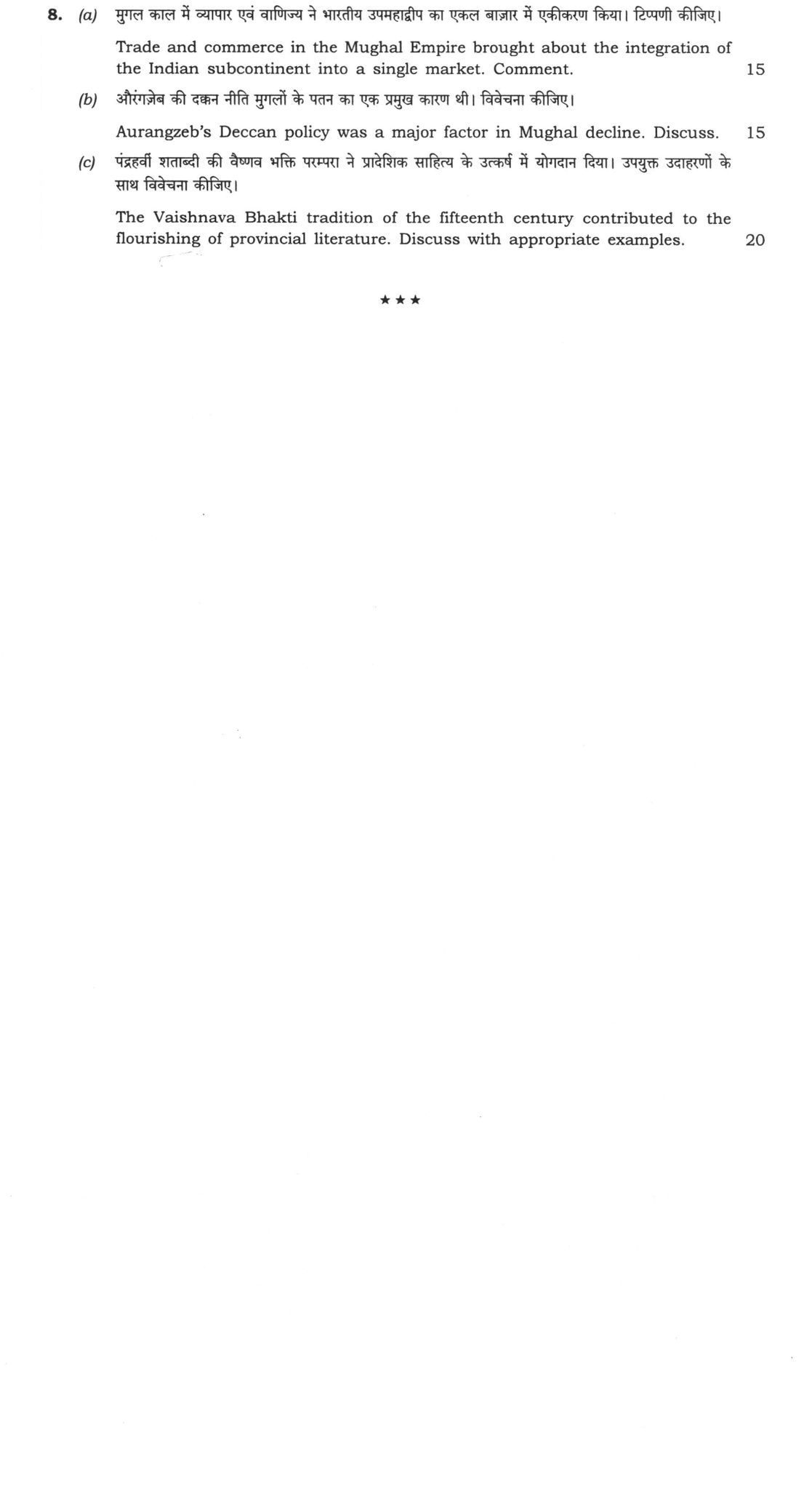
Trade and commerce in the Mughal Empire brought about the integration of the Indian subcontinent into a single market. Comment. 15 marks
Aurangzeb's Deccan policy was a major factor in Mughal decline. Discuss. 15 marks
The Vaishnava Bhakti tradition of the fifteenth century contributed to the flourishing of provincial literature. Discuss with appropriate examples. 20 marks
हिंदी में प्रश्न पढ़ें
मुगल काल में व्यापार एवं वाणिज्य ने भारतीय उपमहाद्वीप का एकल बाजार में एकीकरण किया। टिप्पणी कीजिए। (15 अंक)
औरंगजेब की दक्कन नीति मुगलों के पतन का एक प्रमुख कारण थी। विवेचना कीजिए। (15 अंक)
पंद्रहवीं शताब्दी की वैष्णव भक्ति परंपरा ने प्रादेशिक साहित्य के उत्कर्ष में योगदान दिया। उपयुक्त उदाहरणों के साथ विवेचना कीजिए। (20 अंक)
Model answer
Written by UPSC Answer Check against this question's marking rubric, to the expected length. UPSC does not publish answers for Mains — this is one way to score well, not an official key.
Mughal Trade and Market Integration The Mughal state stimulated commercial integration through currency standardisation—the high-purity silver rupee and copper dam established under Sher Shah and Akbar—and cash revenue extraction under the zabt and jagirdari systems, which compelled agrarian monetization. An extensive financial network run by sarrafs (money-changers), using hundis (bills of exchange), enabled seamless credit and remittance flows across distant regions. Inter-regional trade connected peripheral production zones to the imperial core: Bengal supplied raw silk, cotton, and grain to North India; Gujarat routed fine textiles to Delhi and Agra; and the Coromandel coast channeled calicoes via Masulipatnam. European trading enterprises (Portuguese, Dutch, English) further integrated domestic manufactures with trans-oceanic markets, deepening regional economic specialization. However, high overland transport costs, regional tolls (rahdari), and localized rural subsistence meant this constituted an articulated network of interdependent regional economies rather than a completely unified "single market."
Aurangzeb’s Deccan Policy and Imperial Decline Aurangzeb’s Deccan enterprise spanned direct military intervention, the annexation of Bijapur (1686) and Golconda (1687), and protracted warfare against Maratha resistance under Shivaji, Sambhaji, Rajaram, and Tarabai. This prolonged entanglement created an unsustainable military-fiscal drain—J.F. Richards estimates the campaigns consumed four-fifths of imperial resources—and precipitated a structural jagirdari crisis (be-jagiri), as the massive influx of Deccani nobles (khanazads) diluted imperial resources and exacerbated noble factionalism.
Historians debate whether this was the decisive factor in Mughal collapse. While early historiography (J.N. Sarkar) regarded the "Deccan ulcer" as primary, structural analyses present a wider matrix of decline: Satish Chandra identifies deep-seated crises within the tripartite jagirdari framework, Irfan Habib highlights widespread agrarian revolts against excessive surplus extraction, and M. Athar Ali stresses administrative overextension, compounded by Jat, Satnami, and Sikh rebellions and succession instability. The Deccan policy thus acted as a fatal accelerator of pre-existing systemic vulnerabilities rather than an isolated cause.
Vaishnava Bhakti and Provincial Literature Fifteenth-century Vaishnava Bhakti transformed regional dialects into vibrant literary languages by replacing Sanskrit elitism with direct, personal devotion (bhakti). This democratisation generated canonical vernacular compositions:
- Assamese: Sankardev popularized devotional drama and songs through Borgeets and Ankiya Nat.
- Bengali: Chaitanya’s movement inspired biographical and lyrical texts, notably Krishnadas Kaviraj’s Chaitanya Charitamrita.
- Braj Bhasha and Awadhi: Surdas and the Ashtachhap poets composed in Braj, while Tulsidas cast the Ramcharitmanas into Awadhi.
- Rajasthani: Mirabai’s padas expressed emotional mysticism in local dialects.
Mechanisms fueling this literary expansion included performative rituals (kirtans, ras lila, and padavali recitations) that required vernacular intelligibility, manuscript copying and circulation through monastic networks (sattras and mathas), and regional royal patronage, such as that of Gajapati Prataparudra in Odisha and Kachari and Ahom rulers in Assam. Thematically, Vaishnava literature pivoted on intense personal devotion, Radha-Krishna narratives, and casteless social inclusivity. Unlike the esoteric asceticism of the Nathpanthis or the allegorical romance of contemporary Sufi premakhyans, Vaishnava poetry embedded itself directly in provincial daily idioms.
Conclusion These developments illustrate the dynamic balance between centripetal and centrifugal forces in pre-colonial India: fiscal-monetary policies fostered pan-subcontinental market links, imperial overreach in the Deccan triggered political fragmentation, and provincial Vaishnava Bhakti traditions constructed durable regional cultural identities that outlasted imperial structures.
What "Discuss" is asking you to do
Lay the issue out from more than one side — how it arose, what is claimed for it, what is held against it, and where it now stands. UPSC attaches discuss to broad topics with several live dimensions, so coverage of the dimensions earns more than the strength of your opinion.
Structure that answers it
Set the issue up → the case as it is made → the case against → the dimension both sides leave out → where the balance now lies
Where marks are lost
Listing facts with no thread between them, or arguing one side throughout and calling it a discussion.
How this answer will be evaluated
Approach
Framework: Context > Thesis > Evidence > Historiography. (a) comment: context > arguments both sides > judgment > close | (b) discuss: intro > 3-4 dimensions > example > balanced close | (c) discuss: intro > 3-4 dimensions > example > balanced close Full marks: Argues a thesis, cites specific sources/historians, and provides a balanced judgment.
Key points expected
- Contextualize Mughal trade and commerce
- Arguments supporting single market integration
- Arguments against or limits of integration
- Balanced judgment on the extent of integration
- Intro to Aurangzeb's Deccan policy
- 3-4 dimensions of the policy (military, fiscal, political)
- Specific examples of Deccan campaigns
- Balanced close on its role in decline
Evaluation rubric
Each sub-part is marked on its own, against the marks and word limit printed on the paper.
- (a) Contextualize Mughal trade and judge the extent of subcontinental market integration. 15 marks
comment— context → arguments both sides → judgment → close
Must cover
- Contextualize Mughal trade and commerce
- Arguments supporting single market integration
- Arguments against or limits of integration
- Balanced judgment on the extent of integration
Loses marks
- Chronology without analysis
- Textbook retelling of trade
- Ignoring the 'single market' claim
Earns more
- Cite specific trade routes or commodities
- Reference to historiographical debate on Mughal economy
- Mention of specific Mughal policies (e.g., Chauth, Sirdar)
- Reference to specific regions (e.g., Bengal, Gujarat)
Extra mark
- Named historian (e.g., Irfan Habib, R.I. Tembe)
- Specific source quotation (e.g., Ain-i-Akbari)
- (b) Analyze Aurangzeb's Deccan policy as a factor in Mughal decline across multiple dimensions. 15 marks
discuss— intro → 3-4 dimensions → example → balanced close
Must cover
- Intro to Aurangzeb's Deccan policy
- 3-4 dimensions of the policy (military, fiscal, political)
- Specific examples of Deccan campaigns
- Balanced close on its role in decline
Loses marks
- Chronology without analysis
- Textbook retelling of battles
- Ignoring the 'major factor' claim
Earns more
- Reference to specific battles (e.g., Golconda, Bijapur)
- Mention of fiscal drain on the empire
- Reference to Maratha resistance (e.g., Shivaji)
- Historiographical perspective on the 'Deccan Abyss'
Extra mark
- Named historian (e.g., Satish Chandra, Jadunath Sarkar)
- Specific source quotation (e.g., Mughal chronicles)
- (c) Explain how 15th-century Vaishnava Bhakti contributed to provincial literature with examples. 20 marks
discuss— intro → 3-4 dimensions → example → balanced close
Must cover
- Intro to 15th-century Vaishnava Bhakti
- 3-4 dimensions of contribution to literature
- Specific examples of provincial literature
- Balanced close on the flourishing of literature
Loses marks
- Chronology without analysis
- Textbook retelling of Bhakti movement
- Ignoring the 'provincial literature' focus
Earns more
- Reference to specific poets (e.g., Kabir, Tulsidas, Surdas)
- Mention of specific languages (e.g., Hindi, Bengali, Marathi)
- Reference to specific texts (e.g., Ramcharitmanas, Panchatantra)
- Historiographical perspective on Bhakti movement
Extra mark
- Named historian (e.g., Romila Thapar, R.C. Majumdar)
- Specific source quotation (e.g., from a Bhakti text)
Practice this exact question
Write your answer and it is marked point by point against the model answer above — what you covered, what you missed, what you got wrong.
Evaluate my answer →More from History 2022 Paper I
- Q5 Answer the following questions in about 150 words each: (a) What were 'Brahmadeya' grants…
- Q6 (a) The market regulations of Ala-ud-din Khilji were useful for the Sultan's military mig…
- Q7 (a) The Virashaiva Movement of Southern Deccan in the twelfth century was essentially an…
- Q8 (a) Trade and commerce in the Mughal Empire brought about the integration of the Indian s…