Paper II — Q1
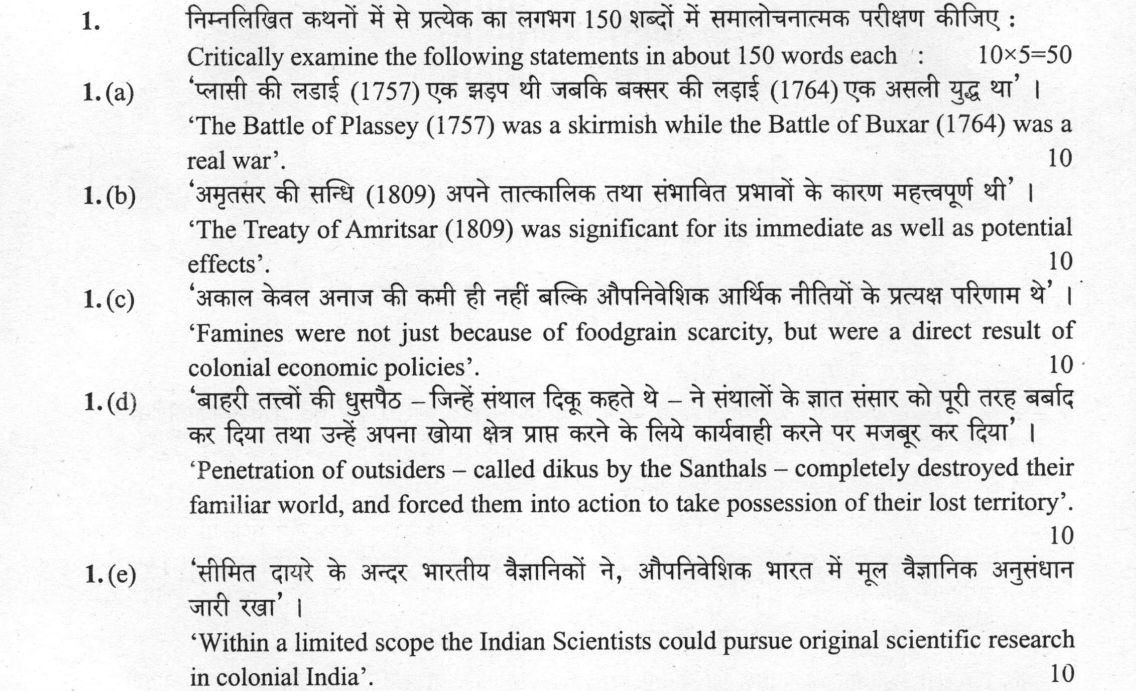
Critically examine the following statements in about 150 words each: (a) 'The Battle of Plassey (1757) was a skirmish while the…
Critically examine the following statements in about 150 words each: 'The Battle of Plassey (1757) was a skirmish while the Battle of Buxar (1764) was a real war'. 10 marks
'The Treaty of Amritsar (1809) was significant for its immediate as well as potential effects'. 10 marks
'Famines were not just because of foodgrain scarcity, but were a direct result of colonial economic policies'. 10 marks
'Penetration of outsiders – called dikus by the Santhals – completely destroyed their familiar world, and forced them into action to take possession of their lost territory'. 10 marks
'Within a limited scope the Indian Scientists could pursue original scientific research in colonial India'. 10 marks
हिंदी में प्रश्न पढ़ें
निम्नलिखित कथनों में से प्रत्येक का लगभग 150 शब्दों में समालोचनात्मक परीक्षण कीजिए : 'प्लासी की लड़ाई (1757) एक झड़प थी जबकि बक्सर की लड़ाई (1764) एक असली युद्ध था' । (10 अंक)
'अमृतसर की संधि (1809) अपने तात्कालिक तथा संभावित प्रभावों के कारण महत्वपूर्ण थी' । (10 अंक)
'अकाल केवल अनाज की कमी ही नहीं बल्कि औपनिवेशिक आर्थिक नीतियों के प्रत्यक्ष परिणाम थे' । (10 अंक)
'बाहरी तत्वों की धुसपैट – जिन्हें संथाल दिकु कहते थे – ने संथालों के जात संसार को पूरी तरह बर्बाद कर दिया तथा उन्हें अपना खोया क्षेत्र प्राप्त करने के लिए कार्यवाही करने पर मजबूर कर दिया' । (10 अंक)
'सीमित दायरे के अंदर भारतीय वैज्ञानिकों ने, औपनिवेशिक भारत में मूल वैज्ञानिक अनुसंधान जारी रखा' । (10 अंक)
Model answer
Written by UPSC Answer Check against this question's marking rubric, to the 150-word length. UPSC does not publish answers for Mains — this is one way to score well, not an official key.
(a) The Battle of Plassey (1757) and Battle of Buxar (1764)
The Battle of Plassey was militarily little more than a skirmish. Robert Clive commanded roughly 3,000 troops against Siraj-ud-Daulah’s massive army, yet victory was achieved through court intrigue and the premeditated betrayal of Mir Jafar and Rai Durlabh rather than tactical superiority. Actual fighting lasted only a few hours with minimal casualties.
Conversely, the Battle of Buxar was a fiercely contested, full-scale military confrontation. Major Hector Munro faced a formidable confederacy of Mughal Emperor Shah Alam II, Nawab Shuja-ud-Daula of Awadh, and Mir Qasim, commanding over 40,000 troops. Unlike Plassey, Buxar was won through British military discipline and field artillery. While Plassey placed a puppet on the throne and gave the English East India Company a political foothold, Buxar broke the back of northern Indian imperial power. It culminated in the Treaty of Allahabad (1765), granting the Company the Diwani of Bengal, Bihar, and Orissa, thereby converting a commercial entity into a sovereign territorial power.
(b) The Treaty of Amritsar (1809)
The Treaty of Amritsar between Maharaja Ranjit Singh and Charles Metcalfe carried profound geopolitical consequences. Immediately, it established the River Sutlej as the formal boundary between the Sikh Empire and British India, effectively ending Ranjit Singh’s ambitions to absorb the Cis-Sutlej states (such as Patiala, Nabha, and Jind), which were taken under British protection.
Its potential and long-term effects were far more significant. Deprived of eastward expansion, Ranjit Singh redirected his military energies northward and westward, conquering Multan, Kashmir, and Peshawar, thereby creating a formidable buffer against Afghan incursions. For the British, the treaty secured a stable, friendly northwestern frontier amidst the looming threat of Napoleonic expansion, while avoiding an expensive conflict with the Khalsa army. It laid the foundation for the British 'scientific frontier' doctrine and allowed the Company to consolidate power in central India. Following Ranjit Singh’s death, this established boundary served as the springboard for the eventual British annexation of Punjab in 1849.
(c) Famines and Colonial Economic Policies
While environmental triggers like monsoon failures precipitated crop shortages, the catastrophic scale of famines in colonial India was fundamentally manufactured by imperial economic policies. The rigid, exorbitant revenue demands under the Ryotwari and Mahalwari settlements stripped the peasantry of customary grain reserves and forced them into chronic indebtedness.
Furthermore, the forced commercialization of agriculture replaced subsistence foodgrains with cash crops like indigo, opium, and cotton. Colonial transport infrastructure, particularly railways, operated as suction pumps to evacuate grains from drought-hit rural hinterlands to metropolitan ports for export, even during peak starvation, guided by rigid laissez-faire orthodoxy. Disastrous famines—including the Great Famine of 1876–78, 1896–97, and the Bengal Famine of 1943—exposed what the Strachey and Woodhead Commissions indirectly revealed: famines were crises of food entitlement and purchasing power, directly engineered by colonial drainage of wealth and market distortion, rather than mere physical shortages.
(d) Santhal Hul (1855) and the 'Dikus'
The Santhal Hul was a radical, armed resistance against the systemic breakdown of tribal life caused by the penetration of 'dikus'—outsider moneylenders (mahajans), traders, revenue collectors, and colonial police into the Damin-i-Koh tract. Santhals, who had cleared the dense Rajmahal forests to establish settled agriculture, found themselves ensnared in usurious debt traps, facing interest rates often exceeding 100 percent.
This economic subjugation led to widespread land alienation, bonded labour (kamioti), and the subversion of traditional village headmanship (the Manjhi system) alongside the loss of customary forest rights. Under the leadership of brothers Sidhu and Kanhu Murmu in 1855, the rebellion transcended mere economic protest. Mobilizing tens of thousands with divine legitimization, the Santhals took up arms not merely for debt relief, but to violently expel the dikus, dismantle colonial administration, and reclaim sovereign possession of their lost ancestral territory through the establishment of Santhal Raj.
(e) Indian Scientists in Colonial India
Scientific research in colonial India operated within severe institutional constraints. The colonial scientific establishment prioritized exploitative, descriptive surveys—such as the Geological and Botanical Surveys—over foundational basic science, while subjecting Indian scholars to racial discrimination in appointments, poor laboratory funding, and exclusion from higher cadres of the Imperial Services.
Despite this institutional confinement, Indian scientists demonstrated extraordinary intellectual autonomy and produced ground-breaking basic research. J.C. Bose pioneered millimeter-wave microwave optics and plant physiology, inventing the crescograph. C.V. Raman, working at the Indian Association for the Cultivation of Science, discovered the Raman Effect, winning the 1930 Nobel Prize. P.C. Ray founded modern Indian chemical research and Bengal Chemicals, while S.N. Bose formulated the Bose-Einstein statistics. Rather than being passive recipients of metropolitan knowledge, these scientists established self-reliant indigenous research traditions and world-class scientific institutions within the narrow spaces permitted by colonial rule.
What "Critically examine" is asking you to do
Test the proposition the question puts to you and return a finding on how far it holds. Examine stems carry a claim, or ask whether something has happened, and expect evidence weighed both ways before the extent is stated — often with remedial measures attached. “Critically” is not a section added at the end: name the yardstick you are judging by — the evidence, the stated objective, a constitutional principle, a rival explanation — and let a verdict close each part of the body. Where the question quotes a claim, that verdict must land on the claim itself, accepted, qualified or rejected, and not on the theme in general.
Structure that answers it
Restate the claim as the question frames it → evidence that supports it → evidence that undercuts it → the conditions under which it holds → verdict on how far it stands
Where marks are lost
Merits in one paragraph, demerits in the next, and a conclusion calling for a balanced and holistic approach. That is a survey with the judgement left out and it holds the answer in the middle band. The opposite error is reading “critically” as permission to attack — and with the odd pairings, critically describe or critically explain, the exposition still carries most of the marks, the judgement being a layer on it rather than a substitute for it.
How this answer will be evaluated
Approach
Framework: Critical Examination (Context > Thesis > Evidence > Historiography). (a) examine: intro > how/why with reasoning > evidence > conclusion | (b) examine: intro > how/why with reasoning > evidence > conclusion | (c) examine: intro > how/why with reasoning > evidence > conclusion | (d) examine: intro > how/why with reasoning > evidence > conclusion | (e) examine: intro > how/why with reasoning > evidence > conclusion Full marks: Clear thesis, strong evidence, historiographical awareness, precise terminology.
Key points expected
- Plassey: Skirmish vs. Buxar: Real War
- Amritsar: Immediate (Punjab) vs. Potential (Frontier)
- Famines: Policy (Tax, Cash Crops) vs. Nature
- Santhals: Dikus (Exploitation) vs. Hul (Rebellion)
- Scientists: Limited Scope (Colonial Constraints) vs. Original Research
Evaluation rubric
Each sub-part is marked on its own, against the marks and word limit printed on the paper.
- (a) Contrast the tactical nature of Plassey with the strategic consolidation of Buxar. 10 marks · 150 words
examine— intro → how/why with reasoning → evidence → conclusion
Must cover
- Plassey as a skirmish (Mir Jafar's betrayal)
- Buxar as a real war (defeat of combined forces)
- Treaty of Allahabad (1765) as the outcome of Buxar
- Diwani rights vs. mere territorial gain
Loses marks
- Narrating events without comparing their significance
- Ignoring the political outcome of Buxar
Earns more
- Mention of Robert Clive's role
- Reference to the Nawab of Bengal's position
- Comparison of troop numbers or casualties
Extra mark
- Citation of a specific historian's view on the 'skirmish' label
- (b) Analyze the immediate territorial gains and the long-term strategic implications of the treaty. 10 marks · 150 words
examine— intro → how/why with reasoning → evidence → conclusion
Must cover
- Immediate effect: British control of Punjab
- Potential effect: Securing the north-western frontier
- Impact on Sikh political structure (Ranjit Singh)
- Strategic buffer against Afghan/Russian threats
Loses marks
- Treating it as a minor border adjustment
- Ignoring the 'potential' (long-term) effects
Earns more
- Mention of the Anglo-Sikh War context
- Reference to the role of the British Resident
- Discussion of the 'subsidiary alliance' model
Extra mark
- Specific clause of the treaty cited
- (c) Argue that colonial economic policies, not just weather, caused the famines. 10 marks · 150 words
examine— intro → how/why with reasoning → evidence → conclusion
Must cover
- Commercialization of agriculture (cash crops)
- Drain of wealth / high taxation
- Destruction of traditional irrigation systems
- Colonial response (or lack thereof) during crises
Loses marks
- Blaming only natural causes (drought/flood)
- Failing to link policy to food scarcity
Earns more
- Reference to the Bengal Famine of 1770
- Mention of the 'Black Hole' or specific policies
- Citing M. M. Lall or similar historian
Extra mark
- Specific statistic on mortality or tax rates
- (d) Explain how the 'dikus' (outsiders) disrupted the Santhal socio-economic world, triggering the rebellion. 10 marks · 150 words
examine— intro → how/why with reasoning → evidence → conclusion
Must cover
- Definition of 'dikus' (moneylenders, zamindars, British)
- Loss of land and traditional rights
- Economic exploitation (usury, forced labor)
- Santhal response (Hul of 1855-56)
Loses marks
- Treating it as a simple banditry issue
- Ignoring the 'familiar world' aspect
Earns more
- Mention of specific Santhal leaders (Sidhu, Kanhu)
- Reference to the 'Bhumidhari' system
- Discussion of the 'diku' concept in Santhal culture
Extra mark
- Specific quote from Santhal oral tradition
- (e) Evaluate the extent to which Indian scientists could conduct original research under colonial constraints. 10 marks · 150 words
examine— intro → how/why with reasoning → evidence → conclusion
Must cover
- Colonial restrictions on scientific funding
- Role of Indian scientists in colonial projects
- Examples of original research (e.g., Raman Effect)
- Institutional barriers (universities, labs)
Loses marks
- Ignoring the 'limited scope' constraint
- Overstating the freedom of Indian scientists
Earns more
- Mention of C. V. Raman or Jagadish Chandra Bose
- Reference to the Indian Association for the Cultivation of Science
- Discussion of the 'limited scope' (applied vs. basic)
Extra mark
- Specific example of a colonial-funded project
Practice this exact question
Write your answer and it is marked point by point against the model answer above — what you covered, what you missed, what you got wrong.
Evaluate my answer →More from History 2022 Paper II
- Q1 Critically examine the following statements in about 150 words each: (a) 'The Battle of P…
- Q2 (a) Explain how the Permanent Settlement initiated a rule of property in Bengal and what…
- Q3 (a) Do you think that the Indian National Movement was a 'multi class movement' which rep…
- Q4 (a) Discuss the policies and programmes of the early nationalists (moderates). To what ex…