Paper II — Q7
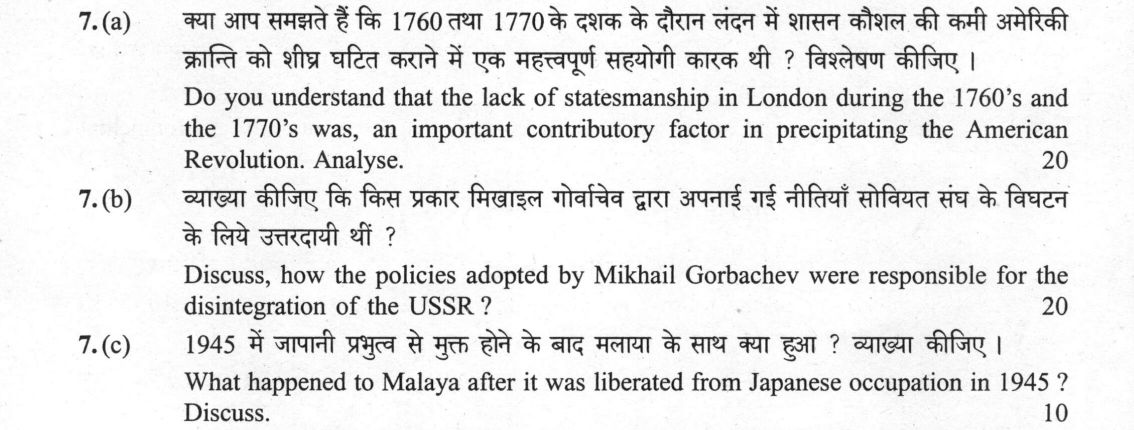
(a) Do you understand that the lack of statesmanship in London during the 1760's and the 1770's was, an important contributory…
Do you understand that the lack of statesmanship in London during the 1760's and the 1770's was, an important contributory factor in precipitating the American Revolution. Analyse. 20 marks
Discuss, how the policies adopted by Mikhail Gorbachev were responsible for the disintegration of the USSR ? 20 marks
What happened to Malaya after it was liberated from Japanese occupation in 1945 ? Discuss. 10 marks
हिंदी में प्रश्न पढ़ें
क्या आप समझते हैं कि 1760 तथा 1770 के दशक के दौरान लंदन में शासन कौशल की कमी अमेरिकी क्रांति को शीघ्र घटित कराने में एक महत्त्वपूर्ण सहयोगी कारक थी ? विश्लेषण कीजिए । (20 अंक)
व्याख्या कीजिए कि किस प्रकार मिखाइल गोर्बाचेव द्वारा अपनाई गई नीतियाँ सोवियत संघ के विघटन के लिये उत्तरदायी थीं ? (20 अंक)
1945 में जापानी प्रभुत्व से मुक्त होने के बाद मलाया के साथ क्या हुआ ? व्याख्या कीजिए । (10 अंक)
Model answer
Written by UPSC Answer Check against this question's marking rubric, to the expected length. UPSC does not publish answers for Mains — this is one way to score well, not an official key.
American Revolution. The Revolution was not caused by one grievance but by London’s failure to govern an Atlantic empire flexibly. Under Walpole, salutary neglect had let colonial assemblies develop self-government. After the Seven Years’ War, post-war finance and imperial anxiety produced sharper assertiveness. The Stamp Act 1765, introduced under the Grenville ministry, taxed internal colonial transactions and provoked “no taxation without representation.” Its repeal showed London could yield, but the Declaratory Act preserved Parliament’s claim to legislate, leaving the constitutional question unresolved. The Townshend Acts 1767, shaped by Townshend as Chancellor of the Exchequer under Chatham and later Grafton, imposed import duties and reinforced customs control, while the Coercive Acts 1774, under the North ministry, punished Massachusetts after the Boston Tea Party and closed Boston’s port. These measures signalled that colonial elites could be governed without consent. The statesmanship deficit lay in confusing sovereignty with domination. London rejected conciliatory proposals associated with Chatham and Burke, who argued for restoring trust through recognition of colonial rights, and mishandled the Boston Tea Party by treating protest as rebellion. Inflexible policy radicalised moderate merchants; radicalisation forced harsher coercion; coercion made reconciliation impossible. Thus the lack of statesmanship was an important contributory factor, though not the sole cause, because it converted economic and constitutional disputes into revolution.
Gorbachev and the USSR. Gorbachev’s reforms transformed a managed system into one that could no longer contain its contradictions. Perestroika sought economic restructuring through limited market incentives and decentralisation, but failed to deliver growth, exposed shortages and created uncertainty. Glasnost opened political discussion and released suppressed national grievances in the Baltic states, Ukraine, Georgia and the Caucasus. Demokratizatsiya, including multi-candidate elections and weakening the CPSU monopoly, undermined the party’s capacity to coordinate the union. The Sinatra Doctrine, abandoning the Brezhnev Doctrine, allowed Eastern European states to choose their own paths and removed the threat of Soviet intervention that had held the bloc together. Poland’s round-table transition, Hungary’s opening and the fall of the Berlin Wall showed reform could not be reversed without legitimacy. The unintended consequences were decisive: the August 1991 coup discredited the old nomenklatura, accelerated Yeltsin’s rise and made the centre appear weak. Baltic independence declarations in 1990–91, followed by other republics, turned constitutional reform into secession. Unlike the Chinese Communist Party, which suppressed the 1989 Tiananmen protests and retained authoritarian control while pursuing economic reform, Gorbachev chose openness over coercion. That preserved political legitimacy in the short term but made disintegration probable.
Malaya after 1945. Liberation from Japanese occupation did not restore the pre-war order. The British Military Administration, 1945–46, struggled with shortages, labour unrest and the re-emergence of the Malayan Communist Party, which had fought the Japanese and now challenged British authority. The MCP’s armed resistance, especially after the killing of British police in 1948, led to the declaration of a state of emergency. The Briggs Plan, with its “long dike” strategy, resettled rural populations into new villages, cut off guerrilla support, and combined military operations with political and economic measures. The emergency weakened the MCP but deepened communal tensions and exposed the limits of colonial rule. The path to Merdeka in 1957 was therefore a negotiated settlement: Britain conceded independence to a Malay-led coalition while retaining security and economic interests. Across all three cases, imperial overreach met local mobilisation. In America, colonial elites used constitutional language; in the USSR, national parties and popular movements used Gorbachev’s openness; in Malaya, anti-colonial and communist forces forced transition. The lesson is that empires decline not only when weak, but when they fail to adapt governance to the political realities they create.
What "Analyse" is asking you to do
Break the subject into its working parts and show how they act on each other. The marks are in the interconnections — which factor drives which, and what the resulting structure explains — not in the inventory of factors.
Structure that answers it
Define the whole → separate it into its parts → show which part drives which → what that interaction produces → what the structure implies
Where marks are lost
A flat list of causes with no account of which drives which. An answer of neatly separated headings, each self-contained, scores as description.
How this answer will be evaluated
Approach
Framework: Context > Thesis > Evidence > Historiography. (a) analyse: intro > causes > effects > stakeholders/linkages > way forward | (b) discuss: intro > 3-4 dimensions > example > balanced close | (c) discuss: intro > 3-4 dimensions > example > balanced close Full marks: Clear thesis, specific evidence, strong causal links, historiographical awareness.
Key points expected
- Identify specific London policies (e.g., Stamp Act, Townshend Acts).
- Explain the failure of statesmanship in the 1760s-70s.
- Link these failures directly to the precipitating of the Revolution.
- Discuss the impact on colonial relations.
- Define Gorbachev's key policies (Perestroika, Glasnost).
- Explain the economic impact of Perestroika.
- Explain the political/social impact of Glasnost.
- Link these policies to the rise of nationalism and the USSR's collapse.
Evaluation rubric
Each sub-part is marked on its own, against the marks and word limit printed on the paper.
- (a) Analyse the causal link between London's lack of statesmanship and the American Revolution. 20 marks
analyse— intro → causes → effects → stakeholders/linkages → way forward
Must cover
- Identify specific London policies (e.g., Stamp Act, Townshend Acts).
- Explain the failure of statesmanship in the 1760s-70s.
- Link these failures directly to the precipitating of the Revolution.
- Discuss the impact on colonial relations.
Loses marks
- Narrating events without causal analysis.
- Focusing only on colonial grievances, ignoring London's role.
- Generalizing 'bad leadership' without specific examples.
Earns more
- Mention specific British ministers (e.g., Grafton, Rockingham).
- Reference colonial reactions (e.g., Sons of Liberty).
- Discuss the shift from petition to protest.
- Mention the role of the Stamp Act Congress.
Extra mark
- Quote a specific colonial resolution or letter.
- Name a specific historian's interpretation of the 'lack of statesmanship'.
- (b) Discuss how Gorbachev's policies led to the disintegration of the USSR. 20 marks
discuss— intro → 3-4 dimensions → example → balanced close
Must cover
- Define Gorbachev's key policies (Perestroika, Glasnost).
- Explain the economic impact of Perestroika.
- Explain the political/social impact of Glasnost.
- Link these policies to the rise of nationalism and the USSR's collapse.
Loses marks
- Listing policies without explaining their consequences.
- Ignoring the economic dimension of Perestroika.
- Attributing the collapse solely to external factors (e.g., Cold War).
Earns more
- Mention the 1990 economic crisis.
- Reference the 'New Thinking' in foreign policy.
- Discuss the role of the Baltic states' independence movements.
- Mention the August 1991 coup.
Extra mark
- Quote a specific Gorbachev speech or decree.
- Name a specific historian's view on the 'responsibility' of Gorbachev.
- (c) Discuss the events in Malaya after Japanese liberation in 1945. 10 marks
discuss— intro → 3-4 dimensions → example → balanced close
Must cover
- Describe the return of British authority in 1945.
- Explain the establishment of the Malayan Union (1946).
- Discuss the Malayan nationalist response (UMNO, MCA).
- Mention the transition to the Federation of Malaya (1948).
Loses marks
- Focusing only on the Japanese occupation, not the post-1945 period.
- Ignoring the political struggle for independence.
- Confusing the Malayan Union with the Federation of Malaya.
Earns more
- Reference the role of the Malayan People's Party.
- Mention the start of the Malayan Emergency (1948).
- Discuss the economic changes post-war.
- Reference the specific grievances against the Malayan Union.
Extra mark
- Quote a specific nationalist leader's statement.
- Name a specific historian's interpretation of the post-war period.
Practice this exact question
Write your answer and it is marked point by point against the model answer above — what you covered, what you missed, what you got wrong.
Evaluate my answer →More from History 2022 Paper II
- Q4 (a) Discuss the policies and programmes of the early nationalists (moderates). To what ex…
- Q5 Critically examine the following statements in about 150 words each: (a) 'Rousseau kindle…
- Q6 (a) Do you agree that the economic effects of the Industrial Revolution were to add enorm…
- Q7 (a) Do you understand that the lack of statesmanship in London during the 1760's and the…
- Q8 (a) Describe the launching of Non-Alignment Movement. Why the small nations wanted to rem…