Paper II — Q6
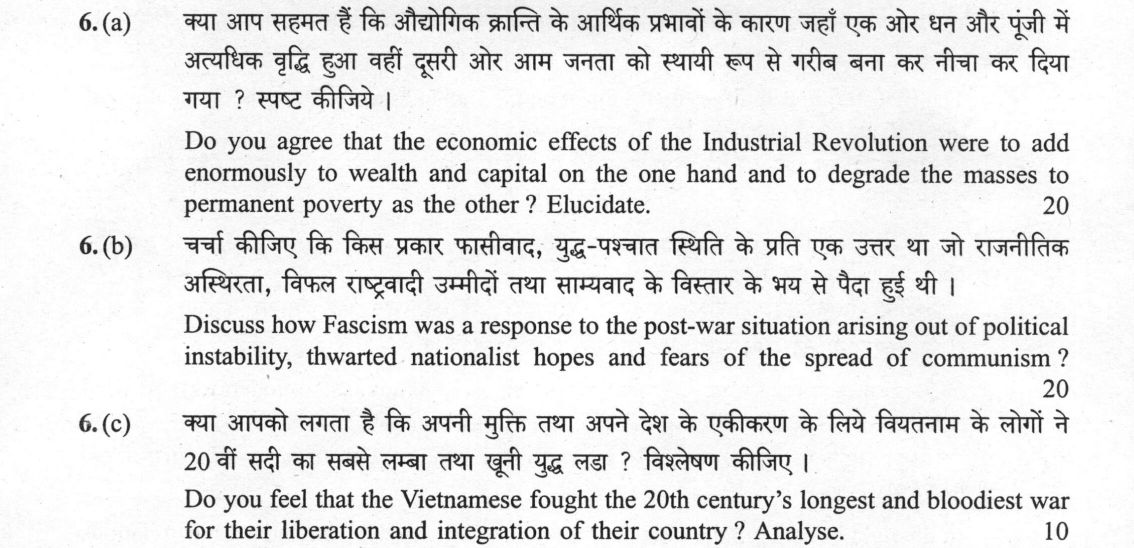
(a) Do you agree that the economic effects of the Industrial Revolution were to add enormously to wealth and capital on the one…
Do you agree that the economic effects of the Industrial Revolution were to add enormously to wealth and capital on the one hand and to degrade the masses to permanent poverty as the other ? Elucidate. 20 marks
Discuss how Fascism was a response to the post-war situation arising out of political instability, thwarted nationalist hopes and fears of the spread of communism ? 20 marks
Do you feel that the Vietnamese fought the 20th century's longest and bloodiest war for their liberation and integration of their country ? Analyse. 10 marks
हिंदी में प्रश्न पढ़ें
क्या आप सहमत हैं कि औद्योगिक क्रांति के आर्थिक प्रभावों के कारण जहाँ एक ओर धन और पूँजी में अत्यधिक वृद्धि हुआ वहीं दूसरी ओर आम जनता को स्थायी रूप से गरीब बना कर नीचा कर दिया गया ? स्पष्ट कीजिए । (20 अंक)
चर्चा कीजिए कि किस प्रकार फासीवाद, युद्ध-पश्चात् स्थिति के प्रति एक उत्तर था जो राजनीतिक अस्थिरता, विफल राष्ट्रवादी उम्मीदों तथा साम्यवाद के विस्तार के भय से पैदा हुई थी । (20 अंक)
क्या आपको लगता है कि अपनी मुक्ति तथा अपने देश के एकीकरण के लिये वियतनाम के लोगों ने 20 वीं सदी का सबसे लम्बा तथा खूनी युद्ध लड़ा ? विश्लेषण कीजिए । (10 अंक)
Model answer
Written by UPSC Answer Check against this question's marking rubric, to the expected length. UPSC does not publish answers for Mains — this is one way to score well, not an official key.
Industrial Revolution The statement is partly true: the Industrial Revolution created enormous wealth while producing severe misery for many workers. In Britain, mechanised cotton, iron and steam transport expanded output, profits and capital formation, raising GDP and strengthening the bourgeoisie. Enclosure and wage labour concentrated land and capital, while factory discipline, child labour and poor housing degraded conditions, as Engels’ Manchester and Chadwick’s 1842 report showed. Yet “permanent poverty” is too absolute. Real wages in 1790–1850 were uneven: they fell or stagnated for some labourers, but by mid-century many workers’ material standards improved, especially after 1850, as food prices fell and mass consumption grew. Optimists such as Clapham and Hartwell stress rising output, trade and living standards; pessimists such as Thompson and Hobsbawm stress exploitation, class formation and the “making of the working class”. Regionally, Britain’s lead was sharper than on the continent, where industrialisation was slower and often state-led. Luddite resistance and later trade unions, Chartism and labour movements show workers were not passive; their organisation helped secure factory legislation and political representation, turning distress into a more stable wage-labour society.
Fascism Fascism was a post-war reaction, not merely a dictatorship. The Treaty of Versailles thwarted nationalist hopes: Italy felt it had received a “mutilated victory” despite winning, while Germany’s defeat, reparations and territorial losses created revisionist rage. Weimar instability—hyperinflation, political violence and weak coalition governments—made liberal democracy seem fragile. In Spain, the 1923 pronunciamiento showed that authoritarian solutions could appear effective. Fear of communism was equally decisive. Italy’s Biennio Rosso, with factory occupations and strikes in 1919–20, and Germany’s Spartacist uprising in 1919, convinced elites, landowners and industrialists that revolutionary socialism threatened property and order. Fascism offered corporatism as a third way between liberal capitalism and class war, a state that disciplined labour while preserving capital. Charismatic leadership gave it momentum: Mussolini’s March on Rome in 1922 exploited elite fear, while Hitler moved from the failed Munich Putsch of 1923 to Chancellorship in 1933 by combining mass anti-Weimar resentment with elite support. Its nationalist revisionism—irredentism in Italy, Lebensraum in Germany—promised national regeneration through expansion. Thus fascism answered the post-war crisis by promising stability, national pride and anti-communism, sacrificing democracy.
Vietnam Calling the Vietnamese war the 20th century’s longest and bloodiest is defensible only as a single national struggle, not a global war. World War II was far bloodier worldwide, but the Vietnamese conflict, 1945–1975, lasted about thirty years and was among the century’s longest and most destructive wars for one country. It was not strictly uninterrupted: the First Indochina War ended at Dien Bien Phu and Geneva in 1954, after which fighting resumed in a different form from 1955/1959 onward. The phases were anti-colonial against France, then civil war and American intervention, accelerated by the Gulf of Tonkin resolution in 1964, ending with Saigon’s fall in 1975. Formal reunification came in 1976 with the establishment of the Socialist Republic of Vietnam, not under the old DRV name. The human cost was immense: about three million Vietnamese and 58,000 Americans died. It was primarily a liberation struggle against colonialism and neo-colonialism, but also shaped by communist ideology and Cold War rivalry; debates persist over whether nationalism or communism was stronger. Compared with Afghanistan and Iran-Iraq, Vietnam’s outcome was decisive: integration came through the unification process associated with the DRV and Viet Cong, formalized in 1976. In sum, industrial capitalism created wealth and misery, fascism exploited post-war fear, and Vietnam’s war shows liberation wars can be long, costly and decisive; together they show how capitalist transformation, extremist reaction and anti-colonial liberation shaped the twentieth century.
What "Elucidate" is asking you to do
Make a stated proposition plain and then prove it with instances. Elucidate stems almost always carry a claim or a named concept, and very often the words “with examples” or “with suitable diagrams” — the illustration is part of the directive, not decoration.
Structure that answers it
Plain-language statement of what the proposition means → the part that is obscure, resolved → first illustration → second illustration → why the proposition holds
Where marks are lost
Adding terminology; elucidate rewards removing it. The commoner loss is a clean explanation with no example, when the stem asked for examples.
How this answer will be evaluated
Approach
Framework: UPSC History Paper 2. (a) comment: context > arguments both sides > judgment > close | (b) discuss: intro > 3-4 dimensions > example > balanced close | (c) analyse: intro > causes > effects > stakeholders/linkages > way forward Full marks: Nuanced analysis with specific historical evidence and historiographical awareness.
Key points expected
- Contextualize the shift from agrarian to industrial economy
- Evidence of capital accumulation and rising GDP
- Evidence of urban squalor and wage stagnation
- Judgment on the 'permanent poverty' claim
- Link political instability to the rise of authoritarianism
- Explain the role of 'thwarted nationalist hopes' (e.g., Treaty of Versailles)
- Analyze the 'fear of communism' as a mobilizing tool
- Identify the specific 'post-war situation' (1918-1922)
Evaluation rubric
Each sub-part is marked on its own, against the marks and word limit printed on the paper.
- (a) Evaluate the dual economic impact of the Industrial Revolution on wealth and labor. 20 marks
comment— context → arguments both sides → judgment → close
Must cover
- Contextualize the shift from agrarian to industrial economy
- Evidence of capital accumulation and rising GDP
- Evidence of urban squalor and wage stagnation
- Judgment on the 'permanent poverty' claim
Loses marks
- Narrating the invention of the steam engine
- Ignoring the 'degradation' aspect of the prompt
- Treating the Industrial Revolution as a single event
Earns more
- Reference to the 'High Water Mark' of 1850-1900
- Mention of the 'Luddite' or 'Chartist' movements
- Comparison of pre- and post-industrial living standards
- Reference to the 'Iron Law of Wages'
Extra mark
- Citation of Engels' 'Condition of the Working Class'
- Reference to the 'White Slavery' of child labor
- (b) Analyze the specific post-WWI conditions that facilitated the rise of Fascism. 20 marks
discuss— intro → 3-4 dimensions → example → balanced close
Must cover
- Link political instability to the rise of authoritarianism
- Explain the role of 'thwarted nationalist hopes' (e.g., Treaty of Versailles)
- Analyze the 'fear of communism' as a mobilizing tool
- Identify the specific 'post-war situation' (1918-1922)
Loses marks
- Focusing only on WWII events
- Ignoring the 'fear of communism' dimension
- Treating Fascism as a generic 'bad' ideology
Earns more
- Reference to the 'March on Rome' (1922)
- Mention of the 'Red Scare' in Europe
- Comparison of Italian and German contexts
- Reference to the 'Dolce Vita' of the 1920s
Extra mark
- Citation of Mussolini's 'Fasci di Combattimento' manifesto
- Reference to the 'Pact of Steel' (1939)
- (c) Assess the Vietnamese war as a struggle for national integration and liberation. 10 marks
analyse— intro → causes → effects → stakeholders/linkages → way forward
Must cover
- Define the 'longest and bloodiest' nature of the conflict
- Analyze the 'liberation' aspect (anti-colonial/anti-imperial)
- Analyze the 'integration' aspect (North-South reunification)
- Evaluate the success of these goals
Loses marks
- Focusing only on the US perspective
- Ignoring the 'integration' (reunification) aspect
- Treating the war as a simple 'Cold War' proxy
Earns more
- Reference to the 'Geneva Accords' (1954)
- Mention of the 'Ho Chi Minh Trail'
- Reference to the 'Paris Peace Accords' (1973)
- Comparison of casualty figures
Extra mark
- Citation of the 'Tet Offensive' (1968)
- Reference to the 'Fall of Saigon' (1975)
Practice this exact question
Write your answer and it is marked point by point against the model answer above — what you covered, what you missed, what you got wrong.
Evaluate my answer →More from History 2022 Paper II
- Q3 (a) Do you think that the Indian National Movement was a 'multi class movement' which rep…
- Q4 (a) Discuss the policies and programmes of the early nationalists (moderates). To what ex…
- Q5 Critically examine the following statements in about 150 words each: (a) 'Rousseau kindle…
- Q6 (a) Do you agree that the economic effects of the Industrial Revolution were to add enorm…
- Q7 (a) Do you understand that the lack of statesmanship in London during the 1760's and the…
- Q8 (a) Describe the launching of Non-Alignment Movement. Why the small nations wanted to rem…