Paper II — Q8
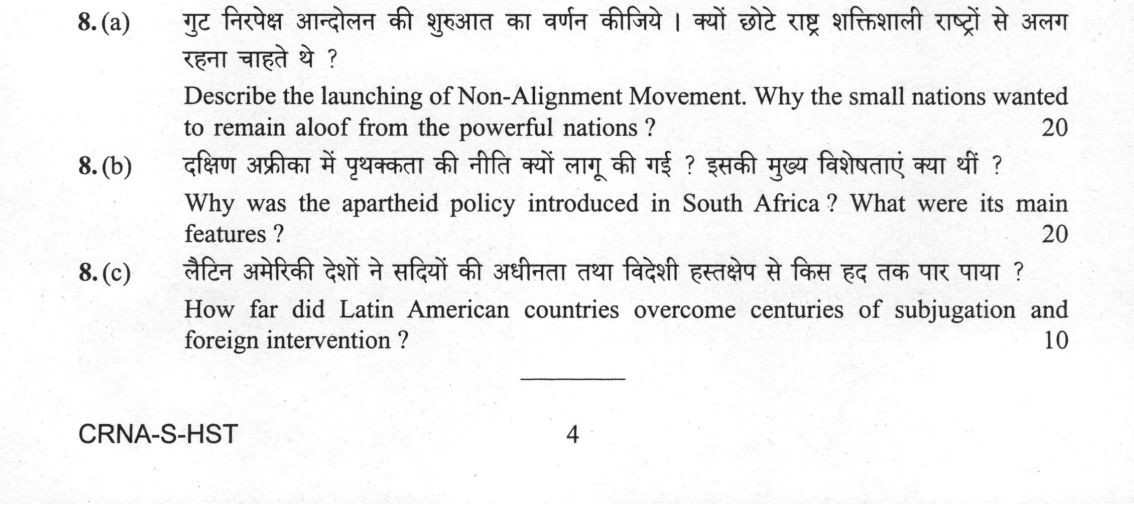
(a) Describe the launching of Non-Alignment Movement. Why the small nations wanted to remain aloof from the powerful nations ?…
Describe the launching of Non-Alignment Movement. Why the small nations wanted to remain aloof from the powerful nations ? 20 marks
Why was the apartheid policy introduced in South Africa ? What were its main features ? 20 marks
How far did Latin American countries overcome centuries of subjugation and foreign intervention ? 10 marks
हिंदी में प्रश्न पढ़ें
गुट निरपेक्ष आंदोलन की शुरुआत का वर्णन कीजिए । क्यों छोटे राष्ट्र शक्तिशाली राष्ट्रों से अलग रहना चाहते थे ? (20 अंक)
दक्षिण अफ्रीका में पृथक्कता की नीति क्यों लागू की गई ? इसकी मुख्य विशेषताएँ क्या थीं ? (20 अंक)
लैटिन अमेरिकी देशों ने सदियों की अधीनता तथा विदेशी हस्तक्षेप से किस हद तक पार पाया ? (10 अंक)
Model answer
Written by UPSC Answer Check against this question's marking rubric, to the expected length. UPSC does not publish answers for Mains — this is one way to score well, not an official key.
The mid-twentieth century witnessed the emergence of newly sovereign states striving to overcome historical subjugation and preserve their autonomy amid Cold War geopolitical tensions.
The Launch of Non-Alignment Movement and Small-Nation Aloofness
The ideological foundations of the Non-Aligned Movement (NAM) were laid at the 1955 Bandung Asian-African Conference, culminating in its formal launch at the 1961 Belgrade Summit. Spearheaded by the core pentarchy—Jawaharlal Nehru of India, Josip Broz Tito of Yugoslavia, Gamal Abdel Nasser of Egypt, Sukarno of Indonesia, and Kwame Nkrumah of Ghana—the movement evolved from regional Afro-Asian solidarity into a wider Third Worldism. NAM distinguished itself from passive neutralism by practicing 'positive neutralism'—an active, principled engagement in world affairs guided by the five principles of Panchsheel to reduce international conflict.
Small nations sought aloofness from the superpower rivalry due to acute post-colonial vulnerabilities. Having recently emerged from European colonial rule, these states faced immense bipolar pressure to join rival military alliances such as SEATO and CENTO, which threatened to compromise their hard-won sovereignty. Pervasive economic dependency and the urgent need for autonomous, domestic socio-economic development led small nations to reject alignment, seeking instead to avoid becoming Cold War proxies and to maintain sovereign control over foreign policy and natural resources.
Genesis and Features of Apartheid in South Africa
Apartheid was formally introduced by the Afrikaner-led National Party following its 1948 electoral victory. Its structural origins lay in the late-nineteenth-century mineral revolution (1867 diamonds, 1886 gold) and British imperial competition, which created institutional demand for cheap, regimented African labor. This was codified by the foundational 1913 Natives Land Act, which dispossessed Africans of over ninety percent of their ancestral land. Ideologically, apartheid drew upon entrenched colonial segregationist policies, radical Afrikaner nationalism forged in the aftermath of the Anglo-Boer War, and Cold War anti-communism, which the state utilized to delegitimize liberation movements.
Apartheid functioned through two interconnected mechanisms. Petty apartheid enforced social segregation in daily life through the Reservation of Separate Amenities Act (1953) and draconian Pass Laws that strictly controlled the movement of Black Africans in urban areas. The Population Registration Act (1950) classified all citizens by racial categories, while the Group Areas Act (1950) enforced strict residential segregation through forced removals. Grand apartheid engineered long-term territorial segregation by stripping Black South Africans of their citizenship and relegating them to impoverished, nominally independent Bantustans (Homelands). Under the Suppression of Communism Act (1950), the regime suppressed domestic political dissent by equating calls for racial equality with communist subversion.
Latin America: Subjugation, Intervention, and Neo-Colonialism
Although Latin American nations achieved formal independence from Spain and Portugal by the 1820s under leaders like Simón Bolívar and José de San Martín, economic subjugation persisted throughout the nineteenth century under British financial hegemony. Following the 1898 Spanish-American War, the United States established hemispheric dominance through Dollar Diplomacy and interventionist doctrines.
Despite the temporary non-interventionist stance of the 1933 Good Neighbor Policy, the Cold War witnessed direct and covert US interventions to protect corporate interests and prevent socialist governance. Key instances included the 1954 CIA-backed coup in Guatemala, the 1961 Bay of Pigs invasion in Cuba, and the 1973 covert intervention that overthrew Salvador Allende in Chile. In the 1980s, catastrophic debt crises forced Latin American economies into IMF-mandated structural adjustment programs, severely constraining national policy space. Although the early twenty-first century "Pink Tide" governments in Venezuela, Bolivia, and Ecuador reasserted national sovereignty over resources, overcoming subjugation remained partial; economic neo-colonialism endured, alongside new vectors of external intervention focused on migration and the war on drugs.
Ultimately, the development of the Non-Aligned Movement, the rise of South African apartheid, and Latin America's recurring foreign interventions illustrate the enduring tension between formal decolonisation and the structural constraints of Cold War neo-colonialism.
What "Describe" is asking you to do
Give a full, ordered account of the thing named — its parts, stages or mechanism — in the sequence in which it actually exists or occurs. Most describe questions come from the science optionals, where the marks sit in correct technical detail and, where the stem says so, a labelled diagram.
Structure that answers it
One-line identification of the subject → the parts or stages in their real order, each with its defining detail → labelled diagram where the subject is structural → closing line on function or significance
Where marks are lost
Loose general prose where the examiner is ticking named parts, correct terminology and their sequence; and in the General Studies papers, turning to evaluation before the description is finished.
How this answer will be evaluated
Approach
Framework: UPSC History Paper 2 (Modern World History). (a) describe: define > structure or process in order > labelled diagram > significance | (b) explain: definition/context > points in order > small example > short close | (c) evaluate: criteria > evidence > balanced judgment Full marks: Precise dates/acts, clear distinction between political and economic factors, strong analytical conclusion.
Key points expected
- 1961 Belgrade Conference and founding leaders (Tito, Nehru, Nasser)
- Five principles of Non-Alignment (1955 Bandung Conference)
- Reason: Avoidance of Cold War nuclear confrontation
- Reason: Protection of sovereignty against superpower hegemony
- Cause: Institutionalization of racial segregation (1948 NP victory)
- Feature: Population Registration Act (1950)
- Feature: Group Areas Act (1950) and land segregation
- Feature: Bantu Education Act (1953) or Pass Laws
Evaluation rubric
Each sub-part is marked on its own, against the marks and word limit printed on the paper.
- (a) Narrative of NAM's origin and analytical justification for small nations' neutrality. 20 marks
describe— define → structure or process in order → labelled diagram → significance
Must cover
- 1961 Belgrade Conference and founding leaders (Tito, Nehru, Nasser)
- Five principles of Non-Alignment (1955 Bandung Conference)
- Reason: Avoidance of Cold War nuclear confrontation
- Reason: Protection of sovereignty against superpower hegemony
Loses marks
- Treating NAM as a military alliance (NATO equivalent)
- Ignoring the economic dimension of non-alignment
- Chronological listing without explaining the 'why'
Earns more
- Mention of 'Third World' or 'G77' linkage
- Reference to 'Bandung Spirit' or 'New Economic Order'
- Specific example of NAM intervention (e.g., Suez Crisis)
Extra mark
- Citation of Nehru's 'Five Pillars' speech
- Reference to the 1961 Belgrade Declaration text
- (b) Causal analysis of Apartheid's introduction and a structured list of its legal features. 20 marks
explain— definition/context → points in order → small example → short close
Must cover
- Cause: Institutionalization of racial segregation (1948 NP victory)
- Feature: Population Registration Act (1950)
- Feature: Group Areas Act (1950) and land segregation
- Feature: Bantu Education Act (1953) or Pass Laws
Loses marks
- Confusing 'segregation' (pre-1948) with 'Apartheid' (post-1948)
- Failing to distinguish between legal and social features
- Vague generalizations without naming specific acts
Earns more
- Mention of 'Grand Apartheid' vs 'Petit Apartheid'
- Reference to the 'Homelands' or 'Bantustans' system
- Link to economic exploitation of Black labor
Extra mark
- Citation of the 1950 Population Registration Act
- Reference to the 1953 Bantu Education Act
- (c) Assessment of the extent to which Latin America achieved true independence from foreign control. 10 marks
evaluate— criteria → evidence → balanced judgment
Must cover
- Reference to the Monroe Doctrine (1823)
- Mention of 'Neocolonialism' or 'Economic Dependence'
- Example of US intervention (e.g., Panama, Cuba, or Chile)
- Judgment on 'Political Independence' vs 'Economic Sovereignty'
Loses marks
- Assuming 19th-century independence meant full sovereignty
- Ignoring the role of European powers (UK/France) in the 19th c.
- Failing to provide a balanced judgment (yes/no)
Earns more
- Reference to the 'Banana Republics' concept
- Mention of the 'Cold War' proxy conflicts in the region
- Reference to the 'OAS' (Organization of American States)
Extra mark
- Citation of the 'Monroe Doctrine' text
- Reference to the 'Alliance for Progress' (1961)
Practice this exact question
Write your answer and it is marked point by point against the model answer above — what you covered, what you missed, what you got wrong.
Evaluate my answer →More from History 2022 Paper II
- Q5 Critically examine the following statements in about 150 words each: (a) 'Rousseau kindle…
- Q6 (a) Do you agree that the economic effects of the Industrial Revolution were to add enorm…
- Q7 (a) Do you understand that the lack of statesmanship in London during the 1760's and the…
- Q8 (a) Describe the launching of Non-Alignment Movement. Why the small nations wanted to rem…