Paper II — Q2
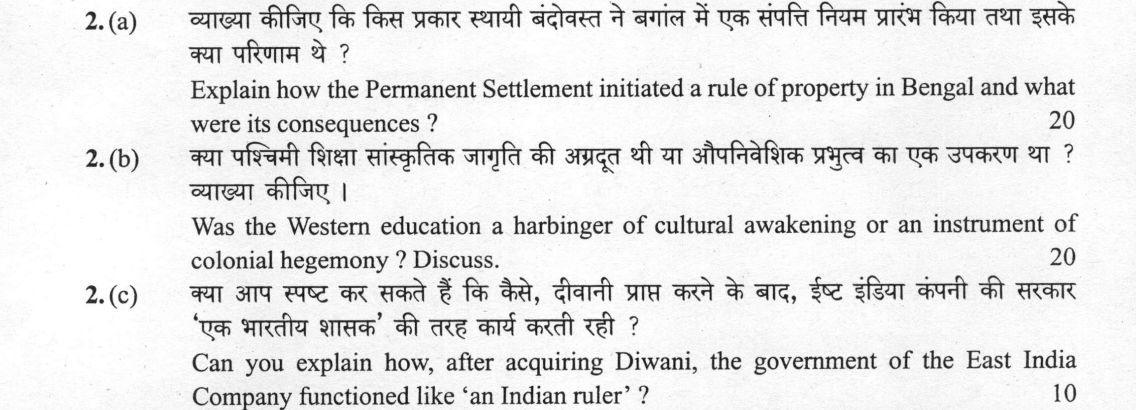
(a) Explain how the Permanent Settlement initiated a rule of property in Bengal and what were its consequences ? (20 marks) (b)…
Explain how the Permanent Settlement initiated a rule of property in Bengal and what were its consequences ? 20 marks
Was the Western education a harbinger of cultural awakening or an instrument of colonial hegemony ? Discuss. 20 marks
Can you explain how, after acquiring Diwani, the government of the East India Company functioned like 'an Indian ruler' ? 10 marks
हिंदी में प्रश्न पढ़ें
व्याख्या कीजिए कि किस प्रकार स्थायी बंदोबस्त ने बंगाल में एक संपत्ति नियम प्रारंभ किया तथा इसके क्या परिणाम थे ? (20 अंक)
क्या पश्चिमी शिक्षा सांस्कृतिक जागृति की अग्रदूत थी या औपनिवेशिक प्रभुत्व का एक उपकरण था ? व्याख्या कीजिए । (20 अंक)
क्या आप स्पष्ट कर सकते हैं कि कैसे, दीवानी प्राप्त करने के बाद, ईस्ट इंडिया कंपनी की सरकार 'एक भारतीय शासक' की तरह कार्य करती रही ? (10 अंक)
Model answer
Written by UPSC Answer Check against this question's marking rubric, to the expected length. UPSC does not publish answers for Mains — this is one way to score well, not an official key.
The British rule in Bengal was built on three linked mechanisms: a new property order, an English-language class, and a Company that ruled through Indian forms.
Rule of property in Bengal Before 1793, Mughal and early Company revenue administration treated zamindars as holders of hereditary rights or local proprietary claims, not as mere tax collectors; their status varied by region. Cornwallis’s Permanent Settlement of 1793 converted the revenue assignment into a hereditary proprietary right. The zamindar became a landlord with a fixed, perpetual revenue obligation to the Company, while the right to collect rent from cultivators became his private property. This created a rule of property because the state no longer managed land through fluctuating assignments; it recognised a class of proprietors whose title rested on a fixed demand. The settlement also led to sub-infeudation: zamindars created jotedars and intermediate tenants to secure rent, producing a jotedar-tenant hierarchy.
The consequences were structural. Agriculture became more commercial as landlords sought cash rents and market crops. Absentee landlordism grew, especially in districts such as Burdwan, where zamindars lived away from estates and relied on agents. Peasants suffered from high rents, insecurity, and immiseration, while in regions such as Birbhum, where peasant resistance and weaker landlord control persisted, the settlement’s impact was uneven. Over time, fixed revenue and landlord extraction discouraged investment, contributing to agrarian stagnation.
Western education: awakening or hegemony Western education had a dual character. Macaulay’s Minute of 1835, emerging from the Anglicist-Orientalist debate, promoted English as the medium of instruction to create a class “Indian in blood and colour, but English in taste, in opinions, in morals and in intellect.” This was colonial hegemony: English education functioned as an ideological apparatus, as Gauri Viswanathan’s Masks of Conquest argues, producing clerks, lawyers and interpreters who legitimised British rule and connected the colony to metropolitan culture.
Yet the same education also became a harbinger of cultural awakening. It created a Bengali middle class, a vernacular press, associations, and reform movements. Raja Rammohan Roy used English and legal knowledge to campaign against Sati, while Ishwar Chandra Vidyasagar led the campaign for widow remarriage, later reflected in the Hindu Widows’ Remarriage Act of 1856. The press and associations gave this class a public space to critique social customs and colonial policy. However, the awakening remained limited because English education was expensive, urban, and disconnected from the masses, and the class it produced often served colonial administrative interests.
The Company as an Indian ruler After acquiring Diwani in 1765, the East India Company began to function like an Indian ruler. Clive’s arrangement produced a dual government, 1765-1772, in which the Company collected revenue while the nawab retained nominal authority. The Company assumed nawabi functions: it maintained an army, conducted diplomatic correspondence, and exercised judicial administration, often through existing Mughal forms. It adopted Persian as a court language, used local titles, and maintained revenue-farming continuity by relying on zamindars, jotedars and amils, while qanungos remained hereditary record-keepers of revenue and land records. This mimicry gave the Company legitimacy and administrative efficiency, but its real purpose was subordination to British commercial interests. After 1772, when the Company took direct control of civil administration, the paradox deepened: it ruled as an Indian sovereign in form, but as a colonial trading power in substance.
In conclusion, the Permanent Settlement created property-based extraction, Western education produced a culturally awakened yet colonial-dependent class, and the Company’s Indian-style rule masked commercial domination. Together they show that British power in Bengal was not merely military conquest but an integrated system of economic, cultural and administrative control.
What "Explain" is asking you to do
Make the working of something clear — what sets it off, what follows from what, and what it produces. Explain is the Commission's mechanism word: it dominates the technical papers and the “explain why” stems, where the marks sit in the causal chain and not in the label.
Structure that answers it
State what it is → the initiating condition → the chain of cause, step by step → an instance where it plays out → what the chain produces
Where marks are lost
Describing what something looks like instead of why it works that way. Naming the stages without linking them reads as description too.
How this answer will be evaluated
Approach
Framework: Context > Thesis > Evidence > Historiography. (a) explain: definition/context > points in order > small example > short close | (b) discuss: intro > 3-4 dimensions > example > balanced close | (c) explain: definition/context > points in order > small example > short close Full marks: Demonstrates deep analytical understanding, cites specific sources/historians, and maintains a clear argumentative structure.
Key points expected
- Identify Zamindars as new proprietary landowners
- Explain the fixed revenue demand mechanism
- Link settlement to the rise of a new landlord class
- Analyze consequences like peasant exploitation or stagnation
- Present arguments for education as cultural awakening
- Present arguments for education as colonial hegemony
- Discuss the creation of a Westernized elite class
- Provide a balanced judgment on the primary impact
Evaluation rubric
Each sub-part is marked on its own, against the marks and word limit printed on the paper.
- (a) Define the mechanism of property rights created by the Permanent Settlement and its socio-economic consequences. 20 marks
explain— definition/context → points in order → small example → short close
Must cover
- Identify Zamindars as new proprietary landowners
- Explain the fixed revenue demand mechanism
- Link settlement to the rise of a new landlord class
- Analyze consequences like peasant exploitation or stagnation
Loses marks
- Narrating events without analyzing the property shift
- Confusing the Permanent Settlement with the Diwani grant
- Ignoring the consequences for the peasantry
Earns more
- Mention the role of the Permanent Settlement Act 1793
- Contrast with the Ryotwari or Mahalwari systems
- Reference the 'Rule of Property' as a legal shift
Extra mark
- Cite a specific historian's view on the settlement
- Quote a specific clause from the settlement deed
- (b) Evaluate the dual nature of Western education as a tool for both cultural awakening and colonial control. 20 marks
discuss— intro → 3-4 dimensions → example → balanced close
Must cover
- Present arguments for education as cultural awakening
- Present arguments for education as colonial hegemony
- Discuss the creation of a Westernized elite class
- Provide a balanced judgment on the primary impact
Loses marks
- Taking only one side without discussion
- Failing to link education to political or social change
- Generalizing without specific examples
Earns more
- Reference Macaulay's Minute on Education
- Mention the role of vernacular press in awakening
- Discuss the concept of 'cultural hegemony' in this context
Extra mark
- Name a specific reformer influenced by Western education
- Cite a specific colonial policy document
- (c) Explain how the East India Company adopted the administrative and fiscal structures of Indian rulers after acquiring Diwani. 10 marks
explain— definition/context → points in order → small example → short close
Must cover
- Define the significance of acquiring Diwani
- Explain the adoption of Indian revenue collection methods
- Describe the Company's role as a tax-collecting entity
- Mention the use of local administrative machinery
Loses marks
- Confusing Diwani with full sovereignty
- Failing to explain the 'Indian ruler' aspect
- Ignoring the fiscal implications of Diwani
Earns more
- Reference the Treaty of Allahabad 1765
- Mention the role of the Nizamut Adalat
- Discuss the 'dual government' in Bengal
Extra mark
- Cite a specific administrative order from the Company
- Name a specific Indian official retained by the Company
Practice this exact question
Write your answer and it is marked point by point against the model answer above — what you covered, what you missed, what you got wrong.
Evaluate my answer →More from History 2022 Paper II
- Q1 Critically examine the following statements in about 150 words each: (a) 'The Battle of P…
- Q2 (a) Explain how the Permanent Settlement initiated a rule of property in Bengal and what…
- Q3 (a) Do you think that the Indian National Movement was a 'multi class movement' which rep…
- Q4 (a) Discuss the policies and programmes of the early nationalists (moderates). To what ex…
- Q5 Critically examine the following statements in about 150 words each: (a) 'Rousseau kindle…