Paper II — Q3
(a) Do you think that the Indian National Movement was a 'multi class movement' which represented the anti-imperialist interests…
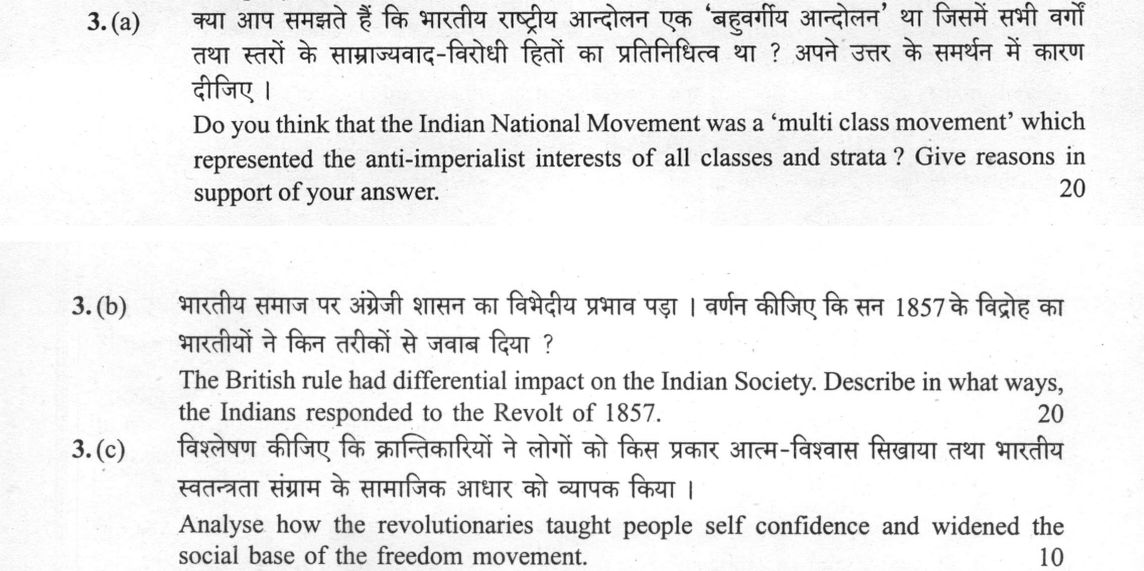
Do you think that the Indian National Movement was a 'multi class movement' which represented the anti-imperialist interests of all classes and strata ? Give reasons in support of your answer. 20 marks
The British rule had differential impact on the Indian Society. Describe in what ways, the Indians responded to the Revolt of 1857. 20 marks
Analyse how the revolutionaries taught people self confidence and widened the social base of the freedom movement. 10 marks
हिंदी में प्रश्न पढ़ें
क्या आप समझते हैं कि भारतीय राष्ट्रीय आंदोलन एक 'बहुवर्गीय आंदोलन' था जिसमें सभी वर्गों तथा स्तरों के साम्राज्यवाद-विरोधी हितों का प्रतिनिधित्व था ? अपने उत्तर के समर्थन में कारण दीजिए । (20 अंक)
भारतीय समाज पर अंग्रेजी शासन का विभेदीय प्रभाव पड़ा । वर्णन कीजिए कि सन् 1857 के विद्रोह का भारतीयों ने किन तरीकों से जवाब दिया ? (20 अंक)
विश्लेषण कीजिए कि क्रांतिकारियों ने लोगों को किस प्रकार आत्म-विश्वास सिखाया तथा भारतीय स्वतंत्रता संग्राम के सामाजिक आधार को व्यापक किया । (10 अंक)
Model answer
Written by UPSC Answer Check against this question's marking rubric, to the expected length. UPSC does not publish answers for Mains — this is one way to score well, not an official key.
The Indian national movement was an evolving anti-colonial coalition that progressively brought diverse social strata into political consciousness, though this integration remained structured by distinct class contradictions and programmatic limitations.
Multi-Class Character and Class Contradictions in the National Movement
The national movement evolved from a narrow, middle-class platform into an all-India mass movement. In its early Moderate phase, the Indian National Congress (INC) primarily represented the western-educated urban intelligentsia and professional elites. Under Gandhi’s leadership post-1919, the social base widened significantly. The peasantry was mobilized through localized struggles such as Champaran (1917) and Kheda (1918), leading to massive rural participation in the Non-Cooperation and Civil Disobedience movements. The urban working class entered the political sphere through the Ahmedabad strike (1918) and trade union mobilizations under the All India Trade Union Congress (AITUC). Concurrently, national capitalists coordinated through the Federation of Indian Chambers of Commerce and Industry (FICCI) provided financial backing, viewing the INC as a bulwark against colonial economic discrimination.
However, evaluating the movement as a fully representative multi-class front reveals significant limitations. As historians like Sumit Sarkar and Ranajit Guha argue, the leadership maintained a bourgeois hegemony that constrained autonomous subaltern radicalism. During the Civil Disobedience and Quit India Movements, the Congress leadership consistently discouraged radical agrarian agendas—such as 'no-rent' campaigns against native zamindars—to preserve multi-class unity and retain landlord-capitalist support. Consequently, while the anti-imperialist umbrella accommodated diverse classes against British rule, subaltern class interests were frequently subordinated to the overarching national-bourgeois consensus.
Differential Impact of Colonialism and Divergent Responses to 1857
Colonial policies produced asymmetric disruptions across Indian society. British tariff structures and cheap imports caused severe deindustrialization, devastating traditional weavers and artisans. Heavy revenue demands, the commercialization of agriculture, and the summary resumption of estates through instruments like the Inam Commission disenfranchised peasants and landed elites alike. Conversely, western education created an emergent middle class that initially viewed British rule as a modernizing force.
These divergent realities dictated the fractured nature of the Revolt of 1857. The uprising drew fervent participation from Bengal Army sepoys, dispossessed Awadh taluqdars, ruined artisans, and displaced peasants, finding symbolic cohesion in Bahadur Shah Zafar and cross-community Hindu-Muslim unity. Forest and peasant communities, including tribal belts in Chotanagpur, joined the fray against money-lenders and colonial officials. Conversely, modern-educated elites in Bengal and Bombay actively opposed the rebellion, viewing it as feudal restorationism. Key princely states, including Scindia, Holkar, and the Nizam, as well as the Punjab chiefs and the Madras and Bombay Presidencies, remained neutral or aided the Company. The post-revolt British administration subsequently institutionalized these fractures through martial and non-martial race categorizations and aggressive divide-and-rule communal policies.
Revolutionary Movement: Instilling Self-Confidence and Expanding Social Base
Revolutionary nationalism fundamentally transformed the psychological landscape of the freedom struggle. Moving beyond the petitioning methods of early moderates, revolutionaries deployed individual heroism and propaganda by deed—such as the Kakori train action (1925), the assassination of Saunders (1928), and the Central Legislative Assembly bombing (1929)—to demystify British administrative invulnerability.
Organizations like the Hindustan Republican Association (HRA), later transformed by Bhagat Singh and Chandrashekhar Azad into the Hindustan Socialist Republican Association (HSRA), expanded the movement's social base. They systematically recruited from lower-middle-class youth, students, and urban workers, shifting the ideological orientation from pure armed action to mass-oriented scientific socialism. In Bengal, groups like Jugantar and Anushilan Samiti, alongside Surya Sen’s Indian Republican Army in Chittagong, mobilized radical youth and women revolutionaries like Pritilata Waddedar and Kalpana Datta. By converting colonial courtrooms into platforms for political propaganda and courting martyrdom through extended hunger strikes, the revolutionaries fostered fearless national self-confidence and galvanized popular anti-colonial sentiment across India.
The Indian freedom movement ultimately functioned as a multi-class anti-imperialist front, whose ideological breadth was continually expanded by mass mobilizations, internal class contestations, and the radicalizing impact of revolutionary actions.
What "Evaluate" is asking you to do
Judge how well something has performed against the standard it set for itself — its stated aim, mandate or promise — and commit to a verdict. Name the yardstick before you judge; an unanchored judgement reads as opinion.
Structure that answers it
Name the yardstick — stated aim, mandate or benchmark → performance against it → shortfall against it → why the gap exists → verdict
Where marks are lost
Presenting both sides and then declining to decide, or delivering a verdict against a standard you never stated, which makes it look arbitrary.
How this answer will be evaluated
Approach
Framework: UPSC History Paper 2 (Modern India). (a) justify: claim > 3-4 reasons > evidence > conclusion | (b) describe: define > structure or process in order > labelled diagram > significance | (c) analyse: intro > causes > effects > stakeholders/linkages > way forward Full marks: Thesis-driven, specific evidence, historiographical awareness, clear structure.
Key points expected
- Thesis on 'multi-class' nature of the movement
- Reasons: Peasant participation (e.g., Bardoli, Tebhaga)
- Reasons: Industrial working class (e.g., Bombay Textile Mills)
- Reasons: Middle class and professional strata (e.g., lawyers, teachers)
- Definition of 'differential impact' of British rule
- Description of responses from different social groups
- Description of responses from different regions
- Description of the nature of the responses (support, neutrality, opposition)
Evaluation rubric
Each sub-part is marked on its own, against the marks and word limit printed on the paper.
- (a) Thesis on the movement's multi-class nature with reasons supporting the claim. 20 marks
justify— claim → 3-4 reasons → evidence → conclusion
Must cover
- Thesis on 'multi-class' nature of the movement
- Reasons: Peasant participation (e.g., Bardoli, Tebhaga)
- Reasons: Industrial working class (e.g., Bombay Textile Mills)
- Reasons: Middle class and professional strata (e.g., lawyers, teachers)
Loses marks
- Narrative retelling of events without class analysis
- Ignoring the 'anti-imperialist' aspect of the question
- Failing to provide specific reasons for the thesis
Earns more
- Mention of specific anti-imperialist demands of different classes
- Reference to Congress as the unifying platform
- Mention of regional variations in class participation
- Reference to specific leaders representing different classes
Extra mark
- Citation of a specific primary source or speech
- Reference to a specific historiographical debate on class
- (b) Description of the varied Indian responses to the 1857 Revolt. 20 marks
describe— define → structure or process in order → labelled diagram → significance
Must cover
- Definition of 'differential impact' of British rule
- Description of responses from different social groups
- Description of responses from different regions
- Description of the nature of the responses (support, neutrality, opposition)
Loses marks
- Failing to address the 'differential impact' aspect
- Generalizing the response without specific examples
- Ignoring the 'Revolt of 1857' context
Earns more
- Mention of specific groups (e.g., landlords, peasants, artisans)
- Mention of specific regions (e.g., Bengal, Punjab, Deccan)
- Reference to the role of the British in suppressing the revolt
- Mention of the long-term consequences of the revolt
Extra mark
- Citation of a specific primary source or account
- Reference to a specific historiographical interpretation of the revolt
- (c) Analysis of how revolutionaries fostered self-confidence and broadened the movement's base. 10 marks
analyse— intro → causes → effects → stakeholders/linkages → way forward
Must cover
- Analysis of how revolutionaries taught self-confidence
- Analysis of how they widened the social base
- Linkage between self-confidence and social base expansion
- Specific examples of revolutionary actions or ideas
Loses marks
- Failing to address both 'self-confidence' and 'social base'
- Generalizing without specific examples
- Ignoring the 'revolutionaries' aspect of the question
Earns more
- Mention of specific revolutionary groups (e.g., Anushilan Samiti, Ghadar Party)
- Reference to specific revolutionary leaders (e.g., Bhagat Singh, Subhas Chandra Bose)
- Mention of the impact on the youth and students
- Reference to the role of revolutionary literature and propaganda
Extra mark
- Citation of a specific revolutionary text or speech
- Reference to a specific historiographical debate on the revolutionaries
Practice this exact question
Write your answer and it is marked point by point against the model answer above — what you covered, what you missed, what you got wrong.
Evaluate my answer →More from History 2022 Paper II
- Q1 Critically examine the following statements in about 150 words each: (a) 'The Battle of P…
- Q2 (a) Explain how the Permanent Settlement initiated a rule of property in Bengal and what…
- Q3 (a) Do you think that the Indian National Movement was a 'multi class movement' which rep…
- Q4 (a) Discuss the policies and programmes of the early nationalists (moderates). To what ex…
- Q5 Critically examine the following statements in about 150 words each: (a) 'Rousseau kindle…
- Q6 (a) Do you agree that the economic effects of the Industrial Revolution were to add enorm…