Paper II — Q4
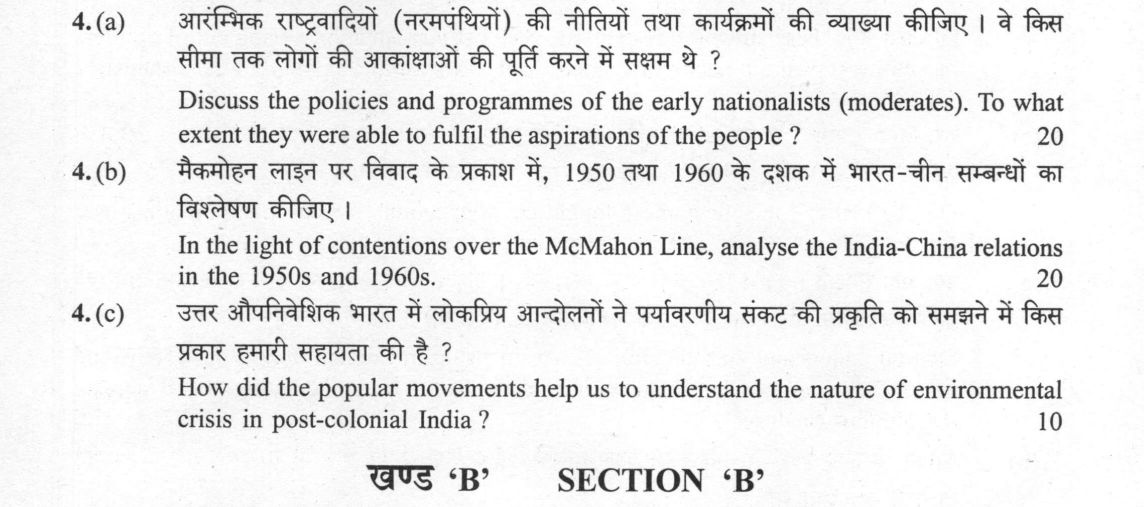
(a) Discuss the policies and programmes of the early nationalists (moderates). To what extent they were able to fulfil the…
Discuss the policies and programmes of the early nationalists (moderates). To what extent they were able to fulfil the aspirations of the people ? 20 marks
In the light of contentions over the McMahon Line, analyse the India-China relations in the 1950s and 1960s. 20 marks
How did the popular movements help us to understand the nature of environmental crisis in post-colonial India ? 10 marks
हिंदी में प्रश्न पढ़ें
आरंभिक राष्ट्रवादियों (नरमपंथियों) की नीतियों तथा कार्यक्रमों की व्याख्या कीजिए । वे किस सीमा तक लोगों की आकांक्षाओं की पूर्ति करने में सक्षम थे ? (20 अंक)
मैकमोहन लाइन पर विवाद के प्रकाश में, 1950 तथा 1960 के दशक में भारत-चीन संबंधों का विश्लेषण कीजिए । (20 अंक)
उत्तर औपनिवेशिक भारत में लोकप्रिय आंदोलनों ने पर्यावरणीय संकट की प्रकृति को समझने में किस प्रकार हमारी सहायता की है ? (10 अंक)
Model answer
Written by UPSC Answer Check against this question's marking rubric, to the expected length. UPSC does not publish answers for Mains — this is one way to score well, not an official key.
The evolution of modern India reflects a continuous contestation between state power, popular aspirations, and institutional governance, spanning from colonial constitutionalism to post-colonial geopolitical and ecological challenges.
Policies, Programmes, and Aspirations under the Moderates
The early nationalists (1885–1905), led by Dadabhai Naoroji, Gopal Krishna Gokhale, Pherozeshah Mehta, and Surendranath Banerjea, adopted constitutional agitation within the legal framework. Their methods rested on the "3Ps"—prayer, petition, and protest—utilising political associations and the vernacular press (such as Amrita Bazar Patrika and The Bengalee) to build public opinion and present memorandums to British authorities.
Their most enduring programme was the economic critique of colonialism. Through the "Drain Theory" pioneered by Naoroji in Poverty and Un-British Rule in India and corroborated by R.C. Dutt’s Economic History of India, they exposed the exploitative mechanism of revenue collection, unilateral capital transfers, and de-industrialisation. On constitutional matters, they demanded administrative Indianisation, reduction of military expenditure, expansion of the legislative councils, and separation of executive from judiciary.
Their success in fulfilling popular aspirations was mixed. On the one hand, they succeeded in fostering a pan-Indian political consciousness, demystifying the benevolent image of the British Raj, and securing modest institutional gains like the Indian Councils Act of 1892. On the other hand, their elitist social base and belief in British justice prevented mass mobilisation. They failed to offer immediate material relief to peasants and industrial workers suffering from recurrent famines and agrarian distress, leading to an inevitable radicalisation of the national movement under the Extremists.
The McMahon Line and India-China Relations in the 1950s and 1960s
The boundary contention stemmed from the 1914 Simla Convention, which delineated the McMahon Line between British India and Tibet. While independent India recognised it as a legitimate customary boundary, the People's Republic of China (PRC) rejected it as an imperialist imposition, considering Tibet sovereign Chinese territory.
Throughout the 1950s, India pursued a policy of accommodation. The 1954 Panchsheel Agreement and the 1955 Bandung Conference cultivated an era of bonhomie (Hindi-Chini Bhai Bhai), but left the frontier ill-defined. Chinese cartographic claims over NEFA (now Arunachal Pradesh) and Aksai Chin soon created friction.
By 1959, relations deteriorated following the Tibetan uprising, the grant of asylum to the Dalai Lama, and violent skirmishes at Longju and the Kongka Pass. Diplomatic letters between Jawaharlal Nehru and Premier Zhou Enlai revealed deep impasses; Zhou sought a package deal swapping Aksai Chin for the McMahon Line, which Indian public opinion and parliament resisted.
Despite cautious diplomatic assessments by figures like K.M. Panikkar, India pursued the "Forward Policy" to establish defensive posts in disputed areas, overseen by Defence Minister V.K. Krishna Menon. This culminated in the disastrous 1962 Sino-Indian War. The conflict shattered the non-aligned solidarity of Asia-Africa, exposed India’s military vulnerabilities, and caused a long-standing freeze in bilateral ties that redirected Indian strategic planning toward militarisation and diplomatic realpolitik.
Popular Movements and the Post-Colonial Environmental Crisis
Post-colonial popular movements demonstrated that India’s environmental crisis was structurally intertwined with state-sponsored developmentalism. The Chipko Movement (1970s) in the Uttarakhand Himalayas revealed how commercial forestry deprived local hill communities of biomass and subsistence, turning ecological degradation into a survival crisis.
The Narmada Bachao Andolan similarly exposed the human and ecological costs of large dams, challenging state claims of public interest by highlighting displacement, inadequate rehabilitation, and biodiversity destruction. In central India, movements in Jharkhand articulated indigenous resistance against open-cast mining and industrial corridors that eroded tribal customary rights over jal, jangal, jameen (water, forest, land).
These movements revealed the core nature of India's environmental crisis:
- It was an outcome of state-led "growthism" that commodified natural resources at the expense of ecological limits.
- It highlighted the friction between "subaltern environmentalism" (the environmentalism of the poor defending their livelihoods) and state-backed elite conservation.
- It exposed a severe democratic deficit in resource governance, where local communities were excluded from ecological decision-making.
A comprehensive reading of state-society relations requires balancing state sovereignty and economic planning with decentralized, ecologically sustainable, and participatory institutions that protect both regional frontiers and subaltern livelihoods.
What "Discuss" is asking you to do
Lay the issue out from more than one side — how it arose, what is claimed for it, what is held against it, and where it now stands. UPSC attaches discuss to broad topics with several live dimensions, so coverage of the dimensions earns more than the strength of your opinion.
Structure that answers it
Set the issue up → the case as it is made → the case against → the dimension both sides leave out → where the balance now lies
Where marks are lost
Listing facts with no thread between them, or arguing one side throughout and calling it a discussion.
How this answer will be evaluated
Approach
Framework: Context > Thesis > Evidence > Historiography. (a) discuss: intro > 3-4 dimensions > example > balanced close | (b) analyse: intro > causes > effects > stakeholders/linkages > way forward | (c) explain: definition/context > points in order > small example > short close Full marks: Thesis-driven, specific evidence, historiographical awareness, balanced judgment.
Key points expected
- Policies: petitions, prayers, protests, constitutional methods
- Programmes: education, economic nationalism, political representation
- Assessment of success in fulfilling aspirations
- Balanced close on limitations of Moderate approach
- Causes: McMahon Line contention, border disputes
- Effects: 1962 war, diplomatic fallout
- Stakeholders: India, China, local populations
- Linkages: Geopolitical context, Cold War dynamics
Evaluation rubric
Each sub-part is marked on its own, against the marks and word limit printed on the paper.
- (a) Analytical assessment of Moderate policies and their success in meeting popular aspirations. 20 marks
discuss— intro → 3-4 dimensions → example → balanced close
Must cover
- Policies: petitions, prayers, protests, constitutional methods
- Programmes: education, economic nationalism, political representation
- Assessment of success in fulfilling aspirations
- Balanced close on limitations of Moderate approach
Loses marks
- Chronological narrative without analysis
- Textbook retelling of events
- Failure to address the 'extent' of success
Earns more
- Reference to specific petitions or resolutions
- Mention of key Moderate leaders (Tilak, Gokhale)
- Link to later Extremist critique
- Historiographical perspective on Moderate legacy
Extra mark
- Specific quote from a Moderate resolution
- Reference to a specific historiographical school
- (b) Causal analysis of India-China relations in 1950s-60s driven by the McMahon Line dispute. 20 marks
analyse— intro → causes → effects → stakeholders/linkages → way forward
Must cover
- Causes: McMahon Line contention, border disputes
- Effects: 1962 war, diplomatic fallout
- Stakeholders: India, China, local populations
- Linkages: Geopolitical context, Cold War dynamics
Loses marks
- Chronological narrative without analysis
- Textbook retelling of the 1962 war
- Failure to link McMahon Line to broader relations
Earns more
- Reference to specific diplomatic exchanges
- Mention of key figures (Nehru, Zhou Enlai)
- Analysis of the 1962 war's impact
- Historiographical debate on the war's causes
Extra mark
- Specific quote from a diplomatic communication
- Reference to a specific historiographical school
- (c) Explanation of how popular movements revealed the nature of environmental crisis in post-colonial India. 10 marks
explain— definition/context → points in order → small example → short close
Must cover
- Definition of environmental crisis in post-colonial context
- Role of popular movements in highlighting issues
- Specific examples of movements (Chipko, Narmada)
- Short close on the impact of these movements
Loses marks
- General description of environmental issues
- Failure to link movements to understanding of crisis
- Lack of specific examples
Earns more
- Reference to specific leaders (Sunita Narain, Medha Patkar)
- Mention of specific policies or laws influenced
- Link to broader environmental justice
- Historiographical perspective on environmental movements
Extra mark
- Specific quote from a movement leader
- Reference to a specific historiographical school
Practice this exact question
Write your answer and it is marked point by point against the model answer above — what you covered, what you missed, what you got wrong.
Evaluate my answer →More from History 2022 Paper II
- Q1 Critically examine the following statements in about 150 words each: (a) 'The Battle of P…
- Q2 (a) Explain how the Permanent Settlement initiated a rule of property in Bengal and what…
- Q3 (a) Do you think that the Indian National Movement was a 'multi class movement' which rep…
- Q4 (a) Discuss the policies and programmes of the early nationalists (moderates). To what ex…
- Q5 Critically examine the following statements in about 150 words each: (a) 'Rousseau kindle…
- Q6 (a) Do you agree that the economic effects of the Industrial Revolution were to add enorm…
- Q7 (a) Do you understand that the lack of statesmanship in London during the 1760's and the…